
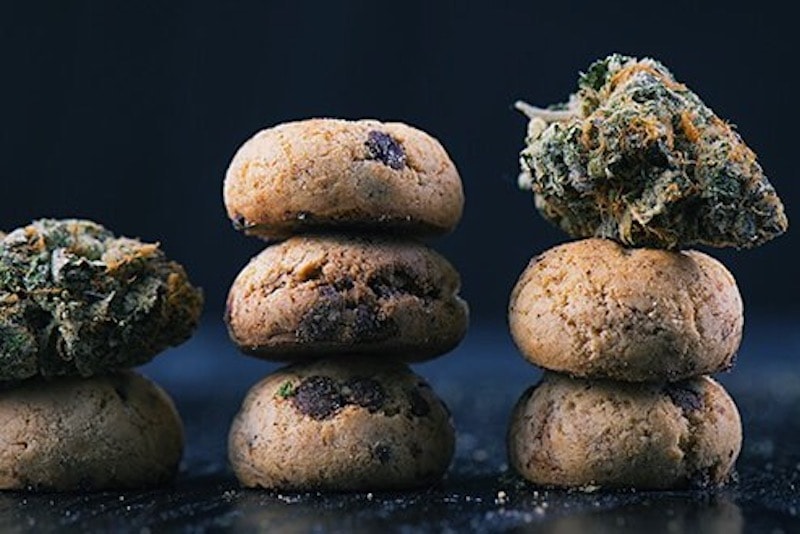
Edible cannabis products are becoming increasingly popular. In the US, edibles are considered a healthy alternative to smoking. The long duration of effects is particularly interesting for medical use. Hash brownies have long been a familiar concept among German cannabis enthusiasts. Numerous recipes circulate on the internet, mostly for cannabutter, brownies, or cocoa. Nevertheless, there’s much uncertainty about how to cook reliably with cannabis.
Often preparations don’t work as desired. Either they don’t work at all, or in extreme cases, the party ends up in the hospital with symptoms of poisoning, as can unfortunately be read occasionally in the daily press. For others, it works reliably, but they couldn’t explain why.

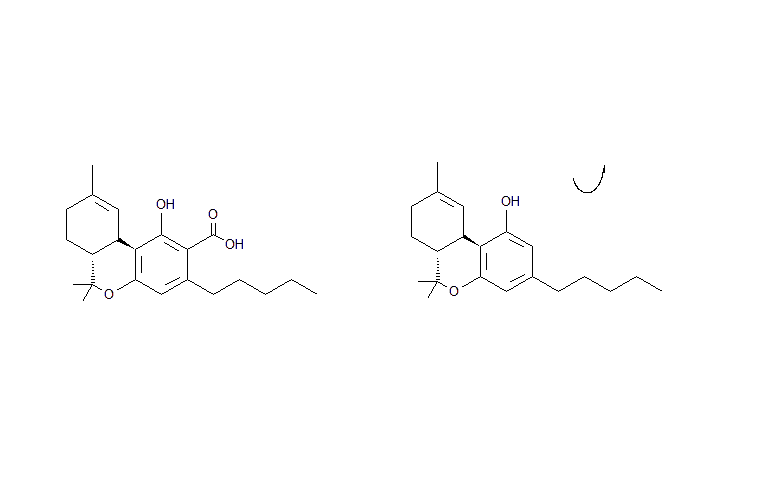
However, when you understand the properties of the active compounds, cooking and baking with cannabis becomes easily manageable. For THC to have psychoactive effects, it must always be decarboxylated. The THC in the plant is actually not active – it has an acidic carboxyl group and is therefore called THC-A (A for „Acid“). No matter how potent and high-percentage a plant is, its THC doesn’t work until it loses the carboxyl group, i.e., becomes decarboxylated.
This sounds terribly scientific and contradicts all intoxication experience, because the plants usually work wonderfully. But decarboxylation is a natural decay process that is massively accelerated by heating. Anyone who smokes a joint simultaneously decarboxylates their cannabis, because smoking creates temperatures of 400 to 800° Celsius. Instead of decarboxylation, one can therefore also speak of activation. The higher the temperature, the faster the THC is activated.
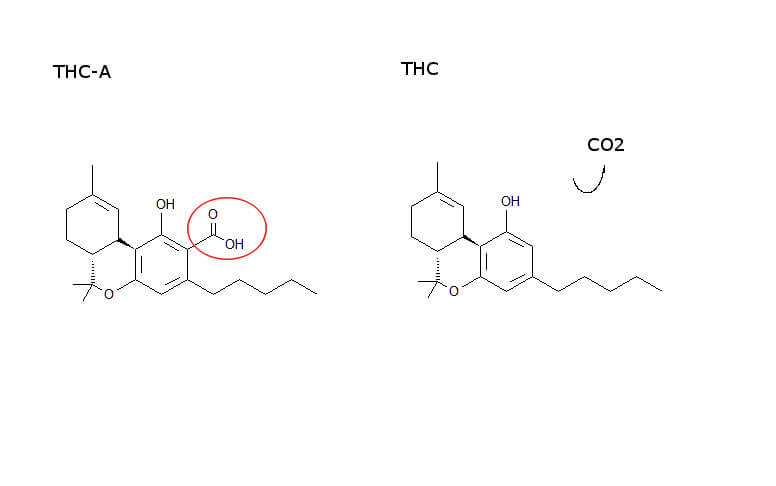
For food, activation should occur at lower temperatures, because at 160° Celsius the active ingredient vaporizes and would be lost. At cooking and baking temperatures of 100 to 140° Celsius, complete activation takes a good 40 to 60 minutes. This explains the unpredictability of hash pastries when the cannabis wasn’t fully activated in a separate step before baking.

Smaller baked goods, like cookies or muffins, wouldn’t be in the oven long enough, while a longer-baked cake with the same amount of active ingredient can be much more potent. A well-known cannabutter recipe, where butter is cooked with plant material and water for at least one hour, always produces an effective product due to the long heating period. This is also why the assumption is widespread that cannabis for eating must always be dissolved in fat. But that’s not quite right. THC for eating doesn’t need to be dissolved in fat.
Datenschutz-Einstellungen aktiv. Klicke auf den Button, um Inhalte von open.spotify.com zu laden.
Can You Eat Cannabis Pure?
Cannabis flower – or hashish – can also be eaten pure if the THC has been sufficiently activated. The active ingredient is indeed fat-soluble, but this has nothing to do with the effectiveness of the preparation. It’s just practically convenient to dissolve THC in fat when the active ingredient should be evenly distributed in the carrier medium, such as cake batter. Any cooking fat is also excellent for storage. The famous cannabutter, for example, keeps almost indefinitely when frozen.
Was dich auch interessieren könnte...
But you can just as well heat the herb alone and then eat it pure or season a meal with it. This is sometimes even recommended: For beginners, it’s much easier to find the right dose with pure, activated cannabis. The portion can be weighed directly and adjusted for personal needs after just a few attempts. Where an occasional user can enjoy a festival in good spirits and still remain reasonable with 0.1 to 0.2 grams, there are pain patients who need several grams per day.
Furthermore, the classic preparation form in brownies and other tasty sweets carries risks. This tempts overdosing or accidents when unknowing people, in the worst case children, sample the delicious cake. It happens much less often that an unknowing person consumes the spice grinder with the oregano.
Eating cannabis should be learned. The onset of effects is very subtle – there’s no overwhelming tingling, but a pure high rises from within. Beginners should always eat cannabis completely sober and then wait for the effects. If you additionally smoke cannabis during this time, you can’t distinguish the effects – the psychedelic clarity is masked by the smoked cannabis, and the high is no longer perceived as special, but rather as unpleasantly long.
Decarboxylating with Rüdiger in the Oven
How Do You Activate the Herb?
Regardless of how you want to eat it, you should always activate your cannabis first before processing. Pure herb can be lightly crumbled and placed in a covered bowl in the oven at 120°C. After one hour, the active compounds should be fully activated. However, this makes the whole house smell very aromatic, and the cannabis tastes quite bland afterward.
Decarboxylating with Rüdiger in Water Bath (60 Minutes)
Another variant is to heat the material in a sealed mason jar for at least one hour in boiling water bath. The aromatic terpenes remain in the flowers. Then activation occurs when cooking cannabutter – the plant material is cooked with butter and water for at least one hour, then the plants are strained out. The effective butter can be skimmed from the cooled liquid. If trim with unknown active ingredient content has been extracted this way, however, the dose must be determined through self-experimentation. It would be good to know whether a person needs rather a teaspoon or several tablespoons of butter. When heating butter for longer periods, you should always work with additional dilution or with a water bath, as butter can burn quickly, which would result in spoiling the entire valuable preparation.
By the way: The „spent“ remains from a vaporizer are usually still surprisingly potent and always fully activated. The browned material can be eaten directly as is. 0.2 to 0.3 grams can already be very surprisingly effective.