The Council of the European Union has adopted its negotiating position on the reform of the Common Market Organization for agricultural products. Hemp receives its own section covering all parts of the plant. However, a clause in the same text gives member states freedom of action precisely where Germany has anchored its restrictions.
📑 Inhaltsverzeichnis
On October 19, 2026, the Council of the European Union adopted its partial negotiating position on the revision of the Common Market Organization for agricultural products. The mandate includes a dedicated section on hemp that goes further than current law: in the future, not only fibers and seeds, but all parts of the hemp plant should be covered. For leaves and flowers, this represents a change in direction.
What the Mandate Contains
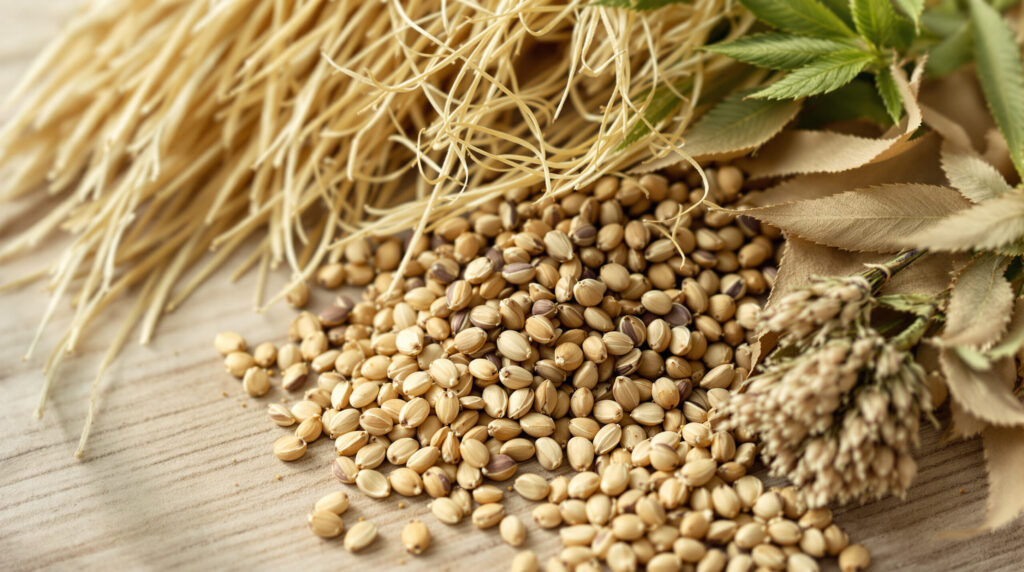
The text introduces a new section 2a with Articles 147b and 147c into the regulation. Article 147b governs production, Article 147c governs marketing. Both establish the same conditions: the variety must be registered in the Common Catalogue of Varieties, the seed must be certified according to Directive 2002/57/EG, and the Delta-9-THC content must not exceed 0.3 percent.


New is subsection (d) in Article 147b(1). It lists „all other parts of the hemp plant“ under tariff code 1211 90 86. The same wording appears in Article 147c for marketing. Previously, the flax and hemp sector of the market organization essentially covered raw hemp and seeds. This expansion is at the core of what industry associations are counting as a success.
The Council’s rationale is economic. In recital 19, it states that innovation and the bioeconomy have led to new applications for hemp biomass from all plant parts, giving farmers additional options for utilization beyond fiber production. Recital 20 openly names the problem: individual member states have imposed national bans on grounds of health protection, and these differing approaches could undermine the functioning of the market organization, create legal uncertainty, and lead to unfair competition between farmers.
The Reservation That Relativizes Everything
Article 147b ends with a fourth paragraph, and Article 147c with an identical fifth paragraph. The provision states that this rule is without prejudice to Union law and national law on the end-use of the relevant products, including on grounds of protecting public health and public security.
The mandate thus harmonizes production and marketing but explicitly excludes end-use. According to the Council’s own statement, this safeguard clause was added to ensure the new rules do not conflict with other national provisions, such as those concerning public safety, drugs, or health.
What This Means for Germany—and What Remains Open
Germany does not regulate industrial hemp through a ban on specific plant parts, but through intended purpose. The so-called intoxication clause is found in Section 1, Number 9, Letter (a) of the Cannabis Consumption Act. It is part of the definition: industrial hemp qualifies as such only when dealings with it serve exclusively commercial or scientific purposes and abuse for intoxication purposes is excluded. We have analyzed the available data on this, and on October 14, the Bundestag’s agricultural committee heard experts on a Green Party draft that would eliminate this clause.
This is precisely where an open question emerges. By its design, the intoxication clause is a rule about end-use, and end-use is what the Council’s safeguard clause leaves to member states. European harmonization covering all plant parts could thus bypass German regulation rather than abolish it. Whether this occurs will be decided only in negotiations with the European Parliament and in the interpretation of the term „end-use.“ This cannot be determined today, and anyone claiming otherwise is reading beyond the text.
A second point concerns food products. Recital 22 notes that for hemp raw materials marketed as food or feed, additional protective measures under EU law or, where absent, national law may apply. The THC limits for hemp leaf tea that take effect in 2027 remain unaffected.
The Court of Justice in the Text
Notably, the Council explicitly bases its reasoning on the case law of the Court of Justice of the European Union. Recital 21 references the judgment in Case C-663/18 of November 19, 2020, paragraphs 72 to 77. The Court had decided there that cannabidiol from legal low-THC hemp cultivated in the EU has no psychoactive effect according to current science and therefore should not be regarded as a narcotic under the UN Conventions of 1961 and 1971. Recital 22 adds that scientific evidence suggests hemp products from varieties with no more than 0.3 percent THC are unlikely to pose a risk to human health.
Controls, Transition, and Exceptions
The mandate requires member states to conduct risk-based controls during production and administrative checks during marketing. Products that do not meet the conditions must not be placed on the market and must otherwise be withdrawn. For hemp sown before the regulation enters into force, a transitional period is provided.
Two exceptions accompany this. Products that do not meet the conditions may continue to be produced where a member state permits this according to its own rules. And for medical and scientific purposes, marketing remains possible under Union law, international law, and national law. Hemp seeds not intended for sowing may be marketed without additional conditions.
Where the Process Stands
The mandate is not applicable law. It is a partial negotiating position—partial because financial and horizontal questions are still being negotiated within the multi-year financial framework for 2028 to 2034. On this basis, the Council presidency enters negotiations with the European Parliament. Only their result becomes law, and until then, nothing changes in any national provision.
The full mandate text has been publicly available since October 20 as Council Document ST-14647-2026-INIT; the Council’s press release was updated accordingly that day. The starting point was the Commission proposal of July 16, 2025.
For the industry, the decision is nevertheless more than a formality. The member states, which previously diverged, have agreed on a common line regarding the production and marketing of all plant parts. How far from self-evident this is becomes clear when looking at member states: In Italy, the Constitutional Court is only beginning proceedings on the hemp flower ban in February 2027; in Ireland, the High Court is examining whether industrial hemp should remain a controlled drug; and in Poland, cultivation area is growing significantly while it shrinks in Germany. The 0.3 percent threshold itself originates from the agricultural reform, which we reported on in 2021.
The crucial question thus no longer presents itself at the European level, but at the national level: How far does the end-use reservation extend? If interpreted narrowly, a single market for all plant parts emerges. If interpreted broadly, each member state retains the ability to regulate through intended purpose precisely what the market organization has just harmonized.
Sollte die EU die Vermarktung aller Nutzhanf-Pflanzenteile harmonisieren?
Sources: Council of the European Union, press release of October 19, 2026, updated October 20, 2026; Council Document ST-14647-2026-INIT, Section 2a, Articles 147b and 147c, and Recitals 19–22; Commission proposal of July 16, 2025; Court of Justice judgment of November 19, 2020, C-663/18. Status: October 21, 2026.

Branchen-Update
News, Analysen und Reportagen — mehrmals im Monat direkt in dein Postfach.