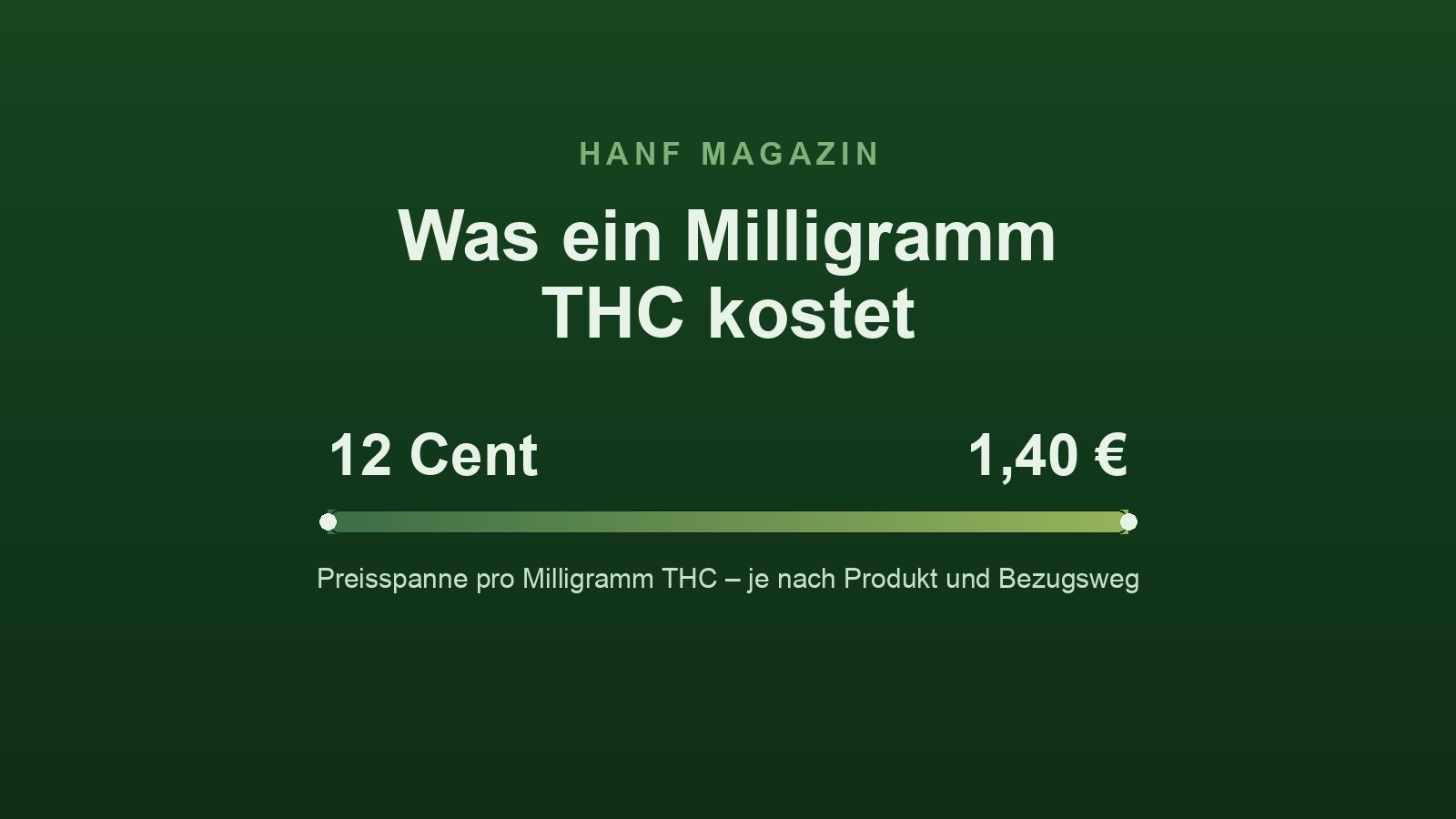
In Germany, one milligram of THC costs between twelve cents and 1.40 euros depending on the preparation. The Working Group on Cannabis as Medicine has compared prices across products. The range is remarkable, as are the limitations of such comparisons.
📑 Inhaltsverzeichnis
Since summer, statutory health insurance decisions about how to begin cannabis therapy are no longer based solely on medical judgment. Before extracts and custom preparations, treatment must first be attempted with an approved finished pharmaceutical product—a priority the German parliament reinforced on October 15th when it limited this priority to approved indications. Cost-effectiveness was cited as one justification.
The Working Group on Cannabis as Medicine therefore calculated what the active ingredient actually costs across different formulations. The math is straightforward: price divided by THC content, expressed per milligram.


THC Cost Per Milligram
| Product | Price Per Milligram THC | Price Source |
|---|---|---|
| Exilby, 1 x 28 ml | €1.401 | Pharmacy retail price 2026 |
| Exilby, 3 x 28 ml | €1.373 | Pharmacy retail price 2026 |
| Naxiva and Panaxol THC25 | €0.813 | SHI, AOK |
| Tilray THC25 | €0.611 | SHI, AOK |
| Sativex | €0.437 | Pharmacy reference price, AOK |
| Dronabinol 2.5%, liquid | €0.235 | Standard appraisal, AOK |
| SOMAÍ 25:1, average self-payer | €0.14–0.18 | Self-payers |
| SOMAÍ 25:1, low-cost pharmacies | ~€0.12 | Self-payers |
The gap between the most and least expensive entries spans a factor of twelve. When dried flower is used as a benchmark, the difference grows even larger: the Working Group calculates that THC in Exilby costs more than twenty times as much as THC in flower. Two to three grams of flower, they estimate, costs 20 to 30 euros.
Why These Numbers Tell Only Part of the Story
The Working Group states its own limitations upfront, and they deserve careful attention. This is purely a comparison of active ingredient costs—explicitly not a statement about therapeutic equivalence. The preparations differ in formulation, indication, and route of administration, as well as approval status, evidence base, and bioavailability.
This is far from a formality. An orally administered preparation and an inhaled flower deliver the same active ingredient through very different pathways, with different onset times and different availability in the body. One milligram is therefore not universally equivalent in its effect. With Sativex, the comparison has an additional limitation: it doesn’t account for the CBD content, meaning the product delivers more than the calculation reflects.
Price dates also vary across the comparison. The AOK reference prices in the table date from October 2025, while figures for Exilby and SOMAÍ are from September 2026. When reading the table, you’re therefore not consistently comparing the same time period.
What This Means for the Reimbursement Debate
Despite all these caveats, one finding stands firm and cannot be explained away: the products the legislature prioritized occupy the upper end of the cost scale. Exilby is an approved finished pharmaceutical and simultaneously the most expensive entry; dronabinol as a custom preparation costs one-sixth as much.
This aligns with what the federal government itself has acknowledged. In response to questions from the Green Party, officials stated they expect no significant savings from the finished pharmaceutical priority. When a priority rule is justified on cost-effectiveness grounds, lawmakers should be able to explain why the prioritized products cost the most per milligram of active ingredient.
One counterargument is that an approved finished pharmaceutical delivers more than active ingredient: proven quality, verified efficacy, and reliable dosing. This is precisely how the legislature justified the priority. Measuring a product’s price by the milligram captures only one dimension. Both arguments coexist, and the Working Group’s figures now provide the empirical foundation this debate has been missing.
For patients, however, the practical reality is different. Since summer, flower is no longer prescribable under insurance plans, and we’ve detailed separately how THC content affects reimbursement decisions. The prices in the Working Group’s table therefore affect both insurance coverage and out-of-pocket costs.
Note: This article reflects the status as of October 15, 2026. The figures presented are cost-effectiveness data and not therapeutic recommendations. Treatment selection, initiation, and modification are determined exclusively by the treating physician. Medicinal cannabis is prescription-only.
Sollten die Krankenkassen alle Cannabis-Präparate gleich erstatten?
Sources: Working Group on Cannabis as Medicine, ACM announcements from September 5, 2026, updated September 6, 2026; original reporting on finished pharmaceutical priority requirements.

Branchen-Update
News, Analysen und Reportagen — mehrmals im Monat direkt in dein Postfach.
Folge uns