
Our article on the location-dependent consumption ban under § 24 MedCanG has prompted a response that turns the perspective around. So far, the question has been whether the regulation protects children from others‘ consumption. A reader points out the reverse case: patients can themselves be children. Then the ban strikes precisely those it purports to protect.
📑 Inhaltsverzeichnis
The starting point is our article Where Patients Cannot Inhale: § 24 MedCanG Explained. There we showed that § 24 MedCanG, through reference to § 5 subsection 2 KCanG, extends the known prohibition zones (schools, children’s playgrounds, pedestrian zones, and others, each including sightlines) to public consumption of medical cannabis via inhalation. And that while the regulation carries the official heading „Protection of Children and Adolescents in Public Spaces,“ it deliberately does not reference § 5 subsection 1 KCanG—the subsection that regulates consumption in the immediate presence of minors.
Roman Quadflieg, a cannabis patient with legal training who had already pointed us to this regulation, now adds a consideration that has been missing from the debate.


The Overlooked Group: Children as Patients
The logic behind the location ban is that children near schools and playgrounds should be shielded from the sight of cannabis consumption. What gets lost is that children are not only bystanders—they can themselves be among those receiving treatment.
That this group exists in significant numbers can be documented. Prof. Dr. Sven Gottschling, director of the Center for Lifespan Palliative Care and Pediatric Pain Therapy at Saarland University Hospital, reported in early September in an article by Ippen Media (author Oliver Stock) that in his center, „more than 500 children and a four-digit number of adults“ had been treated with cannabis medicines. The article itself deals with reimbursement complications, not public consumption. For our purposes, it contributes only one well-documented fact: children and adolescents are cannabis patients too, for instance in palliative care and pain therapy.
Whether and how a child is treated with cannabis medicines is exclusively a medical decision and not the subject of this article. Our concern is solely the legal question of what the location ban in § 24 MedCanG means for patients who happen to be minors.
Important: The Ban Applies Only to Inhalation
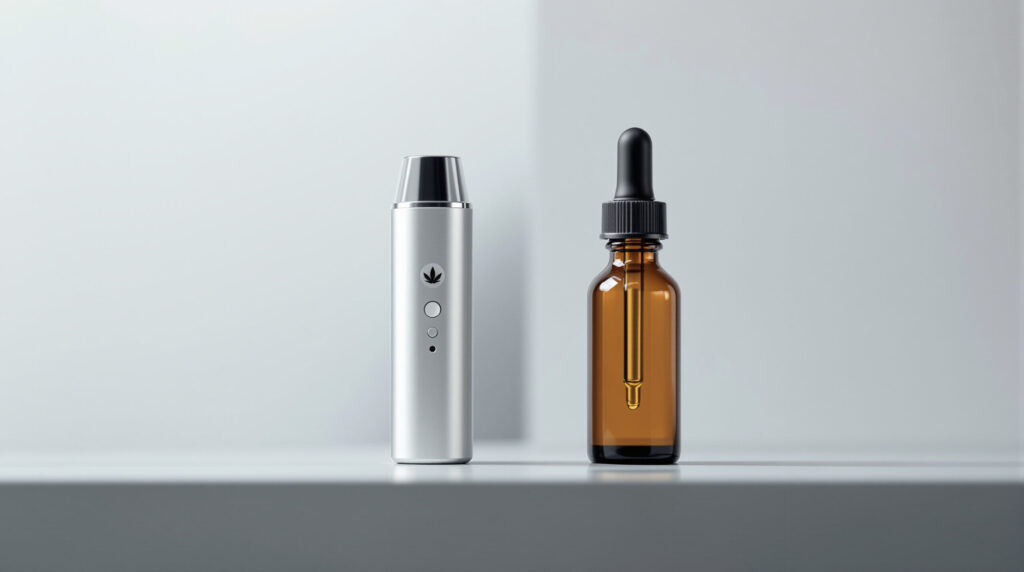
Precision is needed here, otherwise one overstates the problem. § 24 MedCanG explicitly covers only consumption „via inhalation“—that is, vaporization and smoking. Anyone taking the same substance as oil, drops, or capsules falls outside the regulation and may take it anywhere.
This is particularly significant in pediatric medicine because oral forms are frequently used there, such as dronabinol drops. For these cases, the question of prohibition zones does not arise in the first place. The conclusion is therefore not that all young patients are affected at playgrounds. Two narrower points remain valid.
- The concrete case: patients whose therapy depends on inhalation because they need rapid onset of effect, such as for pain spikes or spasticity. For them, the location ban applies regardless of age.
- The fundamental point: § 24 MedCanG contains no exception for medical need, regardless of the age of the treated person. There is no hardship clause, no weighing against treatment necessity, and no indication that a minor patient would be treated differently from any other.
Where the Justification Falters

The legislature justified the ban by saying it aims to avoid consumption incentives in the sense of child and adolescent protection to the greatest extent possible. This also applies to the inhalation of medical cannabis because „in external appearance, consumption for medical purposes cannot be distinguished from cannabis use for non-medical purposes“ (Federal Parliamentary Document 20/8704, page 147). The underlying thought is a risk of confusion.
This is precisely where Quadflieg’s objection strikes. With a medication for which there is no equivalent alternative in the specific case, the incentive argument is difficult to maintain. And it collapses when the person inhaling is themselves a young patient: the youth protection that is meant to keep consumption incentives away from healthy children then turns against a sick child taking their medicine. The purpose of the regulation and its effect diverge in this case.
It remains a question of weighing interests, not a settled matter. One can argue that a patient exception would have required proof and that the number of minor patients dependent on inhalation is likely small. But neither of these changes the fact that the regulation provides no solution for these cases, even though other areas of law address comparable conflicts through case-by-case weighing.
What Current Reform Proposals Change – and What They Don’t
Several initiatives affecting the prohibition zones are on the table in the ongoing debate. The parliamentary group Die Linke demands in its proposal „Protect Health – Legalize Cannabis“ (Federal Parliamentary Document 21/3912 of January 29, 2026), under point 2 letter c, to remove the „remnants of prohibition policy“: „Consumption distance requirements are abolished and equal treatment with non-smoker protection regulations is ensured.“ The situation differs with a proposal considered at Die Linke’s Potsdam party congress in June 2026. Proposal P.06, submitted among others by the Leipzig-North municipal association and the State Working Group for Self-Determined Disability Policy Bavaria, explicitly demands that the location-dependent consumption ban in § 24 MedCanG be „declared void with no replacement“ and that medication intake again be possible regardless of location. The proposal also identifies the point that makes the regulation so difficult to challenge: because § 27 MedCanG provides no penalty provision for violations of § 24, there is no administrative decision against which those affected could sue. This leaves no path to a court that could review the regulation. In the published resolution list of the party congress, P.06 does not appear—it was not adopted there. What happened to it is not publicly documented.
The federal parliamentary group’s proposal, by contrast, addresses only the consumption distance requirements of the Cannabis Consumption Act. It does not address § 24 MedCanG and the question of whether medical intake should be possible regardless of location. The debate thus proceeds in two separate places: within the party there is a proposal directly attacking the regulation, while there is none in parliament. Those reading the text find no provision for patients who inhale, and certainly none for the special case that they themselves are minors.
Roman Quadflieg sees this more critically. In his view, this approach does not solve the problem of § 24 MedCanG at all: treating it equally with non-smoker protection, which in Germany is a matter for individual states, leads to inconsistent regulations across federal states instead of a uniform federal solution and continues to refer patients—including children—to smoking areas. He speaks of „concealing“ the actual problem. That is his assessment, not ours; but it does touch on a documented point: the medical special case does not appear in the reform texts so far.
What Remains

The pointer expands the blind spot we described in the first article by adding a human dimension. § 24 MedCanG not only omits the subsection that directly protects children. It also fails to account for the case where a child is themselves a patient and may depend on medication intake. For oral therapy the question does not arise; for inhalation it does. In both cases, there is no regulation that even considers medical need.
The ongoing evaluation of the Cannabis Consumption Act has already called parts of § 5 KCanG into question. Whether the reference in § 24 MedCanG and the special case of minor patients will also be reviewed is not yet apparent. We will continue to follow this issue.
Note: This article is neither legal nor medical advice and is no substitute for advice from an attorney or physician. The choice of medication and form of administration is decided exclusively by the treating physician; ongoing therapies should not be altered without professional guidance. The figure on treated children represents the cited statement by Prof. Dr. Sven Gottschling; the underlying media report addresses reimbursement, not the consumption ban of § 24 MedCanG. The legal assessment of § 24 MedCanG reflects the current state of interpretation and the argument of the person providing the pointer; legal counsel is required for individual cases.
Sollten minderjährige Patienten von Ortsverboten für Medizinalcannabis ausgenommen werden?
Sources: Medical Cannabis Act, § 24; Cannabis Consumption Act, § 5, each as worded at gesetze-im-internet.de; draft bill on the Cannabis Act, Federal Parliamentary Document 20/8704 of October 9, 2023, page 147; „Cannabis Chaos at Insurance Expense: Doctors Warn of Fatal Consequences,“ Ippen Media (including hna.de), author Oliver Stock, September 3, 2026, with the quote from Prof. Dr. Sven Gottschling; Proposal P.06 „Correct the Illegitimate Paradigm Shift in Die Linke’s Health, Disability, and Drug Policy,“ 1st session of the 10th party congress of Die Linke, Potsdam, June 19–21, 2026; pointer and argument from Roman Quadflieg; own reporting. Further reading on the base regulation: our article on § 24 MedCanG.





Branchen-Update
News, Analysen und Reportagen — mehrmals im Monat direkt in dein Postfach.
Folge uns