
What Söder Actually Said
Markus Söder wants to consider a tax on cannabis consumption. On September 23, the Augsburger Allgemeine quoted Bavaria’s minister president saying that free cannabis would be absurd. There is no draft law behind this statement. Yet the remark is politically significant because it opens two contradictions simultaneously.
📑 Inhaltsverzeichnis
The exact formulation was that one should consider how to change free consumption. So far, this remains merely a thought. Neither the tax object, the collection mechanism, nor a legal basis has been specified. For a federal or state tax, however, these would be the minimum requirements. Article 105 of the German Constitution distributes tax legislation authority between the federal government and states, leaving a minister president no free hand here.
The direction is striking. The CSU ranks among the harshest opponents of partial legalization, and Söder himself had already considered legal action in 2024. We documented how Söder and the CSU considered suing over the Cannabis Act. Typically, those wanting to overturn a law don’t argue based on foregone tax revenue from it.


Legal Cannabis Consumption Isn’t Free
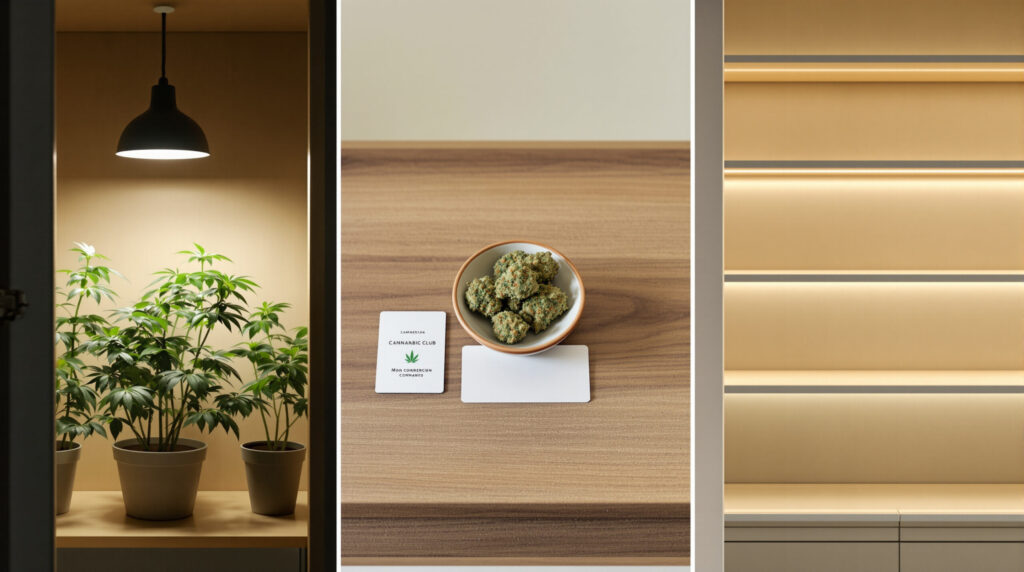
The claim that cannabis consumption is free doesn’t hold up legally. Home growers pay for seeds, soil, electricity, ventilation, and lighting. Those joining a cultivation association pay membership fees, and § 24 of the Consumption Cannabis Act explicitly requires that bylaws govern their determination. These fees aren’t donations—they finance cultivation, facilities, security, and administration.
What’s actually missing is something else: a dedicated consumption tax. It’s absent because the law recognizes no commercial sales. Legal supply runs through home cultivation and non-commercial associations, which may only distribute cannabis to their own members and only from their own harvests. Söder conflates the absence of a tax with the absence of costs.
Where a Cannabis Tax Would Need to Attach Legally
A tax needs an attachment point. For tobacco and alcohol, that’s manufacturing or release into duty-free circulation—a transaction involving a commercial actor. Precisely this actor doesn’t exist in the German model. Three unattractive variants remain.
The first would be a levy on private home cultivation—essentially a tax on three plants in a closet. The second would make the non-commercial association a tax collector, despite it selling nothing to the public. The third would be the honest route: regulated retail sales in specialized shops, which would actually create a tax base. This third variant is exactly the model the CSU opposes. International examples have shown for years how much taxation can fiscally support, including states that fund higher education from marijuana tax revenue.
The comparison reveals the fundamental problem. Tax revenue emerges where a legal market generates sales. As long as sales remain in the black market, the state earns nothing. How large that market remains is documented by the BKA Federal Threat Assessment 2025 with 63.8 tons of marijuana seized.
The Contradiction in Bavaria’s Implementation

The tax idea arrives in a state that throttles legal cultivation. The Bavarian State Office for Health and Food Safety counted 47 cultivation association applications as of August 3, 2026: eleven approved, six rejected, twenty-five withdrawn, five still pending. A withdrawal rate exceeding fifty percent is no minor detail, even though the agency names no reasons for individual cases.
Even more telling is cultivation area. According to September research, none of the eleven approved Bavarian associations had an agency-approved cultivation site in Bavaria at month’s beginning. That doesn’t mean no distribution occurs, however: An association from Grafenwöhr already distributes cannabis to members—grown in Saxony under a Saxon authority permit. A Bavarian club must therefore shift cultivation across the state border for anything to arrive in the Upper Palatinate.
This fits a picture we’ve described for two years: from how Bavaria systematically obstructs cultivation associations, to lawsuits through which the Hemp Association and CSC Inntal challenge approval practices. Debate over legalization in Bavaria predates the federal law anyway, as the earlier citizens‘ initiative for cannabis legalization shows.
The political logic is apparent. First, a group is labeled problematic; then it faces additional costs. Whether Söder aimed to generate revenue, sharpen his image, or simply grab a headline cannot be gleaned from one sentence. His policy can be judged: eleven approvals without domestic cultivation sites, a declared course against partial legalization, and now the prospect of new burdens on consumers.
Frequently Asked Questions
Does Germany have a cannabis tax?
No, a dedicated cannabis consumption tax doesn’t exist. The Consumption Cannabis Act provides for no commercial sales to which such a tax could attach. Membership fees in cultivation associations and home cultivation costs occur independently of any tax.
Could Bavaria introduce a cannabis tax alone?
That’s legally challenging. Article 105 of the Constitution distributes tax legislation between federal and state governments, with consumption tax authority resting primarily with the federal level. A minister president cannot create such a levy through announcement.
Does cannabis from a cultivation association cost money?
Yes. Members pay fees, whose determination must be governed by bylaws under § 24 of the Consumption Cannabis Act. These finance cultivation, facilities, security, and administration. Cost-free distribution isn’t part of the cultivation association model.
How many cultivation associations are approved in Bavaria?
The Bavarian State Office for Health and Food Safety reports eleven approvals from 47 applications as of August 3, 2026. Six applications were rejected, twenty-five withdrawn, and five remained pending. As of month’s beginning, none of the eleven associations had an approved cultivation site in Bavaria.
Where would cannabis tax revenue actually come from?
From regulated retail sales with commercial providers, as several countries with distribution models practice. Without legal trade, there’s no tax base. Revenue stays in the black market, where no one pays taxes.
Sollte Cannabis in Deutschland reguliert verkauft und besteuert werden?
Sources: Augsburger Allgemeine report from September 23, 2026, featuring Markus Söder’s remarks; Consumption Cannabis Act (§ 24 KCanG); Article 105 German Constitution; Bavarian State Office for Health and Food Safety figures as of August 3, 2026.







Branchen-Update
News, Analysen und Reportagen — mehrmals im Monat direkt in dein Postfach.
Folge uns