The Renaissance of a Versatile Material
Hemp is not a „new“ material in the context of construction. Already in ancient bridge construction and medieval half-timbered houses, hemp was used for reinforcement and insulation. What makes hemp such an attractive building material today is its unbeatable environmental footprint. One hectare of industrial hemp binds up to 15 tons of CO₂ during its rapid growth period of just 100 to 120 days – more than an average forest achieves in the same time.
📑 Inhaltsverzeichnis
- The Renaissance of a Versatile Material
- The Heart of It: Hemp Lime and the Thermal Revolution
- The Lime Crisis: When the Binder Becomes the Bottleneck
- The Standardization Chaos: The Final Boss of Innovation
- Hemp Concrete vs. Concrete: An Unequal Battle?
- France as a Model: „Construire en Chanvre“
- The Way Forward: Political Course Corrections
- Comparison of Building Physics Parameters
- Analysis of Results
- Conclusion: Green Hope Between Gray Walls
- 💬 Fragen? Frag den Hanf-Buddy!
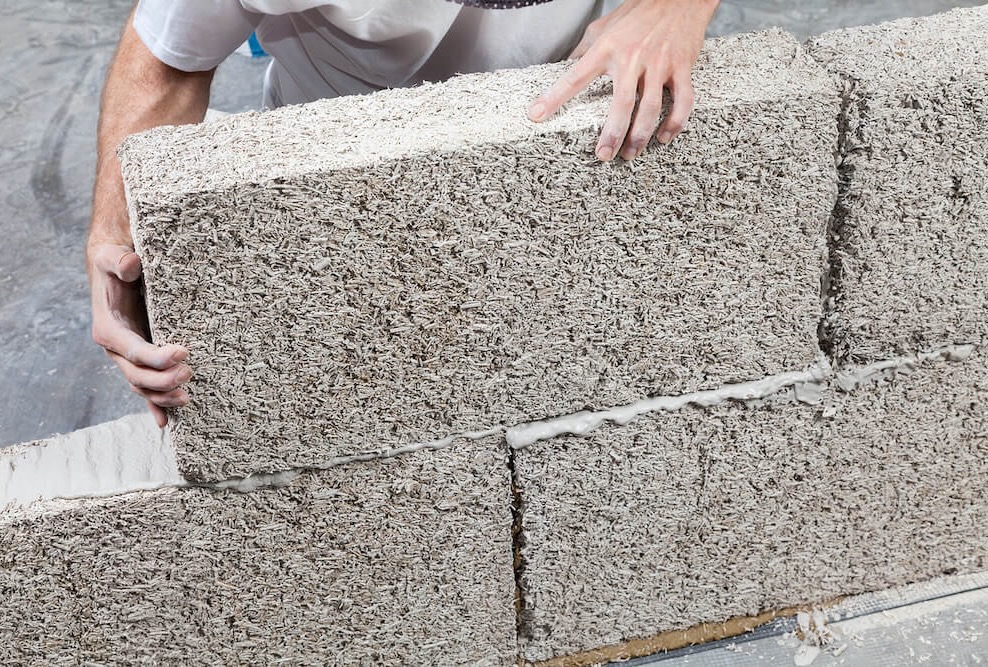
In the building materials industry, primarily so-called hemp shivs are used. These are the woody core of the hemp stalk, which arises as a byproduct during fiber extraction. These shivs possess a porous structure that combines excellent thermal insulating properties with high vapor permeability. The result is hemp lime (hempcrete), a material that not only insulates but also regulates moisture and creates a healthy indoor climate.
The Heart of It: Hemp Lime and the Thermal Revolution
Hemp lime is not a load-bearing building material in the classical sense like concrete. It is usually used in combination with wooden framing. The mixture consists of hemp shivs, water, and a lime-based binder.


The Advantages at a Glance:
- Negative Carbon Footprint: Through carbon sequestration in hemp and carbonation of the lime during curing, the wall binds more CO₂ than was emitted during its production.
- Fire Protection: Despite its plant-based content, hemp lime is naturally fire-resistant (usually class B1 or A2, depending on the mixture).
- Pest Resistance: The combination with lime makes the material unattractive to rodents and resistant to mold.
- Recycling: At the end of its life cycle, hemp lime can theoretically be shredded and reused as fertilizer or an aggregate in horticulture.
The Lime Crisis: When the Binder Becomes the Bottleneck
Although hemp could theoretically grow in abundance, hemp lime production currently faces an unexpected obstacle: lime shortage. Lime is a bulk raw material, but the specific requirements of hemp building materials usually require high-purity air lime or natural hydraulic lime (NHL).
The energy-intensive production of lime suffers from rising energy prices and pressure to reduce emissions in quarries. Additionally, the construction industry competes with agriculture and the chemical industry for the highest-quality lime reserves. In regions where hemp as a building material is booming – such as France or Belgium – this is already causing supply bottlenecks. Without the right binder, hemp shivs remain merely a loose pile of biomass with no structural utility.
The Standardization Chaos: The Final Boss of Innovation
The greatest obstacle to widespread use of hemp in construction, however, is not raw material scarcity but regulatory bureaucracy. Building codes and construction standards determine what materials can be used and how.
1. Missing Approvals
Many hemp products lack general building authority approval. This means for architects: every use of hemp lime is legally considered a „building type of non-regulated kind.“ Builders often must apply for „individual case approval“ – a lengthy, expensive, and bureaucratic process that deters many private builders.
2. The Liability Risk
Since hemp lime is not listed as a standard building material in applicable regulations, planners and contractors bear higher liability risk. Insurers often react hesitantly or demand risk premiums when „experimental“ natural building materials are used.
3. The Certification Marathon
A manufacturer of hemp insulation boards must invest millions to obtain certifications for thermal conductivity, fire behavior, and sound protection. For small and medium-sized enterprises in the hemp industry, this financial effort is often unmanageable, while established mineral wool or polystyrene giants defend their market position through existing standards.
Hemp Concrete vs. Concrete: An Unequal Battle?
One must not make the mistake of seeing hemp as a direct replacement for concrete in skyscrapers. Hemp will never achieve the compressive strength of reinforced concrete to support tall buildings. But it doesn’t need to. Over 70% of building volume in residential construction could be realized without problems using wood-clay-hemp constructions.
The problem is industrial scalability. While the concrete industry has developed optimized supply chains and automated manufacturing processes over decades, hemp construction is still in its infancy. Much of it is manual labor: tamping the hemp-lime mixture into formwork is time-intensive. However, initial approaches with spray methods (hemp-spray) or prefabricated hemp blocks (hemp-blocks) show that the industry is ready for automation.
France as a Model: „Construire en Chanvre“
A look across the border shows that it can be done differently. In France, construction with hemp is already much more established. With the association „Construire en Chanvre,“ national rules were created to standardize the use of hemp building materials. Public buildings such as schools and multi-story social housing are already being built from hemp there. The French government actively promotes bio-based materials through the RT2020 regulation, which strictly limits the carbon footprint of new buildings.
The Way Forward: Political Course Corrections
For hemp to achieve a breakthrough in the building materials industry, three levers must be activated simultaneously:
- Simplified Standardization: Hemp shivs and hemp-lime mixtures need to be added to the list of standard building materials. Harmonization of European standards (EN) could facilitate cross-border trade and application.
- Infrastructure Promotion: Regional processing centers are needed. It makes no ecological sense to grow hemp in one region, transport it for processing elsewhere, and bring it back as a building material.
- CO₂ Tax as Driver: As long as the disposal costs of special waste (such as EPS insulation) and the CO₂ emissions from cement production are not fully priced in, hemp will have a price disadvantage. Consistent CO₂ pricing would make natural building materials competitive overnight.
Comparison of Building Physics Parameters
The following table compares the performance data of hemp lime with classic insulation materials mineral wool and expanded polystyrene (EPS).
| Property | Hemp Lime (Hempcrete) | Mineral Wool | EPS (Polystyrene) |
|---|---|---|---|
| Thermal Conductivity (λ) | 0.07 – 0.09 W/(m·K) | 0.032 – 0.045 W/(m·K) | 0.031 – 0.040 W/(m·K) |
| Bulk Density (ρ) | 300 – 600 kg/m³ | 15 – 150 kg/m³ | 15 – 35 kg/m³ |
| Specific Heat Capacity (c) | ca. 1,500 – 1,700 J/(kg·K) | ca. 800 – 1,000 J/(kg·K) | ca. 1,200 – 1,450 J/(kg·K) |
| Vapor Permeability (μ) | 5 – 10 (highly open) | 1 (completely open) | 30 – 70 (restricted) |
| Fire Protection Class | B1 (hard to ignite) | A1 (non-combustible) | E (normally flammable) |
| CO₂ Balance | Negative (Carbon Sink) | Positive (Emission) | High Positive (Emission) |
Analysis of Results
Although conventional insulation materials often perform better in terms of pure insulating effect (thermal conductivity), hemp lime offers decisive advantages in the overall evaluation of a building:
- Phase Shift: Due to its high bulk density and excellent specific heat capacity, hemp lime stores heat significantly longer. This provides excellent summer heat protection, as midday heat only reaches the interior during cool nights.
- Moisture Regulation: With low vapor resistance, hemp lime acts like a natural air conditioning system. It can absorb moisture and release it when the air is dry, without mold risk or significant loss of insulating effect.
- Sustainability: While EPS is a petroleum-based product and mineral wool must be energy-intensively melted, the main component of hemp lime grows in fields and actively removes carbon from the atmosphere.
This table illustrates that hemp lime is not just an ecological statement but a technically efficient alternative for modern, healthy building.
Conclusion: Green Hope Between Gray Walls
Hemp in the building materials industry is more than an ecological niche for idealists. It is a technological necessity if we want to achieve climate targets in the building sector. The „standardization chaos“ is not a law of nature but a political decision.
We stand at a point where the biological efficiency of hemp meets the rigid structures of traditional building administration. If we succeed in removing certification barriers and securing binder supplies, hemp could become the most important building material of the 21st century. It is the only building material we need not extract from the earth but can grow on it.












Branchen-Update
News, Analysen und Reportagen — mehrmals im Monat direkt in dein Postfach.
Folge uns