
Advertisement · This article is produced in paid cooperation with GreenMedical. The questions come from the editorial team; the answers are authorized in the exact wording of Dr. Christoph Viebig. Editorial classification is the responsibility of Hanf Magazin.
A customer survey only tells us something when someone explains what consequences they draw from it. We asked Dr. Christoph Viebig of GreenMedical ten questions about the results, including uncomfortable ones. His answers reveal a provider who doesn’t explain away the weakest individual result from their own survey.
We analyzed the survey figures in a separate article: 5,556 responses, with data protection, verified quality, and self-determination at the top, followed significantly further back by price and delivery speed. What interested us next was the interpretation. Because a provider survey is always also a self-disclosure, and the more interesting question is what a company does with results that don’t suit them.
Interview
Dr. Christoph Viebig, GreenMedical
On the ranking of patient priorities, the lowest value in their own survey, and the limits of customer surveys.
Question 1
The survey places data protection, verified quality, and self-determination at the very top, even ahead of convenience and price. Did this ranking surprise you?
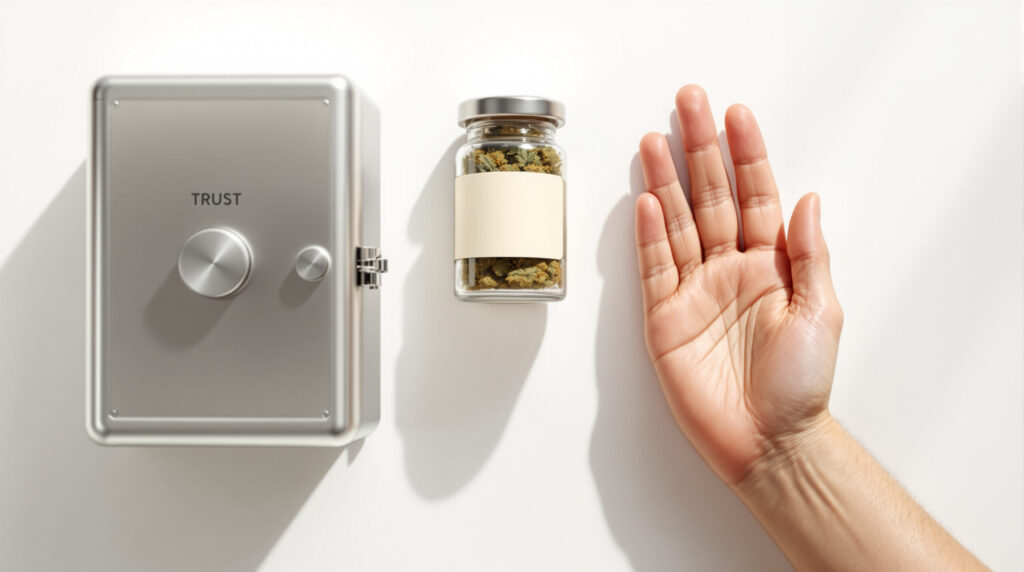
Dr. Christoph Viebig: It wasn’t the direction that surprised me, but the clarity. The three top values are at over 80 percent, practically tied. The gap to price at 63 percent and fast availability at 66 percent is significant. Telemedecine is usually presented in public as a convenience issue. The answers say something different. It’s about trust.
For us, this is primarily a confirmation. We built healthcare provision from the start around security, verified quality, and discretion. We haven’t sacrificed these values in the name of speed or price. The survey tells us we’re on the right path.
But it also tells us that this path is never finished. Data protection and quality assurance aren’t a state you reach once and then check off. Both must be developed with every new process, every new pharmacy connection, and every product decision. That’s exactly what we’re aiming for in the coming years. We don’t just want to make adjustments, but consistently expand further.
Question 2
The personal doctor’s consultation, such as via video, only reaches an average of 2.98 out of 5. For a digital provider, that’s a remarkable finding. How do you classify it?
Dr. Christoph Viebig: What I read from this result is the following. Patients don’t rate the medical examination as unimportant, but rather the video format specifically.
The convenient answer now would be that people don’t value it much and we can therefore scale it back. I don’t share this interpretation. What is medically necessary is decided by the doctor, not by personal preference.
For a digital provider, this is an uncomfortable but healthy finding. It forbids us from equating digitalization with healthcare quality. A video call doesn’t become a quality feature just because it’s digital.
I find the political contrast interesting. In the debate, video consultations are considered the great compromise between digital and in-person care. The respondents gave it the lowest value of the entire survey. Patients apparently don’t think in terms of channels, but in terms of functioning overall care. So our consequence isn’t less medical contact, but better-designed care pathways around that contact.

Question 3
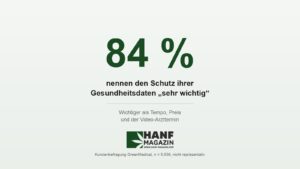
84 percent of respondents call the protection of their health data „very important.“ What does data protection mean in telemedicine care specifically, beyond legal minimum standards?
Dr. Christoph Viebig: The first question we must ask ourselves is: Which information do we actually need and which do we deliberately not collect? That applies to treatment as much as to this survey. We deliberately dispensed with names, age, gender, and indication there. Data you don’t collect can’t be lost.
The second point is storage. For us, this includes encryption, hosting and processing in the EU, as well as clear role and authorization concepts. Medical data is only seen by people who actually need it for their work.
For us it’s also clear that health data is not used for advertising or tracking purposes. Unauthorized disclosure to third parties must not occur.
Question 4
Verified quality with guaranteed active ingredient content is almost tied at the top. How can patients tell that such quality assurance is actually being maintained?
Dr. Christoph Viebig: The framework is not voluntary. Medical cannabis is a prescription-only medicinal product and is subject to pharmacy-only sales. The examination takes place in the pharmacy according to the requirements of the pharmacy operating regulations. There are concrete indicators by which patients can verify the quality. These include the batch designation, an analysis certificate, information about the manufacturer and importer, as well as information on GACP or GMP-compliant origin. Patients can also ask their pharmacy about these specifically.
As a telemedicine provider, we in turn have the responsibility to keep the process transparent. Which pharmacies are connected? What products do they offer and what are its characteristics? What is the path from prescription to dispensing? What we shouldn’t do as a platform provider is promise quality ourselves. Quality is tested, not claimed. Our task is to make this testing traceable.

Question 5
„Decide for yourself who finds out about your treatment“ is one of the three most important points. What role does stigmatization still play in your view, and how does a digital provider address it?
Dr. Christoph Viebig: What you see here is that two years after partial legalization, the legal framework is normalized, but social perception is not. Many people continue to worry about who finds out about their treatment—employers, their social circle, or family.
A digital provider cannot resolve this stigma. That’s a task for education, medical professionals, employers, and politics. What we can do is not reinforce it.
In practical terms, this means understanding discretion as a design principle and not as an optional add-on. There’s no waiting room where you can be recognized. The pharmacy’s packaging is neutral so no one can tell from the package what’s inside. A diagnosis doesn’t belong in a subject line. And patients should have control over where their data is stored.
This sounds like small things. For the 83 percent who give this point the highest rating, it’s anything but a small matter.
Question 6
The survey is explicitly a non-representative customer survey. Why was it important for you to publish it anyway, and where do you see the limits of its validity yourself?
Dr. Christoph Viebig: A lot is said about medical cannabis. Yet it’s rarely discussed with the people it actually affects. 5,556 evaluated responses from our own customer base are not a representative result. But they do provide extensive insights into the patient perspective.
We openly disclose the limitations rather than hide them. There is self-selection. We didn’t collect information on age, gender, region, diagnosis, or duration of therapy. There are also no cross-evaluations and no conclusions about all patients in Germany.
Some of these limitations are self-imposed. A survey of cannabis patients could be evaluated much more deeply if you ask about personal data. We chose not to. For a group that puts data protection and discretion first, anything else would have been contradictory. The price for that is less analytical depth. We pay it consciously. I prefer honest numbers to beautiful ones. Whoever doesn’t include the limitations of their data turns a survey into marketing.
Question 7
How has the profile of patients changed, in your observation, since the Cannabis Consumption Act and Medical Cannabis Act came into effect?
Dr. Christoph Viebig: The hurdle at first contact is completely different now. Previously, the journey often began with shame or uncertainty. Today it more often begins with many legitimate questions about process, costs, and data protection. Many people come without prior knowledge. The profile of patients themselves has become significantly broader and more everyday as a result. We see people from all possible life situations, across professional and age groups.
That aligns with what the survey shows. Security, verified quality, and discretion are at the very top. For people new to therapy, these are the first questions. And apparently they remain the most important ones.
Question 8
Where does telemedicine cannabis care stand in Germany regulatorily right now, and what developments do you expect in the coming one to two years?
Dr. Christoph Viebig: The draft law from October 2025 has been subject to considerable technical criticism since then, including regarding its proportionality and European law questions. It hasn’t been passed to this day. My expectation is that the end result will more likely be a refinement with quality and documentation requirements rather than a blanket channel prohibition.
The biggest problem right now isn’t regulation itself, but the uncertainty it creates. Patients, practices, and pharmacies need planning certainty.
Question 9
What would you want from lawmakers or self-administration to make safe, self-determined care more than just a good survey result?
Dr. Christoph Viebig: First, regulation should be based on quality standards, not channels. Blanket caps and channel prohibitions harm overall care provision. The providers who circumvent the rules anyway are the least likely to be caught by them.
Second, data protection must not only be demanded but also enforced. If 84 percent of respondents put it at the top, there must be checks on who actually maintains it. That applies to digital and analog providers alike.
Third, hybrid care pathways must be possible. Intelligent coordination of digital and outpatient care can serve patients faster and make the system more efficient. We work on that every day.
Question 10
Finally, a personal question: What was the most surprising individual result of the survey for you?
Dr. Christoph Viebig: What surprised me most was that delivery speed doesn’t rank first. Reliability, verified quality, and data protection clearly come before it.
That’s remarkable because many providers in the market position themselves precisely on speed. Express shipping, same-day delivery, prescriptions in minutes. The survey shows that our patients have different priorities. Speed is important to them, but not at any cost. First they want to know they can trust a provider.
In my view, that’s a clear message to the industry. Trust isn’t created by a delivery promise on a website. It’s created by structures. By medical responsibility, by processes that can be tested, and by careful handling of sensitive health data.
That we have these structures in our company isn’t a marketing argument. It’s the reason we can make certain commitments at all.
For me, that’s the mandate from this survey. We need to be not just fast, but above all reliable.
What Remains from This Conversation
What’s remarkable about this interview is less what it confirms than what it doesn’t explain away. The 2.98 average for the video doctor’s consultation is the most uncomfortable result from a telemedicine provider’s own survey. The obvious reading would be to infer less medical contact from it. Viebig explicitly rejects this reading. Whether this actually translates into care pathways can’t be verified from the outside. As a position, it’s still the right one.
What remains open is what any customer survey fundamentally leaves open. Those who respond are already customers. The people who decided against telemedicine care don’t appear in it, and their reasons would be particularly interesting for the debate. We’ve broken down the numbers and their limits in detail in the first part. We’ve described the regulatory background Dr. Viebig refers to in the article Cannabis Telemedicine Under Pressure; the expectation presented there is Dr. Viebig’s, not the editorial team’s.
Sources and References
- Written interview with Dr. Christoph Viebig (GreenMedical), authorized September 2026
- GreenMedical Customer Survey „Medical Cannabis 2026“, whitepaper and results overview; survey conducted via Typeform from August 3-10, 2026, n = 5,556 evaluated responses, non-representative
- Legal framework for quality testing: Pharmacy Operating Regulations; Medical Cannabis Act (MedCanG)
- More about the provider: GreenMedical
Worauf achtest du am meisten bei der Cannabis-Versorgung?
This interview serves to inform about business, market, and patient perspectives and contains no health, medical, or efficacy claims and no therapy recommendations. Decisions regarding medical cannabis therapy are made exclusively by the treating physician. The assessments presented are those of the interview partner and do not represent the position of the editorial team. The cited figures come from a non-representative customer survey by GreenMedical.







Branchen-Update
News, Analysen und Reportagen — mehrmals im Monat direkt in dein Postfach.
Folge uns