
The European Food Safety Authority has issued its first positive opinion on a specific CBD product. The assessment covers synthetically manufactured cannabidiol intended for marketing as a dietary supplement at no more than 2mg per day. This follows our July reporting when such an opinion existed only as an unpublished draft.
📑 Inhaltsverzeichnis
What the EFSA Opinion Concludes About CBD
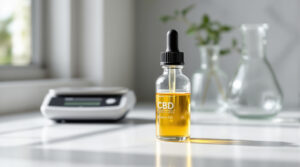
The opinion was published in the EFSA Journal in September 2026. The subject is cannabidiol from chemical synthesis with a purity of at least 98 percent. The substance is intended to be dissolved exclusively in MCT oil and sold as a dietary supplement. The maximum daily dose is 2mg.
The competent panel on nutrition, novel foods, and food allergies considers the product safe under these conditions. The manufacturing process, composition, and specification raise no safety concerns according to its assessment. The panel found no evidence of genotoxic effects. According to industry reports, the applicant is an Irish company that originally requested 25mg daily before later reducing the application to 2mg.


In July, we reported on the first positive EFSA opinion since the review halt, based then on applicant statements. Maximum dosage, target population, and purity requirements were not public at that time. Now they are officially documented. Whether this concerns the same dossier cannot be determined from the opinion summary.
2mg Daily and Three Excluded Groups
The target population is narrowly defined. The product is intended for adults over 25 years old, with pregnant and nursing women explicitly excluded. For people taking medications, the authority could not establish safety. This excludes a considerable portion of the current CBD oil customer base.
The assessment is based on a 90-day rat study submitted by the applicant. The liver emerged as the most sensitive organ, with female animals showing stronger reactions than males. From this data, the panel derived a reference point of 10.5mg per kilogram of body weight per day. They then applied an uncertainty factor of 400 due to missing data on reproductive and developmental toxicity.
The result is 0.026mg per kilogram of body weight per day—approximately 2mg for a 70-kilogram adult. This value aligns practically with the line the authority drew in February when the EFSA released its provisional CBD safety value. This exact dosage faces industry criticism. Consultants expressed skepticism in trade publications that 2mg produces a noticeable effect. Commercial CBD oils typically deliver multiples of this amount per daily dose. The UK Food Standards Authority considers up to 10mg acceptable, as our comparison between British and European standards demonstrates.
Natural Hemp Extracts Remain Without Positive Opinion
The news is mixed for the hemp industry. The positive assessment covers a laboratory-synthesized substance, not a plant extract. In the same EFSA Journal issue appears a second opinion on a Cannabis sativa extract containing 57 to 65 percent CBD and 9 to 17 percent other cannabinoids. Produced using supercritical carbon dioxide, it was proposed for marketing at up to 30mg daily.
Here the panel concludes that safety cannot be established. The EFSA requested additional data on identity, manufacturing, composition, and toxicology. According to the opinion, the applicant did not respond. In May, a plant-derived CBD isolate also failed, submitted at 21mg daily, where questions remained about whether planned formulations contained nanoparticles.
This is not a judgment on full-spectrum products generally. The negative opinions stem from data gaps, not demonstrated risk. They demonstrate, however, how high the hurdle lies for complex extracts. The authority’s provisional safety value applies only to CBD with at least 98 percent purity. That European authorities rarely speak with one voice on cannabis is further illustrated by disputes over pre-drying of cannabis flowers.
What Happens After the Opinion
An opinion is not approval. The EFSA assesses only safety; the European Commission and Member States decide on marketing. Under the Novel Food Regulation, the Commission must present a draft implementing act within seven months of publication. If Member States agree in the competent committee, the substance is added to the EU list of novel foods.
Only then could the product be sold throughout the EU, including in Germany and Austria. Approval applies only to the substance with this exact specification. If the applicant requested protection for proprietary study data, only they may market the product for the first five years. For all other CBD food products, nothing legally changes. They remain non-compliant without authorization.
Chemical law remains unclear. In parallel, proceedings continue where the ECHA wants to classify CBD as reproductive toxic. How both strands align is for the Commission to answer. Major food corporations have monitored the market for years. As early as 2018, it became known that Coca-Cola was exploring entry into the CBD business. Little has happened since due to the lack of legal framework.
Frequently Asked Questions
Is CBD as a food now approved in the EU?
No. The EFSA opinion is the scientific foundation for approval but does not constitute approval itself. A substance is approved only when the Commission adds it to the EU list of novel foods with Member State approval.
To Whom Does the Positive EFSA CBD Opinion Apply?
It applies to synthetic CBD with at least 98 percent purity in MCT oil at no more than 2mg daily. The target population is adults over 25 years old. Pregnant and nursing women are excluded. Safety could not be established for people taking medications.
Why Is the Maximum Dose Only 2mg CBD Daily?
The EFSA applies an uncertainty factor of 400 because critical data is missing, such as on reproductive and developmental toxicity. The starting point was a value from a 90-day rat study where liver weight changed. This yields 0.026mg per kilogram of body weight daily.
What Does This Opinion Mean for CBD Oils from Hemp Extract?
For now, nothing. The positive opinion concerns a single synthetic substance. The EFSA gave negative opinions in 2026 to two plant-derived CBD applications due to missing data. Each manufacturer must demonstrate their product’s safety with a separate dossier.
When Might the First Approved CBD Product Reach the Market?
No timeline is set. The Commission has seven months under the regulation for its draft, after which Member States vote. Realistically, a decision is expected no earlier than 2027.
Würdest du CBD-Öl mit nur 2 mg pro Tag kaufen?
Sources: EFSA Panel on Nutrition, Novel Foods and Food Allergies: Safety of synthetic cannabidiol as a novel food pursuant to Regulation (EU) 2015/2283, EFSA Journal 24(9), 2026, DOI 10.2903/j.efsa.2026.10154; Safety of Cannabis sativa L. extract as a novel food, EFSA Journal 24(9), 2026, DOI 10.2903/j.efsa.2026.10319; Safety of cannabidiol isolate from Cannabis sativa L. as a novel food, EFSA Journal 24(5), 2026, DOI 10.2903/j.efsa.2026.10124; Regulation (EU) 2015/2283; NutraIngredients 21.09.2026; own reporting.





Branchen-Update
News, Analysen und Reportagen — mehrmals im Monat direkt in dein Postfach.