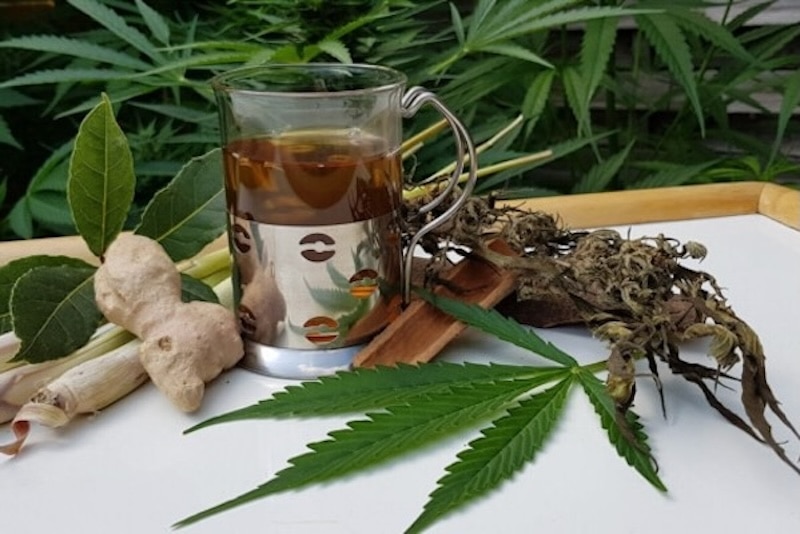
Even on hot days, the subject of tea should not be underestimated – it is no coincidence that in many countries with warmer climates, tea is enjoyed on every occasion.
📑 Inhaltsverzeichnis
- A small selection of hemp tea combinations
- Cannabis, cinnamon & ginger
- Cannabis, nettle & mint
- Rastaman’s „All Spice“
- What actually passes into the water when brewing
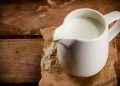
- Why a splash of cream makes the tea a different drink
- Water temperature, steeping time and quantity: what measurably changes things
- Storing hemp tea: why the refrigerator costs potency
- Making hemp tea yourself from fibre hemp
- Which components to process?
- Health risks of hemp teas
- Industrial hemp or cannabis flowers: two raw materials, two legal situations
- The limit values: acute reference dose and the EU regulation from 2027
- What the tea can do and where the data ends
- Frequently asked questions about hemp tea
- 💬 Fragen? Frag den Hanf-Buddy!
In hot weather, warm (not hot) beverages help the body regulate its own heat balance. To brew a hemp tea, any hemp variety can be used, whether the plant comes from a cultivated crop, from the „wild sowing“ of the previous year’s bird seed mixture, or from the industrial hemp field of a farmer friend.
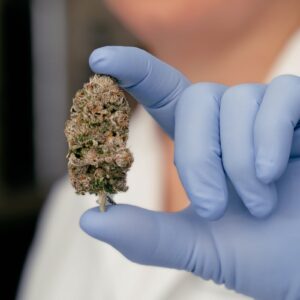
The strength of the medicinal effect naturally depends on the plant here too: the higher the THC(a) or CBD(a) content, the higher the medicinal effect. Hemp tea contains mainly cannabidiolic acid as well as extracts of valuable cannabinoids and flavonoids. Brewing tea from cannabis flowers or leaves is generally not sufficient to activate the psychoactive ingredients, i.e. to decarboxylate them. Thus, even a tea made from a plant that is attributed a high THC content can generally not produce an intoxicating effect.


The taste of freshly prepared tea compared to fermented tea is significantly different, but by no means bad. A tea made from BIO organic products generally brings positive properties for body and mind. With the help of cannabis, these benefits can be particularly enhanced.
A small selection of hemp tea combinations
Many ingredients for fresh tea can be found in nature close to home. Especially when buying exotic ingredients, it is advisable to pay attention to BIO organic origins. Adding sugar early on can be helpful in dissolving the ingredients of the base ingredients. BIO organic raw cane sugar is also recommended for this. Honey should only be added once the tea has cooled below 70 °C.
Cannabis, cinnamon & ginger
Spicy, piquant and high in antioxidants
Cannabis, nettle & mint
Metabolism-promoting & invigorating
This hemp tea combination from domestic regions is a true „vital bomb“. The positive properties of each individual ingredient are manifold and far-reaching. Peppermint was named medicinal plant of the year in 2004. This blend is particularly good for metabolism, blood count and regulates digestion. Preferably only the upper, fresh leaf pairs of mint and nettles should be used.
Rastaman’s „All Spice“
Bayleaf (bay leaf), cinnamon, lemongrass & ginger
In addition to the previously mentioned properties of cinnamon and ginger, lemongrass offers wonderful health benefits here. For example, lemongrass is used for rheumatic complaints, immune deficiency, to prevent flu and combat summer colds, as well as to repel mosquitoes.


What actually passes into the water when brewing
How strong a hemp tea turns out is not determined by the plant’s content alone. What matters is what proportion of it actually reaches the water phase. Cannabinoids in their neutral form are fat-soluble and practically insoluble in water. Their acidic precursors, on the other hand, dissolve much better. This difference is exactly what shapes the composition of each cup.
A Prague working group led by Matěj Malý measured 42 phytocannabinoids and twelve flavonoids in the finished infusion in 2024 in the Journal of Agricultural and Food Chemistry. Three varieties were examined, one THC-rich chemotype and two CBD-rich. The result shows a clear pattern: the acids pass through, the neutral forms largely remain in the herb.
| Active ingredient | Proportion that transfers into the infusion |
|---|---|
| Cannabidiolic acid (CBDA) | 71 to 84 percent |
| Cannabigerolic acid (CBGA) | 15 to 51 percent |
| Flavonoids (mean value) | approximately 53 percent |
| Tetrahydrocannabinolic acid (THCA) | 0.2 to 6 percent |
| Cannabidiol (CBD) | 0.4 to 4.1 percent |
| Delta-9-THC | 0.4 to 2.0 percent |
This allows us to sharpen the rule of thumb mentioned above without discarding it. The plant’s content determines the upper limit, solubility determines the yield. A CBD-rich hemp tea releases a large portion of its cannabidiolic acid into the cup. A THC-rich tea, by contrast, supplies only a fraction of its active ingredient. Our article on raw cannabis and THCA explains what the acid form does in the body, and we discuss cannabidiolic acid itself in detail under CBDA.
Why a splash of cream makes the tea a different drink
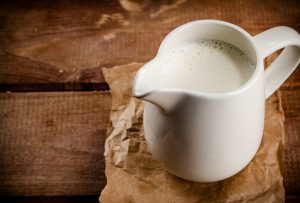
The same research group prepared the infusion a second time, this time adding 20 grams of cream with ten percent fat. The numbers changed completely. The transfer of neutral phytocannabinoids rose on average from four to 68 percent. For Delta-9-THC alone, 53 to 64 percent was achieved. The flavonoids also increased, on average from 53 to 83 percent, with cannflavins A and B rising from 1.6 and twelve percent to 46 and 72 percent.
Adding fat during steeping thus transforms a low-potency infusion into a significantly stronger drink. The authors calculated this for a single cup of 250 millilitres. For the THC-rich chemotype, the acute reference dose was exceeded 261-fold, for the two CBD-rich varieties 9.5-fold and 4.1-fold. Without cream, the same cup was significantly lower for the CBD varieties.
The widespread advice that fat improves absorption is thus correct. However, it does not describe a small effect, but an order of magnitude of around thirty to one hundred. Anyone who drinks a hemp tea made from industrial hemp leaves with a splash of milk stays in the harmless range because the starting material contains hardly any THC. Anyone who uses the same trick with cannabis flowers actually produces an edible. Then the rules of oral consumption apply, namely delayed onset of effects and long duration of action. Our overview of cannabis drinks shows how this works with other preparations.
Water temperature, steeping time and quantity: what measurably changes things
Arno Hazekamp and colleagues systematically tested in 2007 in the Journal of Ethnopharmacology which preparation parameters actually change the composition. The basis was the protocol of the Dutch authority for medicinal cannabis: one gram of flowers per litre of boiling water, simmer for 15 minutes, then strain.
The tea prepared this way contained on average 0.010 milligrams of THC per millilitre and 0.043 milligrams of THCA per millilitre. The acid form is thus roughly four times higher than the neutral THC. Out of 174 milligrams of total THC in the plant material, only about ten milligrams of THC ended up in the entire litre.
| Changed parameter | Effect on the infusion |
|---|---|
| 250 milligrams per 250 millilitres instead of one gram per litre | no significant difference |
| 1.5 grams instead of one gram of herb | no significant increase |
| 0.5 grams instead of one gram of herb | approximately halved concentration |
| Boiling time of ten, 20 or 30 minutes | THCA nearly unchanged, THC rises measurably |
| pure THC, 15 minutes in boiling water | only approximately 17 percent recovered |
| pure THCA, 15 minutes in boiling water | approximately 63 percent recovered |
The most striking figure is saturation. Adding more plant material to the same amount of water does not increase the concentration, because a visible precipitate forms on the glass wall once the solution is saturated. So you can’t get further with quantity. Longer boiling alone raises the THC content, and from a very low starting value.
For practical purposes, this means: ten to fifteen minutes are sufficient. An infusion with hot, but not boiling water extracts less than a simmering preparation. For leaf tea, this speaks in favour of flavour; for flower material, it keeps the dose low. Breakdown products such as CBN or Delta-8-THC do not form during cooking. Heating does not destroy the cannabinoids, it simply dissolves them incompletely. Complete conversion of the acids is only achieved through decarboxylation in the oven.
Storing hemp tea: why the refrigerator costs potency
Shelf life is the most underestimated point. Hazekamp and colleagues stored the same tea for twelve days at four to seven degrees and measured it regularly.
After just one day, only 60 percent of the THC and 71 percent of the THCA remained in solution. After twelve days, the values were at six and eight percent. As it cools, the liquid changes from clear to cloudy, because a precipitate forms. Analysis of this precipitate showed that it contained exactly the amount that was missing from the solution. The cannabinoids do not disappear, they precipitate out.
The second observation is important. All cannabinoids precipitated in the same ratio, so the profile of the tea remains intact and only the concentration decreases. An addition of coffee whitener, a sachet of about 2.5 grams per 200 millilitres, kept the values almost unchanged for five days. Methylated beta-cyclodextrin in a concentration of one to three percent achieved the same thing. If you drink the tea fresh, you don’t need either.
Making hemp tea yourself from fibre hemp
There are two scenarios in the cultivation of fibre hemp
You have male and female plants that mature at different times. Since this is undesirable, the second scenario would be more common. Hermaphroditic fibre hemp is grown, which is well suited for making hemp tea yourself.
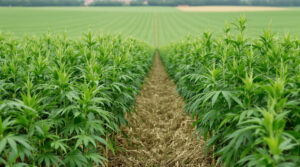
As the fibre hemp grows, it shoots up several metres in height. Fibre hemp should be quite densely planted. Thus, from a certain height, the lower leaves will no longer receive enough light. These can be picked before they die off. The upper leaf levels can also be picked and dried to make hemp tea. Younger and more tender leaves would probably be more valuable. The hemp flowers are seeded on fibre hemp fields. Since hemp seeds are undesirable for hemp tea, the hemp flowers should be harvested before the hemp seeds fully develop and become bothersome.
Or one would have to let the hemp flowers mature and harvest the seeds. Then, so to speak, the remaining flowers are left over. Anyone aiming for sensimilla hemp flowers would have to remove all male and hermaphroditic plants as they would with potent hemp at the flowering stage. Since other farmers also grow fibre hemp, the plants will still seed if they are not in a greenhouse where air only enters filtered.
Which components to process?
The hemp leaves and hemp flowers should be shielded from light to dry. It is very important to ensure that no mould forms in the harvested material. For larger quantities, dry halls with high ceilings would be an advantage, where the hemp plants as a whole or the leaves and flowers hang airy in nets. The air should be able to circulate. In years with high humidity, the air may even need to be dehumidified. In that case, probably shouldn’t ventilate anymore, since the intake air would be very humid.
Theoretically, young plants could also be processed entirely with the stems, but this would not be possible with larger plants. Here, only the leaves, the flowers and possibly the roots, which also contain cannabinoids, are suitable. When large plants are dried, you can still remove the leaf material gradually. For the moment, however, you can harvest faster in the field.
Currently, in many countries, even fiber hemp cannot simply be cultivated. In Austria, one would have to prove in case of doubt that they do not want to manufacture drugs. In Germany, only farmers can apply for cultivation. So you cannot simply grow industrial hemp in your garden to make hemp tea. This is also because industrial hemp produces seeds. If the self-produced seeds are sown every year, the industrial hemp plants will contain some percent THC again after years.

Health risks of hemp teas
Making hemp tea is so simple and harmless that no dangers emanate from the hemp itself; at most minor risks or only for special risk groups from potent hemp tea. However, if someone cultivates indoors, sprays against pests and grows poorly, as well as unpleasantly processes with mold formation, their product will be harmful. Only unsprayed plant parts may be used. At most, harmless pesticides would be an exception. But even with these, waiting periods before harvest should be observed.
However, since lower leaves are already harvested and pesticides are unnecessary, they should generally be avoided. Too much fertilizer can ruin the taste, the wrong soil perhaps too? During processing, no mold may form under any circumstances and other contaminants must not reach the harvest material. Then you should be able to make and drink hemp tea safely or with minimal risk, which tastes good!
Industrial hemp or cannabis flowers: two raw materials, two legal situations
The word hemp tea covers two beverages that have little in common materially and legally. This distinction is worth making before reaching for the pot.
Classic hemp tea consists of leaves and possibly flowers from industrial hemp. Industrial hemp is defined in paragraph 1 number 9 of the Cannabis for Consumption Act as cannabis from certified seed whose tetrahydrocannabinol content does not exceed 0.3 percent. There is also the condition that traffic serves exclusively commercial or scientific purposes that exclude misuse for intoxication purposes. This so-called intoxication clause is the reason why the sale of industrial hemp flowers to end consumers remains controversial. We have broken down how the debate is represented in figures in our analysis of the intoxication clause.
The second case is an infusion of cannabis flowers, for example from private home cultivation according to paragraph 9 of the Cannabis for Consumption Act or from a medical prescription. Food law does not apply here. The quantity limits for possession and cultivation remain unchanged, regardless of whether the material is smoked, vaporized or brewed. Those who process leaves and scraps from their own cultivation will find the options in our article on the utilization of stems and trimming scraps.
The limit values: acute reference dose and the EU regulation from 2027
For hemp tea as a food product, binding figures now exist for the first time. Regulation (EU) 2026/1828 supplements the contaminants regulation (EU) 2023/915 and applies from 1 January 2027. Dried hemp leaves intended for a water infusion may then contain a maximum of 40 milligrams of Delta-9-THC equivalents per kilogram. For ready-to-drink infusions, the limit is 0.02 milligrams per kilogram. The term equivalents refers to the sum of Delta-9-THC and its acid precursor. Water infusions from hemp leaves without flowering and fruiting tips are explicitly not considered novel food. The details can be found in our article on EU limit values for hemp leaf tea, and the Commission had already previously confirmed the novel food status of the leaves.
The health reference value behind this is the acute reference dose. The Federal Institute for Risk Assessment recommends in its statement No. 006/2021 of 17 February 2021 that hemp-containing food products be assessed on the basis of the ARfD derived by EFSA in 2015. It amounts to one microgram of Delta-9-THC per kilogram of body weight. For a person weighing 70 kilograms, this is 70 micrograms in one day. The value was derived from an oral dose of 2.5 milligrams, at which mood swings and fatigue were already observed, divided by a safety factor of 30.
The older reference values of the BgVV from 2000, namely 0.005 milligrams per kilogram for beverages and 0.150 milligrams per kilogram for other food products, were explicitly declared outdated by the BfR in 2018. Anyone reading older sources on this topic should therefore pay attention to the date. When comparing with the ARfD, the BfR generally uses total THC, i.e. the sum of Delta-9-THC and Delta-9-THCA.
What the tea can do and where the data ends
Hemp tea is a traditional beverage, and some of what is attributed to it comes from this tradition. For a sober assessment, it helps to distinguish between three levels.
What has been passed down is herbal knowledge. The combinations of cinnamon, ginger, nettle, mint, bay leaf and lemongrass described above are rooted in a long tradition of use, and that is precisely where they derive their reputation from. This is the body of knowledge on which every tea blend is built.
What has been measured is what ends up in the infusion. The Prague data show a transfer of 71 to 84 percent for cannabidiolic acid and around 53 percent for flavonoids. A hemp tea made from CBD-rich material is therefore chemically not an empty cup, even if it does not intoxicate. We have separate overviews on flavonoids in hemp and on terpenes.
Clinically tested so far is little. For cannabidiolic acid and for cannflavins, mostly preclinical data are available. Hazekamp and colleagues point out that the immunomodulatory properties of the acid forms have only been described in recent years. Cannabis tea should therefore not be understood simply as a carrier for THC, but as its own form of administration. A tea remains a food product and not a medicinal product nonetheless. Anyone who wishes to treat an illness should clarify this with a doctor. Our article Hemp tea as gentle primordial medicine describes the traditional view of the beverage.
Frequently asked questions about hemp tea
Does hemp tea get you high?
As a rule, no. When simply brewing flowers or leaves, the acid forms THCA and CBDA are hardly decarboxylated, meaning they are not converted into psychoactive THC. We explain why the raw plant has different effects in our article on eating raw cannabis.
What does hemp tea contain?
Hemp tea contains mainly cannabidiolic acid (CBDA) as well as other cannabinoids and flavonoids. What cannabidiol actually is, you can read in What is Cannabidiol. Traditional hemp beverages such as Bhang have also been drunk for centuries.
How do you prepare hemp tea correctly?
Pour hot, but not boiling water over a teaspoon of dried hemp flowers or leaves and let the tea steep for 10 to 15 minutes. A pinch of fat – such as a splash of milk or coconut oil – helps to absorb the fat-soluble cannabinoids better. A detailed guide is provided by our overview of hemp tea.
Which hemp tea blends are popular?
Proven combinations are cannabis with cinnamon and ginger, with nettle and mint, or as a spicy variant with bay leaf and lemongrass. Those who prefer something more traditional will find a historical preparation in the oriental hemp specialty Dawamesk.
How long should hemp tea steep?
Ten to 15 minutes are sufficient. Hazekamp and colleagues compared brewing times of ten, 20 and 30 minutes. The THCA content remained nearly unchanged, only the already low THC content increased measurably. Longer steeping brings hardly any more active ingredients, but costs aroma.
Can you boil hemp tea without destroying the active ingredients?
Yes. In the same study, no degradation products such as CBN or Delta-8-THC were produced during boiling. The cannabinoids are thus not destroyed by the heat, they just dissolve incompletely. A simmering infusion extracts more than a brew with hot, but not boiling water.
How much hemp tea can you drink per day?
There is no fixed number of cups because the THC content of the herb varies greatly. The acute reference dose of one microgram Delta-9-THC per kilogram of body weight serves as a reference value, which for 70 kilograms equals 70 micrograms per day. For commercially available leaf tea without added fat, usual portions are typically below this. Tea made with cream from material rich in active ingredients, on the other hand, can exceed this value many times over.
How do hemp teas made from leaves and flowers differ?
Cannabinoids are produced in the glandular hairs, and these are particularly dense on the flower clusters. Leaf tea is therefore lower in active ingredients and tastes grassier, flower tea is more aromatic and richer. The legal difference is even greater: water infusions from hemp leaves without flowering and fruiting tips are explicitly not considered novel food, with flowers the situation is more complicated.
How long does homemade hemp tea keep?
In terms of taste, it keeps for a few days in the refrigerator, but not in terms of active ingredients. After just one day, only 60 percent of the THC and 71 percent of the THCA remained dissolved, after twelve days six and eight percent. The rest precipitates out. A spoon of coffee whitener kept the values nearly stable over five days. The simplest way is to drink the tea fresh.
Can you smoke the hemp leaves from the tea afterwards?
This is not recommended. The boiled herb is damp, it will mold quickly and the smoke becomes particularly harsh due to the residual moisture. Anyone looking for smokable herbs will find an overview in our portrait of legal smoking herbs. For the utilization of leaf material, a second extraction is anyway more rewarding than burning it.






Branchen-Update
News, Analysen und Reportagen — mehrmals im Monat direkt in dein Postfach.
Folge uns