A glass of cannabis lemonade seems harmless compared to a joint, and that’s precisely the catch. When you drink cannabis instead of smoking it, the onset of effects shifts by a good hour and chemically alters the experience. At the same time, surprisingly many homemade beverages fail because nothing happens at all. The reason is almost always the same: cannabinoids don’t dissolve in water, and hot water alone extracts very little from the flower. Anyone wanting to make cannabis beverages themselves needs three things: heat, a fat carrier, and an honest calculation of dosage.
📑 Inhaltsverzeichnis
- Why Cannabis Beverages Without Fat Barely Work
- Decarboxylation Determines the Effect
- Preparing Cannabis Tea Correctly
- Bhang Lassi and the Indian Milk Tradition
- Cold Beverages Need an Emulsifier
- Dosage: How Much THC Belongs in a Glass?
- Cannabis Tea by Prescription: How Things Work Differently at the Pharmacy
- Frequently Asked Questions
- 💬 Fragen? Frag den Hanf-Buddy!
Why Cannabis Beverages Without Fat Barely Work
THC and CBD are lipophilic, meaning they bind to fat rather than water. A classic infusion of ground flowers and hot water extracts only a tiny fraction of cannabinoids. What remains is an aromatic hot drink with terpenes but without significant effects. Once a fat carrier is added, the picture changes dramatically. Practical data from kitchen chemistry shows that cream, whole milk, or coconut oil boost THC extraction into the range of roughly 50 to 65 percent.
As a rule of thumb, one teaspoon of fat per cup suffices. More fat does bind more active compound, but makes the drink heavy and portioning imprecise. It’s also important that the fat is present during the entire heating process. Anyone who boils the mixture first and then pours in the cream afterward sacrifices the exact effect that matters. A more detailed comparison between oral and inhalative consumption can be found in our article on bioavailability and effects in comparison.


Decarboxylation Determines the Effect
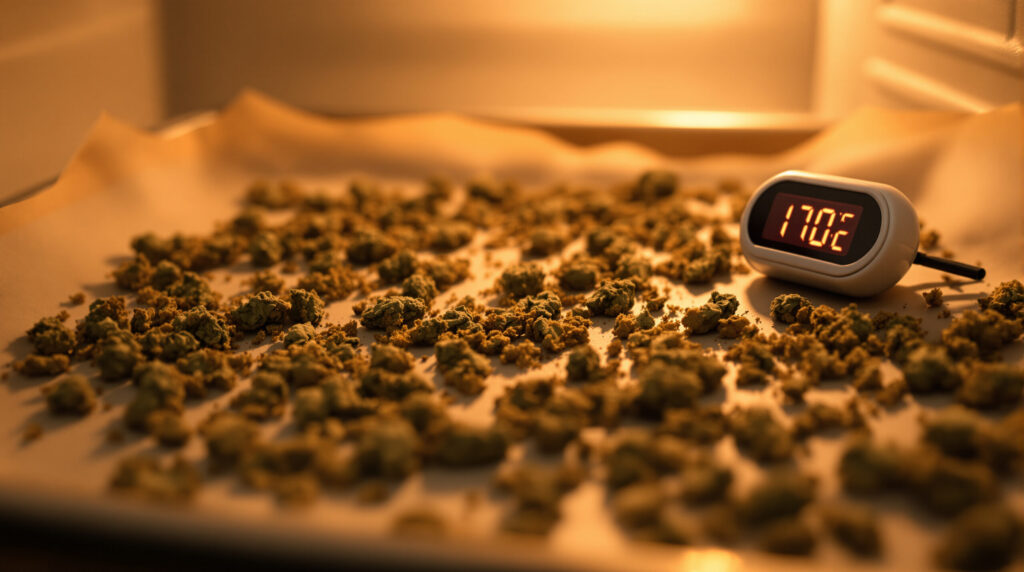
Dried flowers contain hardly any THC, but primarily the acidic form THCA. Only heat splits off a carbon dioxide molecule and converts it into psychoactive THC. This step is called decarboxylation and only proceeds reliably above approximately 105 degrees Celsius. Water boils at 100 degrees, so a tea infusion never reaches this range. Anyone who skips this step produces a THCA beverage with very mild effects.
The clean solution is pre-decarboxylation in the oven. Ground flowers go on a baking sheet at approximately 110 to 115 degrees for 30 to 40 minutes, then into the pot. For details on exactly how this works and which temperature windows lead to which losses, our foundational article on decarboxylation when cooking with cannabis explains this thoroughly. What actually happens to the two molecular forms in tea, we’ve broken down separately in our article on THC and THCA in cannabis tea.
Preparing Cannabis Tea Correctly
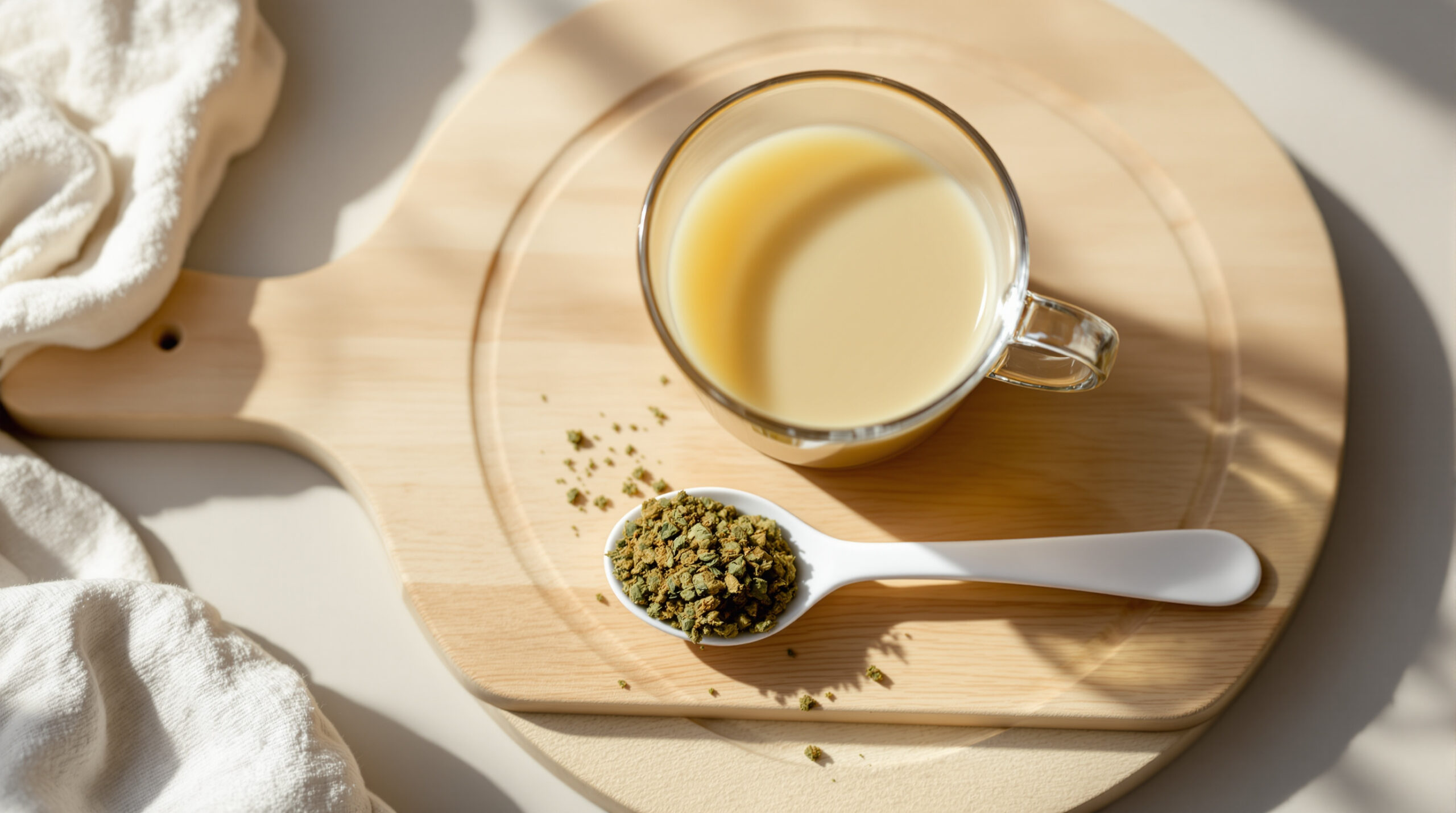
For a cup of cannabis tea, decarboxylated flowers are finely ground and placed in water together with the fat carrier. Half a gram per cup is a reasonable starting point for most people. The mixture should steep on low heat for 30 to 45 minutes, never at a rolling boil. Milk burns easily, and strong heat breaks down THC. Occasional stirring is sufficient.
The mixture is then poured through a fine sieve or cheesecloth. Anyone who thoroughly expresses the plant material will extract a noticeable amount of additional active compound. Spices like cardamom, cinnamon, ginger, or fennel mask the grassy flavor and pair well with the fat base. Stems and leaf remnants also work in the pot but deliver significantly less active compound than flowers. For those who want to make good use of leftovers, our text on raw cannabis and the effects of THCA offers further ideas.
Bhang Lassi and the Indian Milk Tradition
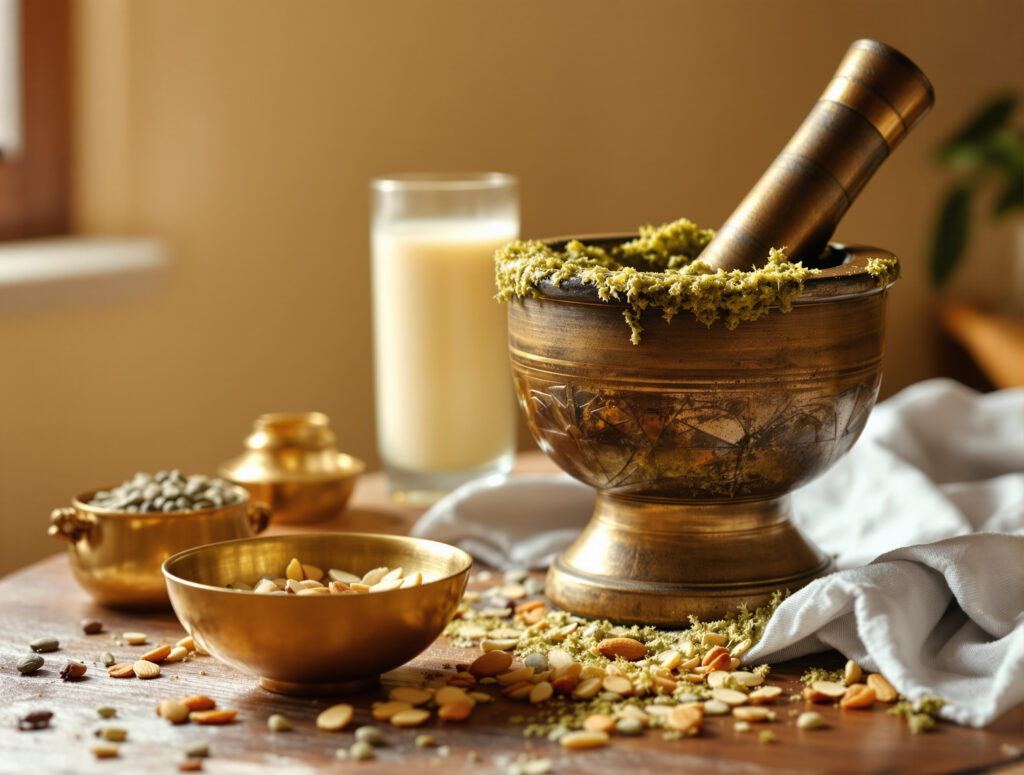
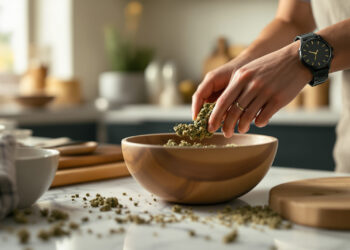
The world’s most famous cannabis beverage comes from India and has elegantly solved the fat problem for centuries. For bhang, leaves and flowers are ground into a paste in a mortar, then stirred with warm milk, ghee, and yogurt. Cardamom, fennel, almonds, and rose water give the drink its character. Bhang is traditionally served at the festivals of Holi and Maha Shivaratri.
From a technical standpoint, bhang lassi is the most consequential form of a cannabis beverage. Whole milk, yogurt, and ghee provide plenty of fat, grinding enlarges the surface area, and prolonged contact with warm milk does the rest. We’ve described the cultural history and a traditional recipe in our profile of the Indian hemp beverage bhang.
Cold Beverages Need an Emulsifier
With lemonades, iced teas, and smoothies, things get trickier. Oil and cold water separate within minutes, and the entire active compound floats as a film on the surface. The first glass from the pitcher is harmless in this case, the last can be quite intense. An emulsifier provides a solution. A quarter teaspoon of sunflower lecithin per portion, briefly blended in a blender, keeps the fat droplets suspended considerably longer.
Industry takes the same approach, just more consistently. So-called nanoemulsions break down oil droplets to less than 100 nanometers and make the cannabinoid virtually water-soluble. This shortens the onset of effects to approximately 10 to 20 minutes instead of the usual 45 to 90 minutes. Such processes require high-pressure homogenizers and can’t be replicated in a home kitchen. Anyone seeking a rapidly hitting beverage will have difficulty avoiding a pre-emulsified product. A related variant with its own dynamics is incidentally cannabis coffee, where caffeine and THC work against each other.
Dosage: How Much THC Belongs in a Glass?
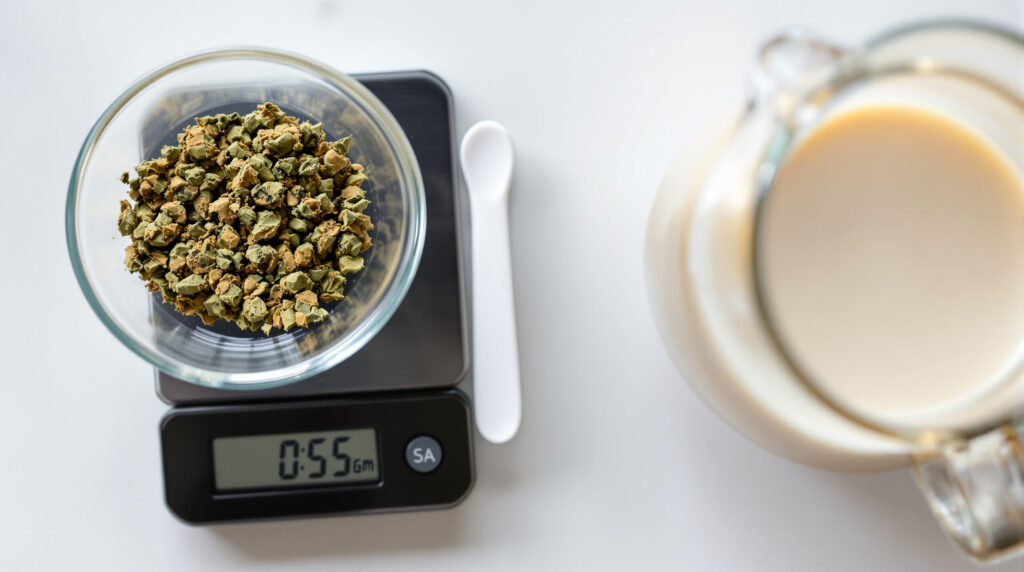
Ingested cannabis passes through the liver, where THC is converted into 11-hydroxy-THC, which is significantly more potent. Effects start late but last four to eight hours. For beginners, 5 to 10 milligrams of THC per serving is a sensible upper limit. Experienced users go higher but should set the amount just as deliberately. The most common mistake is adding more after 30 minutes because seemingly nothing has happened.
Homemade beverages can only be calculated roughly. From one gram of flowers with 15 percent THC, theoretically 150 milligrams result, but after decarboxylation and extraction, perhaps only 60 to 90 milligrams end up in the beverage. Dividing this amount into four servings already puts you in the mid-range. Containers should be labeled and stored out of reach of children. Sharing with other people remains prohibited, even among adults. Our guide to dosing cannabis edibles shows how to systematically avoid miscalculations.
Cannabis Tea by Prescription: How Things Work Differently at the Pharmacy
For patients with a cannabis prescription, tea preparation is a recognized form of application. The New Recipe Formulary describes in monographs 22.14 and 22.15 how pharmacies prepare cannabis flowers for this purpose. Flowers are ground, sifted, and packaged in individual doses of 0.25 to 1 gram. This results in a compounded pharmaceutical product that the pharmacy can bill for.
The pharmaceutical approach solves the same problem as the kitchen, only reproducibly. Dosage is determined via a dosing spoon rather than guesswork, and here too a fat carrier is recommended. The advantage over vaporization lies in the long duration of effects; the disadvantage is in the delayed and hard-to-control onset. For acute symptoms, most practitioners still turn to inhalation.
Frequently Asked Questions
How long does it take for a cannabis beverage to work?
With homemade beverages, noticeable effects typically begin after 45 to 90 minutes. On an empty stomach it can happen faster; after a fatty meal, considerably longer. Industrially manufactured beverages with nanoemulsion often work within 10 to 20 minutes. Within the first two hours, no one should add more.
Can you prepare cannabis tea without fat?
It’s possible, but not advisable. Without a fat carrier, only a fraction of cannabinoids dissolve in water, and while the result tastes like hemp, it barely works. Those who prefer not to use dairy can switch to coconut oil, oat cream, or almond milk with a high fat content. One teaspoon per cup is sufficient.
How long does homemade cannabis tea keep?
A milk-based beverage belongs in the refrigerator immediately and should be consumed within two days. Preparations with coconut oil keep refrigerated for about a week. Light and heat further break down THC, so dark, tightly closing bottles work best. Always shake well before pouring because the fat settles again.
Can you use stems and leaves for beverages?
Yes, and for tea they’re even a sensible way to use leftovers. Cannabinoid content is far below that of flowers, however, so proportionally more material is needed. Stems and leaves must also be decarboxylated beforehand. The flavor turns out stronger and grassier, which spices can help balance nicely.
How much cannabis do you need for a cup?
Hast du schon einmal Cannabis-Getränke selbst zubereitet?
Half a gram of decarboxylated flowers per cup is a typical starting value for experienced users. Beginners are safer with 0.2 to 0.3 grams. The THC content of the variety used is decisive, as there’s a world of difference between 10 and 25 percent. Anyone who documents the first cup can adjust the amount purposefully next time.




Branchen-Update
News, Analysen und Reportagen — mehrmals im Monat direkt in dein Postfach.
Folge uns