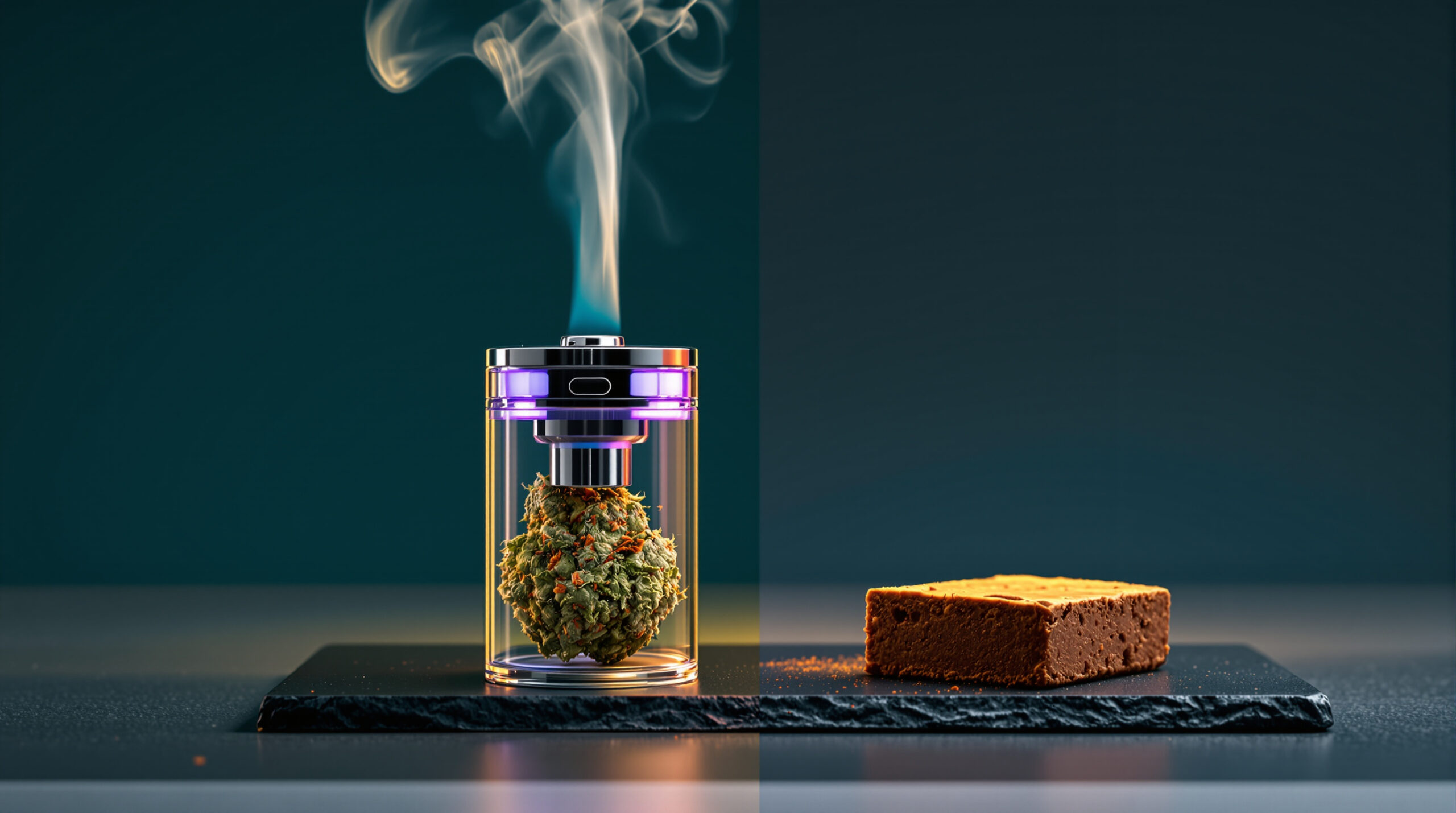
Anyone who consumes cannabis eventually faces a fundamental decision: should the active compound enter the body through the lungs or via the digestive tract? The question „eat cannabis or smoke it“ sounds like a matter of personal preference, but it conceals a fundamental pharmacological difference. The same active compound, the same plant, the same dose can produce a completely different experience depending on the route of administration. Understanding this leads to safer dosing and avoids the typical mistakes that inexperienced consumers repeatedly find themselves in uncomfortable situations because of.
📑 Inhaltsverzeichnis
- Cannabis eaten or smoked: two completely different metabolic pathways
- Bioavailability: Why the calculation isn’t that simple
- Onset of action and duration of effects compared directly
- Health and risk: smoking, vaporizing, or eating?
- Which consumption method suits which goal?
- Frequently asked questions
- 💬 Fragen? Frag den Hanf-Buddy!
The crucial point doesn’t lie in the THC content of the flower, but in what the body does with that THC. When smoking or vaporizing, the lungs absorb the active compound directly; when eating, it must first pass through the digestive tract and liver. This detour fundamentally changes the effect. In the following, we classify both consumption forms based on bioavailability, onset of action, duration of effect, and risk profile, so that the decision doesn’t come down to chance.
Cannabis eaten or smoked: two completely different metabolic pathways
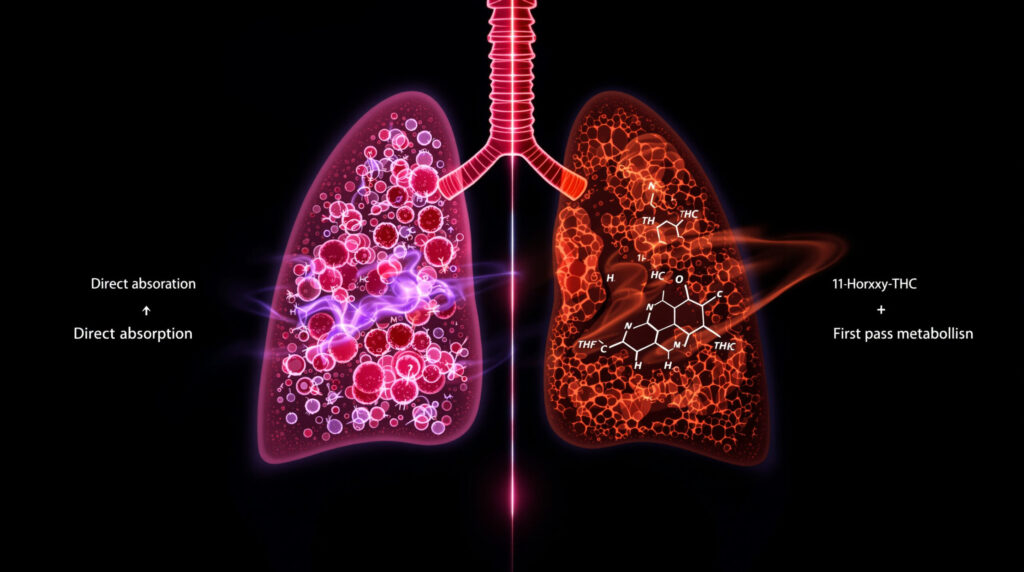
When smoking or vaporizing, THC enters the bloodstream within seconds through the delicate lung alveoli and from there flows almost unimpeded to the brain. This pathway largely bypasses the liver, which is why the effect sets in quickly and in a relatively controllable form. The consumer feels after a few puffs what’s happening and can adjust their behavior accordingly.


Eating works completely differently. THC is absorbed through the mucous membrane of the digestive tract and initially travels via the portal vein to the liver. There, the so-called first-pass effect sets in: a substantial portion of the active compound is metabolized before it even reaches the main circulatory system. The liver converts a large proportion of the THC into the metabolite 11-hydroxy-THC. This conversion is the reason why eaten cannabis feels so distinctly different from smoked cannabis. Those interested in diving deeper into the biochemistry of this metabolite will find the details in our article on the effects of 11-hydroxy-THC in cannabis edibles.
Bioavailability: Why the calculation isn’t that simple
Bioavailability describes what proportion of the consumed active compound actually reaches the bloodstream and can take effect. At first glance, smoking seems to have a clear advantage. With inhalation, the bioavailability of THC averages around 25 percent, though study values vary widely depending on inhalation technique and individual factors. With oral intake via edibles, the value drops significantly to roughly 6 to 20 percent, because some THC is already broken down in the stomach and liver.
However, anyone concluding that eating is the weaker option is mistaken. The metabolite 11-hydroxy-THC formed through the liver is considered psychoactively more potent than the original THC. Moreover, this substance passes the blood-brain barrier efficiently. All in all, the more intense effect of the metabolite not only compensates for the lower bioavailability, but leads in many people to a stronger and more physical experience. The low percentage thus masks the actual power an edible can unleash.
This exact discrepancy between supposedly low uptake and actually strong effects is the most common stumbling block. Those who view bioavailability in isolation and ignore the conversion product systematically underestimate the dose. Bioavailability alone is therefore a poor guide for determining how strong consumption will actually be at the end.
Onset of action and duration of effects compared directly
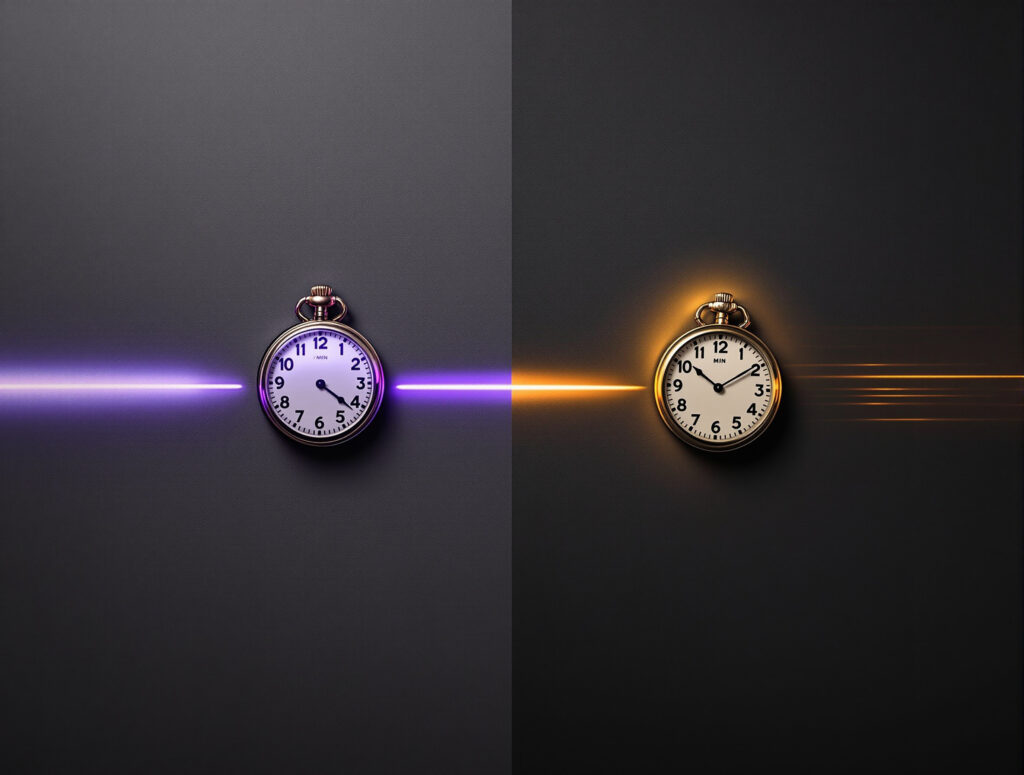
When smoking or vaporizing, effects set in after about five to ten minutes and reach their peak quickly. After one to two hours, the effect largely wears off. This rapid course makes inhalation easy to control, because the dose can be approached puff by puff to the desired intensity. Those who’ve had enough simply stop.
With edibles, the entire timeframe shifts. Effects often take 30 to 120 minutes to appear, because the active compound must first be digested and metabolized in the liver. The peak is often reached only around three hours in, and the entire effect can stretch over four to eight hours, in some cases even longer. This long, deep curve is an advantage for experienced consumers, but for inexperienced ones it’s the biggest source of risk.
The delayed onset of action tempts people to redose. If someone feels nothing after 45 minutes and eats a second portion, they’ll later get hit with the combined effects of both doses. This so-called dose-stacking is the classic path to an overwhelming experience. Practical tips on this can be found in our guide Edibles: eating and drinking instead of smoking.
Health and risk: smoking, vaporizing, or eating?
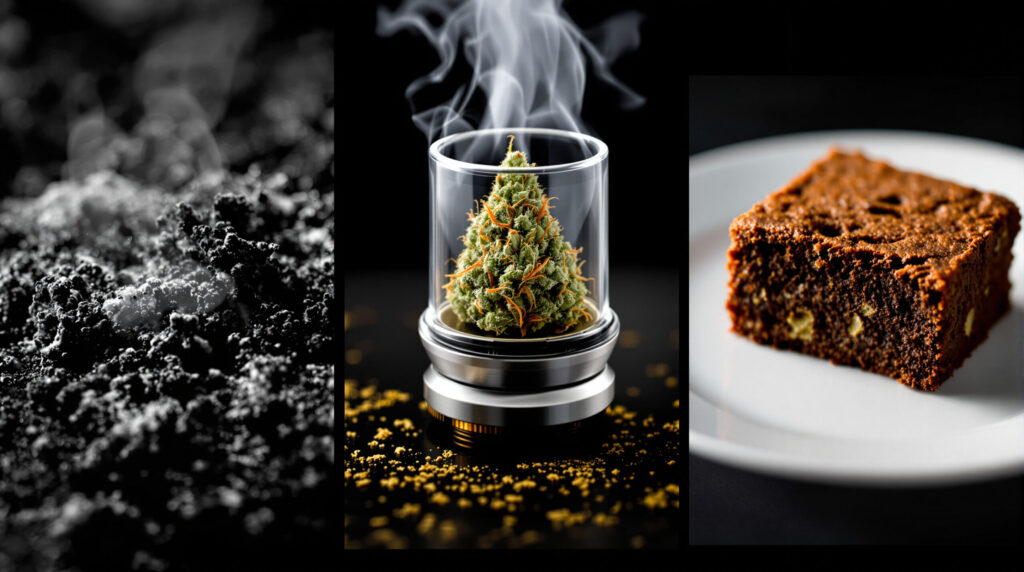
Health assessment shifts the signs once again. Smoking performs worst here, because combustion generates temperatures of several hundred degrees. This produces tar, carbon monoxide, and polycyclic aromatic hydrocarbons—irritants and potentially carcinogenic compounds that reach the lungs with the smoke. This burden has nothing to do with the active compound itself, but results from burning plant material.
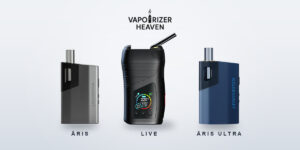
Vaporizing largely circumvents this problem. With vaporization, the flower is gently heated to approximately 160 to 220 degrees so that the active compounds vaporize without combustion occurring. Studies suggest that this eliminates most typical harmful substances while maintaining active compound uptake. Vaporizing is not risk-free either, and long-term effects remain incompletely researched. Those interested in the technical side will find details on optimal settings in our article Vaporizer temperature: what happens at which heat.
Eating doesn’t burden the respiratory tract at all and is the gentlest variant in this regard. However, the risk shifts to dosing. The difficult-to-calculate effects, delayed onset, and long duration of action mean that edibles are disproportionately often associated with emergency medical incidents in statistics from regulated markets. No consumption form is thus universally the best. Those who want to spare their airways pay with increased dosing risk, and vice versa.
Which consumption method suits which goal?
The honest answer is: it depends on your goal. Those seeking quick, easily controllable, and short-lasting effects and wanting to fine-tune their dose precisely are best served by vaporizing. It combines the quick control of inhalation with a significantly better health profile than smoking. For many consumers, it’s therefore the sensible compromise.
Conversely, those appreciating long-lasting, deep, and physical effects—for instance for a quiet evening—and wanting to spare their airways entirely should choose edibles. However, this requires patience and discipline in dosing. The rule of thumb is to start low and wait at least two hours before even considering another portion. Those who follow this rule get the best from the most intense consumption method without falling into the typical overdose trap.
Frequently asked questions
Is cannabis stronger when eaten instead of smoked?
Often yes, even though bioavailability is lower. When eaten, the liver converts a large portion of THC into 11-hydroxy-THC, a metabolite considered psychoactively more potent that efficiently passes the blood-brain barrier. This makes the effects often more physical and intense than when smoking, even though less active compound is absorbed overall.
Why does it take so long for edibles to kick in?
Because the active compound must first travel through the digestive tract and be metabolized in the liver. This process takes time, so effects typically appear only after 30 to 120 minutes and often don’t reach their peak until around three hours. When smoking or vaporizing, by contrast, THC reaches the bloodstream through the lungs in seconds.
Is vaporizing really healthier than smoking?
Current evidence suggests so. Vaporizing produces no combustion byproducts like tar, carbon monoxide, or polycyclic aromatic hydrocarbons, since the flower is only heated, not burned. Studies indicate significantly lower harmful substance exposure. Vaporizing is not risk-free, however, and long-term effects remain incompletely researched.
How do I avoid overdosing with edibles?
The most important principle is to dose low and be patient. Because effects are delayed, you should wait at least two hours before considering another portion. Premature redosing, the so-called dose-stacking, is the most common cause of overwhelming experiences, because the effects of multiple doses later hit all at once.
Which consumption method is most controllable?
Wie konsumierst du Cannabis am häufigsten?
Vaporizing, closely followed by smoking. Because effects from inhaling via the lungs set in within minutes, the dose can be approached puff by puff to the desired level. Edibles are hardest to control, since hours often pass between consumption and full effects, and the dose cannot be reduced after the fact.



Branchen-Update
News, Analysen und Reportagen — mehrmals im Monat direkt in dein Postfach.
Folge uns