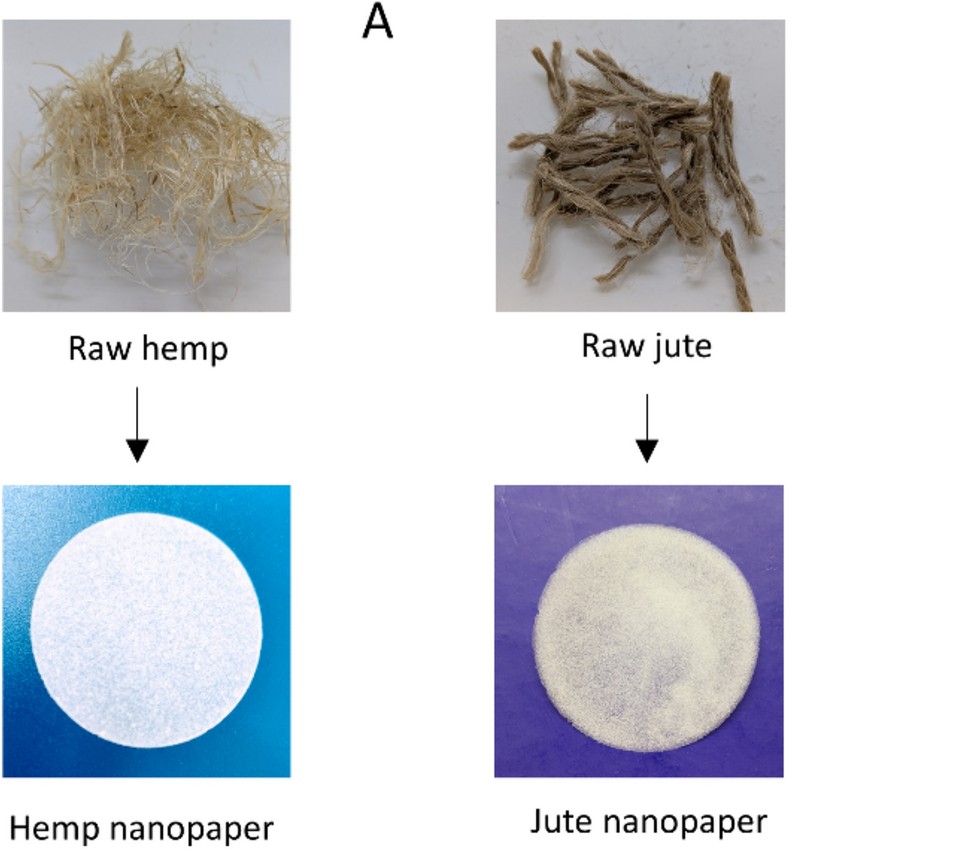
A filter made from hemp fibers that removes more than 90 percent of microplastic fibers from washing machine wastewater: that’s the essence of a new study from Deakin University. Reading the original paper reveals a well-designed lab experiment alongside an honest assessment of what’s still needed for real-world implementation.
📑 Inhaltsverzeichnis
When synthetic clothing is washed, fine fibers are released and flow into wastewater. Because they are small and flexible, conventional water treatment processes struggle to capture them. A research team from the Institute for Frontier Materials at Deakin University in Geelong, Australia, therefore investigated whether filter material could be made from plant fibers to trap these microplastics. The work was published in September 2026 in the journal Cellulose and is freely accessible.
How Hemp Becomes Filter Paper
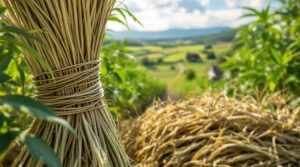
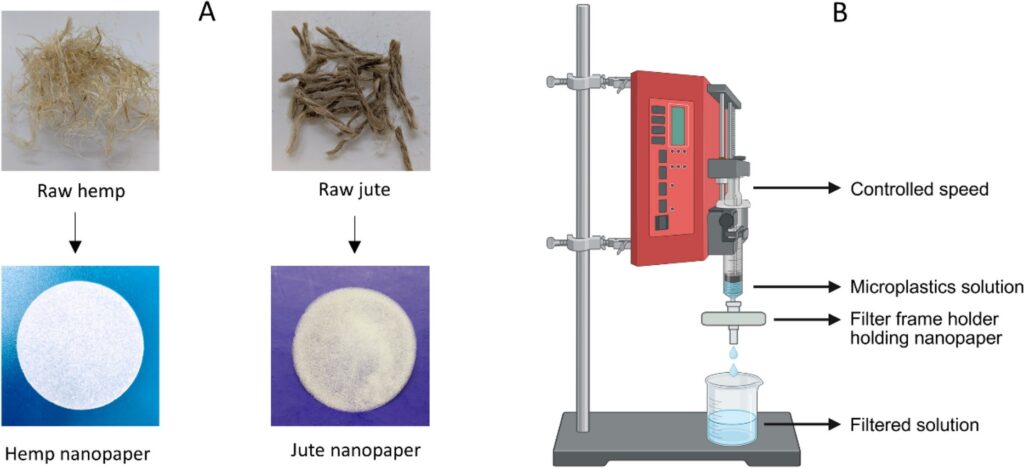
The starting materials were Australian hemp and jute from Bangladesh. The fibers were first bleached and then treated for roughly three hours at 105 degrees Celsius with a so-called deep eutectic solvent made from choline chloride and lactic acid. A high-speed mixer then broke them down into nanofibrils—cellulose fibers in the nanometer range. This suspension was then formed into thin, round sheets via vacuum filtration: the nanopaper.


Despite both plants being processed identically, the results differed significantly. Hemp produced much finer fibrils averaging about 12 nanometers, while jute measured around 29 nanometers. The hemp paper was denser and had roughly seven times the specific surface area—31.9 versus 4.5 square meters per gram. The researchers attribute this to fiber composition: bleaching removed accompanying substances from hemp much more thoroughly. The residual amount in hemp was below four percent, compared to about ten percent in jute.
The Numbers: More Layers, More Effectiveness
For the filter test, the team used polyester fibers collected from commercial laundry wastewater. The key factor in the results was primarily how many layers of nanopaper were stacked together:
- Hemp: approximately 75 percent retention with one layer, 82 percent with two, and 93 percent with three layers
- Jute: approximately 56 percent with one layer, 78 percent with two, and 89 percent with three layers
Hemp thus retains more per layer, while jute catches up through additional layers. The researchers describe this as a transition from pure surface filtration to depth filtration, where fibers are more likely to be trapped as they travel longer paths through multiple layers. Neither the flow rate nor a threefold increase in microplastic concentration from 10 to 30 milligrams per liter changed the results in a statistically measurable way. Filter saturation did not occur in this range. Some early reports about the study cite slightly different values; the figures here come directly from the published paper.
The values can be contextualized through comparisons the paper itself makes. Three layers of nanopaper fall into a comparable range as filters made from cellulose nanofibrils combined with a commercial membrane, for which over 96 percent retention has been reported. At 93 percent, the hemp paper thus falls slightly below this comparison value, not above it.
What the Experiment Doesn’t Show
The authors themselves identify the limitations, and these are crucial for assessing practical viability. Filtration was performed using a syringe pump at constant flow rate. The pressure required for this was not measured. This leaves the permeability of the material, its resistance, and gradual clogging—technically known as fouling—unknown. The actual effective pore size in water was also not determined. The team explicitly recommends follow-up experiments with pressure measurement.
A simple calculation based on the study data illustrates how large the gap between lab and application really is. The filter area in the experiment was just under five square centimeters, with 40 milliliters flowing through per pass. The highest tested loading corresponded to roughly 367 liters per square meter per hour. To filter just one liter of water per minute at this rate would require approximately 0.16 square meters of nanopaper—more than 330 times the experimental area. Whether the material could sustain such throughput continuously cannot be determined from the study, precisely because pressure measurements are missing.
Other questions also remain unaddressed—questions that would determine suitability for household or commercial laundry use: how often nanopaper can be cleaned or reused, how it performs over many wash cycles, and what production costs. The paper contains no data on energy requirements, costs, or lifecycle assessment of the process. The authors derive the material’s sustainability from the renewable and biodegradable nature of cellulose itself, not from a full accounting of the bleaching, solvent treatment, and high-speed mixing involved.
What This Study Means for Hemp
For the hemp industry, this work is nonetheless valuable—less because of the 93 percent figure than because of the direct comparison with jute. It demonstrates that hemp fibers can be refined into finer structures under identical conditions and produce denser architectures. This is a material argument for hemp as a raw material for technical cellulose, beyond classical applications. For what hemp fibers are already used for today, our overview of hemp textiles provides background. And those wearing hemp clothing will find tips for gentle washing in the article on caring for hemp fabrics.
Funding sources are also disclosed: in addition to the Australian Research Council, the Warner Research Institute co-financed the study and, according to the acknowledgments, also provided hemp fibers for the experiment.
Note: This article reflects the state of knowledge as of September 15, 2026. The calculation of filter area requirements is our own simplified estimate based on experimental parameters cited in the study.
Würdest du eine Waschmaschine mit Hanffilter gegen Mikroplastik kaufen?
Sources: Haque, A. N. M. A., Hossain, M. I., Lama, S., Zhang, Y., Bayattork, M., Naebe, M.: Deep eutectic solvent-derived hemp and jute cellulose nanopapers: from nanofibril morphology to nanopaper architecture and polyester microplastic filtration. Cellulose, 2026, DOI 10.1007/s10570-026-07205-x, open access under CC BY 4.0; own calculation.






Branchen-Update
News, Analysen und Reportagen — mehrmals im Monat direkt in dein Postfach.
Folge uns