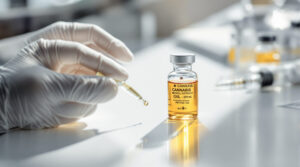

Endometriosis remains one of the conditions where pain management routinely hits its limits. A new analysis from the UK Medical Cannabis Registry now tracks 101 patients over a full two years for the first time. The results show remarkable consistency, though they don’t answer the question most physicians want addressed most.
📑 Inhaltsverzeichnis
The work was published on August 11, 2026, in the Australian and New Zealand Journal of Obstetrics and Gynaecology. Lead author Tania Ahmed works with the study group around Mikael H. Sodergren at Imperial College London, who has been evaluating UK Medical Cannabis Registry data for years. A predecessor study from the same group described just 63 patients over 18 months in November 2025.
What the Two-Year Cannabis Therapy Data Shows for Endometriosis

The study included adult patients with endometriosis as the primary diagnosis who had been registered for at least two years before the data extraction on January 6, 2025. Measurements were taken at baseline and at 1, 3, 6, 12, 18, and 24 months using multiple established instruments.


Researchers measured pain intensity and pain interference using the Brief Pain Inventory, the overall score of the Short-Form McGill Pain Questionnaire 2, a visual analog pain scale, the quality-of-life index EQ-5D-5L, the anxiety questionnaire GAD-7, and the sleep questionnaire SQS. Values improved across all seven scales compared to baseline, at every single follow-up time point. The authors consistently report a significance level of p < 0.001.
The inclusion of anxiety and sleep measures is no afterthought. Both areas are closely linked to pain perception in chronic pelvic pain, as demonstrated recently by a Berlin study on THC for nightmares in PTSD.
Reduced Opioid Prescriptions

The most practically significant finding lies in the prescription data. The median opioid dose prescribed, converted to oral morphine equivalents, fell from 19.9 ± 17.2 mg per day at baseline to 14.8 ± 15.9 mg per day after 24 months. This represents a decline of roughly 26 percent, and it was sustained throughout the entire period.
This trend aligns with other healthcare utilization data. An NIH study on opioid overdose deaths following legalization described a similar relationship at the population level. Similarly, a randomized trial in fibromyalgia, rheumatoid arthritis, and osteoarthritis employed comparable endpoints.
The authors assessed the safety profile as favorable. Eighteen of the 101 participants—17.8 percent—reported a total of 165 adverse events. Of these, 84 reports or 50.9 percent were classified as mild. The most common complaints were fatigue, lethargy, and headache.
Why This Study Does Not Prove Efficacy

A sober assessment is warranted here. This is an observational analysis without a control group. Nobody knows how the same women would have fared without cannabis therapy, and chronic pain trajectories naturally fluctuate widely.
There is also the source of the data. The registry draws from a private pay-for-service clinic, and the study team explicitly names the resulting selection bias. Patients who pay monthly for treatment typically report its benefits differently than comparable groups. The authors draw the only methodologically sound conclusion from this and call for randomized controlled trials. Similar restraint is warranted with other cannabinoid findings, such as the Phase II study of CBD in recurrent pericarditis.
What This Means for Patients in Germany
According to the German Endometriosis Association, approximately two million people in Germany are affected, with roughly 40,000 new diagnoses added each year. The average time to diagnosis is around ten years. This is the real scandal behind any therapy debate. It explains why many patients have already exhausted standard treatment options by the time pain management becomes the focus. We gathered the background on this topic in our article on treating endometriosis with CBD oil and medical cannabis.
The catch is reimbursement. Since the German Bundestag decided in July 2026 to prioritize finished pharmaceutical products, flower cannabis has been removed from standard statutory health insurance coverage. That is precisely the dosage form that played a central role in the British registry. A British registry analysis changes nothing about this legal situation. However, it provides patients and treating physicians with arguments for individual case justifications. It also increases pressure to fund controlled trials for an indication that has been understudied for decades.
Frequently Asked Questions
Does the study prove cannabis works for endometriosis?
No. The investigation is an observational analysis without a control group and therefore cannot establish causality. It merely shows that measured values improved over 24 months. Proving efficacy would require randomized controlled trials—and that is exactly what the authors themselves are calling for.
How much did opioid requirements decline?
The median prescribed dose fell from 19.9 mg oral morphine equivalents per day to 14.8 mg per day after two years. This amounts to a decrease of approximately 26 percent. However, the variation is substantial, with standard deviations in the same ballpark as the mean itself.
What adverse effects occurred?
Nearly 18 percent of participants reported adverse events, totaling 165 in number. About half were mild in severity. The most frequently reported were fatigue, lethargy, and headache. Serious events played no significant role in the analysis.
Can German patients get cannabis prescribed for endometriosis?
Prescription is fundamentally possible because medical cannabis in Germany is not tied to a fixed list of indications. However, since the regulatory change in July 2026, coverage by statutory health insurance has become significantly more restrictive. Flower cannabis has been excluded from standard reimbursement, with finished pharmaceuticals taking priority. Many affected patients therefore pay out of pocket.
Why is the source of the data problematic?
The UK Medical Cannabis Registry captures patients from a private pay-for-service clinic. This population is not representative because these individuals can afford therapy out of pocket and have actively chosen to do so. The study team openly acknowledges this selection bias. It limits the generalizability of the findings.
Sources: Ahmed T. et al., „Cannabis-Based Medicinal Products for Endometriosis: A 2-Year Prospective Analysis From the UK Medical Cannabis Registry“, Australian and New Zealand Journal of Obstetrics and Gynaecology, published online August 11, 2026, DOI 10.1111/ajo.70173. Prior work: Getter et al., same journal, published online November 26, 2025, DOI 10.1111/ajo.70078. Prevalence figures for Germany: German Endometriosis Association.
Sollte Cannabis bei Endometriose von der Kasse bezahlt werden?
Note: This article reports the results of a registry analysis and does not constitute a health or efficacy claim. Registry data without a control group cannot establish causation. Questions about individual therapy belong in the hands of medical professionals.






Branchen-Update
News, Analysen und Reportagen — mehrmals im Monat direkt in dein Postfach.