
What Linnemann Said in Munich
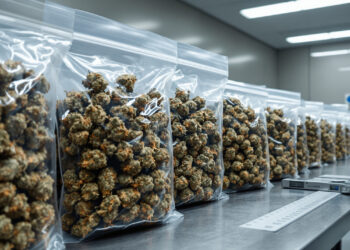
At the German Pharmacy Conference in Munich on September 15, 2026, Federal Health Minister Carsten Linnemann presented a figure that has dominated the debate ever since: imports of medical cannabis flowers are projected to reach 300 tons this year, according to his ministry’s forecast. That would represent a tenfold increase in three years. For the minister, this is not a public health success story but evidence of abuse.
📑 Inhaltsverzeichnis
The import volume „broadly no longer has anything to do with medicine“ but rather with drug consumption, Linnemann told delegates. He was particularly blunt about the distribution model: „Cannabis for consumption at the click of a button via mail order has nothing to do with healthcare anymore.“ He was referring to platforms that issue private prescriptions after patients complete a questionnaire, often through foreign-based providers. The flowers then arrive at patients‘ homes via mail-order pharmacies.
This criticism is not new. What is new is who is making it and with what force. That the government wants to restrict telemedical access became clear as early as spring. Back then, the first ministry drafts circulated, and we reported on the stricter rules for online prescriptions. The Munich appearance sharpens this line on a stage where pharmacies traditionally advocate for in-person distribution.


The 300-Ton Forecast and What It Doesn’t Tell Us

An import volume is first and foremost a logistics figure. It says how much flower material was imported into Germany, not how many people were treated, for what indications, or with what results. The jump the minister describes is enormous, but it falls precisely during the period when cannabis was removed from controlled substance regulations and could thus be prescribed for the first time without the old approval framework. Part of the growth is pent-up demand. Another part stems from market liberalization. A third is likely diversion from the black market and recreational consumption.
The forecast can at least be cross-checked. For the first quarter of 2026, the BfArM (Federal Institute for Drugs and Medical Devices) reported 67.6 instead of the initially reported 50.5 tons. Extrapolated to four quarters, this falls within the ministry’s estimate corridor. The figure is not inflated; it reflects the trend.
No one currently knows reliably how large each segment is. This is exactly what makes the debate so unsatisfying: the number serves as an alarm signal for both sides. Those who emphasize abuse read a tenfold increase. Those who emphasize patient access read that patients are finally getting treatment after years of bureaucracy. How narrow the boundaries have become is evident from a look at § 24 of the Medical Cannabis Act and consumption prohibition zones that apply to patients in daily life.
The Bill: Direct Doctor Contact and Pharmacy-Only Dispensing

The draft that Linnemann is pushing for has been before the German parliament since late 2025. It proposes two key changes. First, prescribing cannabis flowers would only be permitted after direct in-person contact with a doctor. The questionnaire-only pathway would be eliminated. Second, dispensing would be restricted to brick-and-mortar pharmacies; mail delivery would be prohibited. Together, these changes would end the current business model of major telemedical platforms.
This tightening is not isolated. In summer, parliament already passed priority status for finished cannabis pharmaceutical products in insurance reimbursement. Viewing these two measures side by side reveals a direction: flowers become a secondary therapeutic option, with access tied back to medical and pharmaceutical gatekeepers. That such a course is no international outlier is shown by Australia, where the drug regulator has targeted closed-loop prescriptions.
The Study Behind the Argument

Linnemann relied on research on cannabis-related hospital admissions. Specifically, the nationwide time series analysis by Manthey, Radas, and Kraus, published on July 24, 2026, in Deutsches Ärzteblatt International. It analyzed more than 70,000 hospital admissions and found that after the Cannabis Act took effect, there was a 5.6 percent increase in adults and 14.9 percent in adolescents. For intoxications, the increase was 37.1 percent; for cannabis-induced psychosis, 16.7 percent.
The authors themselves are more cautious than political use of their data suggests. The study design does not establish causality. Part of the increase may be due to detection bias, since doctors, amid heated debate, ask more frequently about cannabis use and then code the diagnosis. The study could not account for repeat admissions by the same person, nor did it track concurrent use of other substances. Drawing from these data the conclusion that a mail-order ban is necessary makes a considerable leap: the study does not distinguish between medically prescribed cannabis and cannabis obtained through other channels.
What This Means for Patients
For people actually using flower-based therapy, much depends on implementation details. A mandatory doctor visit is reasonable if enough willing prescribers are accessible. Where they are scarce, the requirement becomes an access barrier. The mail-order ban additionally affects those with limited mobility or whose local pharmacy does not offer cannabis flower prescriptions. The concern that access will suffer rather than abuse being curtailed has accompanied debate over the Medical Cannabis Act since its inception.
It is also unclear whether the bill will be taken up soon in parliament. The draft has been circulating for months without a vote being scheduled. The pharmacy conference appearance is therefore primarily an attempt to accelerate the timeline.
Frequently Asked Questions
Are cannabis prescriptions via questionnaire currently banned?
No. As long as the bill is not passed, existing law applies. A physician can issue a prescription following a telemedical consultation, provided professional requirements are met.
Where does the 300-ton figure come from?
It is a forecast by the Federal Health Ministry for the current year 2026, which Linnemann cited at the German Pharmacy Conference. Final import figures for the full year will only be available after year-end.
Would a mail-order ban also affect extracts and finished pharmaceuticals?
The draft targets cannabis flowers. Finished pharmaceuticals containing cannabinoids are subject to general pharmaceutical regulations. No comparable special restrictions are proposed for them.
Does the cited study prove that legalization causes illness?
No. The time series analysis shows a temporal association, not a causal one. The authors themselves identify several sources of bias, including changing diagnostic practices. Proving causality would require different study designs.
What happens to ongoing therapies if the law passes?
Existing therapies do not automatically end. However, patients would need to obtain follow-up prescriptions through direct doctor contact and fill prescriptions at a brick-and-mortar pharmacy. Transition periods are not yet publicly known.
Sollten Cannabisblüten nur noch in der Apotheke abgegeben werden?
Sources: Deutsches Ärzteblatt, announcement regarding German Pharmacy Conference, September 15, 2026; Manthey J, Radas L, Kraus L: Increase in cannabis-specific hospital admissions after partial legalization in Germany, Dtsch Arztebl Int 2026, DOI 10.3238/arztebl.m2026.0123; German Bundestag, Printed Matter 21/7856.






Branchen-Update
News, Analysen und Reportagen — mehrmals im Monat direkt in dein Postfach.
Folge uns