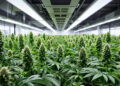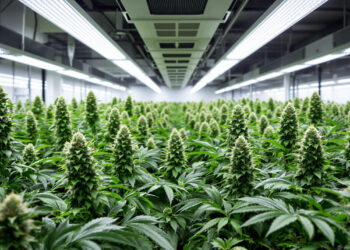
The Administrative Court of Hamburg has prohibited a cultivation association from using greenhouses that were only approved under building code as horticultural operations. Under this ruling, a permit granted under the Cannabis Consumption Law (KCanG) does not replace building approval. Nearly simultaneously, the Federal Association of Cannabis Cultivation Associations (BCAv) updated its state-by-state overview: 896 applications, 455 approvals, plus 126 withdrawn applications. This third figure is the most revealing—it shows how many associations abandon their efforts before authorities even issue a rejection.
📑 Inhaltsverzeichnis
- Hamburg: Court Confirms Greenhouse Usage Prohibition
- Bavaria: Withdrawals Instead of Rejections
- Baden-Württemberg: 37 of 118, Plus One Revocation
- North Rhine-Westphalia and Lower Saxony: The Northwest Carries the Numbers
- Saxony and Rhineland-Palatinate: High Rates, Small Base
- What’s Moving Nationwide
- Frequently Asked Questions
- Sources
- 💬 Fragen? Frag den Hanf-Buddy!
Hamburg: Court Confirms Greenhouse Usage Prohibition
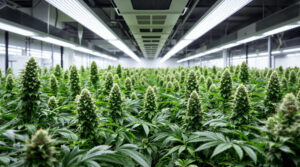
The court decision from July 14, 2026 (Case No. 6 E 4019/26) has been documented in Hamburg’s Administrative Court jurisprudence overview since early August and was picked up by the trade press on August 4. The case involved a facility in the outer areas: a site approved as a horticultural operation where a cultivation association then moved in to grow, care for, and process cannabis plants. The building authority immediately prohibited the use, and the association’s emergency appeal was unsuccessful.
The reasoning is the real turning point for the industry. According to the court, switching from a horticultural operation to a cultivation association constitutes a change of use requiring building approval—because a cultivation association does not engage in commercial horticulture and therefore falls under different building planning standards. A granted KCanG permit says nothing about whether cultivation is permitted on a specific property. Anyone converting existing buildings and only looking at the cannabis permit risks their investment.


For Hamburg itself, the overall picture remains comparatively positive: 28 applications, 18 approvals, only 2 rejections. We reported on the supervisory routine in the Hanseatic city last week; see Hamburg Takes Stock: 17 Cultivation Associations and Only One Advertising Violation.
Bavaria: Withdrawals Instead of Rejections
Bavaria remains the most striking state in the overview. 46 applications face 11 approvals, but 24 applications were withdrawn and only 6 formally rejected. The state barely rejects—it wears applicants down. The building code route has been the central lever for months, which the German Hemp Association is challenging together with the CSC Inntal. We covered the background in Bavaria Blocks Cannabis Cultivation: Hemp Association and CSC Inntal Sue.
The Hamburg decision now shows that the building code question is not a Bavarian-specific problem. It becomes relevant wherever associations want to cultivate in outer areas or converted existing buildings. The difference lies less in the law itself than in the willingness of building authorities to expedite use-change approvals.
Baden-Württemberg: 37 of 118, Plus One Revocation
Baden-Württemberg reports as of July 29: 118 applications, 37 approvals, 18 rejections, 20 withdrawals, and one revocation. After Bavaria, this gives the state the second-weakest approval rate among major area states. At the same time, the Administrative Court of Karlsruhe issued a decision in late July limiting supervisory discretion, detailed in Karlsruhe Court Strikes Down Conditions Against Cultivation Association. Together, both proceedings paint a picture where courts restrain authorities on conditions but support them on building code matters.
North Rhine-Westphalia and Lower Saxony: The Northwest Carries the Numbers
North Rhine-Westphalia continues to lead in absolute terms: 240 applications, 126 approvals, and only 2 rejections with 33 withdrawals. Lower Saxony reaches 146 applications and 94 approvals, but with 29 rejections—showing notably stricter review practices. Together, both states account for 220 of the 455 nationwide approvals. Nearly half of Germany’s legal cultivation infrastructure is concentrated in just two states.
Saxony and Rhineland-Palatinate: High Rates, Small Base
Saxony reports as of July 25: 37 applications and 29 approvals, without a single rejection. This is the highest approval rate among area states. Rhineland-Palatinate reaches as of July 30: 54 applications and 32 approvals with 2 rejections. In both cases, the application base is small, but the administration processes cases thoroughly rather than letting them languish. Hesse stands at 38 applications and 22 approvals in the same range; see also Cannabis in Hesse: 21 Cultivation Associations Approved, 15 Already Cultivating.
What’s Moving Nationwide
Nationally, 455 approvals stand against 896 applications, 85 rejections, 126 withdrawals, and 5 revocations. The ratio of withdrawals to rejections is remarkable. More associations fail due to procedure duration, building code, site search, or financing than are actually rejected. This part of the statistics rarely appears in political debates, though it better explains the law’s displacement effect than the approval number alone.
A methodological note: State data have different dates. While most values are from late July, Mecklenburg-Western Pomerania is from February and Saarland from April. The national total is thus more of a floor than a snapshot figure.
Frequently Asked Questions
How many cultivation associations are approved in Germany?
According to the Federal Association of Cannabis Cultivation Associations (BCAv) state survey, 455 cultivation associations are approved from 896 submitted applications. Most state figures are dated end of July 2026. Approved does not automatically mean an association is already cultivating or distributing.
Is a KCanG permit enough to start cultivation?
No. The Cannabis Consumption Law permit regulates who may cultivate, not where. Building code and planning law additionally govern spaces and land. If an association uses buildings approved for another purpose, this typically constitutes a use-change requiring approval.
Which state offers the best chances for approval?
By approval rate, Saxony, Lower Saxony, and Hesse lead. In absolute numbers, North Rhine-Westphalia leads with 126 approvals. The situation remains most difficult in Bavaria and Saarland, though Bavaria notably shows more withdrawals than rejections.
Where can I find approved cultivation associations near me?
No official national registry exists because permits are issued by state authorities. Lower Saxony has published an official list since April 2026; other states do not. Association and community registries like those from umbrella organizations and map services remain the most practical search, though without guarantees of currency.
Sources
For this monitor, twelve CSC association and registry domains were reviewed: anbauverband.de, cad-bundesverband.de, csc-dachverband.de, csc-dachverband-bayern.de, cannabis-clubs.de, cscsdeutschland.de, csc-maps.de, social-club-maps.de, csc-connect.de, anbauvereine.org, anbauvereine.com, and weedvibes.de. Relevant new content this week came solely from anbauverband.de with the updated applications and approvals overview. Other domains showed unchanged registry and explanatory content; cannabis-clubs.de was inaccessible due to an expired certificate.
Sollten Anbauvereinigungen im Außenbereich baurechtlich privilegiert werden?
Sources: Federal Association of Cannabis Cultivation Associations (BCAv), Applications and Approvals Data, state response dates February 16 to July 30, 2026; Hamburg Administrative Court, Decision from July 14, 2026, Case No. 6 E 4019/26, Jurisprudence Overview.






Branchen-Update
News, Analysen und Reportagen — mehrmals im Monat direkt in dein Postfach.
Folge uns