
Since July 30, 2026, cannabis flowers have been removed from the benefit catalog of statutory health insurance. Six weeks later, the body representing the interests of those affected in the most important decision-making body of the health system has spoken up. Patient representation in the Joint Federal Committee is calling for provisions to protect existing therapies and transitional arrangements for ongoing treatments, as well as swift clarification of reimbursement eligibility. Both are completely absent from the law.
📑 Inhaltsverzeichnis
What patient representation in the G-BA is specifically demanding

The statement was released on September 2, 2026, and distributed through the German Multiple Sclerosis Society Federal Association, which provides one of the patient representatives. The core of the criticism is not directed at the removal itself, but at how it was implemented. From the patient representation’s perspective, it is particularly problematic that the loss of reimbursement eligibility was not accompanied by provisions to protect existing therapies and transitional arrangements for already ongoing treatments.
For patients with an already established therapy, the loss of reimbursement eligibility must not lead to therapy discontinuation. Precisely for them, a reliable follow-up solution has so far been lacking.
This is what Dr. Cornelia Sander, patient representative in the Joint Federal Committee, says. Her colleague Dr. Michaela Mai is more pointed and names the time factor. Those affected need reliable access to care now and cannot wait months for court rulings from social courts. How justified this point is became evident at the end of August when the Social Court in Frankfurt rejected an emergency application against the missing transitional arrangement. The legal path remains open, it’s just slow.


Switching to extracts doesn’t work in practice
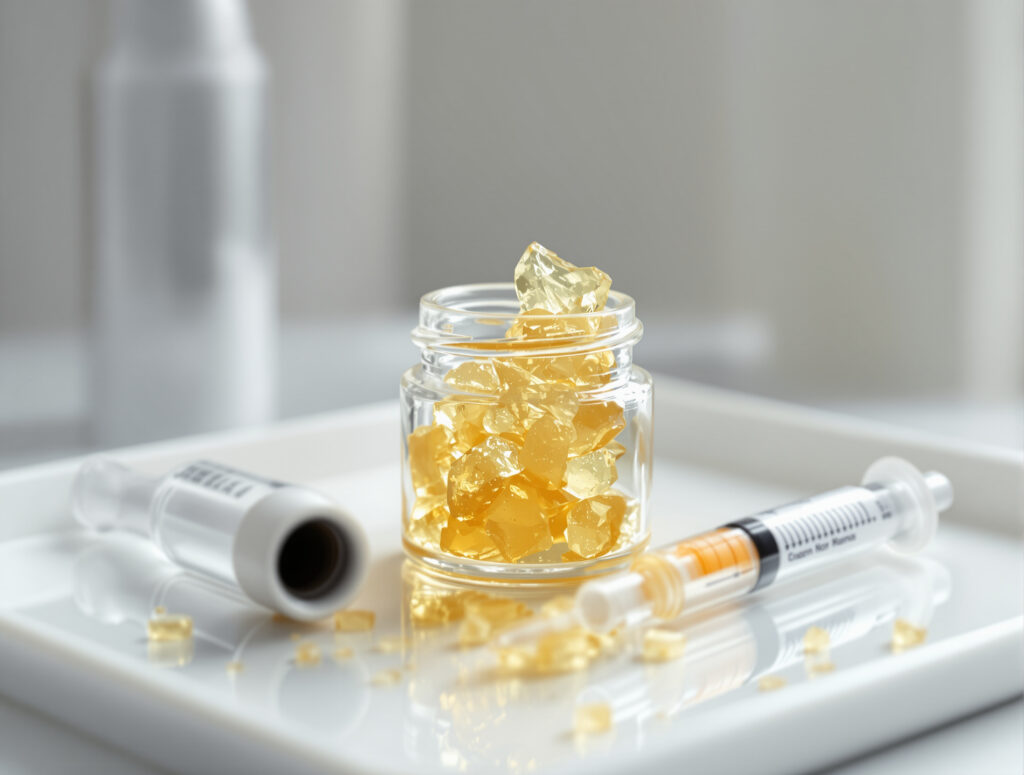
Particularly affected are people who were previously treated with vaporizable flowers and are now supposed to switch to inhalable extracts. This path was precisely the official answer during the legislative process to the question of supply security. The GKV Spitzenverband itself had pointed to this alternative in its statement from January 12, 2026. In practice, individual insurance funds now interpret the reimbursement eligibility of extracts differently. This leads to rejections and thus to unequal treatment without factual justification. Whether a prescription goes through currently depends less on the indication than on the insurance fund.
That this would happen was foreseeable. We already pointed out in July that not only flowers, but also reimbursement of cannabis extracts is in jeopardy. Patient representation now confirms this finding based on supply reality. How differently access to medicinal cannabis is regulated in the German-speaking region is shown by comparison with the legal situation and medical use in Austria.
The six-month therapy trial remains unclear

The second open point concerns the statutorily prescribed therapy trial with a cannabis-containing finished pharmaceutical product. Its prerequisites remain unclear to this day. An attempt at joint interpretation of the law by the GKV Spitzenverband and the National Association of Statutory Health Insurance Physicians does not answer all open questions from the patient representation’s perspective. It has even become disputed on one crucial point. This refers to the KBV’s reversal on August 20, with which it withdrew its own cannabis clarification and extended the finished pharmaceutical preference to off-label use as well.
This pits the interpretation of two institutions against each other that were supposed to create clarity together. For practices, this means liability risk; for patients, legal uncertainty. The origin lies in a regulation that the legislature passed in summer when the Bundestag established the priority for finished pharmaceuticals.
Even undisputed prescriptions come under pressure
The most remarkable part of the statement concerns areas that were not affected by the law change at all. Medications with the active ingredients dronabinol or nabilone, as well as extracts in standardized quality, continue to be covered under the current law. Nevertheless, prescriptions are sometimes no longer issued in practice, and valid prescriptions are not accepted. Here, the uncertainty about the actual scope of the regulation has effects beyond it. A law that only removes flowers is factually narrowing access to therapies that it explicitly left untouched.
This self-reinforcing dynamic of the debate is not an isolated case. Figures and rules around cannabis are regularly overstretched in political debate, as our fact-check on drug deaths and cannabis shows. Ultimately, it affects those who depend on functioning medical care.
What this demand is practically worth
Patient representation in the G-BA is composed of representatives from the four major patient organizations under the Patient Participation Ordinance: the German Disability Council, the Federal Working Group of Patient Centers and Initiatives, the German Working Group of Self-Help Groups, and the Federation of German Consumer Organizations. They may participate in consultations and submit motions, but they have no voting rights. Their demand is therefore directed at the Federal Ministry of Health and the guideline-setting G-BA.
That is the realistic assessment. This statement decides nothing, but it shifts the burden of proof. Until now, politics could treat the removal of flower reimbursement as a cost issue. Now there is a description of the supply gap from a committee that is formally anchored in the G-BA. Together with the ACM petition against the flower phase-out and ongoing social court proceedings, a picture emerges that is harder to ignore than a single association announcement. Whether this results in a transitional arrangement depends on a political decision, not on missing evidence.
Frequently asked questions
What exactly is no longer reimbursable as of July 30, 2026?
With the implementation of the GKV Contribution Stabilization Act, cannabis flowers were removed from the benefit catalog of statutory health insurance. Medications with the active ingredients dronabinol or nabilone, as well as extracts in standardized quality, remain reimbursable under the law.
Is there a transitional arrangement for ongoing therapies?
No. That is precisely the core of the criticism. The new statutory regulation contains neither protection for existing therapies nor transitional arrangements for patients whose treatment began before the cutoff date. An emergency application against this gap was rejected by the Social Court in Frankfurt at the end of August.
Are inhalable extracts reimbursed by insurance funds?
According to the law text, yes; in practice, inconsistently. Patient representation reports differing interpretations by individual health insurance funds and rejections. Those affected should request a written rejection decision and file an objection, as only this creates a reviewable record.
What is the six-month therapy trial?
Before other cannabis-containing therapies, a cannabis-containing finished pharmaceutical product should first be used. How long and under what conditions this trial must run is disputed between the GKV Spitzenverband and the National Association of Statutory Health Insurance Physicians. Since August 20, the KBV has also required a finished pharmaceutical even when it is not approved for the respective indication.
Can patient representation in the G-BA enforce a change?
Not on its own. They may participate in consultations in the Joint Federal Committee and submit motions, but have no voting rights. Their demand has effect as political pressure and as documented description of the care situation, not as a resolution.
Sollten laufende Cannabistherapien einen Bestandsschutz bei der Erstattung erhalten?
Sources: Press release from patient representation in the Joint Federal Committee, distributed via the German Multiple Sclerosis Society Federal Association, September 2, 2026; Statement by the GKV Spitzenverband on the draft of a First Act to Amend the Medicinal Cannabis Act from January 12, 2026; Practice notice from the National Association of Statutory Health Insurance Physicians from August 20, 2026 on initial prescriptions of cannabis-containing medications.




Branchen-Update
News, Analysen und Reportagen — mehrmals im Monat direkt in dein Postfach.
Folge uns