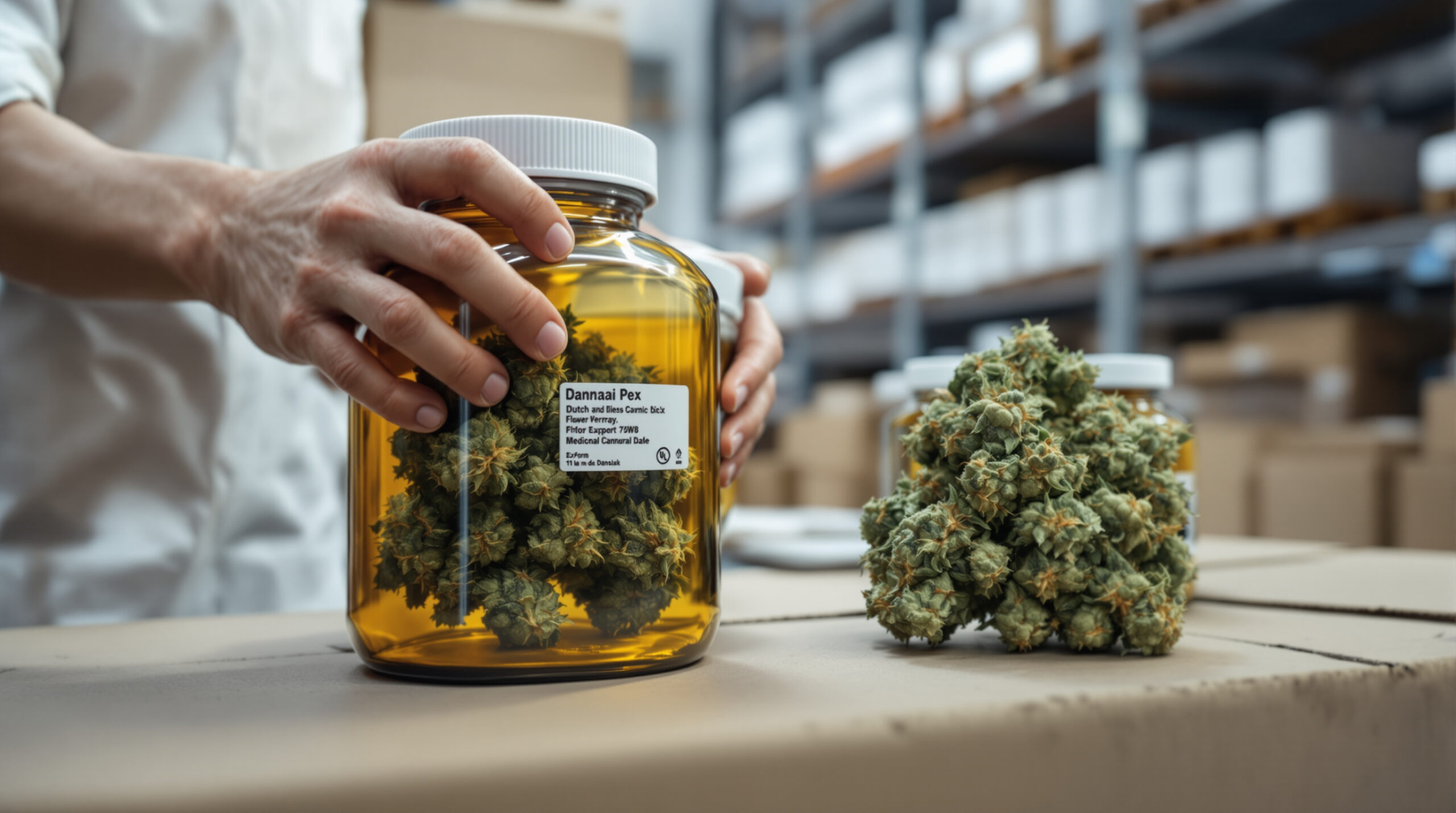
Bedrocan is insolvent. The District Court Groningen opened insolvency proceedings against Bedrocan International B.V., based in Veendam, on October 8, 2026, case number F.18/26/259. This marks the provisional end of the company’s history—since 2003, it had been the sole supplier to the Dutch state cannabis program.
📑 Inhaltsverzeichnis
The insolvency is the preliminary endpoint of a development that began in January, which we have followed from the start: the Netherlands is restructuring its entire procurement model for medicinal cannabis, and Bedrocan has lost its guaranteed sales channel in the process.
For nearly two decades, the path was always the same: anyone outside the Netherlands wanting to source Dutch medicinal cannabis would order from the Bureau voor Medicinale Cannabis, the government office of the Health Ministry, known internationally as the Office of Medicinal Cannabis. The office purchased from a contracted grower and resold the product, including for export. This model is ending.


Manufacturer Bedrocan drew attention to this early in the week in a notice to industry professionals, urging pharmacies, wholesalers, and service providers outside the Netherlands to stop placing new orders with the office and instead contact the company directly. The notice briefly mentions „recent changes to Dutch policy.“ It provides no further details. We looked into what’s actually behind this.
The Insolvency in Numbers and Facts
The proceedings were preceded by a payment moratorium phase. The Surseance van betaling granted on September 24 was ended on October 7, and insolvency proceedings were opened one day later. Attorneys A. Gras and F. C. Verduijn are appointed as insolvency administrators, with D. J. Klijn serving as insolvency judge. The Dutch companies affected employ approximately seventy staff members across locations in Veendam and Emmeloord.
The company itself names the trigger: the Health Ministry terminated the supply contract, and the new regulation allowing producers to supply pharmacies directly is not set to take effect until July 1, 2028, according to current plans. That leaves two and a half years without the business model on which the company was built.
What Is Actually Changing in the Netherlands
The restructuring occurs in three stages and extends considerably further than simply the question of who to order from.
- The framework contract with the Dutch grower ended on January 1, 2026. The office is no longer issuing new cultivation contracts. A tender for two cultivation licenses was concluded without result.
- Exports end at year-end 2026. The justification is that patient supply in the Netherlands takes priority while procurement is being reorganized.
- From 2027, the office will transition to imports, procured through a European tender process. The accompanying amendment to the Opium Act is set to take effect no earlier than July 1, 2028.
This transforms the announcement into a different story. The Netherlands is abandoning the model that made it a reference country for standardized medicinal cannabis over the years—namely, state-controlled procurement from a contracted producer. In this reform, exports are not the goal but rather its first casualty.
Why Denmark, of All Places
For Bedrocan, the loss of the framework contract meant the disappearance of a secured sales channel maintained over many years. In September, the company therefore pointed to its production facility in Denmark, which it said could continue supplying every country where medicinal cannabis is permitted.
This statement is now outdated, and this is the most important point for anyone counting on Danish product. While the Danish company is not part of the Dutch insolvency proceedings, it has reportedly been in its own reconstruction process since October 1, 2026—the Danish equivalent of restructuring under creditor protection. A lawyer from DLA Piper law firm is appointed as restructuring officer, and a creditors‘ meeting was scheduled for October 22. According to reports, the Danish facility produces about one-quarter of Dutch capacity.
Anyone reading that Denmark is stepping in should note the date of that statement. It comes from before the insolvency and describes a situation that no longer exists.
This facility is not a reaction to the current situation. We already reported in 2023 that Bedrocan expanded to Denmark. In retrospect, the move appears to have been preparation for exactly this scenario: a production site outside the Dutch system that could supply independently of its procurement decisions.
What This Means for Supply in Germany
In September, it looked as though only the ordering process would change for German pharmacies, not availability. Bedrocan had asked pharmacies and wholesalers to order directly from the company in the future rather than from the government office. With the insolvency, this direct purchasing arrangement itself is now in question, since whether and to what extent the insolvency administrator will continue production remains open.
Reports indicate that for Dutch supply, a frozen reserve is expected to last until about mid-2027, while the government office states it has stocks until September 2027. This reserve explicitly does not apply to exports outside the Netherlands.
The Dutch patient organization IMC does not regard this risk as merely theoretical and explicitly warns of potential shortages during the transition period. Its most important argument concerns a peculiarity of this therapy: patients are often titrated over a lengthy period to a specific strain. If that particular strain becomes unavailable, it cannot simply be replaced without issue, because the cannabinoid ratio and tolerability differ. The organization therefore demands government assurances on supply security.
For Germany, this restructuring comes at an already strained time. Since July 30, statutory health insurance has not reimbursed cannabis flowers, and patient representatives in the Joint Federal Committee warn that due to unclear legal status, alternatives are now being rejected as well. We described this in our article on cannabis therapies without follow-up solutions. Anyone now losing their accustomed supply route faces two construction sites at once.
It should be emphasized, however, that German and Dutch developments have nothing to do with each other. These are two independent processes that happen to coincide in time. Anyone attributing a causal relationship between them would be mistaken.
The Role of Becanex, Properly Contextualized
In connection with Bedrocan, the name Becanex regularly appears in Germany, and the relationship is frequently misrepresented.
Becanex is not a German subsidiary of Bedrocan, but rather an independent Berlin company specializing in pharmaceutical extraction. Both have worked together since 2014, initially under a scientific license, now within a product cooperation with a joint market presence in Germany. The division of labor is complementary: Bedrocan stands for standardized cultivation in EU-GMP-certified facilities, Becanex for extraction at its Berlin site.
This is relevant to the supply question because Becanex offers a concentrate based on Bedrocan flowers that pharmacies can further process into an inhalable preparation. This is an option for cases where dried flowers are unavailable but the dosage form should remain unchanged. The suitability and application in each individual case is determined exclusively by the treating physician.
What Remains to Be Observed
The insolvency has shifted the question at hand. Four points now determine how things proceed.
First, the question of whether continuation or takeover occurs. Whether production continues under new management is currently open, and everything else depends on this. The same applies to the Danish reconstruction proceedings.
Then the three known factors. First, whether the European tender process leads to supply contracts on time. The failed tender for cultivation licenses shows this is not guaranteed. Second, whether the varieties previously distributed through the Dutch system remain available with the same standardization, since this is precisely what provides therapeutic value for established patients. And third, how quality requirements develop when imported goods replace the previous model. We have already described how uneven European standards are in this regard, using the example of microbial decontamination of medicinal cannabis.
For those affected, the obvious course of action applies in the meantime: anyone with ongoing therapy should clarify the supply route and availability with their pharmacy and treating practice before the next prescription is due. Making changes on your own initiative is not a good idea.
Note: This article reflects the status as of October 15, 2026, is intended for an interested audience, and is not legal or medical advice. It does not replace medical consultation and contains no health or efficacy claims regarding individual preparations. Medicinal cannabis is prescription-only; selection, dosage, and dosage form are determined exclusively by the treating physician. Ongoing therapies should not be changed without professional guidance. Manufacturer statements are identified as such.
Machst du dir Sorgen um die Versorgung mit Medizinalcannabis?
Sources: Central Dutch Insolvency Register, proceedings F.18/26/259 of the District Court Groningen, opened 10.08.2026, preceding Surseance S.18/26/1235 concluded 07.10.2026; reporting on insolvency and Danish reconstruction proceedings, October 2026; Bedrocan International notice to industry professionals from September 10, 2026; reporting from cannabisindustrie.nl on the Bureau voor Medicinale Cannabis transition and IMC patient organization warning; information on concluded cultivation license tender and planned Opium Act amendment entry into force; press release on product cooperation between Bedrocan and Becanex; original reporting.


Branchen-Update
News, Analysen und Reportagen — mehrmals im Monat direkt in dein Postfach.