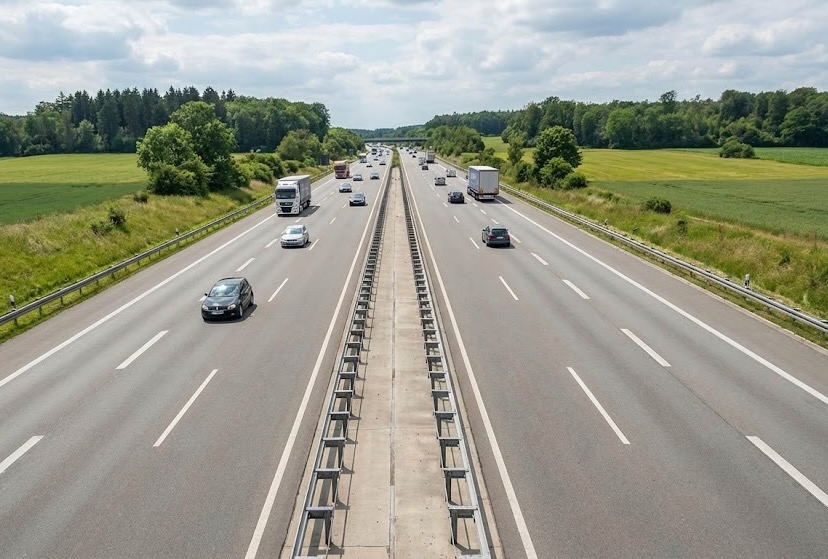
Alongside concerns about youth access, road safety has remained one of the primary arguments used by legalization opponents to reverse cannabis reform. A study published in January 2026 once again examined the effects of cannabis on traffic safety.
📑 Inhaltsverzeichnis
The results are surprising: even though cannabis was decriminalized in Germany, there was actually a decline in driving under direct influence. A comparison with neighboring Austria clearly shows that repressive drug policy does not improve traffic safety. Germany’s decriminalization thus did not send a „wrong signal,“ contrary to all predictions. In parallel, another study confirms that current THC limit values are scientifically questionable, as they can be exceeded even in complete sobriety.
Sample Data from Germany and Austria
Study participants were surveyed online about their cannabis use and participation in road traffic within the first two hours after consumption. Before decriminalization, 6,670 people in Germany and 2,132 people in Austria were surveyed. After the reform, the sample consisted of 9,692 Germans and 2,102 Austrians.


The results show interesting dynamics: In Germany, the number of people who had consumed cannabis at least once in the past 30 days increased from 12.1% to 14.4%—a moderate increase that is not necessarily attributable to decriminalization. During the same observation period, consumption in Austria rose in nearly identical fashion despite strict prohibition.
Fewer Driving Incidents Under Cannabis Influence Despite Liberalization
Contrary to numerous concerns, there was actually a slight decline in driving under direct cannabis influence. Participants were asked how often they had driven a vehicle within the first two hours after consumption in the past 12 months. Before decriminalization in Germany, 28.5% of consumers reported having driven during this critical window, compared to just 26.8% afterward. During the same period in Austria, there was a slight increase from 12.8% to 16.3%.
While this increase in Austria is not statistically significant enough to classify it as a direct consequence of German policy, it does demonstrate one crucial point: there is no correlation between legislation and consumer driving behavior. Germany did not experience the feared traffic chaos, nor did Austria’s repressive policy increase road safety.
The study also distinguished between pure cannabis use and polysubstance use. Approximately 21.5% of respondents consumed other substances alongside cannabis, with alcohol being most common. This proportion was roughly equal in both countries and primarily affected regular consumers, where residual blood THC levels coincided with weekend alcohol consumption.
THC Limits Exceeded Despite No Impairment
With decriminalization, Germany settled on a conservative threshold of 3.5 ng/ml in blood serum, equivalent to approximately 1.75 ng/ml in whole blood. That individuals who are completely sober can still exceed this low threshold days later was demonstrated by another US study published in 2026. The study involved 190 cannabis consumers who were instructed to abstain from any use for 48 hours.
The results are alarming for legal practice: 43% of participants still had detectable THC in their blood after two days of abstinence. 24% of subjects showed values over 2 ng/ml in whole blood even after 48 hours. In 5.3% of participants, values exceeding 5 ng/ml were measured.
The study’s authors emphasized that a static THC threshold alone can only serve as a limited indicator of actual impairment. Long-term research is essential to develop methods that can objectively and fairly determine real impairment.






Sollten die THC-Grenzwerte im Straßenverkehr angehoben werden?
Branchen-Update
News, Analysen und Reportagen — mehrmals im Monat direkt in dein Postfach.
Folge uns