Hardly any topic in the CBD trade is promoted as aggressively yet backed by such thin evidence as sexuality. We examined what the research actually shows, why studies appear to contradict each other, and where research becomes marketing.
📑 Inhaltsverzeichnis
- What the endocannabinoid system has to do with arousal
- The research on cannabis: more comprehensive than assumed, less uniform than claimed
- Comparison with alcohol
- Why studies seem to contradict each other: dose reverses direction
- CBD is not THC, and the data for CBD is significantly thinner
- CBD lubricants: what’s in them and what to know
- Two points missing from product advertising
- What to take from this
- 💬 Fragen? Frag den Hanf-Buddy!
Search for CBD and sex, and you’ll almost always land on product pages. Lubricating gels with cannabidiol, massage oils, capsules, accompanied by promises of heightened sensation, reduced tension, more intense orgasms. Studies are readily cited, usually without context. The actual research landscape is more interesting than the advertising, only it says something different.
What the endocannabinoid system has to do with arousal
The starting point isn’t a marketing invention. The endocannabinoid system is involved in regulating mood, stress processing, and blood flow—all of which play a role in sexual arousal. CB1 receptors are found in brain areas responsible for motivation and reward, as well as in the peripheral nervous system.


A frequently cited 2012 study by Klein and colleagues in the Journal of Sexual Medicine examined how concentrations of the body’s own endocannabinoids change in women over the course of sexual arousal (DOI: 10.1111/j.1743-6109.2012.02708.x). The measured values changed measurably. This demonstrates system involvement, but it doesn’t prove that external supply produces the same effect. This is precisely where product descriptions most often make the leap.
The research on cannabis: more comprehensive than assumed, less uniform than claimed

There is significantly more data on cannabis overall—primarily THC—than on CBD alone. The largest analysis comes from Sun and Eisenberg, who analyzed 2017 data from the National Survey of Family Growth, a representative U.S. survey (DOI: 10.1016/j.jsxm.2017.09.005). Result: Consumers reported a higher average frequency of sexual intercourse than non-consumers.
This sounds clear-cut, but it isn’t. It’s a cross-sectional survey. It shows a correlation, not causation. People who have sex more frequently could just as easily use cannabis more often, and both could stem from common factors like age, relationship status, or general risk-taking behavior. The authors themselves phrase their conclusions cautiously.
Two additional studies are frequently cited as evidence. In 2019, Lynn and colleagues surveyed 373 women at a gynecological practice, of whom 127 reported using cannabis before sexual activity (DOI: 10.1016/j.esxm.2019.01.003). Kasman and colleagues conducted a 2020 study using the Female Sexual Function Index with customers at a cannabis retail location (DOI: 10.1016/j.esxm.2020.06.009). 452 women participated in this survey. Those who consumed more frequently achieved higher average scores on the index—29.0 compared to 26.7 at the lowest consumption frequency.
Both studies rely on self-reporting, and the second has a pre-selected sample: those shopping at a cannabis store have typically already had positive experiences. This doesn’t invalidate the research, but it limits what it can show. The studies describe how consumers report their experiences. They don’t measure effects.
The picture is less uniform in men. Shiff and colleagues analyzed 2021 data from 7,809 men at an andrology clinic over ten years (DOI: 10.5489/cuaj.7185). Even the 2011 review article by Shamloul and Bella in the Journal of Sexual Medicine concluded that available results are contradictory and study quality is limited (DOI: 10.1111/j.1743-6109.2010.02198.x). Less has changed in this assessment than the volume of publications might suggest.
Comparison with alcohol
More revealing than comparing consumers with non-consumers is comparing two substances in the same people. A Spanish study in Revista Internacional de Andrología did exactly that in 2024, surveying 483 people familiar with both alcohol and cannabis (DOI: 10.22514/j.androl.2024.014). The two substances affected sexual experience differently—not just in degree, but in different areas.
The practical takeaway: if you mix both, you can’t assume the effects add up. Alcohol reliably impairs sexual function beyond a certain amount, and a second substance doesn’t change that.
Why studies seem to contradict each other: dose reverses direction
The most important point for understanding this field is almost never explained, even though it resolves most contradictions.
Cannabinoids often work in a biphasic manner. This means: low and high doses don’t produce more or less of the same effect, but opposite effects. A 2024 review by Shustorovich and colleagues in Pain Medicine examined the literature on pain, anxiety, and sleep disorders for this pattern and describes precisely this U-shaped dose-response curve (DOI: 10.1093/pm/pnae004). This is particularly well-documented for anxiety: small amounts of THC have a relaxing effect for many people, while larger amounts can increase tension and restlessness.
Transferring this to sexuality, the apparent contradiction suddenly makes sense. If tension is a central obstacle, a low dose can alter the experience. If the same substance in a higher dose triggers heart palpitations, rumination, or dissociation from one’s body, the opposite occurs. Studies comparing consumers to non-consumers without capturing the dose average these two groups into a result that applies to no one.
This also explains why anecdotal reports vary so widely and why older articles on this topic, including in our own archives, reach different conclusions. The substance isn’t contradictory; the question asked is.
CBD is not THC, and the data for CBD is significantly thinner
Here lies the largest gap between research and product promises. Almost all studies mentioned above concern cannabis with THC. Studies isolating CBD in a sexual context barely exist. Anyone marketing a CBD product by referencing these studies is transferring results to a different active compound.
What exists for CBD is evidence elsewhere. The influential 2015 review by Blessing and colleagues in Neurotherapeutics summarized the research on CBD and anxiety disorders (DOI: 10.1007/s13311-015-0387-1). Preclinical findings are consistent; the number of controlled human studies was and remains limited.
This suggests the only plausible pathway through which CBD could play any role here, and it’s indirect: not through an effect on arousal or sensation, but through possible tension reduction. This is a hypothesis, not a proven effect, and it hasn’t been studied in a sexual context. Phrases like „increases desire“ or „intensifies orgasm“ are supported by nothing. In the EU, such claims are also prohibited on food and cosmetics.
CBD lubricants: what’s in them and what to know
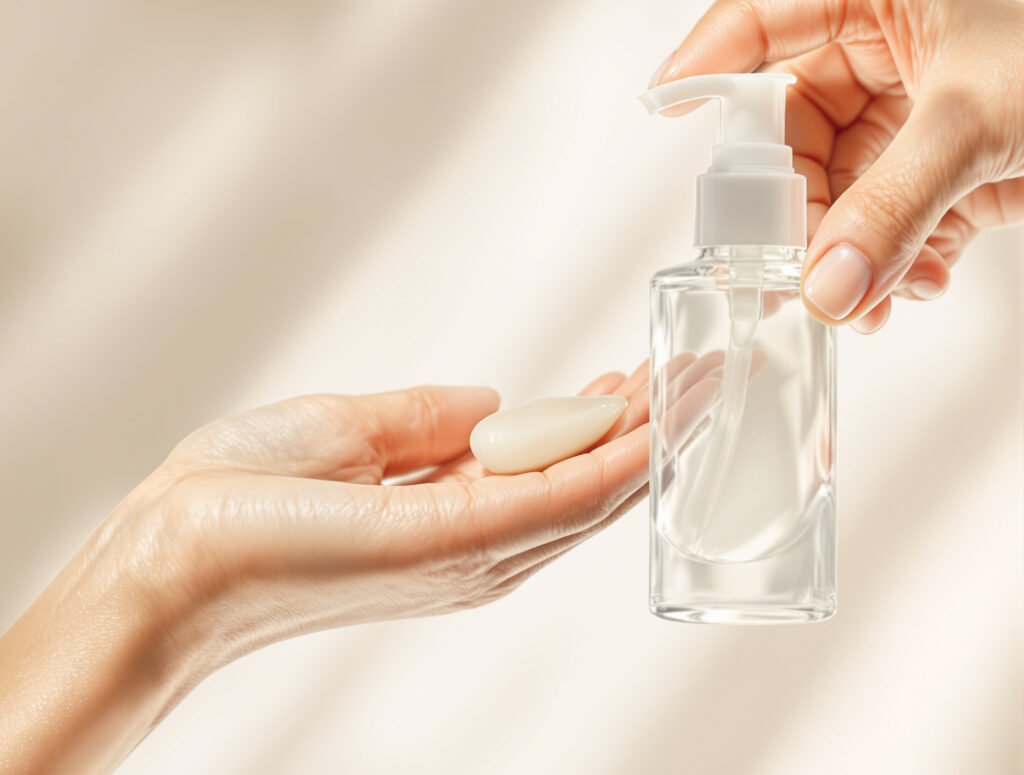
The fastest-growing product category is lubricating gels with cannabidiol, typically containing 100 to 300 milligrams per bottle. They’re marketed with promises of muscle relaxation and enhanced sensation.
Clinical studies demonstrating such effects from vaginal or topical application don’t exist. What has been studied concerns cannabinoid absorption through skin in general, where permeability is limited. Mucous membranes behave differently than outer skin, but reliable data on absorption and local effects in the genital area are lacking.
One practical point matters more than any discussion of effects and is almost never mentioned on product pages: Oil-based lubricants damage latex. Fats and oils reduce the tear resistance of natural latex, which is why condom manufacturers explicitly recommend water- or silicone-based products. The effect of additional lubricants on condom integrity is standardized testing. Many CBD gels are oil-based because cannabidiol is fat-soluble. If you use condoms for contraception, check the product’s base, and when in doubt, choose a water-based gel.
Additionally, mucous membranes react more sensitively than arm skin. Fragrances and preservatives that pass unnoticed in body oils can irritate here. Reviewing the full ingredient list matters more than checking the CBD amount.
Two points missing from product advertising
Substance use and contraception. Surveys on sexual behavior regularly show that substance use before sex correlates with riskier behavior—fewer condoms used. This isn’t an effect of the active ingredient on the body, but a consequence of altered decision-making in the moment. Knowing this allows you to plan for it.
Drug interactions. CBD is broken down in the liver by the same enzyme systems as many medications and can inhibit their breakdown. This is documented especially for higher doses with internal use. If you regularly take medications, you should clarify their use medically rather than relying on the widespread claim that CBD is side-effect-free. That statement, in this form, doesn’t hold up.
What to take from this
The connection between the endocannabinoid system and sexual response is real and scientifically described. What follows for a purchased product remains open.
- Existing studies predominantly concern cannabis with THC, not isolated CBD.
- Many rely largely on self-reporting and show correlations, not causation.
- Dose can reverse the direction of effects, explaining many apparent contradictions.
- For CBD in a sexual context, reliable evidence is entirely lacking; the discussed pathway through tension reduction is a hypothesis.
- For lubricants, the product base matters more than CBD content; oil-based and latex don’t mix.
If you have sexual problems that cause distress, medical evaluation is better advice than a gel. Behind low desire, pain, or erectile dysfunction often lie treatable causes, from hormonal changes to medication side effects to cardiovascular disease. We’ve compiled how cannabis affects male fertility in our dedicated article on cannabis use and male fertility. For hormone-related complaints during menopause, see our overview of cannabidiol in menopause. A more detailed examination of the relationship between cannabis and sexuality can be found in our earlier article Marijuana and Sex.
Hast du CBD schon mal gezielt für Sex verwendet?
Note: This article reflects the current state of research and does not constitute medical advice. It contains no health or efficacy claims for individual products and no consumption recommendation. For persistent sexual dysfunction, medical evaluation is recommended. Cannabis products are for adults only.

Branchen-Update
News, Analysen und Reportagen — mehrmals im Monat direkt in dein Postfach.
Folge uns