Question 8, 24-Month Outlook
Where do you see German cannabis cultivation in 24 months, and which method will prevail?
Lorenz: Looking at many clubs and increasingly more home growers, German grow enthusiasts seem to be increasingly enjoying the medium of rockwool or also coco. It’s somewhat in our genes to want to control everything perfectly. And hydroponic cultivation with crop steering plays perfectly into our hands.
Note: The interview was conducted in writing. Answers were lightly edited for readability and spelling without being changed in content. Lorenz Minks speaks on Saturday, June 13, 2026, at 12:30 p.m. on the Masterclass Stage of the Mary Jane Berlin comparing cultivation methods. Further information: research-gardens.com.


Question 6, Practical Insight for MJB
What surprising practical insight will you share at Mary Jane that isn’t in any textbook?
Lorenz: I won’t share practical insights that haven’t already been documented elsewhere. I’m not reinventing the wheel. I mainly want to take away the fear of different cultivation methods and prepare the numerous circulating practical tips in compact form. I’ve already shared many tips in this interview. For everything else and more in-depth material that doesn’t fit in this article, I cordially invite everyone to my lecture on Saturday, June 13, at 12:30 p.m. at Mary Jane. There will also be a surprise living soil expert.
Question 7, Equipment vs. Marketing
Which equipment investment really pays off for DE growers in 2026, and which is marketing?
Lorenz: For CSCs and commercial cultivation: an integrated crop steering system like CarbonActive or GrowLink provides the most added value in day-to-day operations, allowing you to adjust irrigation based on soil moisture.
For home growers, investing in an inexpensive smart home irrigation system is worthwhile, which you adjust manually from week to week to match the plants‘ water consumption. Costs under 50 euros.
What you definitely don’t need in Central European climate is air conditioning. At CarbonActive, we’ve optimized the open ventilation system for commercial cultivation areas to the point where you can maintain optimal VPD values year-round. With this system, even beginners achieve proven 2 g/watt on rockwool, at atmospheric CO2 levels, without air conditioning.
„Hype“ in my book includes under-canopy lights. Whether you provide more wattage above or below plants makes no difference according to increasingly practical experience with appropriate crop management (defoliation, bending down). I also no longer believe in special spectrum in the fixture, even though I was a longtime advocate of special spectra and even named one of my companies „380 nanometer.“ (Laughs.)
Question 8, 24-Month Outlook
Where do you see German cannabis cultivation in 24 months, and which method will prevail?
Lorenz: Looking at many clubs and increasingly more home growers, German grow enthusiasts seem to be increasingly enjoying the medium of rockwool or also coco. It’s somewhat in our genes to want to control everything perfectly. And hydroponic cultivation with crop steering plays perfectly into our hands.
Note: The interview was conducted in writing. Answers were lightly edited for readability and spelling without being changed in content. Lorenz Minks speaks on Saturday, June 13, 2026, at 12:30 p.m. on the Masterclass Stage of the Mary Jane Berlin comparing cultivation methods. Further information: research-gardens.com.
Question 5, CSC Scaling
CSC cultivation becomes a scaling question in 2026. Which method scales technically and economically most cleanly to 200 to 500 members?
Lorenz: Definitely rockwool. Especially with the user-friendly Athena fertilizer, you can run one fertilization recipe for all genetics without noticing any losses. Years ago I had to find the right recipe for each strain – today it’s much more user-friendly.
While living soil always has surprises in store just when you least expect them, cultivation on rockwool is reproducible. If you always follow the same cleaning protocols and operate soil moisture-controlled crop steering with a system like CarbonActive, rockwool behaves very predictably. Living soil, on the other hand, can completely collapse after a few weeks to months. You then have to dispose of tons of soil. Pre-conditioned living soil in large quantities isn’t quickly redelivered or cultivated according to your own requirements, and certainly not simply distributed to the beds.
The ongoing costs of mineral cultivation are much more predictable through higher operational safety than in organic cultivation. Fertilizer costs at about 5 percent of total production costs (with hand trimming) are not a significant cost driver and shouldn’t serve as the basis for deciding between living soil vs. rockwool. Other hydroponic systems produce no substrate costs at all, but with rockwool still come in at only 3 to 5 percent of total production costs. Living soil is equally expensive but pays off more if you use the substrate for longer than one year in a row.
„German engineering has finally found a new playground with rockwool and crop steering.“
Lorenz Minks · Research-Gardens
Question 6, Practical Insight for MJB
What surprising practical insight will you share at Mary Jane that isn’t in any textbook?
Lorenz: I won’t share practical insights that haven’t already been documented elsewhere. I’m not reinventing the wheel. I mainly want to take away the fear of different cultivation methods and prepare the numerous circulating practical tips in compact form. I’ve already shared many tips in this interview. For everything else and more in-depth material that doesn’t fit in this article, I cordially invite everyone to my lecture on Saturday, June 13, at 12:30 p.m. at Mary Jane. There will also be a surprise living soil expert.
Question 7, Equipment vs. Marketing
Which equipment investment really pays off for DE growers in 2026, and which is marketing?
Lorenz: For CSCs and commercial cultivation: an integrated crop steering system like CarbonActive or GrowLink provides the most added value in day-to-day operations, allowing you to adjust irrigation based on soil moisture.
For home growers, investing in an inexpensive smart home irrigation system is worthwhile, which you adjust manually from week to week to match the plants‘ water consumption. Costs under 50 euros.
What you definitely don’t need in Central European climate is air conditioning. At CarbonActive, we’ve optimized the open ventilation system for commercial cultivation areas to the point where you can maintain optimal VPD values year-round. With this system, even beginners achieve proven 2 g/watt on rockwool, at atmospheric CO2 levels, without air conditioning.
„Hype“ in my book includes under-canopy lights. Whether you provide more wattage above or below plants makes no difference according to increasingly practical experience with appropriate crop management (defoliation, bending down). I also no longer believe in special spectrum in the fixture, even though I was a longtime advocate of special spectra and even named one of my companies „380 nanometer.“ (Laughs.)
Question 8, 24-Month Outlook
Where do you see German cannabis cultivation in 24 months, and which method will prevail?
Lorenz: Looking at many clubs and increasingly more home growers, German grow enthusiasts seem to be increasingly enjoying the medium of rockwool or also coco. It’s somewhat in our genes to want to control everything perfectly. And hydroponic cultivation with crop steering plays perfectly into our hands.
Note: The interview was conducted in writing. Answers were lightly edited for readability and spelling without being changed in content. Lorenz Minks speaks on Saturday, June 13, 2026, at 12:30 p.m. on the Masterclass Stage of the Mary Jane Berlin comparing cultivation methods. Further information: research-gardens.com.
Question 4, Rockwool in Practice
What are the three most common mistakes when starting with rockwool, and how can you avoid them uncomplicated?
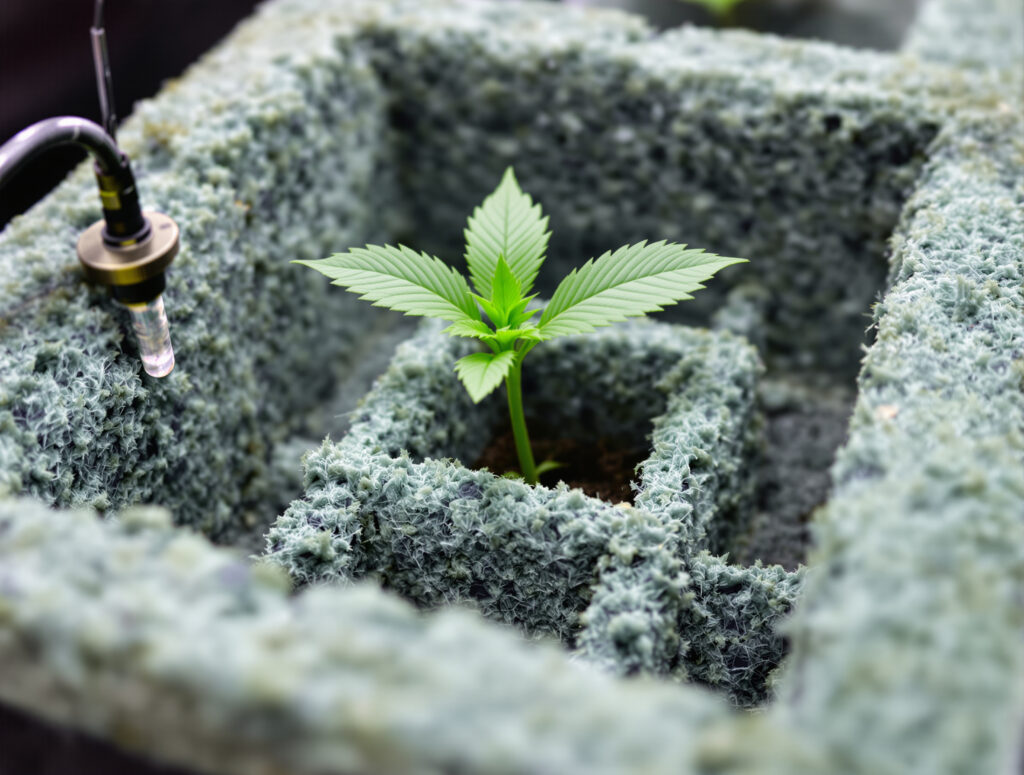
Lorenz: Don’t overthink it. Mix Athena fertilizer according to the formula to an EC value of 3.0 mS/cm, soak the rockwool block or slab 24 hours before plant placement. Wait 10 to 14 days before the first watering, until the medium has dried back to the point where the surface is just slightly moist but not wet.
After that, water every morning with enough to get some drain coming out the bottom. Don’t pour too much nutrient solution at once, but rather gradually in small amounts with intervals of about 15 minutes until water eventually flows out of the medium. You can automate this with automatic smart home pumps for less than 50 euros. In the first two weeks of flowering, you can skip the drain if you don’t yet see many visible roots in the medium (bottom or sides). At this stage, a slightly drier medium is advantageous because roots grow faster in dry environments as they search for water. From flowering week three, I then recommend generating drain again every morning.
For precise crop steering, you can use soil moisture sensors (warning: many are unfortunately inaccurate) or weigh the medium with the plant from time to time after drain comes out the bottom. This way you know how much water the medium can maximally absorb. From this baseline, you can subtract about 15 to 20 percent weight to calculate the minimum water content of the medium that you shouldn’t go below. To not fall below this value, especially with pronounced root development, you can provide a few corrective waterings throughout the day to keep the medium sufficiently moist.
Many fear high salt content in the medium, drying out, or overwatering: rockwool is very forgiving in this regard. I’ve often seen EC values up to 25 mS/cm, and the plants still looked great. Especially with pronounced root development, plants pull water out of the block very quickly, and the porous structure of rockwool almost always provides enough oxygen to prevent overwatering symptoms. Drying out is also unlikely because rockwool can still deliver water to the plant even with very low water content.
Pro tip: Regularly check the pH value in the medium with a plastic syringe. If the EC value in the block gets too high, plants show this very quickly with yellow leaf tips. In that case, flushing the medium helps, i.e., generating drain to relieve the plants from salt stress. That doesn’t take long either.
Question 5, CSC Scaling
CSC cultivation becomes a scaling question in 2026. Which method scales technically and economically most cleanly to 200 to 500 members?
Lorenz: Definitely rockwool. Especially with the user-friendly Athena fertilizer, you can run one fertilization recipe for all genetics without noticing any losses. Years ago I had to find the right recipe for each strain – today it’s much more user-friendly.
While living soil always has surprises in store just when you least expect them, cultivation on rockwool is reproducible. If you always follow the same cleaning protocols and operate soil moisture-controlled crop steering with a system like CarbonActive, rockwool behaves very predictably. Living soil, on the other hand, can completely collapse after a few weeks to months. You then have to dispose of tons of soil. Pre-conditioned living soil in large quantities isn’t quickly redelivered or cultivated according to your own requirements, and certainly not simply distributed to the beds.
The ongoing costs of mineral cultivation are much more predictable through higher operational safety than in organic cultivation. Fertilizer costs at about 5 percent of total production costs (with hand trimming) are not a significant cost driver and shouldn’t serve as the basis for deciding between living soil vs. rockwool. Other hydroponic systems produce no substrate costs at all, but with rockwool still come in at only 3 to 5 percent of total production costs. Living soil is equally expensive but pays off more if you use the substrate for longer than one year in a row.
„German engineering has finally found a new playground with rockwool and crop steering.“
Lorenz Minks · Research-Gardens
Question 6, Practical Insight for MJB
What surprising practical insight will you share at Mary Jane that isn’t in any textbook?
Lorenz: I won’t share practical insights that haven’t already been documented elsewhere. I’m not reinventing the wheel. I mainly want to take away the fear of different cultivation methods and prepare the numerous circulating practical tips in compact form. I’ve already shared many tips in this interview. For everything else and more in-depth material that doesn’t fit in this article, I cordially invite everyone to my lecture on Saturday, June 13, at 12:30 p.m. at Mary Jane. There will also be a surprise living soil expert.
Question 7, Equipment vs. Marketing
Which equipment investment really pays off for DE growers in 2026, and which is marketing?
Lorenz: For CSCs and commercial cultivation: an integrated crop steering system like CarbonActive or GrowLink provides the most added value in day-to-day operations, allowing you to adjust irrigation based on soil moisture.
For home growers, investing in an inexpensive smart home irrigation system is worthwhile, which you adjust manually from week to week to match the plants‘ water consumption. Costs under 50 euros.
What you definitely don’t need in Central European climate is air conditioning. At CarbonActive, we’ve optimized the open ventilation system for commercial cultivation areas to the point where you can maintain optimal VPD values year-round. With this system, even beginners achieve proven 2 g/watt on rockwool, at atmospheric CO2 levels, without air conditioning.
„Hype“ in my book includes under-canopy lights. Whether you provide more wattage above or below plants makes no difference according to increasingly practical experience with appropriate crop management (defoliation, bending down). I also no longer believe in special spectrum in the fixture, even though I was a longtime advocate of special spectra and even named one of my companies „380 nanometer.“ (Laughs.)
Question 8, 24-Month Outlook
Where do you see German cannabis cultivation in 24 months, and which method will prevail?
Lorenz: Looking at many clubs and increasingly more home growers, German grow enthusiasts seem to be increasingly enjoying the medium of rockwool or also coco. It’s somewhat in our genes to want to control everything perfectly. And hydroponic cultivation with crop steering plays perfectly into our hands.
Note: The interview was conducted in writing. Answers were lightly edited for readability and spelling without being changed in content. Lorenz Minks speaks on Saturday, June 13, 2026, at 12:30 p.m. on the Masterclass Stage of the Mary Jane Berlin comparing cultivation methods. Further information: research-gardens.com.
Question 3, Hydroponics in DE
Hydroponics has a hard time in DE even though yields are often higher. What’s that about from your experience – tech aversion, water mentality, time factor?
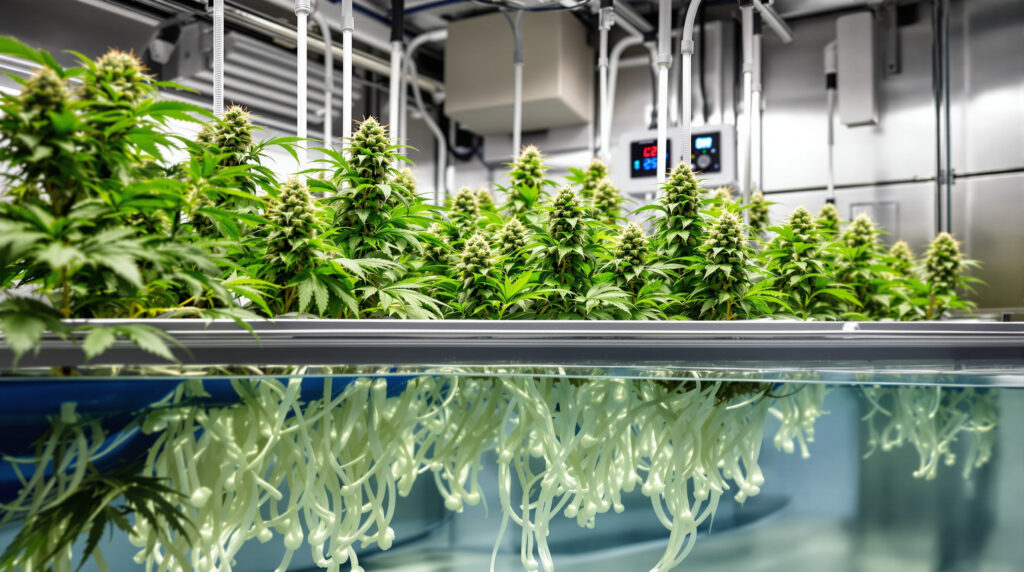
Lorenz: You’ve mentioned the most important points. The technical hurdles seem enormous at first glance when you think about hydroponics. The fear of water damage is great, especially with continuously water-bearing systems like aeroponics, deep water culture, or nutrient film systems. Yet it’s often overlooked that rockwool cultivation is a hydroponic system that places similar irrigation requirements on you as cultivation on soil-like substrate. I’ve also often hand-watered smaller balcony or indoor grows on rockwool. It doesn’t always take high-end crop steering for top results.
The time factor in the initial setup of a rockwool cultivation is exactly the same as the risk of water damage compared to soil cultivation. With rockwool slabs, you don’t need to water for the first 10 days anyway, so after starting cultivation you have at least these 10 days to set up an inexpensive pump with smart home integration for under 50 euros. Young plants need these 10 to 14 days to develop roots and consume the stored water in the rockwool slab to the point where water needs to be added.
I see more and more home growers on social media cultivating on rockwool. I definitely have the feeling that German engineering has finally found a new playground with rockwool and crop steering. There are numerous tinkerers in Germany and Switzerland who are currently developing their own crop steering systems for home growers.
Question 4, Rockwool in Practice
What are the three most common mistakes when starting with rockwool, and how can you avoid them uncomplicated?
Lorenz: Don’t overthink it. Mix Athena fertilizer according to the formula to an EC value of 3.0 mS/cm, soak the rockwool block or slab 24 hours before plant placement. Wait 10 to 14 days before the first watering, until the medium has dried back to the point where the surface is just slightly moist but not wet.
After that, water every morning with enough to get some drain coming out the bottom. Don’t pour too much nutrient solution at once, but rather gradually in small amounts with intervals of about 15 minutes until water eventually flows out of the medium. You can automate this with automatic smart home pumps for less than 50 euros. In the first two weeks of flowering, you can skip the drain if you don’t yet see many visible roots in the medium (bottom or sides). At this stage, a slightly drier medium is advantageous because roots grow faster in dry environments as they search for water. From flowering week three, I then recommend generating drain again every morning.
For precise crop steering, you can use soil moisture sensors (warning: many are unfortunately inaccurate) or weigh the medium with the plant from time to time after drain comes out the bottom. This way you know how much water the medium can maximally absorb. From this baseline, you can subtract about 15 to 20 percent weight to calculate the minimum water content of the medium that you shouldn’t go below. To not fall below this value, especially with pronounced root development, you can provide a few corrective waterings throughout the day to keep the medium sufficiently moist.
Many fear high salt content in the medium, drying out, or overwatering: rockwool is very forgiving in this regard. I’ve often seen EC values up to 25 mS/cm, and the plants still looked great. Especially with pronounced root development, plants pull water out of the block very quickly, and the porous structure of rockwool almost always provides enough oxygen to prevent overwatering symptoms. Drying out is also unlikely because rockwool can still deliver water to the plant even with very low water content.
Pro tip: Regularly check the pH value in the medium with a plastic syringe. If the EC value in the block gets too high, plants show this very quickly with yellow leaf tips. In that case, flushing the medium helps, i.e., generating drain to relieve the plants from salt stress. That doesn’t take long either.
Question 5, CSC Scaling
CSC cultivation becomes a scaling question in 2026. Which method scales technically and economically most cleanly to 200 to 500 members?
Lorenz: Definitely rockwool. Especially with the user-friendly Athena fertilizer, you can run one fertilization recipe for all genetics without noticing any losses. Years ago I had to find the right recipe for each strain – today it’s much more user-friendly.
While living soil always has surprises in store just when you least expect them, cultivation on rockwool is reproducible. If you always follow the same cleaning protocols and operate soil moisture-controlled crop steering with a system like CarbonActive, rockwool behaves very predictably. Living soil, on the other hand, can completely collapse after a few weeks to months. You then have to dispose of tons of soil. Pre-conditioned living soil in large quantities isn’t quickly redelivered or cultivated according to your own requirements, and certainly not simply distributed to the beds.
The ongoing costs of mineral cultivation are much more predictable through higher operational safety than in organic cultivation. Fertilizer costs at about 5 percent of total production costs (with hand trimming) are not a significant cost driver and shouldn’t serve as the basis for deciding between living soil vs. rockwool. Other hydroponic systems produce no substrate costs at all, but with rockwool still come in at only 3 to 5 percent of total production costs. Living soil is equally expensive but pays off more if you use the substrate for longer than one year in a row.
„German engineering has finally found a new playground with rockwool and crop steering.“
Lorenz Minks · Research-Gardens
Question 6, Practical Insight for MJB
What surprising practical insight will you share at Mary Jane that isn’t in any textbook?
Lorenz: I won’t share practical insights that haven’t already been documented elsewhere. I’m not reinventing the wheel. I mainly want to take away the fear of different cultivation methods and prepare the numerous circulating practical tips in compact form. I’ve already shared many tips in this interview. For everything else and more in-depth material that doesn’t fit in this article, I cordially invite everyone to my lecture on Saturday, June 13, at 12:30 p.m. at Mary Jane. There will also be a surprise living soil expert.
Question 7, Equipment vs. Marketing
Which equipment investment really pays off for DE growers in 2026, and which is marketing?
Lorenz: For CSCs and commercial cultivation: an integrated crop steering system like CarbonActive or GrowLink provides the most added value in day-to-day operations, allowing you to adjust irrigation based on soil moisture.
For home growers, investing in an inexpensive smart home irrigation system is worthwhile, which you adjust manually from week to week to match the plants‘ water consumption. Costs under 50 euros.
What you definitely don’t need in Central European climate is air conditioning. At CarbonActive, we’ve optimized the open ventilation system for commercial cultivation areas to the point where you can maintain optimal VPD values year-round. With this system, even beginners achieve proven 2 g/watt on rockwool, at atmospheric CO2 levels, without air conditioning.
„Hype“ in my book includes under-canopy lights. Whether you provide more wattage above or below plants makes no difference according to increasingly practical experience with appropriate crop management (defoliation, bending down). I also no longer believe in special spectrum in the fixture, even though I was a longtime advocate of special spectra and even named one of my companies „380 nanometer.“ (Laughs.)
Question 8, 24-Month Outlook
Where do you see German cannabis cultivation in 24 months, and which method will prevail?
Lorenz: Looking at many clubs and increasingly more home growers, German grow enthusiasts seem to be increasingly enjoying the medium of rockwool or also coco. It’s somewhat in our genes to want to control everything perfectly. And hydroponic cultivation with crop steering plays perfectly into our hands.
Note: The interview was conducted in writing. Answers were lightly edited for readability and spelling without being changed in content. Lorenz Minks speaks on Saturday, June 13, 2026, at 12:30 p.m. on the Masterclass Stage of the Mary Jane Berlin comparing cultivation methods. Further information: research-gardens.com.
Question 2, Living Soil Demystified
Living soil is ideologically charged. What are the real, measurable benefits vs. mythology?
Lorenz: In my view, there are no real measurable benefits. Plants feed on the same 17 essential „mineral“ chemical elements in both mineral and biological fertilization. In living soil cultivation, these are converted in the soil from complex, non-plant-available molecules into plant-available molecules.
Subjectively, living soil consumers often anecdotally perceive a more complex, multifaceted aroma. A rather „round“ flavor, if you use the head note, heart note, and base note known from perfumery for sensory determination. In my perception, living soil cannabis has a distinctly more pronounced base note and thus a subjectively rounder aroma profile. This resonates positively with many cannabis enthusiasts. The downside of this round taste: from my experience traveling to many cannabis hotspots around the world, the aromas of different strains grown on living soil differ considerably less from each other than strains grown with mineral nutrients with more dominant heart and head notes.
I personally have sourced the same Wedding Cake from Swiss Extract for over two years, grown on living soil in a plastic greenhouse without technical bells and whistles. From a consumer perspective, the product works perfectly for me, even though the flavor is very interchangeable and definitely nothing special. However, Swiss Extract dries and stores the cannabis so well that it vaporizes very smoothly. Because often head or heart notes come through terpenes that vaporize or burn much more flammably and thus scratch the airways more. These scent notes, on the other hand, are indispensable for developing the distinctive aromas that strains are known for.
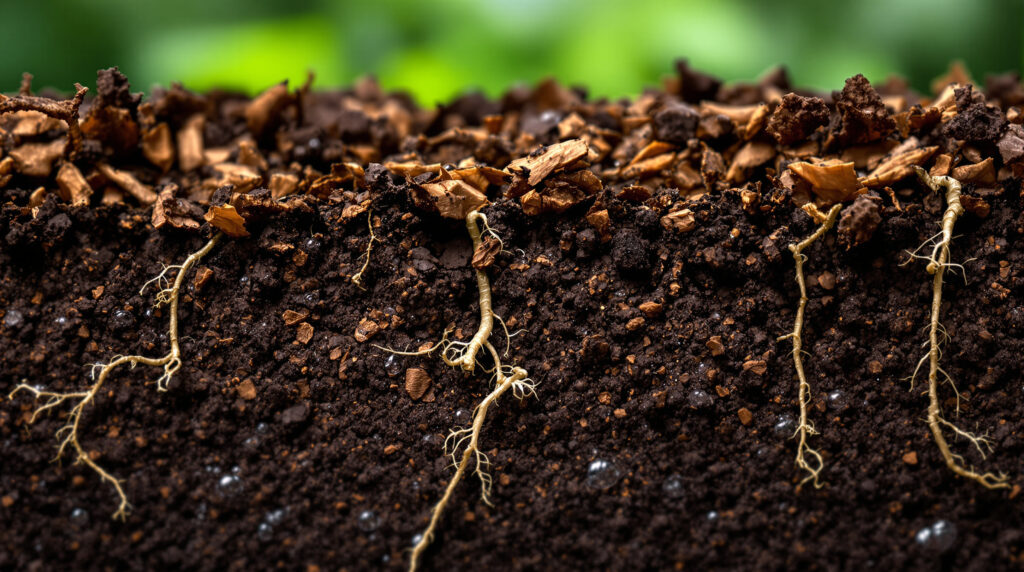
„In my view, there are no real measurable benefits. Plants feed on the same 17 essential chemical elements regardless of whether they’re fertilized with minerals or organics.“
Lorenz Minks · Research-Gardens
Question 3, Hydroponics in DE
Hydroponics has a hard time in DE even though yields are often higher. What’s that about from your experience – tech aversion, water mentality, time factor?
Lorenz: You’ve mentioned the most important points. The technical hurdles seem enormous at first glance when you think about hydroponics. The fear of water damage is great, especially with continuously water-bearing systems like aeroponics, deep water culture, or nutrient film systems. Yet it’s often overlooked that rockwool cultivation is a hydroponic system that places similar irrigation requirements on you as cultivation on soil-like substrate. I’ve also often hand-watered smaller balcony or indoor grows on rockwool. It doesn’t always take high-end crop steering for top results.
The time factor in the initial setup of a rockwool cultivation is exactly the same as the risk of water damage compared to soil cultivation. With rockwool slabs, you don’t need to water for the first 10 days anyway, so after starting cultivation you have at least these 10 days to set up an inexpensive pump with smart home integration for under 50 euros. Young plants need these 10 to 14 days to develop roots and consume the stored water in the rockwool slab to the point where water needs to be added.
I see more and more home growers on social media cultivating on rockwool. I definitely have the feeling that German engineering has finally found a new playground with rockwool and crop steering. There are numerous tinkerers in Germany and Switzerland who are currently developing their own crop steering systems for home growers.
Question 4, Rockwool in Practice
What are the three most common mistakes when starting with rockwool, and how can you avoid them uncomplicated?
Lorenz: Don’t overthink it. Mix Athena fertilizer according to the formula to an EC value of 3.0 mS/cm, soak the rockwool block or slab 24 hours before plant placement. Wait 10 to 14 days before the first watering, until the medium has dried back to the point where the surface is just slightly moist but not wet.
After that, water every morning with enough to get some drain coming out the bottom. Don’t pour too much nutrient solution at once, but rather gradually in small amounts with intervals of about 15 minutes until water eventually flows out of the medium. You can automate this with automatic smart home pumps for less than 50 euros. In the first two weeks of flowering, you can skip the drain if you don’t yet see many visible roots in the medium (bottom or sides). At this stage, a slightly drier medium is advantageous because roots grow faster in dry environments as they search for water. From flowering week three, I then recommend generating drain again every morning.
For precise crop steering, you can use soil moisture sensors (warning: many are unfortunately inaccurate) or weigh the medium with the plant from time to time after drain comes out the bottom. This way you know how much water the medium can maximally absorb. From this baseline, you can subtract about 15 to 20 percent weight to calculate the minimum water content of the medium that you shouldn’t go below. To not fall below this value, especially with pronounced root development, you can provide a few corrective waterings throughout the day to keep the medium sufficiently moist.
Many fear high salt content in the medium, drying out, or overwatering: rockwool is very forgiving in this regard. I’ve often seen EC values up to 25 mS/cm, and the plants still looked great. Especially with pronounced root development, plants pull water out of the block very quickly, and the porous structure of rockwool almost always provides enough oxygen to prevent overwatering symptoms. Drying out is also unlikely because rockwool can still deliver water to the plant even with very low water content.
Pro tip: Regularly check the pH value in the medium with a plastic syringe. If the EC value in the block gets too high, plants show this very quickly with yellow leaf tips. In that case, flushing the medium helps, i.e., generating drain to relieve the plants from salt stress. That doesn’t take long either.
Question 5, CSC Scaling
CSC cultivation becomes a scaling question in 2026. Which method scales technically and economically most cleanly to 200 to 500 members?
Lorenz: Definitely rockwool. Especially with the user-friendly Athena fertilizer, you can run one fertilization recipe for all genetics without noticing any losses. Years ago I had to find the right recipe for each strain – today it’s much more user-friendly.
While living soil always has surprises in store just when you least expect them, cultivation on rockwool is reproducible. If you always follow the same cleaning protocols and operate soil moisture-controlled crop steering with a system like CarbonActive, rockwool behaves very predictably. Living soil, on the other hand, can completely collapse after a few weeks to months. You then have to dispose of tons of soil. Pre-conditioned living soil in large quantities isn’t quickly redelivered or cultivated according to your own requirements, and certainly not simply distributed to the beds.
The ongoing costs of mineral cultivation are much more predictable through higher operational safety than in organic cultivation. Fertilizer costs at about 5 percent of total production costs (with hand trimming) are not a significant cost driver and shouldn’t serve as the basis for deciding between living soil vs. rockwool. Other hydroponic systems produce no substrate costs at all, but with rockwool still come in at only 3 to 5 percent of total production costs. Living soil is equally expensive but pays off more if you use the substrate for longer than one year in a row.
„German engineering has finally found a new playground with rockwool and crop steering.“
Lorenz Minks · Research-Gardens
Question 6, Practical Insight for MJB
What surprising practical insight will you share at Mary Jane that isn’t in any textbook?
Lorenz: I won’t share practical insights that haven’t already been documented elsewhere. I’m not reinventing the wheel. I mainly want to take away the fear of different cultivation methods and prepare the numerous circulating practical tips in compact form. I’ve already shared many tips in this interview. For everything else and more in-depth material that doesn’t fit in this article, I cordially invite everyone to my lecture on Saturday, June 13, at 12:30 p.m. at Mary Jane. There will also be a surprise living soil expert.
Question 7, Equipment vs. Marketing
Which equipment investment really pays off for DE growers in 2026, and which is marketing?
Lorenz: For CSCs and commercial cultivation: an integrated crop steering system like CarbonActive or GrowLink provides the most added value in day-to-day operations, allowing you to adjust irrigation based on soil moisture.
For home growers, investing in an inexpensive smart home irrigation system is worthwhile, which you adjust manually from week to week to match the plants‘ water consumption. Costs under 50 euros.
What you definitely don’t need in Central European climate is air conditioning. At CarbonActive, we’ve optimized the open ventilation system for commercial cultivation areas to the point where you can maintain optimal VPD values year-round. With this system, even beginners achieve proven 2 g/watt on rockwool, at atmospheric CO2 levels, without air conditioning.
„Hype“ in my book includes under-canopy lights. Whether you provide more wattage above or below plants makes no difference according to increasingly practical experience with appropriate crop management (defoliation, bending down). I also no longer believe in special spectrum in the fixture, even though I was a longtime advocate of special spectra and even named one of my companies „380 nanometer.“ (Laughs.)
Question 8, 24-Month Outlook
Where do you see German cannabis cultivation in 24 months, and which method will prevail?
Lorenz: Looking at many clubs and increasingly more home growers, German grow enthusiasts seem to be increasingly enjoying the medium of rockwool or also coco. It’s somewhat in our genes to want to control everything perfectly. And hydroponic cultivation with crop steering plays perfectly into our hands.
Note: The interview was conducted in writing. Answers were lightly edited for readability and spelling without being changed in content. Lorenz Minks speaks on Saturday, June 13, 2026, at 12:30 p.m. on the Masterclass Stage of the Mary Jane Berlin comparing cultivation methods. Further information: research-gardens.com.
Question 1, Getting Started 2026
In which setting should a German hobby grower start in 2026, and which recommendations from US forums are simply wrong for DE conditions?
Lorenz: First: I’m not currently operating living soil beds, but I did cultivate 1.5 hectares on an organic field in the Linth Valley in Switzerland. The Linth Valley has water from Alpine glaciers flowing through the Linth Canal. The water is very mineral-rich due to its alpine origin, and the canal serves as natural irrigation without artificial irrigation systems. The advantage of outdoor cultivation is not only energy efficiency and free irrigation, but also the presence of great biodiversity for pest control. Helper microbes, ladybugs, predatory mites, birds, and other beneficial insects help combat pests and pathogens. Indoor living soil cultivation doesn’t have these advantages because the small crevices of the rooms are just barely large enough for pest entry like thrips and spider mites, but too small for beneficial insects like ladybugs.
That’s also the biggest disadvantage of living soil in the indoor sphere: you’re already trying to „play God“ while controlling the cardinal parameters of temperature, humidity, light intensity, CO2 content, soil moisture, soil temperature, and the correct composition of 17 essential nutrients. Now also controlling the correct composition of microbes, fungi, the ratio of plant-available vs. non-plant-available organic nutrients, oxygen, and sugars in the soil multiplies the number of parameters to control and thus the error potential significantly.
I’m unfortunately not informed about current recommendations in US forums. But my clear recommendation has two paths: If you’re a „technician,“ go with rockwool, a crop steering irrigation system (for example, a smart home setup for under 50 euros from Amazon), mineral fertilizer like Athena, and go for it. The result: maximum yields, defined aroma profile, quick ability to respond to errors. If you’re a „pragmatist,“ buy soil, biological dry fertilizer, and go for it. The more biological life, the more „living soil.“ The result: lower yields, but complex aroma and lower error susceptibility with higher randomness.
Question 2, Living Soil Demystified
Living soil is ideologically charged. What are the real, measurable benefits vs. mythology?
Lorenz: In my view, there are no real measurable benefits. Plants feed on the same 17 essential „mineral“ chemical elements in both mineral and biological fertilization. In living soil cultivation, these are converted in the soil from complex, non-plant-available molecules into plant-available molecules.
Subjectively, living soil consumers often anecdotally perceive a more complex, multifaceted aroma. A rather „round“ flavor, if you use the head note, heart note, and base note known from perfumery for sensory determination. In my perception, living soil cannabis has a distinctly more pronounced base note and thus a subjectively rounder aroma profile. This resonates positively with many cannabis enthusiasts. The downside of this round taste: from my experience traveling to many cannabis hotspots around the world, the aromas of different strains grown on living soil differ considerably less from each other than strains grown with mineral nutrients with more dominant heart and head notes.
I personally have sourced the same Wedding Cake from Swiss Extract for over two years, grown on living soil in a plastic greenhouse without technical bells and whistles. From a consumer perspective, the product works perfectly for me, even though the flavor is very interchangeable and definitely nothing special. However, Swiss Extract dries and stores the cannabis so well that it vaporizes very smoothly. Because often head or heart notes come through terpenes that vaporize or burn much more flammably and thus scratch the airways more. These scent notes, on the other hand, are indispensable for developing the distinctive aromas that strains are known for.
„In my view, there are no real measurable benefits. Plants feed on the same 17 essential chemical elements regardless of whether they’re fertilized with minerals or organics.“
Lorenz Minks · Research-Gardens
Question 3, Hydroponics in DE
Hydroponics has a hard time in DE even though yields are often higher. What’s that about from your experience – tech aversion, water mentality, time factor?
Lorenz: You’ve mentioned the most important points. The technical hurdles seem enormous at first glance when you think about hydroponics. The fear of water damage is great, especially with continuously water-bearing systems like aeroponics, deep water culture, or nutrient film systems. Yet it’s often overlooked that rockwool cultivation is a hydroponic system that places similar irrigation requirements on you as cultivation on soil-like substrate. I’ve also often hand-watered smaller balcony or indoor grows on rockwool. It doesn’t always take high-end crop steering for top results.
The time factor in the initial setup of a rockwool cultivation is exactly the same as the risk of water damage compared to soil cultivation. With rockwool slabs, you don’t need to water for the first 10 days anyway, so after starting cultivation you have at least these 10 days to set up an inexpensive pump with smart home integration for under 50 euros. Young plants need these 10 to 14 days to develop roots and consume the stored water in the rockwool slab to the point where water needs to be added.
I see more and more home growers on social media cultivating on rockwool. I definitely have the feeling that German engineering has finally found a new playground with rockwool and crop steering. There are numerous tinkerers in Germany and Switzerland who are currently developing their own crop steering systems for home growers.
Question 4, Rockwool in Practice
What are the three most common mistakes when starting with rockwool, and how can you avoid them uncomplicated?
Lorenz: Don’t overthink it. Mix Athena fertilizer according to the formula to an EC value of 3.0 mS/cm, soak the rockwool block or slab 24 hours before plant placement. Wait 10 to 14 days before the first watering, until the medium has dried back to the point where the surface is just slightly moist but not wet.
After that, water every morning with enough to get some drain coming out the bottom. Don’t pour too much nutrient solution at once, but rather gradually in small amounts with intervals of about 15 minutes until water eventually flows out of the medium. You can automate this with automatic smart home pumps for less than 50 euros. In the first two weeks of flowering, you can skip the drain if you don’t yet see many visible roots in the medium (bottom or sides). At this stage, a slightly drier medium is advantageous because roots grow faster in dry environments as they search for water. From flowering week three, I then recommend generating drain again every morning.
For precise crop steering, you can use soil moisture sensors (warning: many are unfortunately inaccurate) or weigh the medium with the plant from time to time after drain comes out the bottom. This way you know how much water the medium can maximally absorb. From this baseline, you can subtract about 15 to 20 percent weight to calculate the minimum water content of the medium that you shouldn’t go below. To not fall below this value, especially with pronounced root development, you can provide a few corrective waterings throughout the day to keep the medium sufficiently moist.
Many fear high salt content in the medium, drying out, or overwatering: rockwool is very forgiving in this regard. I’ve often seen EC values up to 25 mS/cm, and the plants still looked great. Especially with pronounced root development, plants pull water out of the block very quickly, and the porous structure of rockwool almost always provides enough oxygen to prevent overwatering symptoms. Drying out is also unlikely because rockwool can still deliver water to the plant even with very low water content.
Pro tip: Regularly check the pH value in the medium with a plastic syringe. If the EC value in the block gets too high, plants show this very quickly with yellow leaf tips. In that case, flushing the medium helps, i.e., generating drain to relieve the plants from salt stress. That doesn’t take long either.
Question 5, CSC Scaling
CSC cultivation becomes a scaling question in 2026. Which method scales technically and economically most cleanly to 200 to 500 members?
Lorenz: Definitely rockwool. Especially with the user-friendly Athena fertilizer, you can run one fertilization recipe for all genetics without noticing any losses. Years ago I had to find the right recipe for each strain – today it’s much more user-friendly.
While living soil always has surprises in store just when you least expect them, cultivation on rockwool is reproducible. If you always follow the same cleaning protocols and operate soil moisture-controlled crop steering with a system like CarbonActive, rockwool behaves very predictably. Living soil, on the other hand, can completely collapse after a few weeks to months. You then have to dispose of tons of soil. Pre-conditioned living soil in large quantities isn’t quickly redelivered or cultivated according to your own requirements, and certainly not simply distributed to the beds.
The ongoing costs of mineral cultivation are much more predictable through higher operational safety than in organic cultivation. Fertilizer costs at about 5 percent of total production costs (with hand trimming) are not a significant cost driver and shouldn’t serve as the basis for deciding between living soil vs. rockwool. Other hydroponic systems produce no substrate costs at all, but with rockwool still come in at only 3 to 5 percent of total production costs. Living soil is equally expensive but pays off more if you use the substrate for longer than one year in a row.
„German engineering has finally found a new playground with rockwool and crop steering.“
Lorenz Minks · Research-Gardens
Question 6, Practical Insight for MJB
What surprising practical insight will you share at Mary Jane that isn’t in any textbook?
Lorenz: I won’t share practical insights that haven’t already been documented elsewhere. I’m not reinventing the wheel. I mainly want to take away the fear of different cultivation methods and prepare the numerous circulating practical tips in compact form. I’ve already shared many tips in this interview. For everything else and more in-depth material that doesn’t fit in this article, I cordially invite everyone to my lecture on Saturday, June 13, at 12:30 p.m. at Mary Jane. There will also be a surprise living soil expert.
Question 7, Equipment vs. Marketing
Which equipment investment really pays off for DE growers in 2026, and which is marketing?
Lorenz: For CSCs and commercial cultivation: an integrated crop steering system like CarbonActive or GrowLink provides the most added value in day-to-day operations, allowing you to adjust irrigation based on soil moisture.
For home growers, investing in an inexpensive smart home irrigation system is worthwhile, which you adjust manually from week to week to match the plants‘ water consumption. Costs under 50 euros.
What you definitely don’t need in Central European climate is air conditioning. At CarbonActive, we’ve optimized the open ventilation system for commercial cultivation areas to the point where you can maintain optimal VPD values year-round. With this system, even beginners achieve proven 2 g/watt on rockwool, at atmospheric CO2 levels, without air conditioning.
„Hype“ in my book includes under-canopy lights. Whether you provide more wattage above or below plants makes no difference according to increasingly practical experience with appropriate crop management (defoliation, bending down). I also no longer believe in special spectrum in the fixture, even though I was a longtime advocate of special spectra and even named one of my companies „380 nanometer.“ (Laughs.)
Question 8, 24-Month Outlook
Where do you see German cannabis cultivation in 24 months, and which method will prevail?
Lorenz: Looking at many clubs and increasingly more home growers, German grow enthusiasts seem to be increasingly enjoying the medium of rockwool or also coco. It’s somewhat in our genes to want to control everything perfectly. And hydroponic cultivation with crop steering plays perfectly into our hands.
Note: The interview was conducted in writing. Answers were lightly edited for readability and spelling without being changed in content. Lorenz Minks speaks on Saturday, June 13, 2026, at 12:30 p.m. on the Masterclass Stage of the Mary Jane Berlin comparing cultivation methods. Further information: research-gardens.com.
💬 In Conversation
Lorenz Minks, Research-Gardens
Lorenz Minks is founder of Research-Gardens, international cannabis consultant, and one of the very few with a horticulture degree and simultaneously hectare-scale outdoor practice (1.5 hectares of cannabis cultivation in Switzerland’s Linth Valley). At the Mary Jane Berlin, he speaks on Saturday, June 13, at 12:30 p.m. on the Masterclass Stage about cultivation methods. We asked him eight questions in advance that German hobby growers and Cannabis Social Clubs need as a decision-making foundation for 2026.
Question 1, Getting Started 2026
In which setting should a German hobby grower start in 2026, and which recommendations from US forums are simply wrong for DE conditions?
Lorenz: First: I’m not currently operating living soil beds, but I did cultivate 1.5 hectares on an organic field in the Linth Valley in Switzerland. The Linth Valley has water from Alpine glaciers flowing through the Linth Canal. The water is very mineral-rich due to its alpine origin, and the canal serves as natural irrigation without artificial irrigation systems. The advantage of outdoor cultivation is not only energy efficiency and free irrigation, but also the presence of great biodiversity for pest control. Helper microbes, ladybugs, predatory mites, birds, and other beneficial insects help combat pests and pathogens. Indoor living soil cultivation doesn’t have these advantages because the small crevices of the rooms are just barely large enough for pest entry like thrips and spider mites, but too small for beneficial insects like ladybugs.
That’s also the biggest disadvantage of living soil in the indoor sphere: you’re already trying to „play God“ while controlling the cardinal parameters of temperature, humidity, light intensity, CO2 content, soil moisture, soil temperature, and the correct composition of 17 essential nutrients. Now also controlling the correct composition of microbes, fungi, the ratio of plant-available vs. non-plant-available organic nutrients, oxygen, and sugars in the soil multiplies the number of parameters to control and thus the error potential significantly.
I’m unfortunately not informed about current recommendations in US forums. But my clear recommendation has two paths: If you’re a „technician,“ go with rockwool, a crop steering irrigation system (for example, a smart home setup for under 50 euros from Amazon), mineral fertilizer like Athena, and go for it. The result: maximum yields, defined aroma profile, quick ability to respond to errors. If you’re a „pragmatist,“ buy soil, biological dry fertilizer, and go for it. The more biological life, the more „living soil.“ The result: lower yields, but complex aroma and lower error susceptibility with higher randomness.
Question 2, Living Soil Demystified
Living soil is ideologically charged. What are the real, measurable benefits vs. mythology?
Lorenz: In my view, there are no real measurable benefits. Plants feed on the same 17 essential „mineral“ chemical elements in both mineral and biological fertilization. In living soil cultivation, these are converted in the soil from complex, non-plant-available molecules into plant-available molecules.
Subjectively, living soil consumers often anecdotally perceive a more complex, multifaceted aroma. A rather „round“ flavor, if you use the head note, heart note, and base note known from perfumery for sensory determination. In my perception, living soil cannabis has a distinctly more pronounced base note and thus a subjectively rounder aroma profile. This resonates positively with many cannabis enthusiasts. The downside of this round taste: from my experience traveling to many cannabis hotspots around the world, the aromas of different strains grown on living soil differ considerably less from each other than strains grown with mineral nutrients with more dominant heart and head notes.
I personally have sourced the same Wedding Cake from Swiss Extract for over two years, grown on living soil in a plastic greenhouse without technical bells and whistles. From a consumer perspective, the product works perfectly for me, even though the flavor is very interchangeable and definitely nothing special. However, Swiss Extract dries and stores the cannabis so well that it vaporizes very smoothly. Because often head or heart notes come through terpenes that vaporize or burn much more flammably and thus scratch the airways more. These scent notes, on the other hand, are indispensable for developing the distinctive aromas that strains are known for.
„In my view, there are no real measurable benefits. Plants feed on the same 17 essential chemical elements regardless of whether they’re fertilized with minerals or organics.“
Lorenz Minks · Research-Gardens
Question 3, Hydroponics in DE
Hydroponics has a hard time in DE even though yields are often higher. What’s that about from your experience – tech aversion, water mentality, time factor?
Lorenz: You’ve mentioned the most important points. The technical hurdles seem enormous at first glance when you think about hydroponics. The fear of water damage is great, especially with continuously water-bearing systems like aeroponics, deep water culture, or nutrient film systems. Yet it’s often overlooked that rockwool cultivation is a hydroponic system that places similar irrigation requirements on you as cultivation on soil-like substrate. I’ve also often hand-watered smaller balcony or indoor grows on rockwool. It doesn’t always take high-end crop steering for top results.
The time factor in the initial setup of a rockwool cultivation is exactly the same as the risk of water damage compared to soil cultivation. With rockwool slabs, you don’t need to water for the first 10 days anyway, so after starting cultivation you have at least these 10 days to set up an inexpensive pump with smart home integration for under 50 euros. Young plants need these 10 to 14 days to develop roots and consume the stored water in the rockwool slab to the point where water needs to be added.
I see more and more home growers on social media cultivating on rockwool. I definitely have the feeling that German engineering has finally found a new playground with rockwool and crop steering. There are numerous tinkerers in Germany and Switzerland who are currently developing their own crop steering systems for home growers.
Question 4, Rockwool in Practice
What are the three most common mistakes when starting with rockwool, and how can you avoid them uncomplicated?
Lorenz: Don’t overthink it. Mix Athena fertilizer according to the formula to an EC value of 3.0 mS/cm, soak the rockwool block or slab 24 hours before plant placement. Wait 10 to 14 days before the first watering, until the medium has dried back to the point where the surface is just slightly moist but not wet.
After that, water every morning with enough to get some drain coming out the bottom. Don’t pour too much nutrient solution at once, but rather gradually in small amounts with intervals of about 15 minutes until water eventually flows out of the medium. You can automate this with automatic smart home pumps for less than 50 euros. In the first two weeks of flowering, you can skip the drain if you don’t yet see many visible roots in the medium (bottom or sides). At this stage, a slightly drier medium is advantageous because roots grow faster in dry environments as they search for water. From flowering week three, I then recommend generating drain again every morning.
For precise crop steering, you can use soil moisture sensors (warning: many are unfortunately inaccurate) or weigh the medium with the plant from time to time after drain comes out the bottom. This way you know how much water the medium can maximally absorb. From this baseline, you can subtract about 15 to 20 percent weight to calculate the minimum water content of the medium that you shouldn’t go below. To not fall below this value, especially with pronounced root development, you can provide a few corrective waterings throughout the day to keep the medium sufficiently moist.
Many fear high salt content in the medium, drying out, or overwatering: rockwool is very forgiving in this regard. I’ve often seen EC values up to 25 mS/cm, and the plants still looked great. Especially with pronounced root development, plants pull water out of the block very quickly, and the porous structure of rockwool almost always provides enough oxygen to prevent overwatering symptoms. Drying out is also unlikely because rockwool can still deliver water to the plant even with very low water content.
Pro tip: Regularly check the pH value in the medium with a plastic syringe. If the EC value in the block gets too high, plants show this very quickly with yellow leaf tips. In that case, flushing the medium helps, i.e., generating drain to relieve the plants from salt stress. That doesn’t take long either.
Question 5, CSC Scaling
CSC cultivation becomes a scaling question in 2026. Which method scales technically and economically most cleanly to 200 to 500 members?
Lorenz: Definitely rockwool. Especially with the user-friendly Athena fertilizer, you can run one fertilization recipe for all genetics without noticing any losses. Years ago I had to find the right recipe for each strain – today it’s much more user-friendly.
While living soil always has surprises in store just when you least expect them, cultivation on rockwool is reproducible. If you always follow the same cleaning protocols and operate soil moisture-controlled crop steering with a system like CarbonActive, rockwool behaves very predictably. Living soil, on the other hand, can completely collapse after a few weeks to months. You then have to dispose of tons of soil. Pre-conditioned living soil in large quantities isn’t quickly redelivered or cultivated according to your own requirements, and certainly not simply distributed to the beds.
The ongoing costs of mineral cultivation are much more predictable through higher operational safety than in organic cultivation. Fertilizer costs at about 5 percent of total production costs (with hand trimming) are not a significant cost driver and shouldn’t serve as the basis for deciding between living soil vs. rockwool. Other hydroponic systems produce no substrate costs at all, but with rockwool still come in at only 3 to 5 percent of total production costs. Living soil is equally expensive but pays off more if you use the substrate for longer than one year in a row.
„German engineering has finally found a new playground with rockwool and crop steering.“
Lorenz Minks · Research-Gardens
Question 6, Practical Insight for MJB
What surprising practical insight will you share at Mary Jane that isn’t in any textbook?
Lorenz: I won’t share practical insights that haven’t already been documented elsewhere. I’m not reinventing the wheel. I mainly want to take away the fear of different cultivation methods and prepare the numerous circulating practical tips in compact form. I’ve already shared many tips in this interview. For everything else and more in-depth material that doesn’t fit in this article, I cordially invite everyone to my lecture on Saturday, June 13, at 12:30 p.m. at Mary Jane. There will also be a surprise living soil expert.
Question 7, Equipment vs. Marketing
Which equipment investment really pays off for DE growers in 2026, and which is marketing?
Lorenz: For CSCs and commercial cultivation: an integrated crop steering system like CarbonActive or GrowLink provides the most added value in day-to-day operations, allowing you to adjust irrigation based on soil moisture.
For home growers, investing in an inexpensive smart home irrigation system is worthwhile, which you adjust manually from week to week to match the plants‘ water consumption. Costs under 50 euros.
What you definitely don’t need in Central European climate is air conditioning. At CarbonActive, we’ve optimized the open ventilation system for commercial cultivation areas to the point where you can maintain optimal VPD values year-round. With this system, even beginners achieve proven 2 g/watt on rockwool, at atmospheric CO2 levels, without air conditioning.
„Hype“ in my book includes under-canopy lights. Whether you provide more wattage above or below plants makes no difference according to increasingly practical experience with appropriate crop management (defoliation, bending down). I also no longer believe in special spectrum in the fixture, even though I was a longtime advocate of special spectra and even named one of my companies „380 nanometer.“ (Laughs.)
Question 8, 24-Month Outlook
Where do you see German cannabis cultivation in 24 months, and which method will prevail?
Lorenz: Looking at many clubs and increasingly more home growers, German grow enthusiasts seem to be increasingly enjoying the medium of rockwool or also coco. It’s somewhat in our genes to want to control everything perfectly. And hydroponic cultivation with crop steering plays perfectly into our hands.
Note: The interview was conducted in writing. Answers were lightly edited for readability and spelling without being changed in content. Lorenz Minks speaks on Saturday, June 13, 2026, at 12:30 p.m. on the Masterclass Stage of the Mary Jane Berlin comparing cultivation methods. Further information: research-gardens.com.
There are few voices in the German-speaking cannabis scene who speak about cultivation methods with such technical depth and ideological clarity as Lorenz Minks. The founder of Research-Gardens holds a degree in horticulture, has cultivated 1.5 hectares of legal cannabis on an organic field in Switzerland’s Linth Valley, and now advises cannabis companies worldwide on cultivation techniques, climate control, and crop steering. When you listen to Minks speak, it becomes clear: this is someone who knows the practice from two worlds – both from the afternoon shade of Swiss mountains and from the LED lights of professional indoor facilities.
This dual perspective is precisely what makes the conversation with him ahead of the Mary Jane Berlin so valuable. While Germany’s CSC scene faces the question in 2026 of how to supply 200 to 500 members, recommendations from US communities that don’t fit German conditions are simultaneously circulating in forums and social media. Living soil becomes a matter of belief, rockwool is dismissed as „too industrial,“ and hydroponics is considered too complicated by many. In the interview, Minks systematically dispels these reflexes – not from a marketing position, but on the basis of plant physiology, years of consulting, and his own consumer experience.
What’s remarkable is how honestly Minks deals with himself: he was a longtime advocate of specific LED spectra and even named a company „380 nanometer“ – today he considers both overrated. He privately consumes Wedding Cake from a Swiss living soil grower and in the same breath says the flavor is „interchangeable and definitely nothing special.“ And he names specific brands (Athena, CarbonActive, GrowLink), specific prices (under 50 euros for smart home irrigation), specific values (EC 3.0 mS/cm for entry level). What emerges in the following Q&A is therefore not theoretical cultivation doctrine, but a 2026 status report for German hobby growers and CSCs: what’s worth it, what’s hype, and which cultivation method will ultimately prevail.
💬 In Conversation
Lorenz Minks, Research-Gardens
Lorenz Minks is founder of Research-Gardens, international cannabis consultant, and one of the very few with a horticulture degree and simultaneously hectare-scale outdoor practice (1.5 hectares of cannabis cultivation in Switzerland’s Linth Valley). At the Mary Jane Berlin, he speaks on Saturday, June 13, at 12:30 p.m. on the Masterclass Stage about cultivation methods. We asked him eight questions in advance that German hobby growers and Cannabis Social Clubs need as a decision-making foundation for 2026.
Question 1, Getting Started 2026
In which setting should a German hobby grower start in 2026, and which recommendations from US forums are simply wrong for DE conditions?
Lorenz: First: I’m not currently operating living soil beds, but I did cultivate 1.5 hectares on an organic field in the Linth Valley in Switzerland. The Linth Valley has water from Alpine glaciers flowing through the Linth Canal. The water is very mineral-rich due to its alpine origin, and the canal serves as natural irrigation without artificial irrigation systems. The advantage of outdoor cultivation is not only energy efficiency and free irrigation, but also the presence of great biodiversity for pest control. Helper microbes, ladybugs, predatory mites, birds, and other beneficial insects help combat pests and pathogens. Indoor living soil cultivation doesn’t have these advantages because the small crevices of the rooms are just barely large enough for pest entry like thrips and spider mites, but too small for beneficial insects like ladybugs.
That’s also the biggest disadvantage of living soil in the indoor sphere: you’re already trying to „play God“ while controlling the cardinal parameters of temperature, humidity, light intensity, CO2 content, soil moisture, soil temperature, and the correct composition of 17 essential nutrients. Now also controlling the correct composition of microbes, fungi, the ratio of plant-available vs. non-plant-available organic nutrients, oxygen, and sugars in the soil multiplies the number of parameters to control and thus the error potential significantly.
I’m unfortunately not informed about current recommendations in US forums. But my clear recommendation has two paths: If you’re a „technician,“ go with rockwool, a crop steering irrigation system (for example, a smart home setup for under 50 euros from Amazon), mineral fertilizer like Athena, and go for it. The result: maximum yields, defined aroma profile, quick ability to respond to errors. If you’re a „pragmatist,“ buy soil, biological dry fertilizer, and go for it. The more biological life, the more „living soil.“ The result: lower yields, but complex aroma and lower error susceptibility with higher randomness.
Question 2, Living Soil Demystified
Living soil is ideologically charged. What are the real, measurable benefits vs. mythology?
Lorenz: In my view, there are no real measurable benefits. Plants feed on the same 17 essential „mineral“ chemical elements in both mineral and biological fertilization. In living soil cultivation, these are converted in the soil from complex, non-plant-available molecules into plant-available molecules.
Subjectively, living soil consumers often anecdotally perceive a more complex, multifaceted aroma. A rather „round“ flavor, if you use the head note, heart note, and base note known from perfumery for sensory determination. In my perception, living soil cannabis has a distinctly more pronounced base note and thus a subjectively rounder aroma profile. This resonates positively with many cannabis enthusiasts. The downside of this round taste: from my experience traveling to many cannabis hotspots around the world, the aromas of different strains grown on living soil differ considerably less from each other than strains grown with mineral nutrients with more dominant heart and head notes.
I personally have sourced the same Wedding Cake from Swiss Extract for over two years, grown on living soil in a plastic greenhouse without technical bells and whistles. From a consumer perspective, the product works perfectly for me, even though the flavor is very interchangeable and definitely nothing special. However, Swiss Extract dries and stores the cannabis so well that it vaporizes very smoothly. Because often head or heart notes come through terpenes that vaporize or burn much more flammably and thus scratch the airways more. These scent notes, on the other hand, are indispensable for developing the distinctive aromas that strains are known for.
„In my view, there are no real measurable benefits. Plants feed on the same 17 essential chemical elements regardless of whether they’re fertilized with minerals or organics.“
Lorenz Minks · Research-Gardens
Question 3, Hydroponics in DE
Hydroponics has a hard time in DE even though yields are often higher. What’s that about from your experience – tech aversion, water mentality, time factor?
Lorenz: You’ve mentioned the most important points. The technical hurdles seem enormous at first glance when you think about hydroponics. The fear of water damage is great, especially with continuously water-bearing systems like aeroponics, deep water culture, or nutrient film systems. Yet it’s often overlooked that rockwool cultivation is a hydroponic system that places similar irrigation requirements on you as cultivation on soil-like substrate. I’ve also often hand-watered smaller balcony or indoor grows on rockwool. It doesn’t always take high-end crop steering for top results.
The time factor in the initial setup of a rockwool cultivation is exactly the same as the risk of water damage compared to soil cultivation. With rockwool slabs, you don’t need to water for the first 10 days anyway, so after starting cultivation you have at least these 10 days to set up an inexpensive pump with smart home integration for under 50 euros. Young plants need these 10 to 14 days to develop roots and consume the stored water in the rockwool slab to the point where water needs to be added.
I see more and more home growers on social media cultivating on rockwool. I definitely have the feeling that German engineering has finally found a new playground with rockwool and crop steering. There are numerous tinkerers in Germany and Switzerland who are currently developing their own crop steering systems for home growers.
Question 4, Rockwool in Practice
What are the three most common mistakes when starting with rockwool, and how can you avoid them uncomplicated?
Lorenz: Don’t overthink it. Mix Athena fertilizer according to the formula to an EC value of 3.0 mS/cm, soak the rockwool block or slab 24 hours before plant placement. Wait 10 to 14 days before the first watering, until the medium has dried back to the point where the surface is just slightly moist but not wet.
After that, water every morning with enough to get some drain coming out the bottom. Don’t pour too much nutrient solution at once, but rather gradually in small amounts with intervals of about 15 minutes until water eventually flows out of the medium. You can automate this with automatic smart home pumps for less than 50 euros. In the first two weeks of flowering, you can skip the drain if you don’t yet see many visible roots in the medium (bottom or sides). At this stage, a slightly drier medium is advantageous because roots grow faster in dry environments as they search for water. From flowering week three, I then recommend generating drain again every morning.
For precise crop steering, you can use soil moisture sensors (warning: many are unfortunately inaccurate) or weigh the medium with the plant from time to time after drain comes out the bottom. This way you know how much water the medium can maximally absorb. From this baseline, you can subtract about 15 to 20 percent weight to calculate the minimum water content of the medium that you shouldn’t go below. To not fall below this value, especially with pronounced root development, you can provide a few corrective waterings throughout the day to keep the medium sufficiently moist.
Many fear high salt content in the medium, drying out, or overwatering: rockwool is very forgiving in this regard. I’ve often seen EC values up to 25 mS/cm, and the plants still looked great. Especially with pronounced root development, plants pull water out of the block very quickly, and the porous structure of rockwool almost always provides enough oxygen to prevent overwatering symptoms. Drying out is also unlikely because rockwool can still deliver water to the plant even with very low water content.
Pro tip: Regularly check the pH value in the medium with a plastic syringe. If the EC value in the block gets too high, plants show this very quickly with yellow leaf tips. In that case, flushing the medium helps, i.e., generating drain to relieve the plants from salt stress. That doesn’t take long either.
Question 5, CSC Scaling
CSC cultivation becomes a scaling question in 2026. Which method scales technically and economically most cleanly to 200 to 500 members?
Lorenz: Definitely rockwool. Especially with the user-friendly Athena fertilizer, you can run one fertilization recipe for all genetics without noticing any losses. Years ago I had to find the right recipe for each strain – today it’s much more user-friendly.
While living soil always has surprises in store just when you least expect them, cultivation on rockwool is reproducible. If you always follow the same cleaning protocols and operate soil moisture-controlled crop steering with a system like CarbonActive, rockwool behaves very predictably. Living soil, on the other hand, can completely collapse after a few weeks to months. You then have to dispose of tons of soil. Pre-conditioned living soil in large quantities isn’t quickly redelivered or cultivated according to your own requirements, and certainly not simply distributed to the beds.
The ongoing costs of mineral cultivation are much more predictable through higher operational safety than in organic cultivation. Fertilizer costs at about 5 percent of total production costs (with hand trimming) are not a significant cost driver and shouldn’t serve as the basis for deciding between living soil vs. rockwool. Other hydroponic systems produce no substrate costs at all, but with rockwool still come in at only 3 to 5 percent of total production costs. Living soil is equally expensive but pays off more if you use the substrate for longer than one year in a row.
„German engineering has finally found a new playground with rockwool and crop steering.“
Lorenz Minks · Research-Gardens
Question 6, Practical Insight for MJB
What surprising practical insight will you share at Mary Jane that isn’t in any textbook?
Lorenz: I won’t share practical insights that haven’t already been documented elsewhere. I’m not reinventing the wheel. I mainly want to take away the fear of different cultivation methods and prepare the numerous circulating practical tips in compact form. I’ve already shared many tips in this interview. For everything else and more in-depth material that doesn’t fit in this article, I cordially invite everyone to my lecture on Saturday, June 13, at 12:30 p.m. at Mary Jane. There will also be a surprise living soil expert.
Question 7, Equipment vs. Marketing
Which equipment investment really pays off for DE growers in 2026, and which is marketing?
Lorenz: For CSCs and commercial cultivation: an integrated crop steering system like CarbonActive or GrowLink provides the most added value in day-to-day operations, allowing you to adjust irrigation based on soil moisture.
For home growers, investing in an inexpensive smart home irrigation system is worthwhile, which you adjust manually from week to week to match the plants‘ water consumption. Costs under 50 euros.
What you definitely don’t need in Central European climate is air conditioning. At CarbonActive, we’ve optimized the open ventilation system for commercial cultivation areas to the point where you can maintain optimal VPD values year-round. With this system, even beginners achieve proven 2 g/watt on rockwool, at atmospheric CO2 levels, without air conditioning.
„Hype“ in my book includes under-canopy lights. Whether you provide more wattage above or below plants makes no difference according to increasingly practical experience with appropriate crop management (defoliation, bending down). I also no longer believe in special spectrum in the fixture, even though I was a longtime advocate of special spectra and even named one of my companies „380 nanometer.“ (Laughs.)
Question 8, 24-Month Outlook
Where do you see German cannabis cultivation in 24 months, and which method will prevail?
Lorenz: Looking at many clubs and increasingly more home growers, German grow enthusiasts seem to be increasingly enjoying the medium of rockwool or also coco. It’s somewhat in our genes to want to control everything perfectly. And hydroponic cultivation with crop steering plays perfectly into our hands.
Note: The interview was conducted in writing. Answers were lightly edited for readability and spelling without being changed in content. Lorenz Minks speaks on Saturday, June 13, 2026, at 12:30 p.m. on the Masterclass Stage of the Mary Jane Berlin comparing cultivation methods. Further information: research-gardens.com.
There are few voices in the German-speaking cannabis scene who speak about cultivation methods with such technical depth and ideological clarity as Lorenz Minks. The founder of Research-Gardens holds a degree in horticulture, has cultivated 1.5 hectares of legal cannabis on an organic field in Switzerland’s Linth Valley, and now advises cannabis companies worldwide on cultivation techniques, climate control, and crop steering. When you listen to Minks speak, it becomes clear: this is someone who knows the practice from two worlds – both from the afternoon shade of Swiss mountains and from the LED lights of professional indoor facilities.
This dual perspective is precisely what makes the conversation with him ahead of the Mary Jane Berlin so valuable. While Germany’s CSC scene faces the question in 2026 of how to supply 200 to 500 members, recommendations from US communities that don’t fit German conditions are simultaneously circulating in forums and social media. Living soil becomes a matter of belief, rockwool is dismissed as „too industrial,“ and hydroponics is considered too complicated by many. In the interview, Minks systematically dispels these reflexes – not from a marketing position, but on the basis of plant physiology, years of consulting, and his own consumer experience.
What’s remarkable is how honestly Minks deals with himself: he was a longtime advocate of specific LED spectra and even named a company „380 nanometer“ – today he considers both overrated. He privately consumes Wedding Cake from a Swiss living soil grower and in the same breath says the flavor is „interchangeable and definitely nothing special.“ And he names specific brands (Athena, CarbonActive, GrowLink), specific prices (under 50 euros for smart home irrigation), specific values (EC 3.0 mS/cm for entry level). What emerges in the following Q&A is therefore not theoretical cultivation doctrine, but a 2026 status report for German hobby growers and CSCs: what’s worth it, what’s hype, and which cultivation method will ultimately prevail.
💬 In Conversation
Lorenz Minks, Research-Gardens
Lorenz Minks is founder of Research-Gardens, international cannabis consultant, and one of the very few with a horticulture degree and simultaneously hectare-scale outdoor practice (1.5 hectares of cannabis cultivation in Switzerland’s Linth Valley). At the Mary Jane Berlin, he speaks on Saturday, June 13, at 12:30 p.m. on the Masterclass Stage about cultivation methods. We asked him eight questions in advance that German hobby growers and Cannabis Social Clubs need as a decision-making foundation for 2026.
Question 1, Getting Started 2026
In which setting should a German hobby grower start in 2026, and which recommendations from US forums are simply wrong for DE conditions?
Lorenz: First: I’m not currently operating living soil beds, but I did cultivate 1.5 hectares on an organic field in the Linth Valley in Switzerland. The Linth Valley has water from Alpine glaciers flowing through the Linth Canal. The water is very mineral-rich due to its alpine origin, and the canal serves as natural irrigation without artificial irrigation systems. The advantage of outdoor cultivation is not only energy efficiency and free irrigation, but also the presence of great biodiversity for pest control. Helper microbes, ladybugs, predatory mites, birds, and other beneficial insects help combat pests and pathogens. Indoor living soil cultivation doesn’t have these advantages because the small crevices of the rooms are just barely large enough for pest entry like thrips and spider mites, but too small for beneficial insects like ladybugs.
That’s also the biggest disadvantage of living soil in the indoor sphere: you’re already trying to „play God“ while controlling the cardinal parameters of temperature, humidity, light intensity, CO2 content, soil moisture, soil temperature, and the correct composition of 17 essential nutrients. Now also controlling the correct composition of microbes, fungi, the ratio of plant-available vs. non-plant-available organic nutrients, oxygen, and sugars in the soil multiplies the number of parameters to control and thus the error potential significantly.
I’m unfortunately not informed about current recommendations in US forums. But my clear recommendation has two paths: If you’re a „technician,“ go with rockwool, a crop steering irrigation system (for example, a smart home setup for under 50 euros from Amazon), mineral fertilizer like Athena, and go for it. The result: maximum yields, defined aroma profile, quick ability to respond to errors. If you’re a „pragmatist,“ buy soil, biological dry fertilizer, and go for it. The more biological life, the more „living soil.“ The result: lower yields, but complex aroma and lower error susceptibility with higher randomness.
Question 2, Living Soil Demystified
Living soil is ideologically charged. What are the real, measurable benefits vs. mythology?
Lorenz: In my view, there are no real measurable benefits. Plants feed on the same 17 essential „mineral“ chemical elements in both mineral and biological fertilization. In living soil cultivation, these are converted in the soil from complex, non-plant-available molecules into plant-available molecules.
Subjectively, living soil consumers often anecdotally perceive a more complex, multifaceted aroma. A rather „round“ flavor, if you use the head note, heart note, and base note known from perfumery for sensory determination. In my perception, living soil cannabis has a distinctly more pronounced base note and thus a subjectively rounder aroma profile. This resonates positively with many cannabis enthusiasts. The downside of this round taste: from my experience traveling to many cannabis hotspots around the world, the aromas of different strains grown on living soil differ considerably less from each other than strains grown with mineral nutrients with more dominant heart and head notes.
I personally have sourced the same Wedding Cake from Swiss Extract for over two years, grown on living soil in a plastic greenhouse without technical bells and whistles. From a consumer perspective, the product works perfectly for me, even though the flavor is very interchangeable and definitely nothing special. However, Swiss Extract dries and stores the cannabis so well that it vaporizes very smoothly. Because often head or heart notes come through terpenes that vaporize or burn much more flammably and thus scratch the airways more. These scent notes, on the other hand, are indispensable for developing the distinctive aromas that strains are known for.
„In my view, there are no real measurable benefits. Plants feed on the same 17 essential chemical elements regardless of whether they’re fertilized with minerals or organics.“
Lorenz Minks · Research-Gardens
Question 3, Hydroponics in DE
Hydroponics has a hard time in DE even though yields are often higher. What’s that about from your experience – tech aversion, water mentality, time factor?
Lorenz: You’ve mentioned the most important points. The technical hurdles seem enormous at first glance when you think about hydroponics. The fear of water damage is great, especially with continuously water-bearing systems like aeroponics, deep water culture, or nutrient film systems. Yet it’s often overlooked that rockwool cultivation is a hydroponic system that places similar irrigation requirements on you as cultivation on soil-like substrate. I’ve also often hand-watered smaller balcony or indoor grows on rockwool. It doesn’t always take high-end crop steering for top results.
The time factor in the initial setup of a rockwool cultivation is exactly the same as the risk of water damage compared to soil cultivation. With rockwool slabs, you don’t need to water for the first 10 days anyway, so after starting cultivation you have at least these 10 days to set up an inexpensive pump with smart home integration for under 50 euros. Young plants need these 10 to 14 days to develop roots and consume the stored water in the rockwool slab to the point where water needs to be added.
I see more and more home growers on social media cultivating on rockwool. I definitely have the feeling that German engineering has finally found a new playground with rockwool and crop steering. There are numerous tinkerers in Germany and Switzerland who are currently developing their own crop steering systems for home growers.
Question 4, Rockwool in Practice
What are the three most common mistakes when starting with rockwool, and how can you avoid them uncomplicated?
Lorenz: Don’t overthink it. Mix Athena fertilizer according to the formula to an EC value of 3.0 mS/cm, soak the rockwool block or slab 24 hours before plant placement. Wait 10 to 14 days before the first watering, until the medium has dried back to the point where the surface is just slightly moist but not wet.
After that, water every morning with enough to get some drain coming out the bottom. Don’t pour too much nutrient solution at once, but rather gradually in small amounts with intervals of about 15 minutes until water eventually flows out of the medium. You can automate this with automatic smart home pumps for less than 50 euros. In the first two weeks of flowering, you can skip the drain if you don’t yet see many visible roots in the medium (bottom or sides). At this stage, a slightly drier medium is advantageous because roots grow faster in dry environments as they search for water. From flowering week three, I then recommend generating drain again every morning.
For precise crop steering, you can use soil moisture sensors (warning: many are unfortunately inaccurate) or weigh the medium with the plant from time to time after drain comes out the bottom. This way you know how much water the medium can maximally absorb. From this baseline, you can subtract about 15 to 20 percent weight to calculate the minimum water content of the medium that you shouldn’t go below. To not fall below this value, especially with pronounced root development, you can provide a few corrective waterings throughout the day to keep the medium sufficiently moist.
Many fear high salt content in the medium, drying out, or overwatering: rockwool is very forgiving in this regard. I’ve often seen EC values up to 25 mS/cm, and the plants still looked great. Especially with pronounced root development, plants pull water out of the block very quickly, and the porous structure of rockwool almost always provides enough oxygen to prevent overwatering symptoms. Drying out is also unlikely because rockwool can still deliver water to the plant even with very low water content.
Pro tip: Regularly check the pH value in the medium with a plastic syringe. If the EC value in the block gets too high, plants show this very quickly with yellow leaf tips. In that case, flushing the medium helps, i.e., generating drain to relieve the plants from salt stress. That doesn’t take long either.
Question 5, CSC Scaling
CSC cultivation becomes a scaling question in 2026. Which method scales technically and economically most cleanly to 200 to 500 members?
Lorenz: Definitely rockwool. Especially with the user-friendly Athena fertilizer, you can run one fertilization recipe for all genetics without noticing any losses. Years ago I had to find the right recipe for each strain – today it’s much more user-friendly.
While living soil always has surprises in store just when you least expect them, cultivation on rockwool is reproducible. If you always follow the same cleaning protocols and operate soil moisture-controlled crop steering with a system like CarbonActive, rockwool behaves very predictably. Living soil, on the other hand, can completely collapse after a few weeks to months. You then have to dispose of tons of soil. Pre-conditioned living soil in large quantities isn’t quickly redelivered or cultivated according to your own requirements, and certainly not simply distributed to the beds.
The ongoing costs of mineral cultivation are much more predictable through higher operational safety than in organic cultivation. Fertilizer costs at about 5 percent of total production costs (with hand trimming) are not a significant cost driver and shouldn’t serve as the basis for deciding between living soil vs. rockwool. Other hydroponic systems produce no substrate costs at all, but with rockwool still come in at only 3 to 5 percent of total production costs. Living soil is equally expensive but pays off more if you use the substrate for longer than one year in a row.
„German engineering has finally found a new playground with rockwool and crop steering.“
Lorenz Minks · Research-Gardens
Question 6, Practical Insight for MJB
What surprising practical insight will you share at Mary Jane that isn’t in any textbook?
Lorenz: I won’t share practical insights that haven’t already been documented elsewhere. I’m not reinventing the wheel. I mainly want to take away the fear of different cultivation methods and prepare the numerous circulating practical tips in compact form. I’ve already shared many tips in this interview. For everything else and more in-depth material that doesn’t fit in this article, I cordially invite everyone to my lecture on Saturday, June 13, at 12:30 p.m. at Mary Jane. There will also be a surprise living soil expert.
Question 7, Equipment vs. Marketing
Which equipment investment really pays off for DE growers in 2026, and which is marketing?
Lorenz: For CSCs and commercial cultivation: an integrated crop steering system like CarbonActive or GrowLink provides the most added value in day-to-day operations, allowing you to adjust irrigation based on soil moisture.
For home growers, investing in an inexpensive smart home irrigation system is worthwhile, which you adjust manually from week to week to match the plants‘ water consumption. Costs under 50 euros.
What you definitely don’t need in Central European climate is air conditioning. At CarbonActive, we’ve optimized the open ventilation system for commercial cultivation areas to the point where you can maintain optimal VPD values year-round. With this system, even beginners achieve proven 2 g/watt on rockwool, at atmospheric CO2 levels, without air conditioning.
„Hype“ in my book includes under-canopy lights. Whether you provide more wattage above or below plants makes no difference according to increasingly practical experience with appropriate crop management (defoliation, bending down). I also no longer believe in special spectrum in the fixture, even though I was a longtime advocate of special spectra and even named one of my companies „380 nanometer.“ (Laughs.)
Question 8, 24-Month Outlook
Where do you see German cannabis cultivation in 24 months, and which method will prevail?
Lorenz: Looking at many clubs and increasingly more home growers, German grow enthusiasts seem to be increasingly enjoying the medium of rockwool or also coco. It’s somewhat in our genes to want to control everything perfectly. And hydroponic cultivation with crop steering plays perfectly into our hands.
Womit baust du derzeit an oder planst du anzubauen?
Note: The interview was conducted in writing. Answers were lightly edited for readability and spelling without being changed in content. Lorenz Minks speaks on Saturday, June 13, 2026, at 12:30 p.m. on the Masterclass Stage of the Mary Jane Berlin comparing cultivation methods. Further information: research-gardens.com.







Branchen-Update
News, Analysen und Reportagen — mehrmals im Monat direkt in dein Postfach.
Folge uns