Question 8: 24-Month Horizon
📑 Inhaltsverzeichnis
Where do you see yourself professionally in 24 months, and what needs to happen in Germany for the Ganjier profession to take institutional root here?
Adele: My greatest wish: that pilot projects in Germany get approved. That would give us the legal foundation, first shops where responsible legalization can be practically tested, and genuine demand for professional staff that needs training. That’s exactly where I’d very much like to contribute and promote the profession not only in Germany but across Europe.
Over the next two years, I also see myself working strongly in Switzerland. That’s where pilot projects are taking shape and the potential legal market with a planned national training system. I want to transfer this model to Germany.


For the Ganjier profession to take institutional root here, it needs above all one first step: approved pilot projects. From that emerges infrastructure, specialty shops, training demand, a professional field that trains staff. The profession doesn’t come from law alone, but from there being a place where it’s genuinely needed.
Note: The interview was conducted in writing. Answers were lightly edited for readability and spelling without changing content. Adele Hollmann is Senior Scientific Affairs Manager at Grashaus Projects, avaay, and Sanity Group, as well as a certified Ganjier. At Mary Jane Berlin, she speaks about Ganjier basics for cannabis consumers. Further reading: avaay’s „High Science“ channel on social media and sanitygroup.com.
- Cannabis Law 2026: Olivia Ewenike on Social Club Hurdles and Telemedicine
- Microbial Decontamination of Medicinal Cannabis: Where the EU Industry Lags Regulatorily and Who’s Liable
Question 6: Underrepresented Style Categories
Which cannabis style categories or terpene profiles are underrepresented in Germany in 2026, even though they’d be sensorily exciting?
Adele: I’m mainly missing floral scent profiles. They should be more creative and refined than what the German market currently offers. I also find exciting the plants deliberately tailored to specific indications with matching aroma or scent profiles.
And one thing is particularly close to my heart: bringing back the „old“ cultivars. Landraces with lower THC content but with character-strong profiles grown over generations. The German market orients itself heavily toward „the higher the THC, the better.“ That’s the most boring axis you can evaluate cannabis on. Diversity in terpene and aroma profiles is much more interesting to me than a high potency value alone.
Question 7: The First Exercise for Consumers
You’re speaking about Ganjier basics for the audience at Mary Jane. What one exercise would you give every cannabis consumer as their first step to take home?
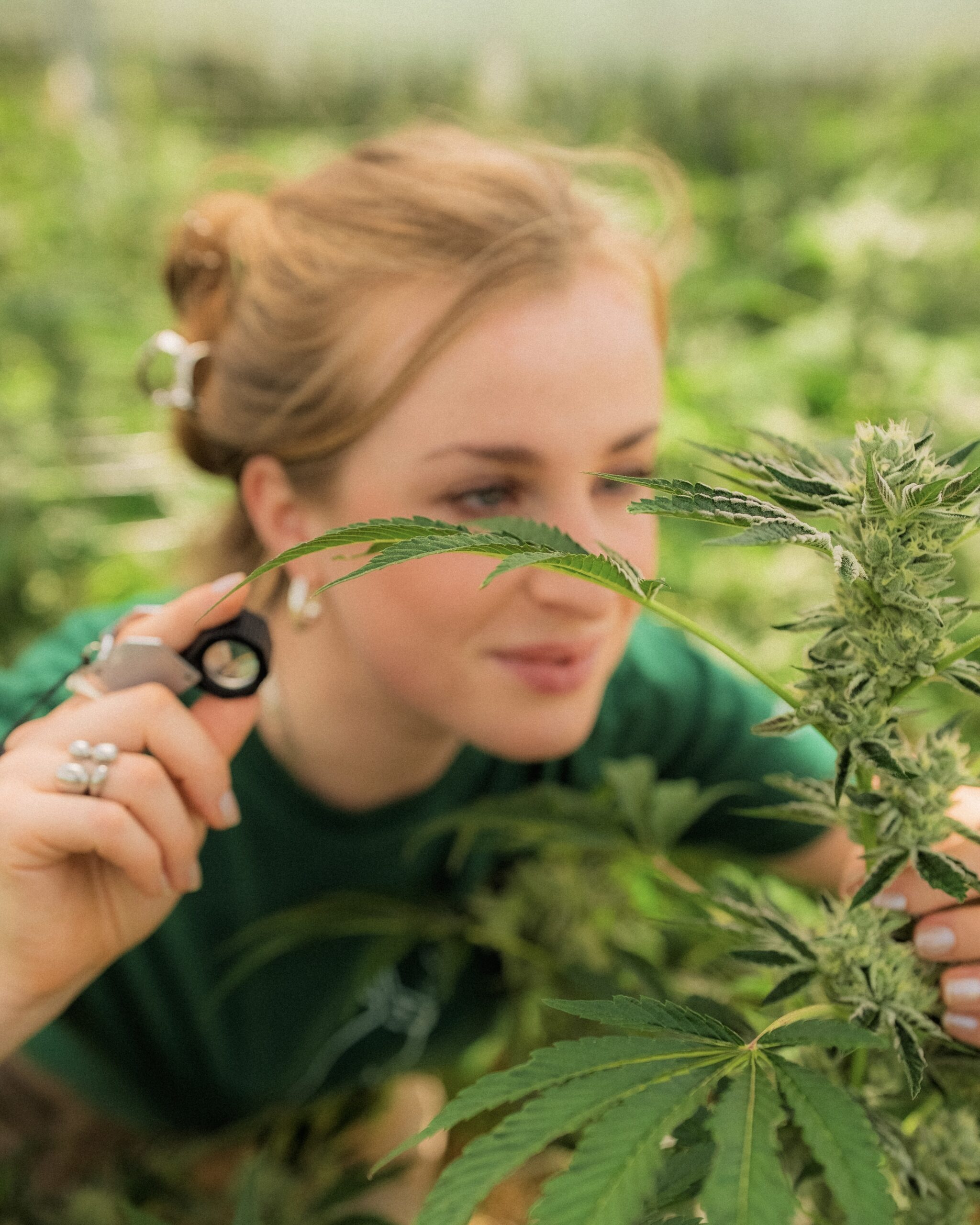
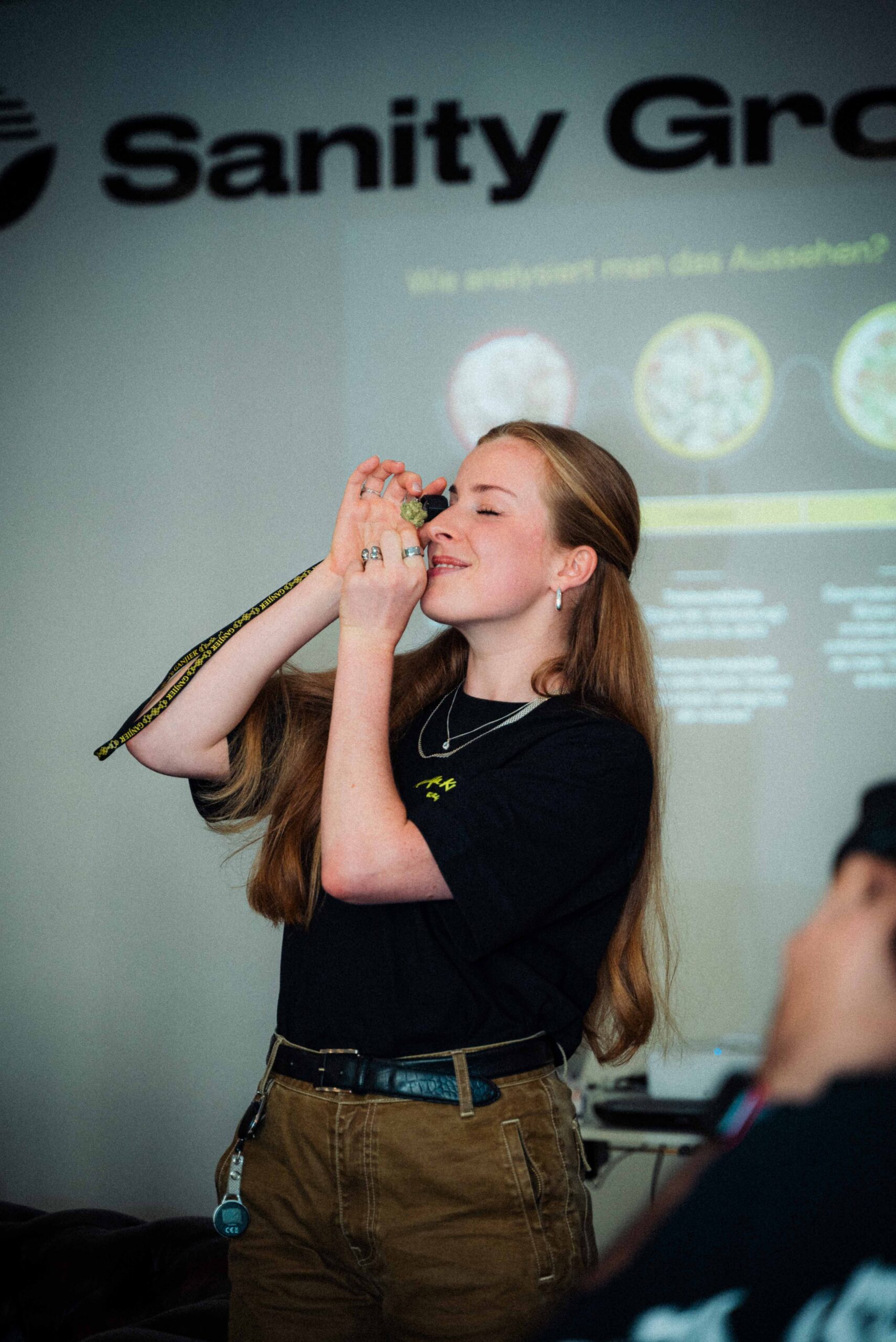
Adele: For me, it starts with a magnifying glass. My wish would be for people to buy a magnifying glass, look very closely at the cannabis flower under it, and discover the trichomes—those little resin glands. That’s a really nice task, and you learn enormously much about quality. If the trichomes are still completely intact, that’s a very good sign. If the trichome heads have fallen off, that speaks to lesser quality or improper handling.
The second exercise is conscious smelling. That also works entirely without consumption. It’s about identifying and naming the different layers of a scent, then working progressively finer into the sub-categories.
Whoever trains their nose and their eye through the magnifying glass already has the two most important Ganjier tools in hand.
Question 8: 24-Month Horizon
Where do you see yourself professionally in 24 months, and what needs to happen in Germany for the Ganjier profession to take institutional root here?
Adele: My greatest wish: that pilot projects in Germany get approved. That would give us the legal foundation, first shops where responsible legalization can be practically tested, and genuine demand for professional staff that needs training. That’s exactly where I’d very much like to contribute and promote the profession not only in Germany but across Europe.
Over the next two years, I also see myself working strongly in Switzerland. That’s where pilot projects are taking shape and the potential legal market with a planned national training system. I want to transfer this model to Germany.
For the Ganjier profession to take institutional root here, it needs above all one first step: approved pilot projects. From that emerges infrastructure, specialty shops, training demand, a professional field that trains staff. The profession doesn’t come from law alone, but from there being a place where it’s genuinely needed.
Note: The interview was conducted in writing. Answers were lightly edited for readability and spelling without changing content. Adele Hollmann is Senior Scientific Affairs Manager at Grashaus Projects, avaay, and Sanity Group, as well as a certified Ganjier. At Mary Jane Berlin, she speaks about Ganjier basics for cannabis consumers. Further reading: avaay’s „High Science“ channel on social media and sanitygroup.com.
- Cannabis Law 2026: Olivia Ewenike on Social Club Hurdles and Telemedicine
- Microbial Decontamination of Medicinal Cannabis: Where the EU Industry Lags Regulatorily and Who’s Liable
Question 5: Lab Testing vs. Sensory Evaluation
Lab testing versus sensory evaluation. Where do these two worlds regularly contradict each other, and which aspect has more practical validity?
Adele: The two worlds contradict each other less than they answer different questions. Lab analysis is indispensable when it comes to safety: contamination checks for pesticides, mold, or heavy metals, and exact THC and CBD values. No nose can do that.
But once it’s about organoleptic quality, sensory evaluation is the more precise instrument: how intensely a flower smells, how its aroma profile is structured, how the texture and plant structure feel. These properties strongly shape the later experience but don’t appear on any lab certificate. A data sheet is also just a snapshot. It says nothing about whether a cure went well or how the product will smell in a few weeks. My rule of thumb: the lab protects against harm, sensory evaluation describes quality. Anyone working professionally needs both.
„The lab protects against harm, sensory evaluation describes quality. Anyone working professionally needs both.“
Adele Hollmann · Sanity Group
Question 6: Underrepresented Style Categories
Which cannabis style categories or terpene profiles are underrepresented in Germany in 2026, even though they’d be sensorily exciting?
Adele: I’m mainly missing floral scent profiles. They should be more creative and refined than what the German market currently offers. I also find exciting the plants deliberately tailored to specific indications with matching aroma or scent profiles.
And one thing is particularly close to my heart: bringing back the „old“ cultivars. Landraces with lower THC content but with character-strong profiles grown over generations. The German market orients itself heavily toward „the higher the THC, the better.“ That’s the most boring axis you can evaluate cannabis on. Diversity in terpene and aroma profiles is much more interesting to me than a high potency value alone.
Question 7: The First Exercise for Consumers
You’re speaking about Ganjier basics for the audience at Mary Jane. What one exercise would you give every cannabis consumer as their first step to take home?
Adele: For me, it starts with a magnifying glass. My wish would be for people to buy a magnifying glass, look very closely at the cannabis flower under it, and discover the trichomes—those little resin glands. That’s a really nice task, and you learn enormously much about quality. If the trichomes are still completely intact, that’s a very good sign. If the trichome heads have fallen off, that speaks to lesser quality or improper handling.
The second exercise is conscious smelling. That also works entirely without consumption. It’s about identifying and naming the different layers of a scent, then working progressively finer into the sub-categories.
Whoever trains their nose and their eye through the magnifying glass already has the two most important Ganjier tools in hand.
Question 8: 24-Month Horizon
Where do you see yourself professionally in 24 months, and what needs to happen in Germany for the Ganjier profession to take institutional root here?
Adele: My greatest wish: that pilot projects in Germany get approved. That would give us the legal foundation, first shops where responsible legalization can be practically tested, and genuine demand for professional staff that needs training. That’s exactly where I’d very much like to contribute and promote the profession not only in Germany but across Europe.
Over the next two years, I also see myself working strongly in Switzerland. That’s where pilot projects are taking shape and the potential legal market with a planned national training system. I want to transfer this model to Germany.
For the Ganjier profession to take institutional root here, it needs above all one first step: approved pilot projects. From that emerges infrastructure, specialty shops, training demand, a professional field that trains staff. The profession doesn’t come from law alone, but from there being a place where it’s genuinely needed.
Note: The interview was conducted in writing. Answers were lightly edited for readability and spelling without changing content. Adele Hollmann is Senior Scientific Affairs Manager at Grashaus Projects, avaay, and Sanity Group, as well as a certified Ganjier. At Mary Jane Berlin, she speaks about Ganjier basics for cannabis consumers. Further reading: avaay’s „High Science“ channel on social media and sanitygroup.com.
- Cannabis Law 2026: Olivia Ewenike on Social Club Hurdles and Telemedicine
- Microbial Decontamination of Medicinal Cannabis: Where the EU Industry Lags Regulatorily and Who’s Liable
Question 4: Education Formats at avaay and Sanity Group
Sanity Group and avaay are your current setting. What concrete education formats are you building for the German market where Ganjier knowledge flows in?
Adele: The most important format is our social media channel „High Science,“ which I manage for avaay, one of our medicinal cannabis brands. There I explain cannabis from A to Z—plant science, mechanisms of action, quality, and responsible use—in language that’s understandable even without prior knowledge.
Added to that are lectures at public institutions and presentations at conferences and podcasts. More scope would emerge once Grashaus Projects pilot projects received approval, which I had the opportunity to help design. Then education can be built on a real, regulated setting.
So the most concrete part of my work currently lies in Switzerland as well. For our pilot project there, I develop training for professional staff, conduct those trainings, and run workshops for study participants. That’s where Ganjier knowledge flows directly into a legal model today.
Question 5: Lab Testing vs. Sensory Evaluation
Lab testing versus sensory evaluation. Where do these two worlds regularly contradict each other, and which aspect has more practical validity?
Adele: The two worlds contradict each other less than they answer different questions. Lab analysis is indispensable when it comes to safety: contamination checks for pesticides, mold, or heavy metals, and exact THC and CBD values. No nose can do that.
But once it’s about organoleptic quality, sensory evaluation is the more precise instrument: how intensely a flower smells, how its aroma profile is structured, how the texture and plant structure feel. These properties strongly shape the later experience but don’t appear on any lab certificate. A data sheet is also just a snapshot. It says nothing about whether a cure went well or how the product will smell in a few weeks. My rule of thumb: the lab protects against harm, sensory evaluation describes quality. Anyone working professionally needs both.
„The lab protects against harm, sensory evaluation describes quality. Anyone working professionally needs both.“
Adele Hollmann · Sanity Group
Question 6: Underrepresented Style Categories
Which cannabis style categories or terpene profiles are underrepresented in Germany in 2026, even though they’d be sensorily exciting?
Adele: I’m mainly missing floral scent profiles. They should be more creative and refined than what the German market currently offers. I also find exciting the plants deliberately tailored to specific indications with matching aroma or scent profiles.
And one thing is particularly close to my heart: bringing back the „old“ cultivars. Landraces with lower THC content but with character-strong profiles grown over generations. The German market orients itself heavily toward „the higher the THC, the better.“ That’s the most boring axis you can evaluate cannabis on. Diversity in terpene and aroma profiles is much more interesting to me than a high potency value alone.
Question 7: The First Exercise for Consumers
You’re speaking about Ganjier basics for the audience at Mary Jane. What one exercise would you give every cannabis consumer as their first step to take home?
Adele: For me, it starts with a magnifying glass. My wish would be for people to buy a magnifying glass, look very closely at the cannabis flower under it, and discover the trichomes—those little resin glands. That’s a really nice task, and you learn enormously much about quality. If the trichomes are still completely intact, that’s a very good sign. If the trichome heads have fallen off, that speaks to lesser quality or improper handling.
The second exercise is conscious smelling. That also works entirely without consumption. It’s about identifying and naming the different layers of a scent, then working progressively finer into the sub-categories.
Whoever trains their nose and their eye through the magnifying glass already has the two most important Ganjier tools in hand.
Question 8: 24-Month Horizon
Where do you see yourself professionally in 24 months, and what needs to happen in Germany for the Ganjier profession to take institutional root here?
Adele: My greatest wish: that pilot projects in Germany get approved. That would give us the legal foundation, first shops where responsible legalization can be practically tested, and genuine demand for professional staff that needs training. That’s exactly where I’d very much like to contribute and promote the profession not only in Germany but across Europe.
Over the next two years, I also see myself working strongly in Switzerland. That’s where pilot projects are taking shape and the potential legal market with a planned national training system. I want to transfer this model to Germany.
For the Ganjier profession to take institutional root here, it needs above all one first step: approved pilot projects. From that emerges infrastructure, specialty shops, training demand, a professional field that trains staff. The profession doesn’t come from law alone, but from there being a place where it’s genuinely needed.
Note: The interview was conducted in writing. Answers were lightly edited for readability and spelling without changing content. Adele Hollmann is Senior Scientific Affairs Manager at Grashaus Projects, avaay, and Sanity Group, as well as a certified Ganjier. At Mary Jane Berlin, she speaks about Ganjier basics for cannabis consumers. Further reading: avaay’s „High Science“ channel on social media and sanitygroup.com.
- Cannabis Law 2026: Olivia Ewenike on Social Club Hurdles and Telemedicine
- Microbial Decontamination of Medicinal Cannabis: Where the EU Industry Lags Regulatorily and Who’s Liable
Question 3: Trichomes as an Underestimated Category
Which sensory categories are, from your experience, least understood by consumers AND industry professionals?
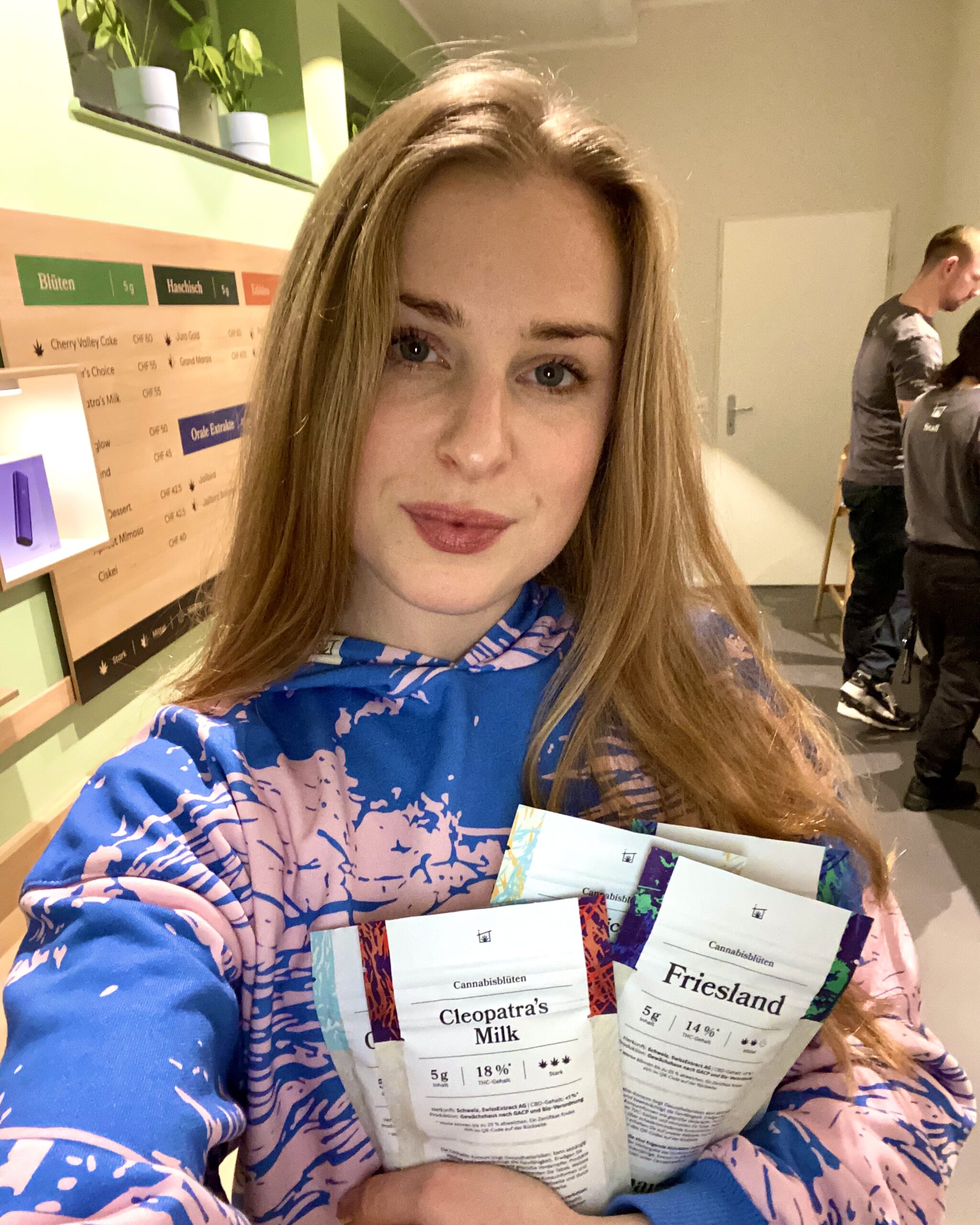
Adele: Clearly trichomes. Many have seen them before but can’t really name what they actually are and why they’re so important. Trichomes are the resin glands of the plant—tiny structures where virtually all relevant compounds sit: cannabinoids, terpenes, flavonoids. If you want to judge the quality of a flower, you first look at the trichomes.
Preserving them is critical. A carefully handled flower still has its trichome heads intact. If they’ve fallen off or been rubbed away, you’ve lost much of what matters. This same principle underlies products like resin or extracts. There, only the „trichome juice“ is deliberately used—the concentrate from the gland heads. Once you understand that trichomes are what’s actually valuable, your perspective on every product changes.
Question 4: Education Formats at avaay and Sanity Group
Sanity Group and avaay are your current setting. What concrete education formats are you building for the German market where Ganjier knowledge flows in?
Adele: The most important format is our social media channel „High Science,“ which I manage for avaay, one of our medicinal cannabis brands. There I explain cannabis from A to Z—plant science, mechanisms of action, quality, and responsible use—in language that’s understandable even without prior knowledge.
Added to that are lectures at public institutions and presentations at conferences and podcasts. More scope would emerge once Grashaus Projects pilot projects received approval, which I had the opportunity to help design. Then education can be built on a real, regulated setting.
So the most concrete part of my work currently lies in Switzerland as well. For our pilot project there, I develop training for professional staff, conduct those trainings, and run workshops for study participants. That’s where Ganjier knowledge flows directly into a legal model today.
Question 5: Lab Testing vs. Sensory Evaluation
Lab testing versus sensory evaluation. Where do these two worlds regularly contradict each other, and which aspect has more practical validity?
Adele: The two worlds contradict each other less than they answer different questions. Lab analysis is indispensable when it comes to safety: contamination checks for pesticides, mold, or heavy metals, and exact THC and CBD values. No nose can do that.
But once it’s about organoleptic quality, sensory evaluation is the more precise instrument: how intensely a flower smells, how its aroma profile is structured, how the texture and plant structure feel. These properties strongly shape the later experience but don’t appear on any lab certificate. A data sheet is also just a snapshot. It says nothing about whether a cure went well or how the product will smell in a few weeks. My rule of thumb: the lab protects against harm, sensory evaluation describes quality. Anyone working professionally needs both.
„The lab protects against harm, sensory evaluation describes quality. Anyone working professionally needs both.“
Adele Hollmann · Sanity Group
Question 6: Underrepresented Style Categories
Which cannabis style categories or terpene profiles are underrepresented in Germany in 2026, even though they’d be sensorily exciting?
Adele: I’m mainly missing floral scent profiles. They should be more creative and refined than what the German market currently offers. I also find exciting the plants deliberately tailored to specific indications with matching aroma or scent profiles.
And one thing is particularly close to my heart: bringing back the „old“ cultivars. Landraces with lower THC content but with character-strong profiles grown over generations. The German market orients itself heavily toward „the higher the THC, the better.“ That’s the most boring axis you can evaluate cannabis on. Diversity in terpene and aroma profiles is much more interesting to me than a high potency value alone.
Question 7: The First Exercise for Consumers
You’re speaking about Ganjier basics for the audience at Mary Jane. What one exercise would you give every cannabis consumer as their first step to take home?
Adele: For me, it starts with a magnifying glass. My wish would be for people to buy a magnifying glass, look very closely at the cannabis flower under it, and discover the trichomes—those little resin glands. That’s a really nice task, and you learn enormously much about quality. If the trichomes are still completely intact, that’s a very good sign. If the trichome heads have fallen off, that speaks to lesser quality or improper handling.
The second exercise is conscious smelling. That also works entirely without consumption. It’s about identifying and naming the different layers of a scent, then working progressively finer into the sub-categories.
Whoever trains their nose and their eye through the magnifying glass already has the two most important Ganjier tools in hand.
Question 8: 24-Month Horizon
Where do you see yourself professionally in 24 months, and what needs to happen in Germany for the Ganjier profession to take institutional root here?
Adele: My greatest wish: that pilot projects in Germany get approved. That would give us the legal foundation, first shops where responsible legalization can be practically tested, and genuine demand for professional staff that needs training. That’s exactly where I’d very much like to contribute and promote the profession not only in Germany but across Europe.
Over the next two years, I also see myself working strongly in Switzerland. That’s where pilot projects are taking shape and the potential legal market with a planned national training system. I want to transfer this model to Germany.
For the Ganjier profession to take institutional root here, it needs above all one first step: approved pilot projects. From that emerges infrastructure, specialty shops, training demand, a professional field that trains staff. The profession doesn’t come from law alone, but from there being a place where it’s genuinely needed.
Note: The interview was conducted in writing. Answers were lightly edited for readability and spelling without changing content. Adele Hollmann is Senior Scientific Affairs Manager at Grashaus Projects, avaay, and Sanity Group, as well as a certified Ganjier. At Mary Jane Berlin, she speaks about Ganjier basics for cannabis consumers. Further reading: avaay’s „High Science“ channel on social media and sanitygroup.com.
- Cannabis Law 2026: Olivia Ewenike on Social Club Hurdles and Telemedicine
- Microbial Decontamination of Medicinal Cannabis: Where the EU Industry Lags Regulatorily and Who’s Liable
Question 2: Realistic Roles in the German Market
The Ganjier profession is established in the USA, still unknown in Germany. What realistic role do you see for Ganjiers in the German market, at pharmacies, in social clubs, in specialty retail?
Adele: The Ganjier role has several applications. You can be the one who sources for the medicinal cannabis market—visiting producers, testing quality, and helping decide what to purchase. My colleague Tim takes on this sourcing task at our company. Or you can lean more toward education and harm reduction, even conducting awareness work in schools. I’m clearly drawn to the education sector.
It would be nice if pharmacists also received more training to better evaluate products and advise patients more specifically. But there’s a clear boundary here: pharmacy staff can’t consume the products. A Ganjier role in a pharmacy would therefore be limited to quality analysis that works entirely without consumption—using microscopes and your nose. That’s valuable for better product understanding, but limited.
In social clubs, professionally trained staff is certainly a gain, but the use case is manageable. The real major demand only emerges with specialty retail shops, and those don’t yet exist in Germany. That’s precisely why my current focus is strong on Switzerland. That’s where pilot projects are taking shape, and hopefully based on their insights, a large-scale legal market will soon follow where one can not only use but actively help shape a national training system. The Ganjier profession needs infrastructure where it’s needed, and that infrastructure is emerging more in Switzerland than in Germany right now.
Question 3: Trichomes as an Underestimated Category
Which sensory categories are, from your experience, least understood by consumers AND industry professionals?
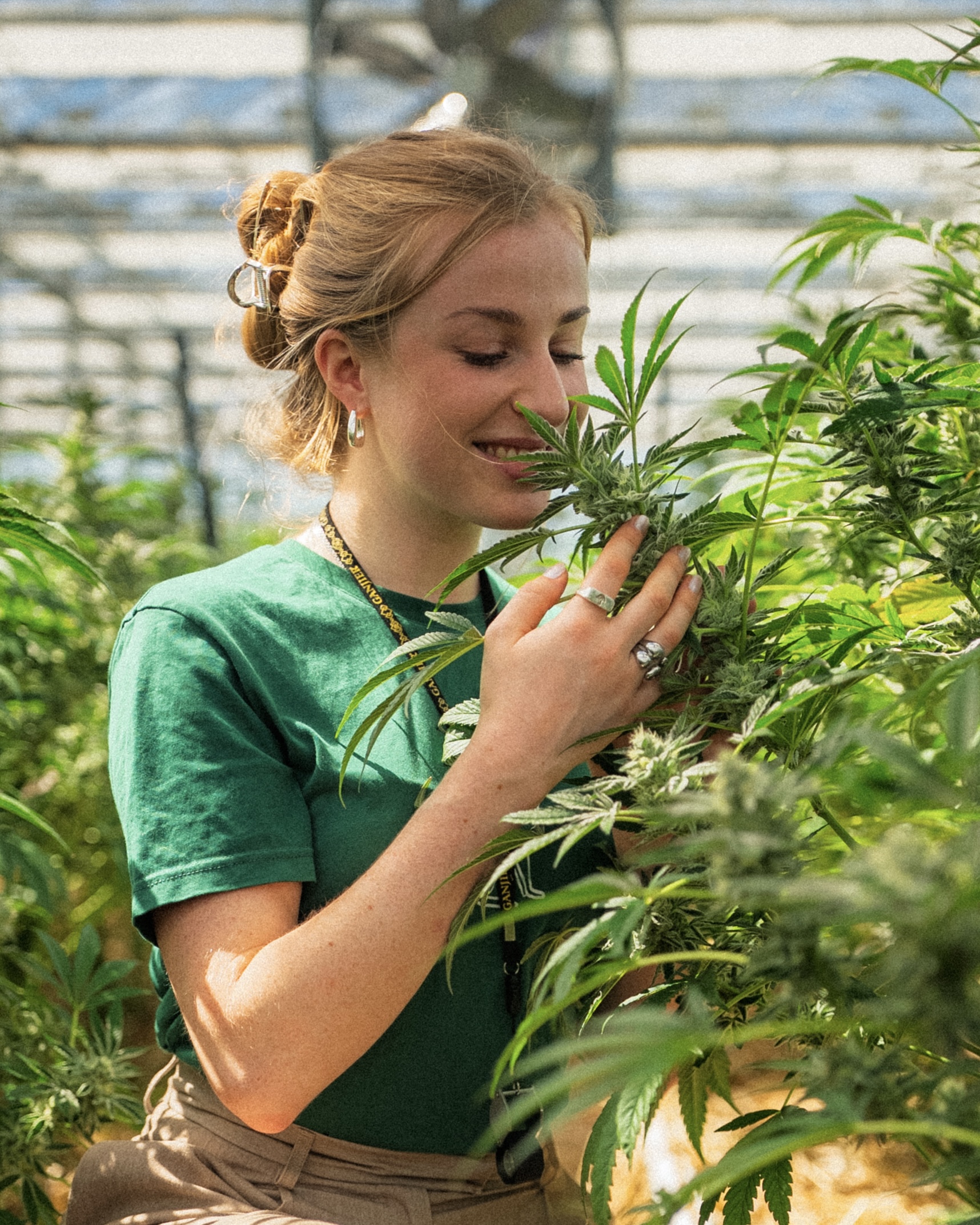
Adele: Clearly trichomes. Many have seen them before but can’t really name what they actually are and why they’re so important. Trichomes are the resin glands of the plant—tiny structures where virtually all relevant compounds sit: cannabinoids, terpenes, flavonoids. If you want to judge the quality of a flower, you first look at the trichomes.
Preserving them is critical. A carefully handled flower still has its trichome heads intact. If they’ve fallen off or been rubbed away, you’ve lost much of what matters. This same principle underlies products like resin or extracts. There, only the „trichome juice“ is deliberately used—the concentrate from the gland heads. Once you understand that trichomes are what’s actually valuable, your perspective on every product changes.
Question 4: Education Formats at avaay and Sanity Group
Sanity Group and avaay are your current setting. What concrete education formats are you building for the German market where Ganjier knowledge flows in?
Adele: The most important format is our social media channel „High Science,“ which I manage for avaay, one of our medicinal cannabis brands. There I explain cannabis from A to Z—plant science, mechanisms of action, quality, and responsible use—in language that’s understandable even without prior knowledge.
Added to that are lectures at public institutions and presentations at conferences and podcasts. More scope would emerge once Grashaus Projects pilot projects received approval, which I had the opportunity to help design. Then education can be built on a real, regulated setting.
So the most concrete part of my work currently lies in Switzerland as well. For our pilot project there, I develop training for professional staff, conduct those trainings, and run workshops for study participants. That’s where Ganjier knowledge flows directly into a legal model today.
Question 5: Lab Testing vs. Sensory Evaluation
Lab testing versus sensory evaluation. Where do these two worlds regularly contradict each other, and which aspect has more practical validity?
Adele: The two worlds contradict each other less than they answer different questions. Lab analysis is indispensable when it comes to safety: contamination checks for pesticides, mold, or heavy metals, and exact THC and CBD values. No nose can do that.
But once it’s about organoleptic quality, sensory evaluation is the more precise instrument: how intensely a flower smells, how its aroma profile is structured, how the texture and plant structure feel. These properties strongly shape the later experience but don’t appear on any lab certificate. A data sheet is also just a snapshot. It says nothing about whether a cure went well or how the product will smell in a few weeks. My rule of thumb: the lab protects against harm, sensory evaluation describes quality. Anyone working professionally needs both.
„The lab protects against harm, sensory evaluation describes quality. Anyone working professionally needs both.“
Adele Hollmann · Sanity Group
Question 6: Underrepresented Style Categories
Which cannabis style categories or terpene profiles are underrepresented in Germany in 2026, even though they’d be sensorily exciting?
Adele: I’m mainly missing floral scent profiles. They should be more creative and refined than what the German market currently offers. I also find exciting the plants deliberately tailored to specific indications with matching aroma or scent profiles.
And one thing is particularly close to my heart: bringing back the „old“ cultivars. Landraces with lower THC content but with character-strong profiles grown over generations. The German market orients itself heavily toward „the higher the THC, the better.“ That’s the most boring axis you can evaluate cannabis on. Diversity in terpene and aroma profiles is much more interesting to me than a high potency value alone.
Question 7: The First Exercise for Consumers
You’re speaking about Ganjier basics for the audience at Mary Jane. What one exercise would you give every cannabis consumer as their first step to take home?
Adele: For me, it starts with a magnifying glass. My wish would be for people to buy a magnifying glass, look very closely at the cannabis flower under it, and discover the trichomes—those little resin glands. That’s a really nice task, and you learn enormously much about quality. If the trichomes are still completely intact, that’s a very good sign. If the trichome heads have fallen off, that speaks to lesser quality or improper handling.
The second exercise is conscious smelling. That also works entirely without consumption. It’s about identifying and naming the different layers of a scent, then working progressively finer into the sub-categories.
Whoever trains their nose and their eye through the magnifying glass already has the two most important Ganjier tools in hand.
Question 8: 24-Month Horizon
Where do you see yourself professionally in 24 months, and what needs to happen in Germany for the Ganjier profession to take institutional root here?
Adele: My greatest wish: that pilot projects in Germany get approved. That would give us the legal foundation, first shops where responsible legalization can be practically tested, and genuine demand for professional staff that needs training. That’s exactly where I’d very much like to contribute and promote the profession not only in Germany but across Europe.
Over the next two years, I also see myself working strongly in Switzerland. That’s where pilot projects are taking shape and the potential legal market with a planned national training system. I want to transfer this model to Germany.
For the Ganjier profession to take institutional root here, it needs above all one first step: approved pilot projects. From that emerges infrastructure, specialty shops, training demand, a professional field that trains staff. The profession doesn’t come from law alone, but from there being a place where it’s genuinely needed.
Note: The interview was conducted in writing. Answers were lightly edited for readability and spelling without changing content. Adele Hollmann is Senior Scientific Affairs Manager at Grashaus Projects, avaay, and Sanity Group, as well as a certified Ganjier. At Mary Jane Berlin, she speaks about Ganjier basics for cannabis consumers. Further reading: avaay’s „High Science“ channel on social media and sanitygroup.com.
- Cannabis Law 2026: Olivia Ewenike on Social Club Hurdles and Telemedicine
- Microbial Decontamination of Medicinal Cannabis: Where the EU Industry Lags Regulatorily and Who’s Liable
Question 1: Tasting Without Spitting
You’re Germany’s first female Ganjier and helped open Europe’s first legal dispensary in Switzerland. How does Ganjier tasting practically differ from wine or whisky tasting?
Adele: The practical difference from wine or whisky tasting is fundamental: you can’t spit out cannabis vapor. Whoever tastes also consumes the substance. That’s exactly why the steps before inhalation are so important to me: appearance, smell, and the dry hit—the draw on an unlit flower. Through these three stages, you can already learn remarkably much about quality without having consumed anything. A wine sommelier can taste generously. A Ganjier must look, smell, and feel much more carefully before anything even burns.
„You can’t spit out cannabis vapor. Whoever tastes also consumes the substance. A Ganjier must look, smell, and feel much more carefully before anything even burns.“
Adele Hollmann · Sanity Group
Question 2: Realistic Roles in the German Market
The Ganjier profession is established in the USA, still unknown in Germany. What realistic role do you see for Ganjiers in the German market, at pharmacies, in social clubs, in specialty retail?
Adele: The Ganjier role has several applications. You can be the one who sources for the medicinal cannabis market—visiting producers, testing quality, and helping decide what to purchase. My colleague Tim takes on this sourcing task at our company. Or you can lean more toward education and harm reduction, even conducting awareness work in schools. I’m clearly drawn to the education sector.
It would be nice if pharmacists also received more training to better evaluate products and advise patients more specifically. But there’s a clear boundary here: pharmacy staff can’t consume the products. A Ganjier role in a pharmacy would therefore be limited to quality analysis that works entirely without consumption—using microscopes and your nose. That’s valuable for better product understanding, but limited.
In social clubs, professionally trained staff is certainly a gain, but the use case is manageable. The real major demand only emerges with specialty retail shops, and those don’t yet exist in Germany. That’s precisely why my current focus is strong on Switzerland. That’s where pilot projects are taking shape, and hopefully based on their insights, a large-scale legal market will soon follow where one can not only use but actively help shape a national training system. The Ganjier profession needs infrastructure where it’s needed, and that infrastructure is emerging more in Switzerland than in Germany right now.
Question 3: Trichomes as an Underestimated Category
Which sensory categories are, from your experience, least understood by consumers AND industry professionals?
Adele: Clearly trichomes. Many have seen them before but can’t really name what they actually are and why they’re so important. Trichomes are the resin glands of the plant—tiny structures where virtually all relevant compounds sit: cannabinoids, terpenes, flavonoids. If you want to judge the quality of a flower, you first look at the trichomes.
Preserving them is critical. A carefully handled flower still has its trichome heads intact. If they’ve fallen off or been rubbed away, you’ve lost much of what matters. This same principle underlies products like resin or extracts. There, only the „trichome juice“ is deliberately used—the concentrate from the gland heads. Once you understand that trichomes are what’s actually valuable, your perspective on every product changes.
Question 4: Education Formats at avaay and Sanity Group
Sanity Group and avaay are your current setting. What concrete education formats are you building for the German market where Ganjier knowledge flows in?
Adele: The most important format is our social media channel „High Science,“ which I manage for avaay, one of our medicinal cannabis brands. There I explain cannabis from A to Z—plant science, mechanisms of action, quality, and responsible use—in language that’s understandable even without prior knowledge.
Added to that are lectures at public institutions and presentations at conferences and podcasts. More scope would emerge once Grashaus Projects pilot projects received approval, which I had the opportunity to help design. Then education can be built on a real, regulated setting.
So the most concrete part of my work currently lies in Switzerland as well. For our pilot project there, I develop training for professional staff, conduct those trainings, and run workshops for study participants. That’s where Ganjier knowledge flows directly into a legal model today.
Question 5: Lab Testing vs. Sensory Evaluation
Lab testing versus sensory evaluation. Where do these two worlds regularly contradict each other, and which aspect has more practical validity?
Adele: The two worlds contradict each other less than they answer different questions. Lab analysis is indispensable when it comes to safety: contamination checks for pesticides, mold, or heavy metals, and exact THC and CBD values. No nose can do that.
But once it’s about organoleptic quality, sensory evaluation is the more precise instrument: how intensely a flower smells, how its aroma profile is structured, how the texture and plant structure feel. These properties strongly shape the later experience but don’t appear on any lab certificate. A data sheet is also just a snapshot. It says nothing about whether a cure went well or how the product will smell in a few weeks. My rule of thumb: the lab protects against harm, sensory evaluation describes quality. Anyone working professionally needs both.
„The lab protects against harm, sensory evaluation describes quality. Anyone working professionally needs both.“
Adele Hollmann · Sanity Group
Question 6: Underrepresented Style Categories
Which cannabis style categories or terpene profiles are underrepresented in Germany in 2026, even though they’d be sensorily exciting?
Adele: I’m mainly missing floral scent profiles. They should be more creative and refined than what the German market currently offers. I also find exciting the plants deliberately tailored to specific indications with matching aroma or scent profiles.
And one thing is particularly close to my heart: bringing back the „old“ cultivars. Landraces with lower THC content but with character-strong profiles grown over generations. The German market orients itself heavily toward „the higher the THC, the better.“ That’s the most boring axis you can evaluate cannabis on. Diversity in terpene and aroma profiles is much more interesting to me than a high potency value alone.
Question 7: The First Exercise for Consumers
You’re speaking about Ganjier basics for the audience at Mary Jane. What one exercise would you give every cannabis consumer as their first step to take home?
Adele: For me, it starts with a magnifying glass. My wish would be for people to buy a magnifying glass, look very closely at the cannabis flower under it, and discover the trichomes—those little resin glands. That’s a really nice task, and you learn enormously much about quality. If the trichomes are still completely intact, that’s a very good sign. If the trichome heads have fallen off, that speaks to lesser quality or improper handling.
The second exercise is conscious smelling. That also works entirely without consumption. It’s about identifying and naming the different layers of a scent, then working progressively finer into the sub-categories.
Whoever trains their nose and their eye through the magnifying glass already has the two most important Ganjier tools in hand.
Question 8: 24-Month Horizon
Where do you see yourself professionally in 24 months, and what needs to happen in Germany for the Ganjier profession to take institutional root here?
Adele: My greatest wish: that pilot projects in Germany get approved. That would give us the legal foundation, first shops where responsible legalization can be practically tested, and genuine demand for professional staff that needs training. That’s exactly where I’d very much like to contribute and promote the profession not only in Germany but across Europe.
Over the next two years, I also see myself working strongly in Switzerland. That’s where pilot projects are taking shape and the potential legal market with a planned national training system. I want to transfer this model to Germany.
For the Ganjier profession to take institutional root here, it needs above all one first step: approved pilot projects. From that emerges infrastructure, specialty shops, training demand, a professional field that trains staff. The profession doesn’t come from law alone, but from there being a place where it’s genuinely needed.
Note: The interview was conducted in writing. Answers were lightly edited for readability and spelling without changing content. Adele Hollmann is Senior Scientific Affairs Manager at Grashaus Projects, avaay, and Sanity Group, as well as a certified Ganjier. At Mary Jane Berlin, she speaks about Ganjier basics for cannabis consumers. Further reading: avaay’s „High Science“ channel on social media and sanitygroup.com.
- Cannabis Law 2026: Olivia Ewenike on Social Club Hurdles and Telemedicine
- Microbial Decontamination of Medicinal Cannabis: Where the EU Industry Lags Regulatorily and Who’s Liable
💬 In Conversation
Adele Hollmann, Senior Scientific Affairs Manager (Grashaus Projects / avaay / Sanity Group), Ganjier
Adele Hollmann is Senior Scientific Affairs Manager at Grashaus Projects, avaay, and Sanity Group, as well as a certified Ganjier. She was involved in opening Europe’s first legal cannabis dispensary in Switzerland and manages cannabis education communication for avaay under „High Science“ on social media. At Mary Jane Berlin, she speaks about Ganjier basics for a broad cannabis audience.
Question 1: Tasting Without Spitting
You’re Germany’s first female Ganjier and helped open Europe’s first legal dispensary in Switzerland. How does Ganjier tasting practically differ from wine or whisky tasting?
Adele: The practical difference from wine or whisky tasting is fundamental: you can’t spit out cannabis vapor. Whoever tastes also consumes the substance. That’s exactly why the steps before inhalation are so important to me: appearance, smell, and the dry hit—the draw on an unlit flower. Through these three stages, you can already learn remarkably much about quality without having consumed anything. A wine sommelier can taste generously. A Ganjier must look, smell, and feel much more carefully before anything even burns.
„You can’t spit out cannabis vapor. Whoever tastes also consumes the substance. A Ganjier must look, smell, and feel much more carefully before anything even burns.“
Adele Hollmann · Sanity Group
Question 2: Realistic Roles in the German Market
The Ganjier profession is established in the USA, still unknown in Germany. What realistic role do you see for Ganjiers in the German market, at pharmacies, in social clubs, in specialty retail?
Adele: The Ganjier role has several applications. You can be the one who sources for the medicinal cannabis market—visiting producers, testing quality, and helping decide what to purchase. My colleague Tim takes on this sourcing task at our company. Or you can lean more toward education and harm reduction, even conducting awareness work in schools. I’m clearly drawn to the education sector.
It would be nice if pharmacists also received more training to better evaluate products and advise patients more specifically. But there’s a clear boundary here: pharmacy staff can’t consume the products. A Ganjier role in a pharmacy would therefore be limited to quality analysis that works entirely without consumption—using microscopes and your nose. That’s valuable for better product understanding, but limited.
In social clubs, professionally trained staff is certainly a gain, but the use case is manageable. The real major demand only emerges with specialty retail shops, and those don’t yet exist in Germany. That’s precisely why my current focus is strong on Switzerland. That’s where pilot projects are taking shape, and hopefully based on their insights, a large-scale legal market will soon follow where one can not only use but actively help shape a national training system. The Ganjier profession needs infrastructure where it’s needed, and that infrastructure is emerging more in Switzerland than in Germany right now.
Question 3: Trichomes as an Underestimated Category
Which sensory categories are, from your experience, least understood by consumers AND industry professionals?
Adele: Clearly trichomes. Many have seen them before but can’t really name what they actually are and why they’re so important. Trichomes are the resin glands of the plant—tiny structures where virtually all relevant compounds sit: cannabinoids, terpenes, flavonoids. If you want to judge the quality of a flower, you first look at the trichomes.
Preserving them is critical. A carefully handled flower still has its trichome heads intact. If they’ve fallen off or been rubbed away, you’ve lost much of what matters. This same principle underlies products like resin or extracts. There, only the „trichome juice“ is deliberately used—the concentrate from the gland heads. Once you understand that trichomes are what’s actually valuable, your perspective on every product changes.
Question 4: Education Formats at avaay and Sanity Group
Sanity Group and avaay are your current setting. What concrete education formats are you building for the German market where Ganjier knowledge flows in?
Adele: The most important format is our social media channel „High Science,“ which I manage for avaay, one of our medicinal cannabis brands. There I explain cannabis from A to Z—plant science, mechanisms of action, quality, and responsible use—in language that’s understandable even without prior knowledge.
Added to that are lectures at public institutions and presentations at conferences and podcasts. More scope would emerge once Grashaus Projects pilot projects received approval, which I had the opportunity to help design. Then education can be built on a real, regulated setting.
So the most concrete part of my work currently lies in Switzerland as well. For our pilot project there, I develop training for professional staff, conduct those trainings, and run workshops for study participants. That’s where Ganjier knowledge flows directly into a legal model today.
Question 5: Lab Testing vs. Sensory Evaluation
Lab testing versus sensory evaluation. Where do these two worlds regularly contradict each other, and which aspect has more practical validity?
Adele: The two worlds contradict each other less than they answer different questions. Lab analysis is indispensable when it comes to safety: contamination checks for pesticides, mold, or heavy metals, and exact THC and CBD values. No nose can do that.
But once it’s about organoleptic quality, sensory evaluation is the more precise instrument: how intensely a flower smells, how its aroma profile is structured, how the texture and plant structure feel. These properties strongly shape the later experience but don’t appear on any lab certificate. A data sheet is also just a snapshot. It says nothing about whether a cure went well or how the product will smell in a few weeks. My rule of thumb: the lab protects against harm, sensory evaluation describes quality. Anyone working professionally needs both.
„The lab protects against harm, sensory evaluation describes quality. Anyone working professionally needs both.“
Adele Hollmann · Sanity Group
Question 6: Underrepresented Style Categories
Which cannabis style categories or terpene profiles are underrepresented in Germany in 2026, even though they’d be sensorily exciting?
Adele: I’m mainly missing floral scent profiles. They should be more creative and refined than what the German market currently offers. I also find exciting the plants deliberately tailored to specific indications with matching aroma or scent profiles.
And one thing is particularly close to my heart: bringing back the „old“ cultivars. Landraces with lower THC content but with character-strong profiles grown over generations. The German market orients itself heavily toward „the higher the THC, the better.“ That’s the most boring axis you can evaluate cannabis on. Diversity in terpene and aroma profiles is much more interesting to me than a high potency value alone.
Question 7: The First Exercise for Consumers
You’re speaking about Ganjier basics for the audience at Mary Jane. What one exercise would you give every cannabis consumer as their first step to take home?
Adele: For me, it starts with a magnifying glass. My wish would be for people to buy a magnifying glass, look very closely at the cannabis flower under it, and discover the trichomes—those little resin glands. That’s a really nice task, and you learn enormously much about quality. If the trichomes are still completely intact, that’s a very good sign. If the trichome heads have fallen off, that speaks to lesser quality or improper handling.
The second exercise is conscious smelling. That also works entirely without consumption. It’s about identifying and naming the different layers of a scent, then working progressively finer into the sub-categories.
Whoever trains their nose and their eye through the magnifying glass already has the two most important Ganjier tools in hand.
Question 8: 24-Month Horizon
Where do you see yourself professionally in 24 months, and what needs to happen in Germany for the Ganjier profession to take institutional root here?
Adele: My greatest wish: that pilot projects in Germany get approved. That would give us the legal foundation, first shops where responsible legalization can be practically tested, and genuine demand for professional staff that needs training. That’s exactly where I’d very much like to contribute and promote the profession not only in Germany but across Europe.
Over the next two years, I also see myself working strongly in Switzerland. That’s where pilot projects are taking shape and the potential legal market with a planned national training system. I want to transfer this model to Germany.
For the Ganjier profession to take institutional root here, it needs above all one first step: approved pilot projects. From that emerges infrastructure, specialty shops, training demand, a professional field that trains staff. The profession doesn’t come from law alone, but from there being a place where it’s genuinely needed.
Note: The interview was conducted in writing. Answers were lightly edited for readability and spelling without changing content. Adele Hollmann is Senior Scientific Affairs Manager at Grashaus Projects, avaay, and Sanity Group, as well as a certified Ganjier. At Mary Jane Berlin, she speaks about Ganjier basics for cannabis consumers. Further reading: avaay’s „High Science“ channel on social media and sanitygroup.com.
- Cannabis Law 2026: Olivia Ewenike on Social Club Hurdles and Telemedicine
- Microbial Decontamination of Medicinal Cannabis: Where the EU Industry Lags Regulatorily and Who’s Liable
In the USA, „Ganjier“ is the counterpart to sommelier or whisky connoisseur. In Germany, this profession is barely known. Adele Hollmann is Germany’s first female Ganjier, helped open Europe’s first legal cannabis dispensary in Switzerland, and now works as Senior Scientific Affairs Manager for Grashaus Projects and avaay within the Sanity Group. This gives her a dual role rarely found in Germany: industrial medicinal cannabis expertise on one side, sensory depth and education on the other.
In a written interview with Hanf Magazin, Hollmann discusses the practical differences between cannabis and wine tasting, explains why most consumers and even many industry professionals underestimate trichomes, positions the role of lab testing versus sensory evaluation, and clearly names why the Ganjier profession hasn’t yet taken root in Germany institutionally. Spoiler: it’s not about the law, but about specialty retailers that don’t yet exist.
The answers were submitted in writing and minimally edited for readability.
💬 In Conversation
Adele Hollmann, Senior Scientific Affairs Manager (Grashaus Projects / avaay / Sanity Group), Ganjier
Adele Hollmann is Senior Scientific Affairs Manager at Grashaus Projects, avaay, and Sanity Group, as well as a certified Ganjier. She was involved in opening Europe’s first legal cannabis dispensary in Switzerland and manages cannabis education communication for avaay under „High Science“ on social media. At Mary Jane Berlin, she speaks about Ganjier basics for a broad cannabis audience.
Question 1: Tasting Without Spitting
You’re Germany’s first female Ganjier and helped open Europe’s first legal dispensary in Switzerland. How does Ganjier tasting practically differ from wine or whisky tasting?
Adele: The practical difference from wine or whisky tasting is fundamental: you can’t spit out cannabis vapor. Whoever tastes also consumes the substance. That’s exactly why the steps before inhalation are so important to me: appearance, smell, and the dry hit—the draw on an unlit flower. Through these three stages, you can already learn remarkably much about quality without having consumed anything. A wine sommelier can taste generously. A Ganjier must look, smell, and feel much more carefully before anything even burns.
„You can’t spit out cannabis vapor. Whoever tastes also consumes the substance. A Ganjier must look, smell, and feel much more carefully before anything even burns.“
Adele Hollmann · Sanity Group
Question 2: Realistic Roles in the German Market
The Ganjier profession is established in the USA, still unknown in Germany. What realistic role do you see for Ganjiers in the German market, at pharmacies, in social clubs, in specialty retail?
Adele: The Ganjier role has several applications. You can be the one who sources for the medicinal cannabis market—visiting producers, testing quality, and helping decide what to purchase. My colleague Tim takes on this sourcing task at our company. Or you can lean more toward education and harm reduction, even conducting awareness work in schools. I’m clearly drawn to the education sector.
It would be nice if pharmacists also received more training to better evaluate products and advise patients more specifically. But there’s a clear boundary here: pharmacy staff can’t consume the products. A Ganjier role in a pharmacy would therefore be limited to quality analysis that works entirely without consumption—using microscopes and your nose. That’s valuable for better product understanding, but limited.
In social clubs, professionally trained staff is certainly a gain, but the use case is manageable. The real major demand only emerges with specialty retail shops, and those don’t yet exist in Germany. That’s precisely why my current focus is strong on Switzerland. That’s where pilot projects are taking shape, and hopefully based on their insights, a large-scale legal market will soon follow where one can not only use but actively help shape a national training system. The Ganjier profession needs infrastructure where it’s needed, and that infrastructure is emerging more in Switzerland than in Germany right now.
Question 3: Trichomes as an Underestimated Category
Which sensory categories are, from your experience, least understood by consumers AND industry professionals?
Adele: Clearly trichomes. Many have seen them before but can’t really name what they actually are and why they’re so important. Trichomes are the resin glands of the plant—tiny structures where virtually all relevant compounds sit: cannabinoids, terpenes, flavonoids. If you want to judge the quality of a flower, you first look at the trichomes.
Preserving them is critical. A carefully handled flower still has its trichome heads intact. If they’ve fallen off or been rubbed away, you’ve lost much of what matters. This same principle underlies products like resin or extracts. There, only the „trichome juice“ is deliberately used—the concentrate from the gland heads. Once you understand that trichomes are what’s actually valuable, your perspective on every product changes.
Question 4: Education Formats at avaay and Sanity Group
Sanity Group and avaay are your current setting. What concrete education formats are you building for the German market where Ganjier knowledge flows in?
Adele: The most important format is our social media channel „High Science,“ which I manage for avaay, one of our medicinal cannabis brands. There I explain cannabis from A to Z—plant science, mechanisms of action, quality, and responsible use—in language that’s understandable even without prior knowledge.
Added to that are lectures at public institutions and presentations at conferences and podcasts. More scope would emerge once Grashaus Projects pilot projects received approval, which I had the opportunity to help design. Then education can be built on a real, regulated setting.
So the most concrete part of my work currently lies in Switzerland as well. For our pilot project there, I develop training for professional staff, conduct those trainings, and run workshops for study participants. That’s where Ganjier knowledge flows directly into a legal model today.
Question 5: Lab Testing vs. Sensory Evaluation
Lab testing versus sensory evaluation. Where do these two worlds regularly contradict each other, and which aspect has more practical validity?
Adele: The two worlds contradict each other less than they answer different questions. Lab analysis is indispensable when it comes to safety: contamination checks for pesticides, mold, or heavy metals, and exact THC and CBD values. No nose can do that.
But once it’s about organoleptic quality, sensory evaluation is the more precise instrument: how intensely a flower smells, how its aroma profile is structured, how the texture and plant structure feel. These properties strongly shape the later experience but don’t appear on any lab certificate. A data sheet is also just a snapshot. It says nothing about whether a cure went well or how the product will smell in a few weeks. My rule of thumb: the lab protects against harm, sensory evaluation describes quality. Anyone working professionally needs both.
„The lab protects against harm, sensory evaluation describes quality. Anyone working professionally needs both.“
Adele Hollmann · Sanity Group
Question 6: Underrepresented Style Categories
Which cannabis style categories or terpene profiles are underrepresented in Germany in 2026, even though they’d be sensorily exciting?
Adele: I’m mainly missing floral scent profiles. They should be more creative and refined than what the German market currently offers. I also find exciting the plants deliberately tailored to specific indications with matching aroma or scent profiles.
And one thing is particularly close to my heart: bringing back the „old“ cultivars. Landraces with lower THC content but with character-strong profiles grown over generations. The German market orients itself heavily toward „the higher the THC, the better.“ That’s the most boring axis you can evaluate cannabis on. Diversity in terpene and aroma profiles is much more interesting to me than a high potency value alone.
Question 7: The First Exercise for Consumers
You’re speaking about Ganjier basics for the audience at Mary Jane. What one exercise would you give every cannabis consumer as their first step to take home?
Adele: For me, it starts with a magnifying glass. My wish would be for people to buy a magnifying glass, look very closely at the cannabis flower under it, and discover the trichomes—those little resin glands. That’s a really nice task, and you learn enormously much about quality. If the trichomes are still completely intact, that’s a very good sign. If the trichome heads have fallen off, that speaks to lesser quality or improper handling.
The second exercise is conscious smelling. That also works entirely without consumption. It’s about identifying and naming the different layers of a scent, then working progressively finer into the sub-categories.
Whoever trains their nose and their eye through the magnifying glass already has the two most important Ganjier tools in hand.
Question 8: 24-Month Horizon
Where do you see yourself professionally in 24 months, and what needs to happen in Germany for the Ganjier profession to take institutional root here?
Adele: My greatest wish: that pilot projects in Germany get approved. That would give us the legal foundation, first shops where responsible legalization can be practically tested, and genuine demand for professional staff that needs training. That’s exactly where I’d very much like to contribute and promote the profession not only in Germany but across Europe.
Over the next two years, I also see myself working strongly in Switzerland. That’s where pilot projects are taking shape and the potential legal market with a planned national training system. I want to transfer this model to Germany.
For the Ganjier profession to take institutional root here, it needs above all one first step: approved pilot projects. From that emerges infrastructure, specialty shops, training demand, a professional field that trains staff. The profession doesn’t come from law alone, but from there being a place where it’s genuinely needed.
Note: The interview was conducted in writing. Answers were lightly edited for readability and spelling without changing content. Adele Hollmann is Senior Scientific Affairs Manager at Grashaus Projects, avaay, and Sanity Group, as well as a certified Ganjier. At Mary Jane Berlin, she speaks about Ganjier basics for cannabis consumers. Further reading: avaay’s „High Science“ channel on social media and sanitygroup.com.
- Cannabis Law 2026: Olivia Ewenike on Social Club Hurdles and Telemedicine
- Microbial Decontamination of Medicinal Cannabis: Where the EU Industry Lags Regulatorily and Who’s Liable
In the USA, „Ganjier“ is the counterpart to sommelier or whisky connoisseur. In Germany, this profession is barely known. Adele Hollmann is Germany’s first female Ganjier, helped open Europe’s first legal cannabis dispensary in Switzerland, and now works as Senior Scientific Affairs Manager for Grashaus Projects and avaay within the Sanity Group. This gives her a dual role rarely found in Germany: industrial medicinal cannabis expertise on one side, sensory depth and education on the other.
In a written interview with Hanf Magazin, Hollmann discusses the practical differences between cannabis and wine tasting, explains why most consumers and even many industry professionals underestimate trichomes, positions the role of lab testing versus sensory evaluation, and clearly names why the Ganjier profession hasn’t yet taken root in Germany institutionally. Spoiler: it’s not about the law, but about specialty retailers that don’t yet exist.
The answers were submitted in writing and minimally edited for readability.
💬 In Conversation
Adele Hollmann, Senior Scientific Affairs Manager (Grashaus Projects / avaay / Sanity Group), Ganjier
Adele Hollmann is Senior Scientific Affairs Manager at Grashaus Projects, avaay, and Sanity Group, as well as a certified Ganjier. She was involved in opening Europe’s first legal cannabis dispensary in Switzerland and manages cannabis education communication for avaay under „High Science“ on social media. At Mary Jane Berlin, she speaks about Ganjier basics for a broad cannabis audience.
Question 1: Tasting Without Spitting
You’re Germany’s first female Ganjier and helped open Europe’s first legal dispensary in Switzerland. How does Ganjier tasting practically differ from wine or whisky tasting?
Adele: The practical difference from wine or whisky tasting is fundamental: you can’t spit out cannabis vapor. Whoever tastes also consumes the substance. That’s exactly why the steps before inhalation are so important to me: appearance, smell, and the dry hit—the draw on an unlit flower. Through these three stages, you can already learn remarkably much about quality without having consumed anything. A wine sommelier can taste generously. A Ganjier must look, smell, and feel much more carefully before anything even burns.
„You can’t spit out cannabis vapor. Whoever tastes also consumes the substance. A Ganjier must look, smell, and feel much more carefully before anything even burns.“
Adele Hollmann · Sanity Group
Question 2: Realistic Roles in the German Market
The Ganjier profession is established in the USA, still unknown in Germany. What realistic role do you see for Ganjiers in the German market, at pharmacies, in social clubs, in specialty retail?
Adele: The Ganjier role has several applications. You can be the one who sources for the medicinal cannabis market—visiting producers, testing quality, and helping decide what to purchase. My colleague Tim takes on this sourcing task at our company. Or you can lean more toward education and harm reduction, even conducting awareness work in schools. I’m clearly drawn to the education sector.
It would be nice if pharmacists also received more training to better evaluate products and advise patients more specifically. But there’s a clear boundary here: pharmacy staff can’t consume the products. A Ganjier role in a pharmacy would therefore be limited to quality analysis that works entirely without consumption—using microscopes and your nose. That’s valuable for better product understanding, but limited.
In social clubs, professionally trained staff is certainly a gain, but the use case is manageable. The real major demand only emerges with specialty retail shops, and those don’t yet exist in Germany. That’s precisely why my current focus is strong on Switzerland. That’s where pilot projects are taking shape, and hopefully based on their insights, a large-scale legal market will soon follow where one can not only use but actively help shape a national training system. The Ganjier profession needs infrastructure where it’s needed, and that infrastructure is emerging more in Switzerland than in Germany right now.
Question 3: Trichomes as an Underestimated Category
Which sensory categories are, from your experience, least understood by consumers AND industry professionals?
Adele: Clearly trichomes. Many have seen them before but can’t really name what they actually are and why they’re so important. Trichomes are the resin glands of the plant—tiny structures where virtually all relevant compounds sit: cannabinoids, terpenes, flavonoids. If you want to judge the quality of a flower, you first look at the trichomes.
Preserving them is critical. A carefully handled flower still has its trichome heads intact. If they’ve fallen off or been rubbed away, you’ve lost much of what matters. This same principle underlies products like resin or extracts. There, only the „trichome juice“ is deliberately used—the concentrate from the gland heads. Once you understand that trichomes are what’s actually valuable, your perspective on every product changes.
Question 4: Education Formats at avaay and Sanity Group
Sanity Group and avaay are your current setting. What concrete education formats are you building for the German market where Ganjier knowledge flows in?
Adele: The most important format is our social media channel „High Science,“ which I manage for avaay, one of our medicinal cannabis brands. There I explain cannabis from A to Z—plant science, mechanisms of action, quality, and responsible use—in language that’s understandable even without prior knowledge.
Added to that are lectures at public institutions and presentations at conferences and podcasts. More scope would emerge once Grashaus Projects pilot projects received approval, which I had the opportunity to help design. Then education can be built on a real, regulated setting.
So the most concrete part of my work currently lies in Switzerland as well. For our pilot project there, I develop training for professional staff, conduct those trainings, and run workshops for study participants. That’s where Ganjier knowledge flows directly into a legal model today.
Question 5: Lab Testing vs. Sensory Evaluation
Lab testing versus sensory evaluation. Where do these two worlds regularly contradict each other, and which aspect has more practical validity?
Adele: The two worlds contradict each other less than they answer different questions. Lab analysis is indispensable when it comes to safety: contamination checks for pesticides, mold, or heavy metals, and exact THC and CBD values. No nose can do that.
But once it’s about organoleptic quality, sensory evaluation is the more precise instrument: how intensely a flower smells, how its aroma profile is structured, how the texture and plant structure feel. These properties strongly shape the later experience but don’t appear on any lab certificate. A data sheet is also just a snapshot. It says nothing about whether a cure went well or how the product will smell in a few weeks. My rule of thumb: the lab protects against harm, sensory evaluation describes quality. Anyone working professionally needs both.
„The lab protects against harm, sensory evaluation describes quality. Anyone working professionally needs both.“
Adele Hollmann · Sanity Group
Question 6: Underrepresented Style Categories
Which cannabis style categories or terpene profiles are underrepresented in Germany in 2026, even though they’d be sensorily exciting?
Adele: I’m mainly missing floral scent profiles. They should be more creative and refined than what the German market currently offers. I also find exciting the plants deliberately tailored to specific indications with matching aroma or scent profiles.
And one thing is particularly close to my heart: bringing back the „old“ cultivars. Landraces with lower THC content but with character-strong profiles grown over generations. The German market orients itself heavily toward „the higher the THC, the better.“ That’s the most boring axis you can evaluate cannabis on. Diversity in terpene and aroma profiles is much more interesting to me than a high potency value alone.
Question 7: The First Exercise for Consumers
You’re speaking about Ganjier basics for the audience at Mary Jane. What one exercise would you give every cannabis consumer as their first step to take home?
Adele: For me, it starts with a magnifying glass. My wish would be for people to buy a magnifying glass, look very closely at the cannabis flower under it, and discover the trichomes—those little resin glands. That’s a really nice task, and you learn enormously much about quality. If the trichomes are still completely intact, that’s a very good sign. If the trichome heads have fallen off, that speaks to lesser quality or improper handling.
The second exercise is conscious smelling. That also works entirely without consumption. It’s about identifying and naming the different layers of a scent, then working progressively finer into the sub-categories.
Whoever trains their nose and their eye through the magnifying glass already has the two most important Ganjier tools in hand.
Question 8: 24-Month Horizon
Where do you see yourself professionally in 24 months, and what needs to happen in Germany for the Ganjier profession to take institutional root here?
Adele: My greatest wish: that pilot projects in Germany get approved. That would give us the legal foundation, first shops where responsible legalization can be practically tested, and genuine demand for professional staff that needs training. That’s exactly where I’d very much like to contribute and promote the profession not only in Germany but across Europe.
Over the next two years, I also see myself working strongly in Switzerland. That’s where pilot projects are taking shape and the potential legal market with a planned national training system. I want to transfer this model to Germany.
For the Ganjier profession to take institutional root here, it needs above all one first step: approved pilot projects. From that emerges infrastructure, specialty shops, training demand, a professional field that trains staff. The profession doesn’t come from law alone, but from there being a place where it’s genuinely needed.
Hast du schon mal von dem Beruf Ganjier gehört?
Note: The interview was conducted in writing. Answers were lightly edited for readability and spelling without changing content. Adele Hollmann is Senior Scientific Affairs Manager at Grashaus Projects, avaay, and Sanity Group, as well as a certified Ganjier. At Mary Jane Berlin, she speaks about Ganjier basics for cannabis consumers. Further reading: avaay’s „High Science“ channel on social media and sanitygroup.com.
- Cannabis Law 2026: Olivia Ewenike on Social Club Hurdles and Telemedicine
- Microbial Decontamination of Medicinal Cannabis: Where the EU Industry Lags Regulatorily and Who’s Liable







Branchen-Update
News, Analysen und Reportagen — mehrmals im Monat direkt in dein Postfach.