Most people know hemp seeds as hulled kernels—sprinkled on granola or tossed in salads. Less known is what happens when you let them sprout. In the first installment of our column with Gerda Steinfellner, we explore a processing step that transforms a seed into something entirely different.
📑 Inhaltsverzeichnis
This column is created in collaboration with Gerda Steinfellner, a nutritional scientist and co-founder of Hanfland, an Austrian company processing food-grade hemp. This dual role brings both scientific perspective and production expertise. Hemp Magazine editorially oversees these pieces, which are published without payment.
What Happens Inside the Seed During Germination
A seed is a dormant state. It contains everything a plant needs to start growing, but keeps it in stable, storable form. Add water at the right temperature with oxygen present, and metabolism kicks in. Enzymes become active and break down stored compounds: starch converts to shorter sugars, storage proteins split into amino acids, and fats are mobilized.


For the kitchen, this means two immediate changes. The seed softens, and its flavor shifts—usually toward milder and slightly sweeter notes. The composition also changes, which is where things get interesting and complex, since so much depends on variety, duration, and conditions.
„During germination, the seed’s own enzymes go to work,“ explains Gerda Steinfellner. „They break down stored compounds right inside the seed itself. In your stomach, these enzymes get broken down by stomach acid like any other protein.“ So you’re eating a food that has already unlocked its nutritional stores.
How extensive these changes are is shown in a 2026 study that directly analyzed whole, hulled, and sprouted hemp seeds side by side (Mierlita, Frontiers in Nutrition, Volume 13, Article 1825902). Phytic acid in sprouted seeds dropped 57 percent compared to whole seeds, while condensed tannins fell by 66 percent. The crude fiber content rose to 30.7 percent of dry matter, with 93 percent of carbohydrates coming from dietary fiber. Phytic acid and condensed tannins are secondary plant compounds; the study measures their quantity in the seed, not their effects in the body.
Why Hemp Seeds Are Special in This Process
Unlike grains or legumes, fat plays the lead role in hemp seeds. About one-third of the seed consists of fat, with an unusual omega-6 to omega-3 fatty acid ratio for plant oils. During germination, some of this reserve is tapped, and the longer the process runs, the more the profile shifts.
Practically speaking: sprouted hemp seeds aren’t a superior product to unsprouted ones—they’re simply different. People use them for taste, texture, and culinary application, not because they rank higher in some hierarchy.
Comparing them to hulled seeds is revealing. „Hulling also significantly lowers phytic acid, but removes the hull along with fiber and some plant compounds. With germination, the hull stays on,“ Steinfellner notes. In the study mentioned, sprouted seeds showed the highest antioxidant activity in lab tests, while hulled seeds showed the lowest. With protein, it’s reversed: hulled seeds contain 33.8 percent, while sprouted seeds contain 28.2 percent. „Each form has its place.“
Steinfellner draws an important line at marketing claims: „I distinguish when translating findings. ‚Lower phytic acid‘ is a measurement. ‚Antioxidant activity‘ is a lab value from a test tube. What that actually does in your body—this measurement doesn’t tell you, and that’s exactly where superfood marketing begins. I cite the number and source and skip the promise.“
Sprouting at Home vs. Buying Sprouted Seeds
If you want to try sprouting yourself, you need unhulled seeds. Hulled seeds don’t sprout—they lack the protective shell and are prepared for the kitchen, not for growing. This is the most common mistake and why attempts often end in mold instead of sprouts.
The process resembles sprouting other seeds: soak, rinse, keep moist and airy, rinse multiple times daily. Hygiene is crucial, because warm, moist conditions favor all kinds of microbes, not just the ones you want. If you’re uncertain, buy pre-sprouted seeds from controlled production.
For your own kitchen, Steinfellner has clear instructions: „Hemp seeds are dark germinators. Soak unhulled seeds for eight to twelve hours in the dark, then rinse and drain two to three times daily at room temperature. Once the white root tip appears, the seed is sprouted.“ Waiting longer adds little benefit and increases mold risk. „If it smells musty, discard everything.“
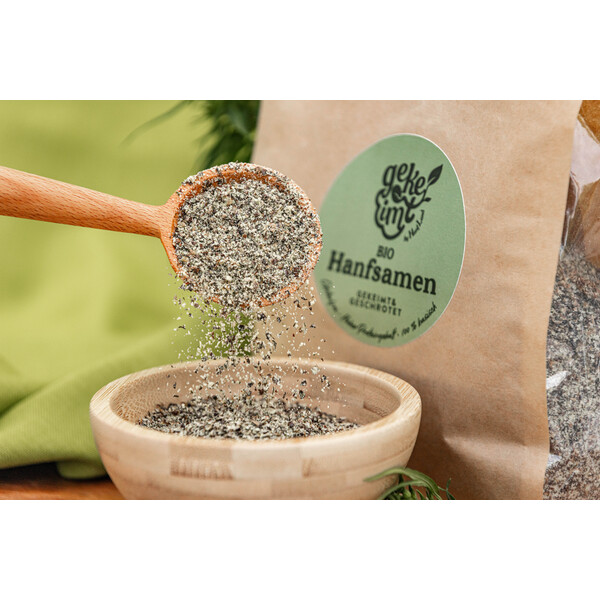
In commercial production, the process is more controlled. At Hanfland, the Keimkraft brand sprouts seeds under specified conditions and then dries them gently. „The difference from home sprouting lies in control: consistent temperature, set germination time, hygiene protocols,“ according to Steinfellner.
Using Sprouted Seeds in Your Kitchen
Sprouted hemp seeds are softer than unsprouted ones and taste milder. They belong in applications where you won’t heat them further: over salads, in spreads, stirred into yogurt, in cold grain bowls. Once heat enters the picture, the advantage disappears, and you might as well use unsprouted seeds.
For information on how hemp seeds are generally composed and what they’re used for, see our article on the nutritional profile of hemp seeds. To learn how Gerda Steinfellner came to food-grade hemp, check our interview about 20 years of Hanfland.
Sources and further information: Daniel Mierlita, „Assessment of nutritional and functional profile of whole, hulled and germinated hemp (Cannabis sativa L.) seeds“, Frontiers in Nutrition, Volume 13 (2026), Article 1825902, doi.org/10.3389/fnut.2026.1825902. Additional background from Hanfland: Sprouted Foods – Why You Suddenly Get More from the Same Food.
Verwendest du Hanfsamen in der Küche?
Note: This article is informational and makes no health or efficacy claims. Information about food does not replace nutritional advice. For questions about your own diet, consult a doctor or registered dietitian.







Branchen-Update
News, Analysen und Reportagen — mehrmals im Monat direkt in dein Postfach.