Note: This article reflects the status as of October 1, 2026, and does not constitute legal or tax advice. Information about product, procedure, and market position comes from Sanaleo and has not been independently verified by us with authorities. The cited ruling from the Düsseldorf Finance Court concerns an individual case and does not bind other authorities. The article contains no health or efficacy claims and no consumption recommendation. Smoking damages health, regardless of what is smoked. Products of this type are reserved for adults.
📑 Inhaltsverzeichnis
- Why a tobacco-free product is subject to tobacco tax
- Why this is anything but self-evident
- How Sanaleo navigated the customs process
- What changes for retailers
- What the tax stamp proves and where its limits lie
- Why taxed hemp products have remained the exception
- About Sanaleo
- Why a tobacco-free product is subject to tobacco tax
- Why this is anything but self-evident
- How Sanaleo navigated the customs process
- What changes for retailers
- What the tax stamp proves and where its limits lie
- Why taxed hemp products have remained the exception
- About Sanaleo
- Why a tobacco-free product is subject to tobacco tax
- Why this is anything but self-evident
- How Sanaleo navigated the customs process
- What changes for retailers
- What the tax stamp proves and where its limits lie
- Why taxed hemp products have remained the exception
- About Sanaleo
- 💬 Fragen? Frag den Hanf-Buddy!
Advertisement. This article was created in paid cooperation with Sanaleo. Editorial classification is the responsibility of Hanf Magazin.
A tax stamp sits on the package, the kind you know from cigarettes, yet there’s no tobacco inside. According to its own statements, Leipzig-based wholesaler Sanaleo is bringing Germany’s first CBD joint with a tax stamp to market. How did the customs process work, and what actual value does a tax stamp have for retailers?
For retailers, the question has been uncomfortable for years: what documents does a hemp product that is smoked actually need? The answer can be found in a law where you wouldn’t necessarily expect it—specifically in the Tobacco Tax Act—and in practice, it carries more weight than many in the market realize. Sanaleo has gone through this process for pre-rolled CBD joints and, according to its own statements, became the first company in Germany to receive tax stamps for this product type. This is a good opportunity to examine what is actually being reviewed in such a procedure.
Why a tobacco-free product is subject to tobacco tax
The decisive regulation is Section 1, Paragraph 8 of the Tobacco Tax Act. It states that cigarettes or smoking tobacco also include products that consist wholly or partially of substances other than tobacco, provided they meet the other requirements. For tax liability, it matters less what a product contains than what purpose it is intended for.
A finished hemp joint meets these requirements because it is suitable for smoking without further processing and is wrapped in paper. From a tax perspective, it is therefore a cigarette, even if it doesn’t contain a shred of tobacco. The only exception applies to products intended exclusively for medical purposes and classified as pharmaceuticals.
The tax obligation results in the tax stamp, because tobacco products can only be placed on the German tax market with cancelled tax stamps. Anyone who wants to commercially sell finished hemp joints therefore needs a tax warehouse, must obtain tax stamps from the main customs office, and must pay the tax.
Why this is anything but self-evident
In practice, the path to a tax stamp for hemp products has been rocky for a long time, as a proceeding before the Düsseldorf Finance Court demonstrates. There, a plaintiff wanted to import nicotine-free herbal cigarettes made from hemp from Austria and the Czech Republic and offer them on the German market as tobacco products. The main customs office refused to issue tax stamps, arguing that cannabis as a plant-based smoking product is not marketable because abuse for intoxication purposes cannot be ruled out.
On November 27, 2024, the court saw things differently and ordered the authority to issue the tax stamps (Case No. 4 K 584/24 VTa). What is remarkable is less the outcome than the path to it, as the court examined the question of abuse potential within the tax procedure itself. With a THC content of at most 0.05 percent, this constitutes a completely insignificant amount of the psychoactive ingredient; abuse at such concentrations is ruled out according to the case law of the Federal Court of Justice. The court did not allow an appeal.
For classifying the tax stamp, this is the central point. Tax stamps are only issued for marketable goods, and for hemp, „marketable“ means it is industrial hemp where abuse for intoxication purposes is ruled out. A tax stamp on a hemp product therefore presupposes this review rather than circumventing it. We have addressed how unresolved the assessment of industrial hemp remains in our article on the abuse clause and the figures behind it.
How Sanaleo navigated the customs process
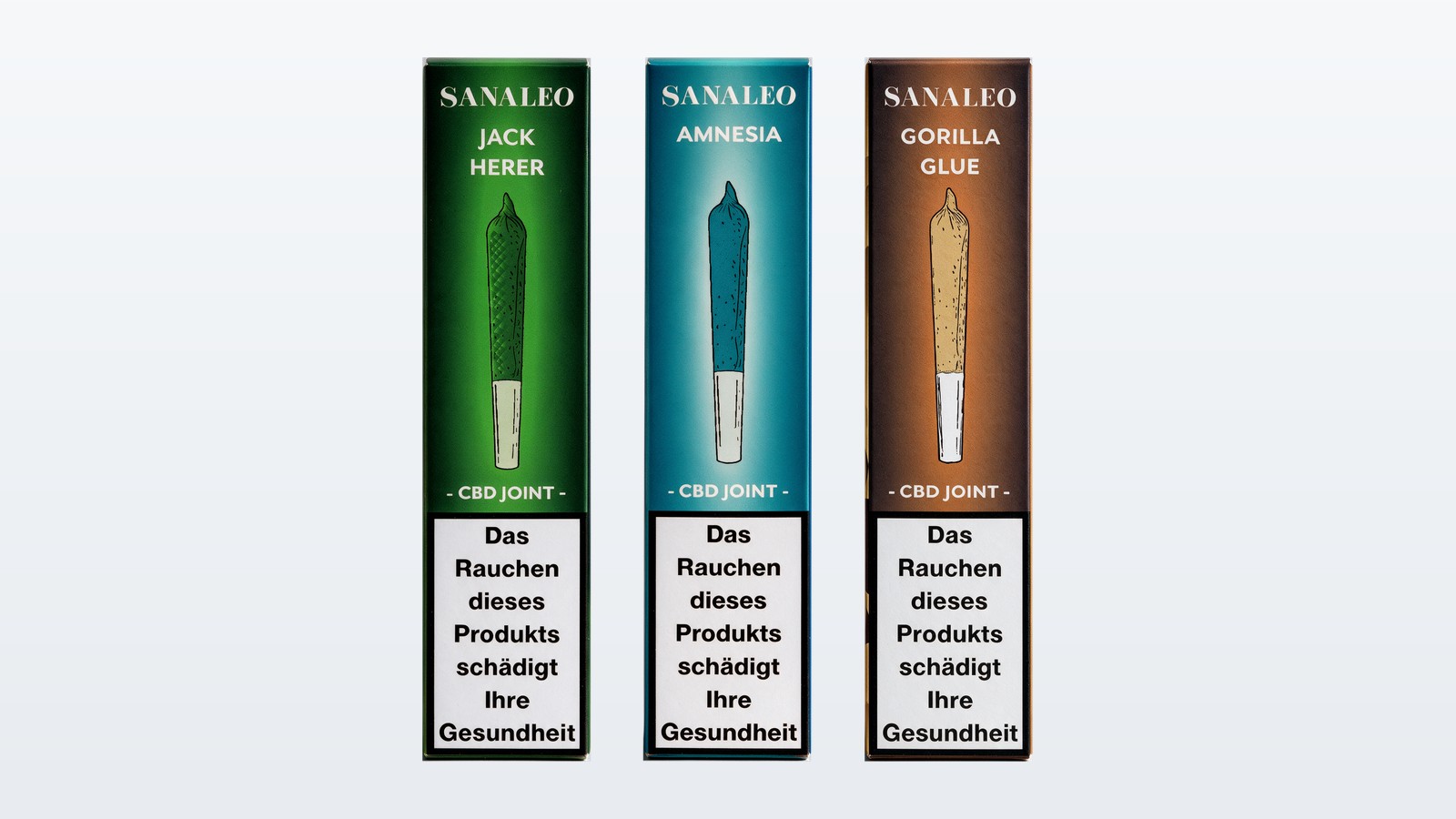
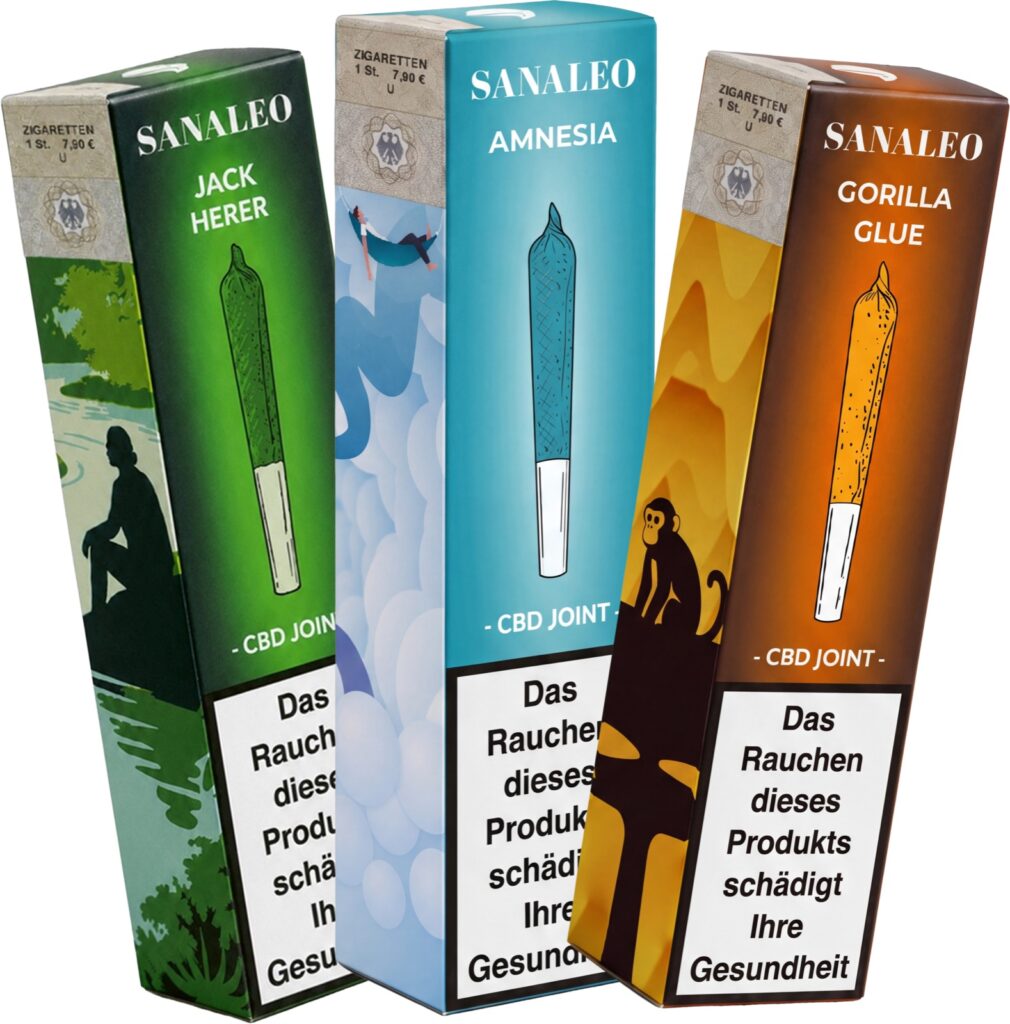
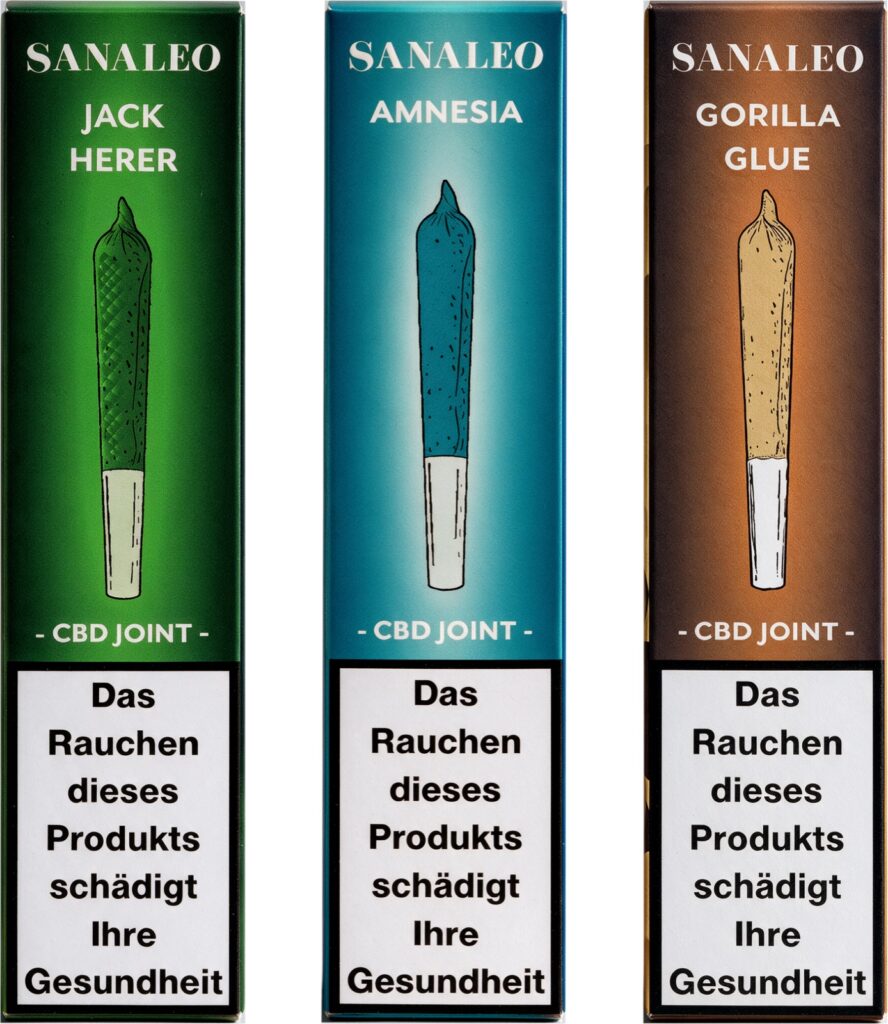
According to its own statements, Sanaleo became the first wholesaler in Germany to receive a tax stamp for THC-free hemp flower as early as May 2025. The current step goes beyond that, as the company is now bringing Germany’s first officially taxed and ready-to-consume CBD joints with tax stamps to market, according to its own account. The strains offered are Gorilla Glue, Jack Herer, and Amnesia, packaged in a folding box.
When asked, Sanaleo describes the path through the procedure as follows: „Customs classified the plant material used for the CBD pre rolls as industrial hemp in the sense of Section 1, Number 9a of the Cannabis Consumption Act. This was a prerequisite for evaluating the products as tobacco tax items and issuing the tobacco tax stamps.“ From a tobacco tax perspective, the joints are treated like cigarettes. According to the company, approximately six months passed from submitting the application to receiving the tax stamps.
Sanaleo did not have to build a new tax warehouse for this, because one already existed for the CBD flower and the permit was merely expanded to include the cigarette tax category. However, there were still many requirements, from analyses to accreditation documentation through product specifications and descriptions of quality management processes. The company had already fulfilled most of this with its application, which is why there were only occasional follow-up questions. Nevertheless, reviewing the documentation took time.
Technically, the step from taxed raw material to a ready-to-consume joint involved additional processes and further tests that had to be developed, established, and documented in a traceable manner. Regulatory-wise, it was easier because Sanaleo as a company and its own quality management processes were already known and recognized by the authority. According to the manufacturer, the product itself is nicotine- and tobacco-free, classified as a plant-based smoking product under the Tobacco Products Act, and is considered THC-free. The company states that goods undergo batch-specific analyses performed exclusively by laboratories accredited to DIN EN ISO/IEC 17025:2018 and GMP-certified.
At InterTabac Stars 2026, Sanaleo received the special prize of the German Tobacco Journal editorial team for the pre-rolled CBD joint, which also reported on it.
What changes for retailers
What taxed goods mean for retail is described by Sanaleo primarily as a matter of legal certainty. „By clearly defining the intended use as a plant-based smoking product and correctly taxing the products, retailers can no longer be accused of circumventing regulations,“ the company states. Additionally, the products are effectively sealed by the tax stamp and marked as THC-free, demonstrating excluded abuse potential even under strict interpretation.
Sanaleo sees the joints available everywhere tobacco and cigarettes are sold—in specialized tobacco shops as well as CBD retailers. Gas stations, kiosks, cigarette machines, and specialty and grocery retail are already among resale partners.
What the tax stamp proves and where its limits lie

Essentially, a tax stamp proves that tobacco tax has been paid on this product. Because the authority checks several things before issuing one, the tax stamp carries more information than just this one fact, and it’s worth distinguishing the different levels.
- The tax stamp presupposes a fulfilled abuse clause. Tax stamps are only issued for marketable goods—for hemp, only for industrial hemp under Section 1, Number 9a of the Cannabis Consumption Act, where abuse for intoxication purposes is ruled out. This is precisely why customs classified Sanaleo’s plant material as industrial hemp beforehand, and because the joints are additionally considered THC-free, the question no longer arises in this case.
- Quality is at least partially reviewed. In the procedure, customs required analyses, accreditation documentation, product specifications, and descriptions of quality management processes, thereby subjecting active ingredient content to control. Sanaleo accordingly observes that customers sometimes read the tax stamp as proof of quality because extensive reviews precede it. However, it does not replace a comprehensive purity certificate.
- It is not a product approval in the true sense, but it is evidence of marketability. Following the Düsseldorf ruling, tax stamps are only issued for marketable goods, so the tax stamp covers this point. Sanaleo reports that many understand it exactly this way in their case, because the tax stamp proves that customs rules out abuse potential for these products.
In practical terms, this means retailers have resolved the tax portion and no longer need to explain during an inspection why no tobacco tax was paid on a smokable product. There’s also the step before that: customs classified the plant material as industrial hemp and evaluated the products as THC-free. For Sanaleo, abuse for intoxication purposes is thus ruled out even under strict interpretation of the abuse clause. What the tax stamp does not accomplish beyond that remains unaffected—it does not replace any of the other tests a product must undergo. But for the point that has regularly caused problems in the past, it is currently the most reliable evidence available.
Why taxed hemp products have remained the exception
That fulfilling a tax obligation can even be reported as an industry first says a lot about the state of the market. The legal situation isn’t new, yet the number of providers with tax warehouses and tax stamps remains limited, and for specialty retailers this is becoming increasingly relevant because, in case of doubt, whoever sells is also liable.
Sanaleo primarily attributes this to an unresolved preliminary question. Whether a tax obligation exists at all must be examined on a case-by-case basis, and for that, the plant material must necessarily be industrial hemp under the Cannabis Consumption Act. Because German authorities struggle to establish concrete criteria for this, practice usually involves disputes over whether a hemp product can be abused for intoxication purposes, rather than whether it is subject to tax.
Accordingly, Sanaleo wishes the legislator would abolish the so-called abuse clause. For THC in industrial hemp, there is already a concrete and measurable threshold value that can be objectively verified and opens no additional room for interpretation. The additional requirement that abuse for intoxication purposes must be ruled out, however, leads to impractical interpretations. In seven years of corporate history, not a single case is known where someone actually became intoxicated from industrial hemp flower, and since legal access to THC-containing cannabis through partial legalization, this possibility is even more remote.
About Sanaleo
Sanaleo has been trading in hemp products since 2019. Today, its range includes CBD flower, CBD vapes, CBD oils, CBD cosmetics, tobacco replacement products, and cannabis seeds. Transparency, education, and quality are core to the company’s self-image. The company’s „Sanaleo – Vision 2030“ is built on this foundation. While joints are distributed through retailers, private customers can order flower directly from the Sanaleo online shop.
Note: This article reflects the status as of October 1, 2026, and does not constitute legal or tax advice. Information about product, procedure, and market position comes from Sanaleo and has not been independently verified by us with authorities. The cited ruling from the Düsseldorf Finance Court concerns an individual case and does not bind other authorities. The article contains no health or efficacy claims and no consumption recommendation. Smoking damages health, regardless of what is smoked. Products of this type are reserved for adults.
Advertisement. This article was created in paid cooperation with Sanaleo. Editorial classification is the responsibility of Hanf Magazin.
A tax stamp sits on the package, the kind you know from cigarettes, yet there’s no tobacco inside. According to its own statements, Leipzig-based wholesaler Sanaleo is bringing Germany’s first CBD joint with a tax stamp to market. How did the customs process work, and what actual value does a tax stamp have for retailers?
For retailers, the question has been uncomfortable for years: what documents does a hemp product that is smoked actually need? The answer can be found in a law where you wouldn’t necessarily expect it—specifically in the Tobacco Tax Act—and in practice, it carries more weight than many in the market realize. Sanaleo has gone through this process for pre-rolled CBD joints and, according to its own statements, became the first company in Germany to receive tax stamps for this product type. This is a good opportunity to examine what is actually being reviewed in such a procedure.
Why a tobacco-free product is subject to tobacco tax
The decisive regulation is Section 1, Paragraph 8 of the Tobacco Tax Act. It states that cigarettes or smoking tobacco also include products that consist wholly or partially of substances other than tobacco, provided they meet the other requirements. For tax liability, it matters less what a product contains than what purpose it is intended for.
A finished hemp joint meets these requirements because it is suitable for smoking without further processing and is wrapped in paper. From a tax perspective, it is therefore a cigarette, even if it doesn’t contain a shred of tobacco. The only exception applies to products intended exclusively for medical purposes and classified as pharmaceuticals.
The tax obligation results in the tax stamp, because tobacco products can only be placed on the German tax market with cancelled tax stamps. Anyone who wants to commercially sell finished hemp joints therefore needs a tax warehouse, must obtain tax stamps from the main customs office, and must pay the tax.
Why this is anything but self-evident
In practice, the path to a tax stamp for hemp products has been rocky for a long time, as a proceeding before the Düsseldorf Finance Court demonstrates. There, a plaintiff wanted to import nicotine-free herbal cigarettes made from hemp from Austria and the Czech Republic and offer them on the German market as tobacco products. The main customs office refused to issue tax stamps, arguing that cannabis as a plant-based smoking product is not marketable because abuse for intoxication purposes cannot be ruled out.
On November 27, 2024, the court saw things differently and ordered the authority to issue the tax stamps (Case No. 4 K 584/24 VTa). What is remarkable is less the outcome than the path to it, as the court examined the question of abuse potential within the tax procedure itself. With a THC content of at most 0.05 percent, this constitutes a completely insignificant amount of the psychoactive ingredient; abuse at such concentrations is ruled out according to the case law of the Federal Court of Justice. The court did not allow an appeal.
For classifying the tax stamp, this is the central point. Tax stamps are only issued for marketable goods, and for hemp, „marketable“ means it is industrial hemp where abuse for intoxication purposes is ruled out. A tax stamp on a hemp product therefore presupposes this review rather than circumventing it. We have addressed how unresolved the assessment of industrial hemp remains in our article on the abuse clause and the figures behind it.
How Sanaleo navigated the customs process
According to its own statements, Sanaleo became the first wholesaler in Germany to receive a tax stamp for THC-free hemp flower as early as May 2025. The current step goes beyond that, as the company is now bringing Germany’s first officially taxed and ready-to-consume CBD joints with tax stamps to market, according to its own account. The strains offered are Gorilla Glue, Jack Herer, and Amnesia, packaged in a folding box.
When asked, Sanaleo describes the path through the procedure as follows: „Customs classified the plant material used for the CBD pre rolls as industrial hemp in the sense of Section 1, Number 9a of the Cannabis Consumption Act. This was a prerequisite for evaluating the products as tobacco tax items and issuing the tobacco tax stamps.“ From a tobacco tax perspective, the joints are treated like cigarettes. According to the company, approximately six months passed from submitting the application to receiving the tax stamps.
Sanaleo did not have to build a new tax warehouse for this, because one already existed for the CBD flower and the permit was merely expanded to include the cigarette tax category. However, there were still many requirements, from analyses to accreditation documentation through product specifications and descriptions of quality management processes. The company had already fulfilled most of this with its application, which is why there were only occasional follow-up questions. Nevertheless, reviewing the documentation took time.
Technically, the step from taxed raw material to a ready-to-consume joint involved additional processes and further tests that had to be developed, established, and documented in a traceable manner. Regulatory-wise, it was easier because Sanaleo as a company and its own quality management processes were already known and recognized by the authority. According to the manufacturer, the product itself is nicotine- and tobacco-free, classified as a plant-based smoking product under the Tobacco Products Act, and is considered THC-free. The company states that goods undergo batch-specific analyses performed exclusively by laboratories accredited to DIN EN ISO/IEC 17025:2018 and GMP-certified.
At InterTabac Stars 2026, Sanaleo received the special prize of the German Tobacco Journal editorial team for the pre-rolled CBD joint, which also reported on it.
What changes for retailers
What taxed goods mean for retail is described by Sanaleo primarily as a matter of legal certainty. „By clearly defining the intended use as a plant-based smoking product and correctly taxing the products, retailers can no longer be accused of circumventing regulations,“ the company states. Additionally, the products are effectively sealed by the tax stamp and marked as THC-free, demonstrating excluded abuse potential even under strict interpretation.
Sanaleo sees the joints available everywhere tobacco and cigarettes are sold—in specialized tobacco shops as well as CBD retailers. Gas stations, kiosks, cigarette machines, and specialty and grocery retail are already among resale partners.
What the tax stamp proves and where its limits lie
Essentially, a tax stamp proves that tobacco tax has been paid on this product. Because the authority checks several things before issuing one, the tax stamp carries more information than just this one fact, and it’s worth distinguishing the different levels.
- The tax stamp presupposes a fulfilled abuse clause. Tax stamps are only issued for marketable goods—for hemp, only for industrial hemp under Section 1, Number 9a of the Cannabis Consumption Act, where abuse for intoxication purposes is ruled out. This is precisely why customs classified Sanaleo’s plant material as industrial hemp beforehand, and because the joints are additionally considered THC-free, the question no longer arises in this case.
- Quality is at least partially reviewed. In the procedure, customs required analyses, accreditation documentation, product specifications, and descriptions of quality management processes, thereby subjecting active ingredient content to control. Sanaleo accordingly observes that customers sometimes read the tax stamp as proof of quality because extensive reviews precede it. However, it does not replace a comprehensive purity certificate.
- It is not a product approval in the true sense, but it is evidence of marketability. Following the Düsseldorf ruling, tax stamps are only issued for marketable goods, so the tax stamp covers this point. Sanaleo reports that many understand it exactly this way in their case, because the tax stamp proves that customs rules out abuse potential for these products.
In practical terms, this means retailers have resolved the tax portion and no longer need to explain during an inspection why no tobacco tax was paid on a smokable product. There’s also the step before that: customs classified the plant material as industrial hemp and evaluated the products as THC-free. For Sanaleo, abuse for intoxication purposes is thus ruled out even under strict interpretation of the abuse clause. What the tax stamp does not accomplish beyond that remains unaffected—it does not replace any of the other tests a product must undergo. But for the point that has regularly caused problems in the past, it is currently the most reliable evidence available.
Why taxed hemp products have remained the exception
That fulfilling a tax obligation can even be reported as an industry first says a lot about the state of the market. The legal situation isn’t new, yet the number of providers with tax warehouses and tax stamps remains limited, and for specialty retailers this is becoming increasingly relevant because, in case of doubt, whoever sells is also liable.
Sanaleo primarily attributes this to an unresolved preliminary question. Whether a tax obligation exists at all must be examined on a case-by-case basis, and for that, the plant material must necessarily be industrial hemp under the Cannabis Consumption Act. Because German authorities struggle to establish concrete criteria for this, practice usually involves disputes over whether a hemp product can be abused for intoxication purposes, rather than whether it is subject to tax.
Accordingly, Sanaleo wishes the legislator would abolish the so-called abuse clause. For THC in industrial hemp, there is already a concrete and measurable threshold value that can be objectively verified and opens no additional room for interpretation. The additional requirement that abuse for intoxication purposes must be ruled out, however, leads to impractical interpretations. In seven years of corporate history, not a single case is known where someone actually became intoxicated from industrial hemp flower, and since legal access to THC-containing cannabis through partial legalization, this possibility is even more remote.
About Sanaleo
Sanaleo has been trading in hemp products since 2019. Today, its range includes CBD flower, CBD vapes, CBD oils, CBD cosmetics, tobacco replacement products, and cannabis seeds. Transparency, education, and quality are core to the company’s self-image. The company’s „Sanaleo – Vision 2030“ is built on this foundation. While joints are distributed through retailers, private customers can order flower directly from the Sanaleo online shop.
Sollten CBD-Joints die gleiche Steuerbanderole wie Tabak tragen?
Note: This article reflects the status as of October 1, 2026, and does not constitute legal or tax advice. Information about product, procedure, and market position comes from Sanaleo and has not been independently verified by us with authorities. The cited ruling from the Düsseldorf Finance Court concerns an individual case and does not bind other authorities. The article contains no health or efficacy claims and no consumption recommendation. Smoking damages health, regardless of what is smoked. Products of this type are reserved for adults.







Branchen-Update
News, Analysen und Reportagen — mehrmals im Monat direkt in dein Postfach.
Folge uns