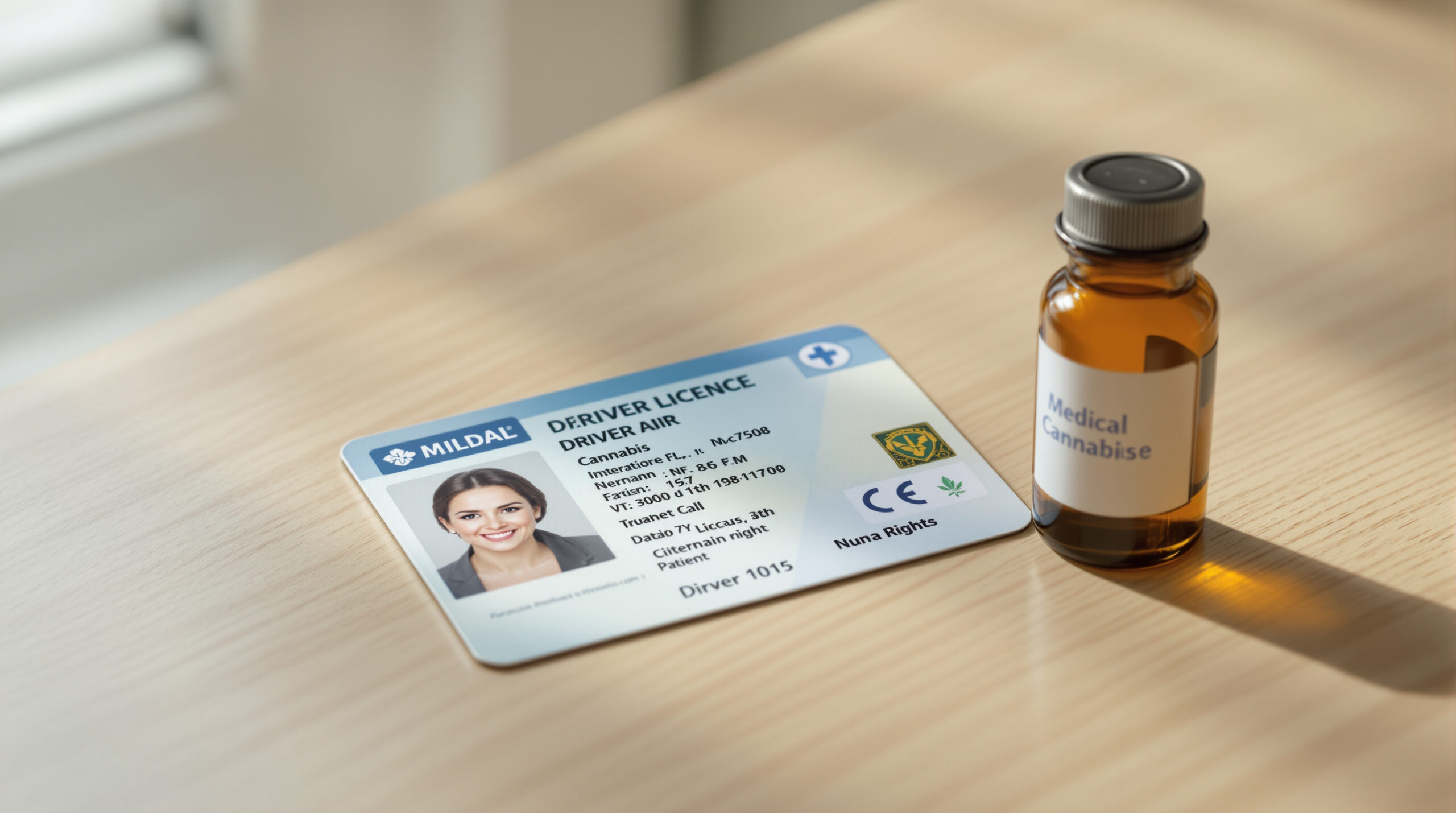
The Australian state of New South Wales passed a law in mid-September that protects patients with prescribed cannabis from automatic penalties behind the wheel. The Governor gave assent on 23 September 2026. Anyone who is registered and drives unimpaired will no longer lose their licence solely because a test detects THC. For the German debate, the move is more interesting than it appears at first glance.
📑 Inhaltsverzeichnis
What Changes for Patients in New South Wales
Until now, New South Wales enforced a strict zero-tolerance policy. Any driver who tested positive for THC on a roadside saliva test faced a fine and license suspension, regardless of whether they had a valid prescription or showed any impairment. The new law replaces this automatic punishment with a registration-based system.
Eligible drivers must register with Transport for NSW. Registration requires proof of a valid prescription and completion of a mandatory online module on cannabis and driving safety. The system applies only to holders of an unrestricted driver’s license. Learner drivers, provisional license holders, and professional drivers are excluded. The presence of alcohol or other substances in the system also disqualifies protection.


Roadside enforcement remains unchanged. A positive preliminary test still results in an immediate 24-hour driving ban. Only the laboratory analysis determines what happens next. Minister Jenny Aitchison emphasized that the system distinguishes between legitimate use of a prescribed medication and impaired driving.
Threshold Values Explained—and Why the Reference Standard Matters
The law uses two threshold values. In saliva, the limit is 50 ng/ml; in blood, it is 3.5 ng/ml. If the laboratory analysis falls below these thresholds and other conditions are met, registered drivers face no penalty. If the value exceeds the limit, a graduated response applies. The first and second detection within two years trigger a formal warning. A third detection results in a fine of 722 Australian dollars plus a minimum three-month license suspension.
These figures must not be confused. The 50 ng/ml figure applies to saliva samples, while 3.5 ng/ml applies to blood. Citing only the larger number creates a misleading impression of an exceptionally lenient policy. In fact, the blood threshold matches exactly the German limit, which we detailed in our overview of the new THC threshold for road traffic in 2026. The difference between the two countries lies not in the threshold height but in the consequences of exceeding it.
How Germany Handles It Differently
Germany has also recognized a patient privilege since 2024. Anyone taking cannabis as a prescribed medication in the proper manner does not commit a traffic offense under road traffic law solely because THC is detected. We have detailed the specifics in our guide to cannabis and road traffic in 2026. No registration procedure or mandatory training exists in Germany.
The real weakness in Germany lies elsewhere. Traffic fine law and driver licensing law operate as two separate proceedings. A patient may be protected in the traffic offense procedure yet still lose their license in administrative proceedings. Our report on how the Administrative Court of North Rhine-Westphalia has stripped cannabis patients of driving licenses illustrates this problem. New South Wales avoids this dual-track system by linking both consequences to the same registered authorization.
Why This Matters Beyond Australia
New South Wales is Australia’s most populous state and was previously among the strictest on cannabis policy. That zero tolerance is being dismantled here shifts the entire national conversation. The Australian market is already under close watch, as shown in our coverage of how the TGA is targeting closed-loop prescriptions. Legal momentum is building elsewhere too, such as in Mexico, where the Supreme Court extended personal use authorization to cannabis cooking.
For Germany, the value lies less in the threshold itself and more in the procedural approach. A registration system creates legal certainty for drivers and a solid foundation for law enforcement. It transforms the question of whether a prescription exists from a roadside evidentiary dispute into a database query. The growing need for medical cannabis regulation is evident from Germany’s debate over stricter medical cannabis rules in light of 300 tons of imports.
One caveat remains. The register and training module are not yet operational. The New South Wales government expects the system to launch in late 2026 or early 2027. A system review is scheduled for one year after launch. Until then, the old regulations remain in effect.
Frequently Asked Questions
Is the New South Wales regulation already in effect?
Not yet. The law has been passed and signed, but implementation depends on a proclamation. Transport for NSW and police must first adapt their systems and establish the register and training module. The government estimates this will take from late 2026 to early 2027.
Are 50 ng/ml really more lenient than the German threshold?
No—the figures refer to different bodily fluids. The 50 ng/ml applies to saliva samples. For blood, New South Wales sets 3.5 ng/ml, exactly matching Germany’s threshold. Comparisons only make sense when the reference standard is specified.
Who is excluded from the regulation?
Learner drivers, provisional license holders, and professional drivers are excluded. Protection also lapses if alcohol or other substances are detected. Driving while visibly impaired remains punishable in all cases, regardless of registration status.
What happens after a positive roadside test?
The initial process remains the same. A positive preliminary test triggers a 24-hour driving ban. The laboratory analysis then determines what follows. If the result falls below the threshold and the driver is registered, no further action is taken.
Could Germany introduce such a register?
Legally, it would be feasible, but it is not currently on the political agenda. Germany’s patient privilege operates without registration but does not protect against license suspension in administrative proceedings. This gap would be the logical starting point for adaptation.
Sollten Cannabispatienten in Deutschland am Steuer besser geschützt werden?
Sources: New South Wales Government ministerial statement on the Road Transport Legislation Amendment (Medical Cannabis and Driving Offences) Bill 2026, Transport for NSW, Parliament of New South Wales (Bill Details), Bubatznews, September 26, 2026.







Branchen-Update
News, Analysen und Reportagen — mehrmals im Monat direkt in dein Postfach.
Folge uns