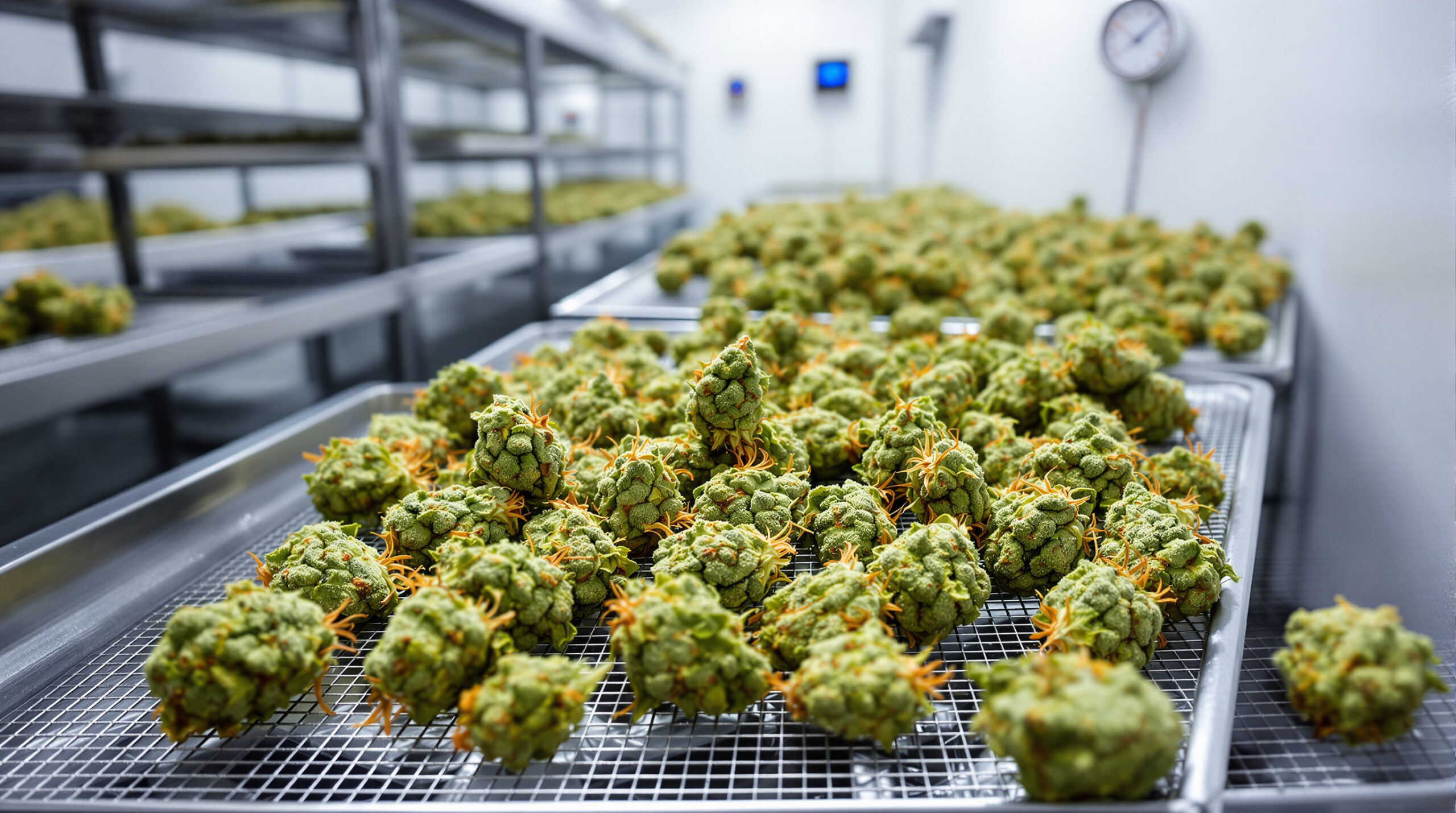
A memo from Wiesbaden is shaking up the established business model of cannabis imports. The Hessian State Office for Health and Care classifies the controlled drying of cannabis flowers as a critical manufacturing step that falls under the strict rules of good manufacturing practice (GMP). This challenges the common practice of importing flowers with the cheaper GACP status and only performing pharmaceutical processing in Europe.
📑 Inhaltsverzeichnis
The Dispute Between GACP and GMP Explained
Behind these two acronyms lie two different worlds of quality assurance. GACP stands for good agricultural practice and regulates cultivation and initial harvest processing. GMP describes good manufacturing practice for pharmaceuticals and sets significantly higher requirements for documentation, facilities, and process control.
For imported medical cannabis, the division has long been convenient. Producers in Canada, Portugal, or Africa harvested under GACP standards, shipped the material to Europe, and had it released in GMP-certified facilities here. The Hessian authority refers to this procedure as GMP-washing and clearly rejects it.


What the Hessian Authority Specifically Demands
The state office relies on European pharmaceutical law, specifically Directive 2001/83/EG and the EU GMP Guide. According to this interpretation, manufacturing does not begin in the German laboratory but rather with drying at the harvest site. The authority explicitly states it knows of no procedure that allows GACP flowers to be stored, transported, and imported over extended periods without quality loss.
The consequence is a high hurdle. Anyone wishing to continue importing GACP material must conclusively demonstrate that incomplete drying does not compromise quality. Many supply chains in their current form are unlikely to provide this proof.
Why the Drying Step Becomes the Decisive Factor
Drying determines residual moisture, terpene profile, and microbial contamination. This is precisely why Hessen views it as a critical process step with direct impact on product quality. If storage is too moist, mold and microbial contamination threaten. If post-treatment is too aggressive, active compounds and aroma suffer.
How closely quality and regulation are intertwined is also evident in microbial reduction. We have already thoroughly analyzed why the industry lags behind regulatorily in microbial decontamination of medical cannabis and who bears liability in case of damage. The question of which producer is actually properly GMP-certified has been occupying the industry for years, as demonstrated by examining individual suppliers and their certification status.
A Patchwork Instead of Uniform Rules
The lack of uniformity is particularly problematic. While Hessen interprets strictly, Switzerland’s Swissmedic explicitly permits simple pre-drying and post-harvest treatment before actual pharmaceutical manufacturing begins. Other German states also draw the line differently. The authority in Hannover places the start of GMP requirements at the first cleaning or drying step.
All cite the same Annex 7 of the GMP Guide but reach different conclusions. For importers, this creates legal uncertainty because the same supply chain can be permissible in one federal state and contestable in another.
Consequences for Importers, Pharmacies, and Patients
Should the Hessian approach prevail, import costs will increase noticeably. GMP-compliant drying and processing at the harvest site requires expensive equipment and trained personnel. Smaller producers in third countries could lose access to the European market, while larger ones would need to invest significantly.
For patients, the ultimate question concerns availability and price. The German market has recently experienced a significant price decline. Simultaneously, import flows are shifting, as seen in record British imports and the detour through Canada. Stricter GMP interpretation could further accelerate these movements.
The conflict between legal imports and regulatory control is not entirely new. Previously, a case caused controversy when customs seized legally imported cannabis. How much regulatory pressure can move the market is also evident in reimbursement policies. Recently, the Bundestag debated the potential end of cannabis flowers on insurance reimbursement.
Frequently Asked Questions
What does GMP-Washing mean?
The term describes the practice of importing cannabis flowers under the cheaper GACP status and only performing pharmaceutical processing in Europe. Critics see this as circumventing GMP requirements that should apply earlier. The Hessian authority explicitly rejects this approach.
What are the differences between GACP and GMP?
GACP regulates cultivation and initial harvest processing according to agricultural standards. GMP is the pharmaceutical manufacturing standard with strict requirements for documentation, facilities, and process control. The dispute revolves around where exactly the boundary between the two lies.
Why is drying so crucial?
Drying determines the residual moisture, terpene profile, and microbial contamination of flowers. From the Hessian authority’s perspective, it is therefore a critical manufacturing step that must be controlled under GMP. This is precisely where the regulatory conflict begins.
What are the consequences of strict interpretation for patients?
Should the Hessian approach become the standard, import and processing could become more expensive. This may affect the availability and price of individual varieties. In the short term, supply remains secure, but medium-term shifts in supply are possible.
Does this regulation apply nationwide?
No. The memo comes from the Hessian State Office for Health and Care and initially applies only to Hesse. Other federal states interpret the boundary between GACP and GMP differently. A nationwide uniform approach is lacking so far.
Sources: Hessisches Landesamt für Gesundheit und Pflege (Memo, June 2026); Business of Cannabis; Krautinvest.





Sollte die GMP-Pflicht bereits bei der Trocknung am Ernteort beginnen?
Branchen-Update
News, Analysen und Reportagen — mehrmals im Monat direkt in dein Postfach.
Folge uns