What the Cannabis-Cortisol Study Actually Measured
Julia Donner, Alexia N. Obrochta, and Anita Cservenka published their work on June 9, 2026, in the journal Cannabis. The study examined 39 adults with frequent cannabis use and 43 healthy control participants. All participants collected saliva samples on two consecutive weekdays—immediately upon waking, 30 minutes later, and again in the evening. Alongside this, they reported their subjective stress levels.
📑 Inhaltsverzeichnis
The focus was the so-called cortisol awakening response, abbreviated as CAR in the literature. This refers to the rise in cortisol levels during the half-hour after waking. Everyone experiences this rise, and its magnitude serves as a relatively stable indicator of activity in the stress axis—the system connecting the hypothalamus, pituitary gland, and adrenal cortex. The logic is straightforward: subtract the cortisol value at waking from the value 30 minutes later.
The Findings That Headlines Left Out
On this very measure—the awakening response—researchers found no difference between the two groups. The p-value was 0.23, far below the threshold for statistical significance. The study’s primary research question received a negative answer: frequent cannabis users do not show different morning cortisol dynamics than control participants.


What did differ was only the baseline value. Upon waking, the cannabis-use group had higher cortisol levels than the control group, with p = 0.047. This single data point supports the entire media narrative about waking up already stressed. Readers who only see the headline may think this is a robust finding. Those who read the paper see a result just barely below the significance threshold.
Why a P-Value of 0.047 Calls for Caution
Eighty-two participants is a respectable number for a saliva study, but it’s not a large sample for making robust claims about the stress axis. Cortisol also fluctuates significantly. Sleep duration, wake time, nicotine, caffeine, and menstrual cycle phase all affect the measurement. There’s also the practical question of whether participants actually collected samples in the first minute after waking. Two days of measurement only partially smooth out such variation.
Add to this the study’s design: it’s a cross-sectional study, not a longitudinal one. Whether cannabis use raises cortisol or whether people with higher baseline stress consume cannabis more frequently cannot be determined from this data. Cservenka herself explicitly acknowledged this in her university’s press release—a caveat that was lost in translation to the headlines. We recently documented how quickly a single measurement value becomes treated as certainty in our coverage of drug screening tests after an Austrian music festival.
The More Compelling Finding That Went Unnoticed
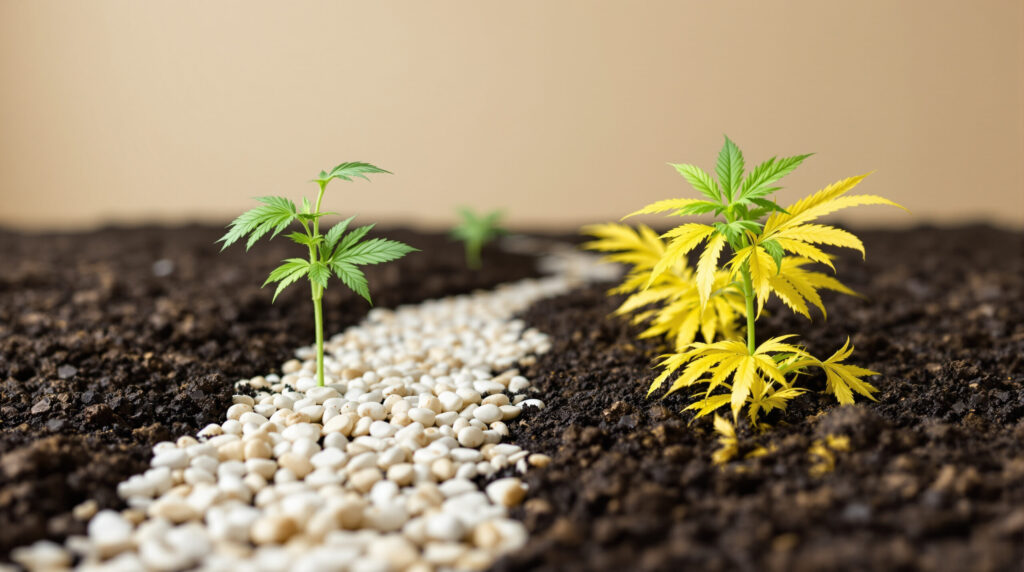
The third finding—and the most meaningful in the entire study—largely disappeared from coverage. The elevated morning cortisol was not associated with the amount or frequency of use. It was associated with the negative consequences of use that participants reported for themselves, with p = 0.007. This is the study’s strongest correlation.
This distinction is more than a statistical detail. It shifts the question away from cannabis use itself and toward problematic cannabis use. The authors accordingly frame this carefully: morning cortisol could be a potential neurobiological marker for problematic cannabis use. This is a research hypothesis for future investigation, not a finished diagnostic tool. We’ve explored in detail how tightly the endocannabinoid system and stress regulation are biologically interwoven in our article on how cannabinoids regulate stress.
What This Means for the German-Language Debate
Stress relief ranks among the most frequently cited reasons for cannabis use, both for recreational consumption and self-medication. The 2025 BIÖG Drug Affinity Study illustrates how prevalent use has become among younger age groups. Meanwhile, a substantial portion of the CBD market is marketed with relaxation promises, despite the evidence base being thinner than the marketing claims. We’ve addressed this directly in our article on how CBD can help with stress management.
For prevention efforts, a biological marker for problematic use would indeed be useful. Currently, counseling centers rely on self-reporting and questionnaires. An objective additional tool could make conversations more evidence-based. But there’s still a long road to get there, and this current study provides at best a starting point. In the ongoing discussion about improvements to cannabis legislation, prevention plays a central role, as reflected in calls from the drug commissioner for corrections to the cannabis law.
For users themselves, this study initially changes nothing. It neither proves that cannabis damages the stress system nor that it reduces stress. Those who notice negative consequences from their use might see here a hint that these effects could also have a physical dimension. Similar caution applies to studies on mood and mental health, as our overview of cannabis and depression demonstrates.
Frequently Asked Questions
Does the study prove that cannabis causes stress?
No. This is a cross-sectional study that describes a correlation but does not establish causation. Whether cannabis use raises cortisol levels or whether people with higher baseline stress use cannabis more frequently remains unclear. Longitudinal studies over extended periods would be needed to answer that question.
What is the cortisol awakening response?
The cortisol awakening response describes the natural rise in cortisol levels during the half-hour after waking. It occurs in everyone and serves as an indicator of activity in the body’s stress axis. In this study, the response did not differ between groups.
How many people participated?
The study included 39 adults with frequent cannabis use and 43 healthy control participants—82 people total. Each person collected three saliva samples on two consecutive weekdays. For an endocrinological study, this is a standard sample size, though not exceptionally large.
Does a higher cortisol value automatically mean more stress?
Not necessarily. Cortisol is a hormone with many functions, including roles in metabolism and immune function. Levels fluctuate throughout the day and respond to sleep quality, caffeine, nicotine, and the timing of sample collection. A single elevated measurement is therefore not proof of elevated stress levels.
Does cannabis help with stress?
This study doesn’t answer that question, since it didn’t test effects but rather compared hormone levels. Many users report subjectively that cannabis has a relaxing effect. However, controlled studies examining cannabis and stress remain scarce, and results vary depending on dose and cannabinoid profile.
Hast du bei dir selbst schon Zusammenhänge zwischen Cannabis und Stress bemerkt?
Source: Donner J., Obrochta A. N., Cservenka A.: „Subjective Stress and Diurnal Salivary Cortisol in Adults with Frequent Cannabis Use“, Cannabis, published online June 9, 2026, DOI 10.26828/cannabis/2026/000390. Also: Oregon State University press release, July 2026.




Branchen-Update
News, Analysen und Reportagen — mehrmals im Monat direkt in dein Postfach.