Depression is one of the most common mental disorders in Germany. According to estimates, approximately one in five adults will experience at least one depressive episode requiring treatment during their lifetime. With the legalization and growing market for medical cannabis, a question increasingly surfaces in clinical consultations: Does cannabis actually help against depression, or does it even worsen the condition long-term? The research landscape in 2026 provides a considerably more nuanced picture than patient forums and lifestyle reports suggest. Anyone taking the data seriously must clearly distinguish between clinical trials, real-world observations, and mechanistic research. This overview does precisely that.
📑 Inhaltsverzeichnis
- How the Endocannabinoid System Regulates Mood
- What Clinical Trials on Cannabis and Depression Actually Show
- Real-World Data: What Patient Registries Show Beyond RCTs
- THC, CBD, or Full-Spectrum: The Question of the Right Active Compound
- Risks: Drug Interactions with Antidepressants and Cannabis Use Disorder
- German Guidelines and a Look at Psilocybin
- Frequently Asked Questions
- 💬 Fragen? Frag den Hanf-Buddy!
How the Endocannabinoid System Regulates Mood
The plausible connection between cannabis and depression lies in the endocannabinoid system, or ECS. CB1 receptors are found in high density in the prefrontal cortex, hippocampus, and amygdala. These are precisely the brain regions that show structural and functional changes in depressed patients. The endogenous cannabinoid anandamide binds to CB1 receptors and exerts mood-stabilizing effects before being broken down by the enzyme FAAH. Animal studies have shown for years that FAAH inhibition can lead to antidepressant effects.
A 2023 study by Hindocha and colleagues published in Translational Psychiatry investigated whether CBD stabilizes anandamide levels in humans. Eighty participants with cannabis use disorder received either 400 or 800 milligrams of cannabidiol daily over 28 days. The higher dose maintained anandamide concentration significantly more stable than placebo. The mechanism thus remains biologically plausible. Additional background is provided in our overview article The Endocannabinoid System Explained. However, plausibility does not replace clinical efficacy evidence, and this is precisely where the real problem begins.


Additionally, the endocannabinoid system directly intervenes in stress regulation. Via the hypothalamic-pituitary-adrenal axis, or HPA axis, endocannabinoids act as a counterregulatory brake on excessive cortisol response. Chronic stress and chronically elevated cortisol are considered central drivers of depressive episodes. A dysfunctional ECS could therefore be more than mere accompanying phenomenon; it may be an independent pathophysiological factor. In animal experiments, pharmacological enhancement of the ECS leads to reduced stress behavior and increased neuroplasticity in the hippocampus. These mechanistic findings are precisely why research groups worldwide continue to invest in this field, despite the thin clinical evidence base.
What Clinical Trials on Cannabis and Depression Actually Show
The key reference point remains the major review by Black and colleagues in Lancet Psychiatry. As early as 2019, the team synthesized 83 studies and reached a sobering conclusion: there is only sparse evidence for the antidepressant efficacy of cannabinoids. A 2026 update by the same working group reinforces this position. The authors continue to consider routine use of cannabis for mental disorders unjustified.
A 2025 meta-analysis by Churchill and colleagues published in Psychological Medicine evaluated 22 longitudinal studies. The result: cannabis users showed a 29 percent higher risk of developing depression compared to non-users over the course of follow-up. With heavy use, the odds ratio rose to 1.81; with moderate use, it was 1.39. These figures come from observational studies, so they do not establish direct causality, but they point to a clearly demonstrable association pattern.
A second review by Sorkhou and colleagues from 2024, published in Frontiers in Public Health, examined 78 studies. The authors found consistent evidence of increased likelihood of major depression among regular users as well as worse prognosis in those with existing diagnoses. Meanwhile, randomized-controlled evidence for antidepressant effects of medical cannabinoids remains limited. To date, no sufficiently large, high-quality RCTs exist that could demonstrate a clear therapeutic effect.
Real-World Data: What Patient Registries Show Beyond RCTs
In contrast to the rather cautious RCT findings, real-world data paint a friendlier picture. The largest available source is the UK Medical Cannabis Registry. Erridge and colleagues evaluated a two-year case series of 698 patients in early 2025 whose primary indication was an anxiety disorder or depression. Scores on the PHQ-9 questionnaire for depressive symptoms, the GAD-7 for anxiety, and sleep quality all improved significantly at all measurement points.
A naturalistic outpatient study from 2024 by Erkens and colleagues with 59 patients with major depression also reported a response rate of 50.8 percent. Response was defined as a reduction of HAM-D values by at least half. These figures sound promising, but they have a methodological weakness: there was no placebo arm. Patients who actively choose cannabis are highly selected and often have strong expectations of the therapy.
Behind the positive registry figures lies a classic selection problem. Patients enrolled in the UK Medical Cannabis Registry often decided on cannabis only after several failed standard therapies. The setting is private medical care, many patients bear the costs themselves, and expectations are correspondingly high. Such expectancy effects explain a substantial portion of mood improvements in placebo-controlled settings. Additionally, dropouts in naturalistic registries are often insufficiently documented. Those who discontinue therapy due to side effects or lack of efficacy tend not to appear in later analyses. This shifts the overall picture in favor of responders.
Real-world data thus usefully complement RCTs, but they do not replace them. Patients considering medical cannabis should understand the prescription process precisely. Background information is provided in the article Cannabis by Prescription. Comparable treatment of a related indication is found in our article Sleep Disorders Reconsidered, which makes the same distinction between clinical and real-world evidence.
THC, CBD, or Full-Spectrum: The Question of the Right Active Compound
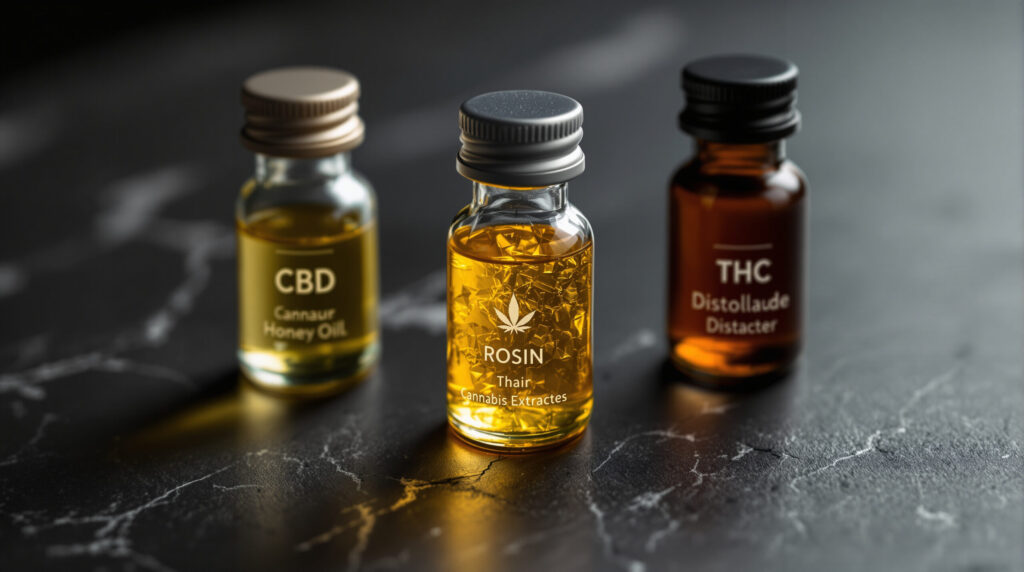
Cannabis is not a single active compound. Therapeutically relevant are primarily THC and CBD, increasingly also minor cannabinoids like CBG. THC acts as a partial agonist at CB1 and CB2 receptors. Low doses can elevate mood, while high doses produce anxiety, dysphoria, and in extreme cases paranoid states. The therapeutic window is therefore narrow, and individual response varies considerably.
CBD barely binds directly to CB1 or CB2. It exerts its effects through other pathways, primarily through partial activation of the serotonin receptor 5-HT1A and through the aforementioned FAAH inhibition. A 2024 review by Zarazúa-Guzmán in Basic and Clinical Pharmacology and Toxicology rates mechanistic plausibility as high but clinical evidence in humans as insufficient. In plain terms: the large, clean RCTs that would demonstrate an antidepressant effect of CBD are lacking. Research into anxiolytic minor cannabinoids remains exciting, as illuminated in the article New Study: CBG Shows Demonstrable Anxiolytic Effect.
Risks: Drug Interactions with Antidepressants and Cannabis Use Disorder
When discussing cannabis for depression, risks must be named openly. First, both THC and CBD inhibit the liver enzymes CYP2C19, CYP2D6, and CYP3A4. These are precisely the enzymes that metabolize many common antidepressants, including citalopram, sertraline, classic tricyclic agents, and atypical antipsychotics like aripiprazole. Concurrent use can significantly elevate antidepressant plasma levels. A documented case of serotonin syndrome from the combination of CBD and an SSRI illustrates the problem.
Second, regular use increases the risk of cannabis use disorder. Data from Canada show a clear increase in inpatient treatment for cannabis dependence since legalization in 2018. A 2026 analysis published in Lancet Regional Health Americas estimates the increase in cannabis-related hospitalizations in psychiatric populations at approximately 270 percent. Cannabis is therefore not a harmless alternative to pharmacotherapy. It is a substance with its own addiction potential and a demonstrably real risk profile.
Third, depressed patients react particularly sensitively to high-dose THC. Even a single unfavorable use occasion can intensify depressive rumination. Patients considering cannabis for depression should do so exclusively under medical supervision, with defined strain, defined dosage, and close monitoring. A related care area, sleep, is explored in detail in the article Cannabis Oil for Sleep Disorders.
German Guidelines and a Look at Psilocybin
The German S3 guideline for unipolar depression, version 3.0, issued by DGPPN, German Medical Association, KBV, and AWMF, does not provide a positive recommendation for cannabinoids. Cannabis is not listed in the guideline as a therapeutic option for depression. The BfArM accompanying survey on medical cannabis, which evaluated extensive patient data between 2017 and 2022, provides only marginal evidence for depression as an indication. Pain, spasticity, and cancer-related therapy dominate the reliable data sets.
While cannabis for depression remains in the evidence shadows, another psychoactive compound delivers remarkable Phase 3 data. The Compass Pathways COMP005 study showed in 2025 a MADRS reduction of 3.6 points versus placebo in 258 patients with treatment-resistant depression. The follow-up study COMP006 confirmed comparable effects in 2026. Those wishing to understand the research landscape on psilocybin will find an entry point in the article Psilocybin Psychotherapy in Germany. Comparable data for cannabis are entirely absent to date.
Frequently Asked Questions
Is Cannabis Prescribable for Depression in Germany?
Basically yes, but not as standard therapy. Medical cannabis has been prescribable since 2017. For the indication of depression, however, there is no positive guideline recommendation. A prescription therefore occurs almost always within the framework of an individual therapeutic attempt when established procedures such as psychotherapy and antidepressants are insufficient or not tolerated.
What Do the Most Important Current Studies Show in Summary?
RCT evidence is weak; major reviews such as Black 2019 and the 2026 update reach a cautious judgment. Observational studies show an increased risk of developing depression over time. Patient registries like the UK Medical Cannabis Registry report symptom improvements, however without placebo control. The findings therefore only appear contradictory; they measure different things.
What Drug Interactions Threaten with Antidepressants?
THC and CBD inhibit the cytochrome enzymes CYP2C19, CYP2D6, and CYP3A4. This can raise levels of many SSRIs, tricyclic antidepressants, and atypical antipsychotics. Concurrent therapy must be strictly medically supervised, ideally with therapeutic drug monitoring. Self-medication alongside ongoing antidepressant treatment is risky.
Does CBD Alone Work Against Depression?
Mechanistically, an antidepressant effect of CBD is plausible, for example via the 5-HT1A receptor and through inhibition of the enzyme FAAH. Clinically, however, large, high-quality RCTs in humans are lacking. Early pilot studies hint at effects, but these are insufficient to call CBD an evidence-based antidepressant.
Does Cannabis Increase Suicide Risk?
US data from 2000 to 2019 show that states with liberal cannabis regulation recorded elevated suicide rates. Direct causality cannot be inferred from this, as many factors are involved. In patients with active depressive episodes and suicidality, cannabis is nonetheless considered problematic. Close psychiatric monitoring is essential in such cases.
How Does Cannabis Differ from Psilocybin for Depression?
Hast du Cannabis schon mal bei depressiver Stimmung ausprobiert?
For psilocybin, the Compass Pathways studies COMP005 and COMP006 provide two positive Phase 3 studies for treatment-resistant depression. For cannabis, comparably robust evidence does not yet exist. Both substances work through entirely different mechanisms. Psilocybin primarily modulates the serotonergic system; cannabis intervenes in the endocannabinoid system.


Branchen-Update
News, Analysen und Reportagen — mehrmals im Monat direkt in dein Postfach.