Europe grows flax and hemp but sends most of it to Asia for processing. A new facility in Portugal is designed to change that—and who’s building it is equally remarkable.
📑 Inhaltsverzeichnis
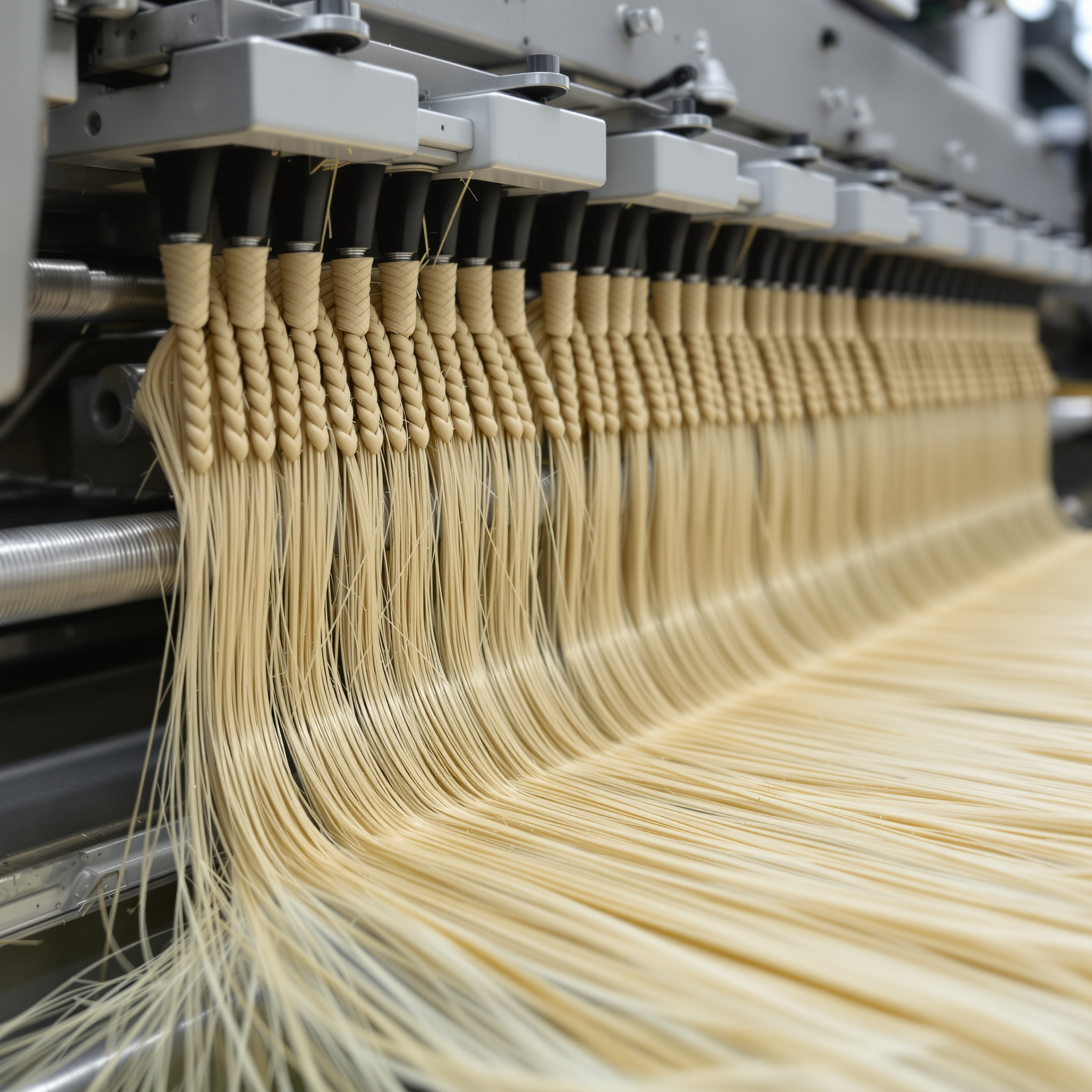
A wet spinning mill for flax and hemp fibers is under construction in Rebordões, near Santo Tirso in northern Portugal. The facility, named Nafilux by Nau Verde, represents a €30 million investment expected to create approximately 250 jobs. According to reports from August 2026, initial operations have begun, with production staff now being hired.
Why a spinning mill, specifically?
The gap in Europe’s fiber chain doesn’t exist in cultivation or garment production—it’s in the processing step between them. Flax is grown extensively in France, Belgium, and the Netherlands; hemp is cultivated across multiple EU member states, with acreage growing sharply in Poland. Yet the vast majority is spun into yarn in Asia before being shipped back to Europe.


Wet spinning is the technically demanding step. Fibers pass through a water bath that dissolves pectins, enabling finer, more uniform yarns suitable for apparel-grade textiles. These facilities are largely absent in Europe. Anyone who builds them shifts significant value creation and substantially reduces transportation distances.
Who’s behind it
The project is led by a consortium of Portuguese textile companies: Calvelex, Mundifios, Paulo de Oliveira, and Riopele. Notably, the Chinese Kingdom Holdings—one of the world’s largest linen yarn producers—is also a partner.
This is the most striking detail of the announcement. An initiative designed to strengthen European supply chains brings in a partner from exactly the country where this processing step has been outsourced for decades. You can read this as a contradiction, or as an admission that wet spinning expertise has been lost across Europe and must now be repurchased. Both interpretations are fair, and both deserve consideration before viewing this as a straightforward success story.
Putting the numbers in perspective
The €30 million investment exists within a broader context. The project is part of the Lusitano mobilization agenda, funded through Portugal’s recovery and resilience plan, which industry reports cite as having a total volume of approximately €111.5 million. Whether the €30 million applies entirely to the wet spinning mill or represents a portion within this broader agenda is unclear from available sources. We therefore cite this figure as stated by the project participants.
For hemp specifically, there’s an important caveat: such facilities are primarily built for flax, with hemp processed as a secondary fiber. How much of the final output will be hemp is determined by market demand, not by the technology itself.
For more context on why this fiber warrants attention, see our comprehensive coverage: the complete guide to hemp textiles, a detailed comparison with cotton, and an exploration of why the oldest utility fiber is experiencing a comeback.
Sources: Portuguese industry reporting from August 28, 2026, on the Nafilux by Nau Verde project in Rebordões, Santo Tirso; information on the Lusitano agenda and recovery and resilience plan; industry association newsletter from October 21, 2026. Investment amount and job figures are statements from the project participants and have not been independently verified by us. Last updated: October 21, 2026.










Sollte Europa die Hanfverarbeitung wieder selbst übernehmen?
Branchen-Update
News, Analysen und Reportagen — mehrmals im Monat direkt in dein Postfach.
Folge uns