On September 14, 2026, the German Federal Criminal Police Office (BKA) published its National Crime Situation Report on Drug Trafficking for 2025. Two figures from this report will dominate the debate, and they point in opposite directions: the number of registered cannabis offenses fell to 42,909, while the amount of seized marijuana tripled to 63.8 tons.
📑 Inhaltsverzeichnis
What the BKA Counted for 2025
Of the 42,909 cannabis offenses, 42,823 involved violations of the Cannabis Consumption Act, with 86 violations of the Medicinal Cannabis Act. The largest category consists of 25,093 cases of illegal trafficking and smuggling. Particularly serious offenses under Section 34(3) of the Cannabis Act account for 5,207 cases, including 4,328 involving commercial-scale operations or handling of non-small quantities. Under the felony provisions of Section 34(4), which include organized group activity, the BKA registered 998 offenses. In total, 34,037 suspects were recorded, of which 19,184 held German citizenship.
Overall drug crime fell by 27.7 percent to 228,104 cases. Excluding cannabis, the picture changes dramatically: this category stands at 122,082 cases—only 4.6 percent below the previous year. The decline in the overall statistics is thus almost entirely a cannabis effect, not the result of generally declining drug crime. This conclusion aligns with a previous DIW analysis on cannabis and cocaine.


Why the 2023 Comparison Doesn’t Hold Up
Trade reporting has circulated since Monday the calculation that cannabis offenses have fallen about 80 percent since 2023. The arithmetic checks out: 215,865 cases in 2023, 101,345 in 2024, 42,909 in 2025. However, the BKA explicitly notes in a footnote that comparisons of 2025 offense numbers with previous years are not possible.
There are two breaks in the statistics. Through 2023, cannabis offenses were recorded exclusively under the Narcotic Drugs Act. In 2024, due to mid-year legislative changes, they were recorded under either the Narcotic Drugs Act or the Cannabis Act. Since 2025, recording has been exclusively under the Cannabis Act. Additionally, the police crime statistics keys were modified between 2024 and 2025. Comparing all three figures places three different recording regimes side by side. The underlying message remains valid—that decriminalization has spared a massive number of criminal proceedings. However, the percentage figure is one the authorities would not themselves derive from their own data. This caution was also lacking in parts of media coverage of the 2025 Police Crime Statistics.
Tripled Seizures and 567 Cultivation Operations
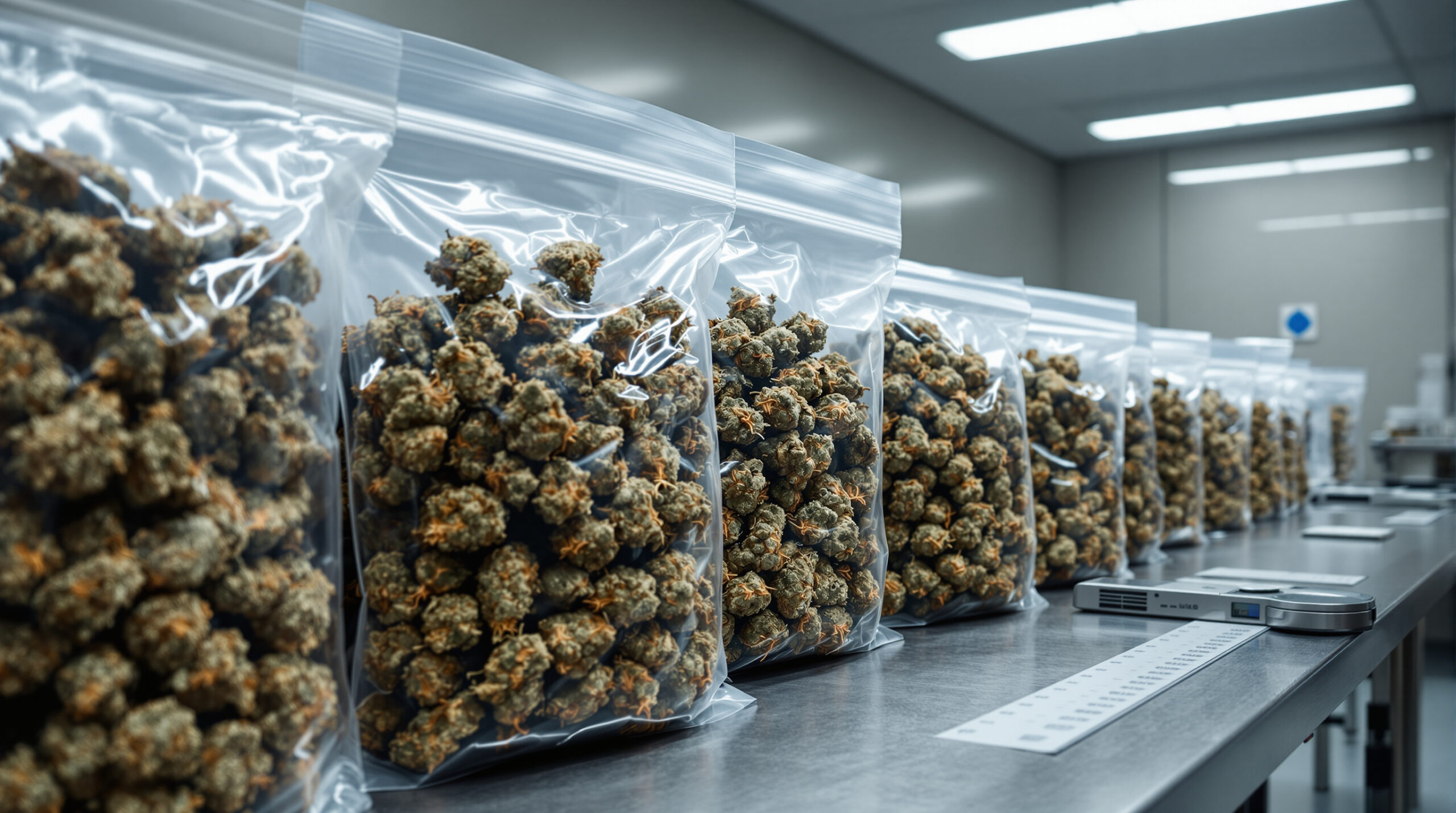
The more reliable figure appears elsewhere. While approximately 19.4 tons of marijuana were seized in 2024, the 2025 figure stands at exactly 63.8 tons. Hashish seizures remained virtually unchanged at 5.1 tons. Additionally, 567 cannabis cultivation operations with capacities of 20 plants or more were dismantled—an increase of about 55 percent from 366 in the previous year. These included 79 professional operations, 174 large-scale operations, and 314 small-scale operations, the vast majority indoors.
The BKA also describes a shift in smuggling routes. The majority of seized cannabis arrived by shipping container or postal shipment from Canada, the United States, and Thailand, increasingly by air freight from the United States and in checked luggage from Thailand. Cannabis from Spain, where professional cultivation by organized groups has become established, reaches Germany via postal shipment. This route shift aligns with cases we’ve previously reported, such as Californian cannabis concealed in furniture shipments.
What This Reveals About the Black Market
Seizure volumes are not a direct measure of supply. They also depend on where enforcement occurs and what resources are available. This distinction is precisely what makes the data interesting: because possession and home cultivation are decriminalized within limits, police and customs must process far fewer minor cases. The freed-up capacity evidently flows toward trafficking, smuggling, and cultivation operations. The parallel increase of over 50 percent in detected cultivation operations fits this pattern.
The political interpretation remains contested. The BKA president stated in spring that the black market remains unbroken despite legalization. The situation report supports this assessment insofar as pressure for imported supply remains high. However, it also contradicts the expectation that a legal access route for adults would naturally eliminate illegal supply if that route remains tightly restricted through cultivation associations and pilot projects fail to launch. For historical context, comparison with an earlier annual drug crime report from the prohibition era proves instructive.
Potency: Hashish Pulling Away
The report substantially relativizes a frequently claimed trend. The median THC content of seized marijuana has risen only marginally over a decade—from 12.6 percent in 2014 to 14.9 percent in 2025. There is no evidence of doubled flower potency. Hashish tells a different story: the median in the same period more than doubled from 9.7 to 27.8 percent. Those discussing risks from high THC levels are therefore speaking primarily about extracts and resins, not about black market flower.
Frequently Asked Questions
What is the BKA National Crime Situation Report on Drug Trafficking?
It is an annual report by the German Federal Criminal Police Office on the state and development of drug crime in Germany, broken down by substance. The basis consists primarily of data from the Police Crime Statistics and findings from investigation proceedings.
Why are cannabis figures not comparable to previous years?
Because the recording basis changed twice. Through 2023, the Narcotic Drugs Act applied; in 2024, both legal frameworks existed within one year; since 2025, recording is exclusively under the Cannabis Act. Additionally, police crime statistics keys were adjusted.
Do higher seizures mean a larger black market?
Not necessarily. Seizures are enforcement outcomes that depend on priorities and resource allocation. An increase can indicate intensified investigations into trafficking and smuggling just as much as it can indicate larger supply.
What is the THC content in seized cannabis?
For marijuana, the 2025 median is 14.9 percent; for hashish, 27.8 percent. These are values from police seizures and cannot be extrapolated to legally purchased products.
How many people were charged with cannabis offenses in 2025?
The BKA reports 34,037 suspects in connection with cannabis offenses. Suspicion does not equal conviction; a substantial portion of proceedings are dismissed.
Wie bewertest du die verdreifachten Marihuana-Sicherstellungen in Deutschland?
Source: Federal Criminal Police Office, National Crime Situation Report on Drug Trafficking 2025, as of September 14, 2026.






Branchen-Update
News, Analysen und Reportagen — mehrmals im Monat direkt in dein Postfach.
Folge uns