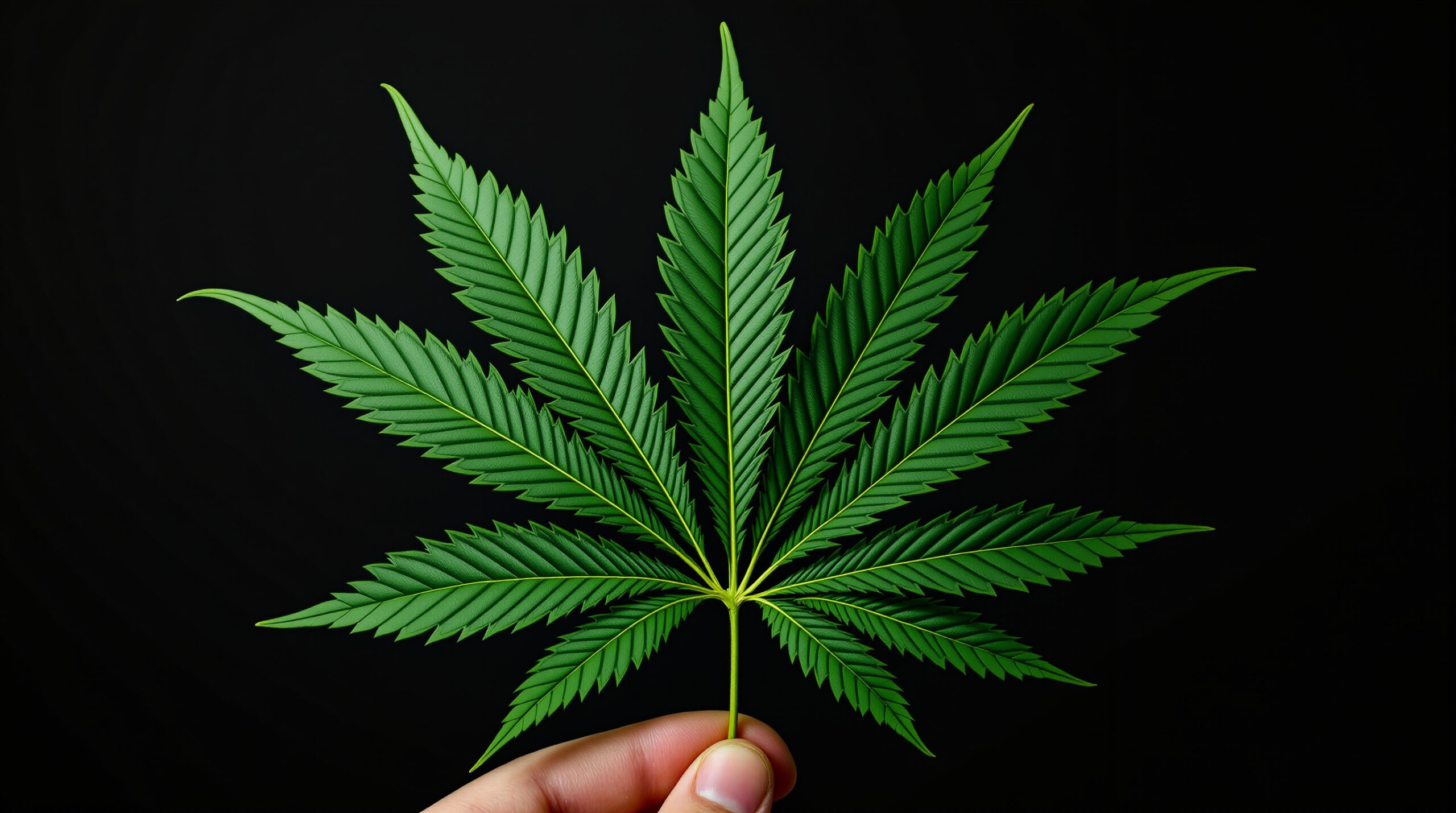
The hemp leaf is one of the most recognizable symbols in the world. It appears on flags, t-shirts, and packaging, yet many people stumble over a seemingly simple question: How many leaves does a hemp leaf actually have? The question sounds like a contradiction, since a leaf is just a leaf. From a botanical perspective, however, there is an elegant construction behind it that explains why we speak of multiple parts when discussing a single hemp leaf.
📑 Inhaltsverzeichnis
- How many leaves does a hemp leaf have? The botanical explanation
- Five, seven, nine: Why the finger count varies
- Recognizing Indica, Sativa, and Ruderalis by the leaf
- The blueprint in detail: Arrangement, margins, and symmetry
- How many leaves does the entire plant carry?
- Frequently asked questions
- 💬 Fragen? Frag den Hanf-Buddy!
The short answer is: A typical hemp leaf consists of five to nine individual fingers, and in rare cases, up to thirteen. These fingers are not independent leaves, but leaflets that together form a single compound leaf. To truly understand the answer, you need to briefly delve into plant anatomy, because the number is no accident—it follows a clear botanical blueprint.
How many leaves does a hemp leaf have? The botanical explanation
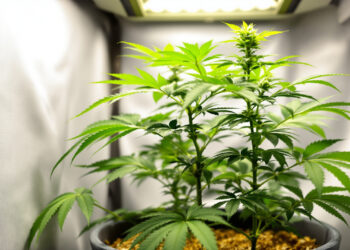
What we colloquially call a hemp leaf is, in botanical terminology, a palmate compound leaf—that is, a fingered or palmate-compound leaf. The individual fingers are called leaflets or pinnae. They all attach at a single point at the end of the petiole and radiate outward like the fingers of an open hand. This very structure gives the plant genus its characteristic silhouette, instantly recognizable worldwide.


The confusion in counting arises because the human eye perceives the individual fingers as separate leaves. In reality, however, it is a single organ. This is comparable to the leaf of a horse chestnut or a fan palm, where multiple leaflets also merge into one unit. The correct answer to the question of how many leaves a hemp leaf has is therefore precise: one leaf, consisting of multiple fingers.
The number of fingers is almost always odd. The longest finger sits in the center, flanked by paired leaflets arranged symmetrically and becoming progressively shorter toward the edges. This symmetry is a reliable identifying feature and distinguishes the hemp leaf from similarly fingered plants like the Japanese maple or certain ornamental mallows, with which it is occasionally confused by non-experts.
Five, seven, nine: Why the finger count varies
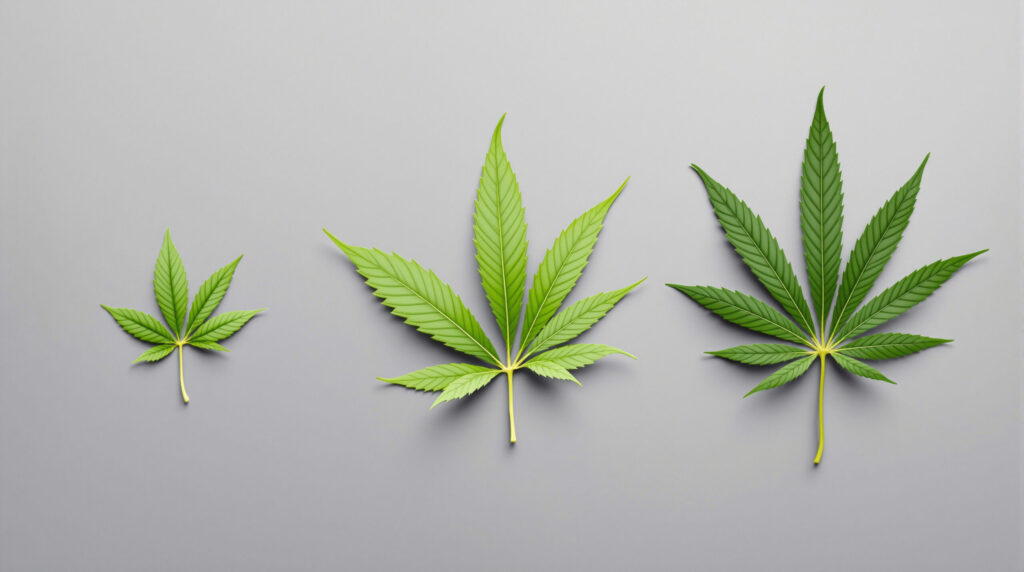
The range of five to nine fingers is not a rigid law, but rather the result of genetics and growth stage. A young plant starts modestly. The first true foliage leaf after the cotyledons often has only a single finger; the next pair already has three. With each subsequent growth spurt, the plant adds another finger, so that five-fingered leaves appear in the mid-vegetative stage and seven fingers become the norm in the fully vegetative phase.
Only a fully grown, vigorous plant produces nine or more fingers under good conditions. Thirteen-fingered leaves are possible but are considered exceptional and usually occur only in particularly vital specimens of certain genetics. The natural progression from simple to multi-fingered leaves can be clearly observed by examining the natural life cycle of the hemp plant, as leaf form is a reliable indicator of age and vitality.
Environmental factors also play a role. Light intensity, nutrient availability, and stress influence how many fingers a plant develops. A weakened or stunted plant often remains at lower finger counts, while an optimally supplied plant reaches its full genetic potential. The finger count is thus less a fixed property than a snapshot of the plant’s condition at any given moment.
Recognizing Indica, Sativa, and Ruderalis by the leaf
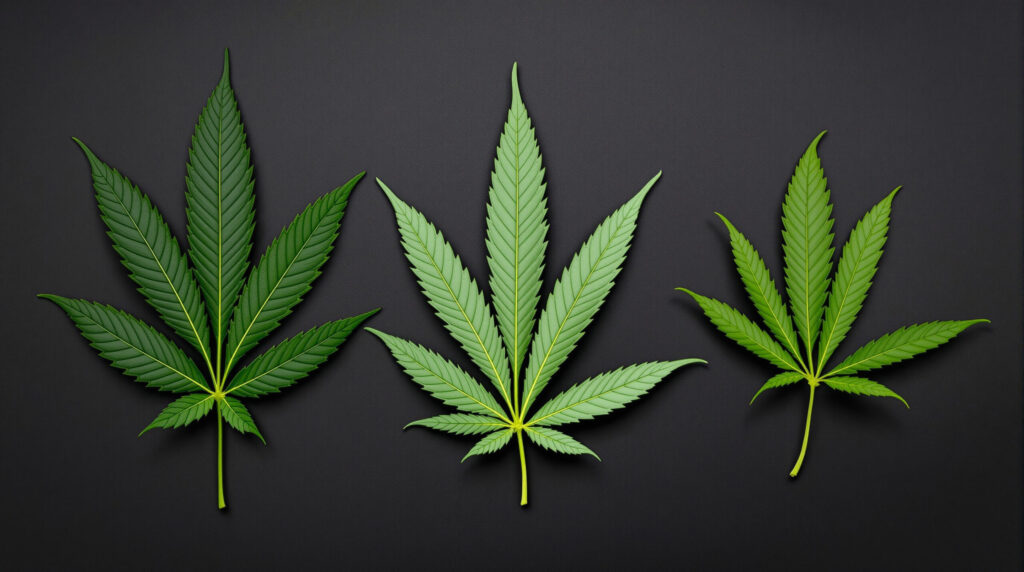
The finger count and shape of individual leaflets reveal much about a plant’s origin to the trained eye. Indica-dominant strains tend to carry broader, fleshier fingers, usually seven to nine in number, appearing shorter and more compact. The leaf as a whole seems more compact and darker. This structure is considered an adaptation to cooler, dimly lit mountain regions where broad fingers capture more light.
Sativa-dominant strains show the opposite. Their fingers are narrow, long, and taper to a point, and a single leaf can carry nine to thirteen of these slender leaflets. The overall appearance is more delicate and lighter. Narrow fingers reduce heat absorption in the hot equatorial regions from which these strains originate. For those who want to explore the differences further, the article on Indica, Sativa, and Hybrid provides current categorization of these classic categories.
The third, less well-known subspecies is Cannabis ruderalis. Its leaves are simpler and carry only three to five fingers, with three being particularly pronounced. This hardy wild form from northern latitudes is today primarily interesting as a gene donor for autoflowering strains. With old, original genetics, examining the leaf is particularly worthwhile, as the article on landrace strains shows, because pure wild forms visibly display their origin in their leaf pattern.
The blueprint in detail: Arrangement, margins, and symmetry
Not only the finger count follows a pattern, but also the arrangement of leaves on the stem. In the lower part of the plant, leaves are opposite, arranged in pairs facing each other, and carry few fingers. Higher up, the plant switches to alternate leaf arrangement, where leaves are staggered, and simultaneously the finger count increases. This transition is a reliable sign of maturity and helps estimate the developmental stage.
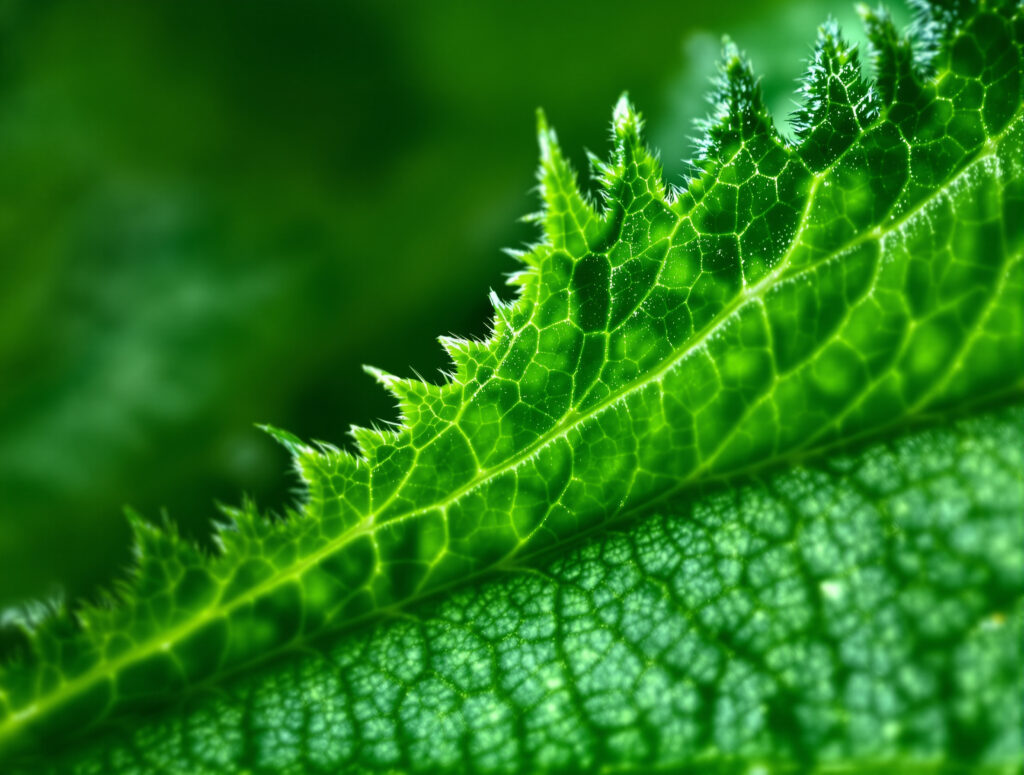
Each individual finger has a serrated margin, whose teeth always point in one direction. This serration is more than a decorative feature. Botanists use the number, depth, and form of the serrations to characterize genetics, as the tooth pattern is remarkably consistent within a strain. The upper surface of the fingers is usually darker and glossier than the lighter, often finely hairy underside.
The large, light-gathering leaves are also called fan leaves or sun sails. They conduct the lion’s share of photosynthesis and supply the plant with energy. Distinct from these are the smaller sugar leaves that sit directly in the flower clusters and are covered in resinous glands. The large fan leaves carry few active compounds, but as the plant’s power plant they are indispensable.
How many leaves does the entire plant carry?
A related question addresses not the single leaf but the entire plant. There is no fixed number here, as it depends on strain, size, cultivation method, and pruning technique. A compact indoor plant might have only a few dozen leaves, while a full-sized outdoor specimen with vigorous branching can carry hundreds. Cultivation techniques like defoliation intentionally change this number to allow light and air to reach the flowers.
For plants and growers alike, function matters more than sheer quantity. The fan leaves are the plant’s solar panels, and a healthy, dense canopy is the foundation for vigorous growth. Removing leaves too early weakens the power plant. This is why experienced growers view the leaf canopy not as superfluous greenery but as what it truly is: the energetic center of the entire plant.
Frequently asked questions
How many leaves does a hemp leaf have?
Botanically speaking, a hemp leaf is a single, palmate compound leaf consisting of multiple fingers. Typically there are five to nine fingers, rarely up to thirteen. The individual fingers are not separate leaves but leaflets of a single shared organ.
Why does a hemp leaf usually have an odd number of fingers?
A central, longest finger sits in the middle of the leaf, flanked by paired leaflets arranged symmetrically. Through this symmetrical arrangement, the total count is almost always odd—five, seven, nine, or eleven fingers.
Can you distinguish Indica from Sativa by finger count?
Tend to yes. Indica-dominant strains carry broad fingers, usually seven to nine, while Sativa-dominant strains show narrow, long fingers with often nine to thirteen leaflets. The shape is more telling than the raw number, and in hybrids both characteristics blend together.
Does a young plant have fewer fingers than a mature one?
Yes. The first true foliage leaf often has only one finger, followed by three-, five-, and seven-fingered leaves. Nine or more fingers appear only on vigorous, mature plants under good conditions. The finger count is thus an indicator of age and vitality.
Are the large fan leaves the same as the resinous leaves on the flower?
Hast du schon einmal die Finger eines Hanfblatts gezählt?
No. The large fan leaves serve photosynthesis and carry few active compounds. The smaller, resin-coated leaves directly in the flower clusters are called sugar leaves and are covered in glandular hairs. Both serve different functions in the plant.





Branchen-Update
News, Analysen und Reportagen — mehrmals im Monat direkt in dein Postfach.
Folge uns