
📑 Inhaltsverzeichnis
Advertisement · This article is produced in paid cooperation with Nordleaf. Selection, research and evaluation of content are the responsibility of Hanf Magazin.
When patients begin cannabis therapy through a digital platform, they usually focus on speed and process. The question that often becomes more important later is different: Where can the prescription actually be filled? This is where providers differ significantly, and pharmacy law has a clear position on it. We looked at what’s behind this and how Nordleaf addresses this point.
We’ve outlined the basic path to cannabis therapy in our overview Cannabis on Prescription: How to Get Cannabis as a Patient. This article focuses on one aspect that rarely comes up in comparisons but is noticeable in everyday practice: how tightly a provider binds the pharmacy to itself.
What pharmacy law says about prescription assignment

The relevant regulation is Section 11 of the Pharmacy Act. According to paragraph 1, pharmacies may not conduct legal transactions or make agreements with physicians or other healthcare providers that involve preferred supply of certain medicines, referral of patients, or assignment of prescriptions. Paragraph 1a additionally targets third parties and prohibits collecting and forwarding prescriptions to derive benefits from them.
The thinking behind this is old and initially has nothing to do with cannabis. The prescription belongs to the patient, and where it is filled should not depend on who does business with whom. For digital platforms that combine treatment and supply in one product, this is an inconvenient regulation, because it’s precisely at this point that business model and legal framework intersect.
Why this question becomes practical with platforms
In practice, the spectrum ranges from providers who merely organize the medical part and then release the prescription, to models where consultation, prescription and dispensing are tightly coupled. Internationally, the term „closed loop“ has become established for this. Australia’s medicines authority has since explicitly targeted such vertically integrated structures, because there prescription and sales were in the same hands.
In Germany too, the issue has reached courts. In summer 2026, the Düsseldorf Regional Court ordered a mail-order pharmacy to cease activity and held it liable as an accessory for advertising by the platform operator it worked with. Legal experts assess how far this decision reaches differently, but the direction is clear: the more tightly a platform and pharmacy are connected, the more they are liable for each other. We have analyzed this case in detail.
For patients, the structure has very tangible consequences. Those bound to a single pharmacy are also bound to its availability, delivery times and pricing. If a preparation runs out there, supply often ends in a holding loop, even though the same prescription could be fulfilled elsewhere.
How Nordleaf addresses this point
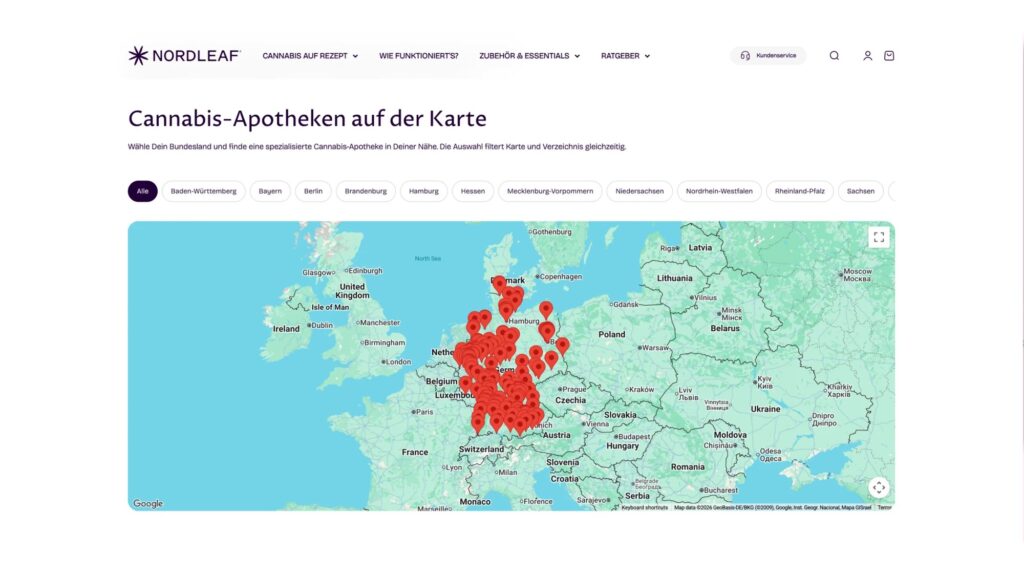

The platform Nordleaf makes this very point part of its offering. According to the provider, an issued prescription can be filled at any suitable German pharmacy, and three options are available alongside each other for the path from prescription to medicine:
- Any suitable pharmacy. The prescription is not tied to a specific business, nor to your regular neighborhood pharmacy.
- Affiliated partner pharmacy with delivery. Their inventory is accessible in real-time according to the provider, with delivery within one to two business days.
- Pick-up on site in Berlin and Munich. For those who don’t want to wait for delivery or prefer not to have a package delivered to their home, pickup is available at pharmacies in these two cities according to the provider.
The partner pharmacy is thus an option, not a requirement. The pickup option is particularly noteworthy in this context, because it runs counter to the logic of a closed mail-order system: it presupposes that the provider actually affiliates with local pharmacies instead of routing everything through a single shipping address. And it would remain available even if lawmakers actually prohibit mail delivery of flowers.
The second point that Nordleaf emphasizes concerns the stage before that. The inquiry is personally reviewed by a physician rather than decided automatically according to the provider, and the decision can be negative. This is no minor matter, because the current draft legislation to amend the Medicinal Cannabis Act targets this very point and seeks to make personal doctor contact mandatory. We’ve described how political pressure on telemedicine arose in Cannabis Telemedicine Under Pressure.
Advertisement: The link to Nordleaf is a paid advertising link and is technically marked as such. The selection and evaluation of the remaining content of this article is unaffected by this.
Both are provider statements that we could not independently verify. However, what can be verified is whether a platform mentions these points at all, and that is already a useful distinguishing feature.
How to recognize open supply

When comparing providers, four questions help that can be clarified before your first inquiry:
- Is a pharmacy specified or suggested? A suggestion is unproblematic, a specification is restrictive.
- Do I get the prescription in hand? Those who can fill it at another pharmacy remain able to act if something gets stuck anywhere.
- Who decides about the prescription, and how? An individual physician decision that can also be negative is the opposite of an order confirmation.
- Is availability transparent? Visible inventory avoids the experience of supply failing in the delivery chain only after the prescription is issued.
None of these questions concerns the product range, and that is precisely the point. Which preparations ultimately come into question is decided by the treating physician. What patients can watch out for themselves is the structure in which this decision is made and implemented.
Why this point is gaining weight right now
The draft legislation to amend the Medicinal Cannabis Act, which has been a Bundestag document (21/3061) since December 2025 and has not been passed to date, provides for personal physician contact as well as a prohibition on mail order delivery of cannabis flowers. The pharmacy’s courier service would remain unaffected. Should this happen, the question of which pharmacy can accept a prescription and how accessible it is will become even more important for those affected than it is today.
Regardless, the sequence remains the same. First comes the medical question of whether cannabis therapy is worth considering in the individual case at all. Only then does the question of how it will be organized become relevant. Those who reverse the two are choosing a platform first and then looking for a justification for it.
Note: This article reflects the status as of October 2, 2026 and is not legal or health advice. Medicinal cannabis is a prescription-only medicine; the article contains no therapeutic claims, efficacy statements or product claims and no therapy recommendation. The choice, initiation, continuation and modification of therapy is decided exclusively by the treating physician. Information on the process and services of Nordleaf comes from the provider and was not independently verified by us.
Wo löst du dein Cannabis-Rezept normalerweise ein?
Sources: Section 11 paragraphs 1 and 1a of the Pharmacy Act; Düsseldorf Regional Court, judgment on accessory liability of a mail-order pharmacy, July 2026; Therapeutic Goods Administration, reform plans for Special Access Scheme, September 2026; Draft of a First Act to Amend the Medicinal Cannabis Act, Bundestag document 21/3061 of December 3, 2025; statements from provider Nordleaf, October 2026; own reporting.






Branchen-Update
News, Analysen und Reportagen — mehrmals im Monat direkt in dein Postfach.
Folge uns