Anyone who consumes cannabis regularly knows the phenomenon: the effects diminish, doses increase, yet satisfaction remains lacking. A tolerance break resets the endocannabinoid system and restores the original sensitivity of CB1 receptors. What actually happens in the brain during this process was first precisely visualized by a Yale PET study in 2012.
📑 Inhaltsverzeichnis
What Happens During Tolerance Development
THC exerts its effects primarily through CB1 receptors in the central nervous system. These receptors are densely distributed in the prefrontal cortex, hippocampus, and basal ganglia—brain regions responsible for reward, memory formation, and emotional regulation. With repeated consumption, the body responds with a classic protective adaptation: it reduces the number of receptors on the cell surface, a process known in pharmacology as downregulation.
Fewer receptors mean fewer binding sites for THC, which manifests subjectively as diminished effects. Consumers compensate by taking higher doses, which further reinforces downregulation—a classic tolerance cycle.


The Hirvonen Study: Made Visible for the First Time

In 2012, Hirvonen et al. published a groundbreaking study in Molecular Psychiatry that used positron emission tomography (PET) and a special tracer called 11C-OMAR to measure CB1 receptor density in the living brains of chronic cannabis users. The result: daily users had significantly lower CB1 receptor densities than non-users, primarily in the neocortex and striatum.
The study became particularly compelling through its second phase: researchers examined the same subjects again after different periods of abstinence. After just 28 days of a break, receptor densities had returned to nearly the same levels as the non-consuming control group. This recovery occurred at different rates across regions but was universally reversible.
D’Souza et al. (2016) confirmed and refined these findings: the majority of recovery occurs within the first two weeks, with dramatically decreasing speed thereafter. In practical terms: the first 14 days of a break deliver the biggest effect, with the following 14 days completing the reset.
How Long Should a Tolerance Break Last?
The answer depends on consumption patterns. Those who consume once weekly have built minimal tolerance; often one week suffices. Daily users need at least 14 days, while heavy chronic users need 28 days or more. For a more personalized assessment, check your profile using our tolerance break calculator.
Important: the break must be complete. Even a single consumption during the break raises THC levels in fatty tissue back to detectable levels and interrupts receptor recovery, not completely, but noticeably. Consistency isn’t optional—it’s essential.
What Happens During the Break
The first days are often biologically the most uncomfortable. Bonn-Miller et al. (2014) and Lawn et al. (2016) documented that typical withdrawal symptoms in chronic users include: sleep disturbances, irritability, mild low mood, vivid dreams progressing to nightmares, and temporary appetite loss. These symptoms are real and biologically grounded, but time-limited: they typically peak between days 2 and 5 and largely subside by day 10.
From the second week onward, many report the opposite: deeper sleep, clearer thinking, greater emotional stability. The reason lies in the restoration of the endogenous endocannabinoid system, which was functionally displaced by exogenous THC during chronic use.
What to Consider After the Break
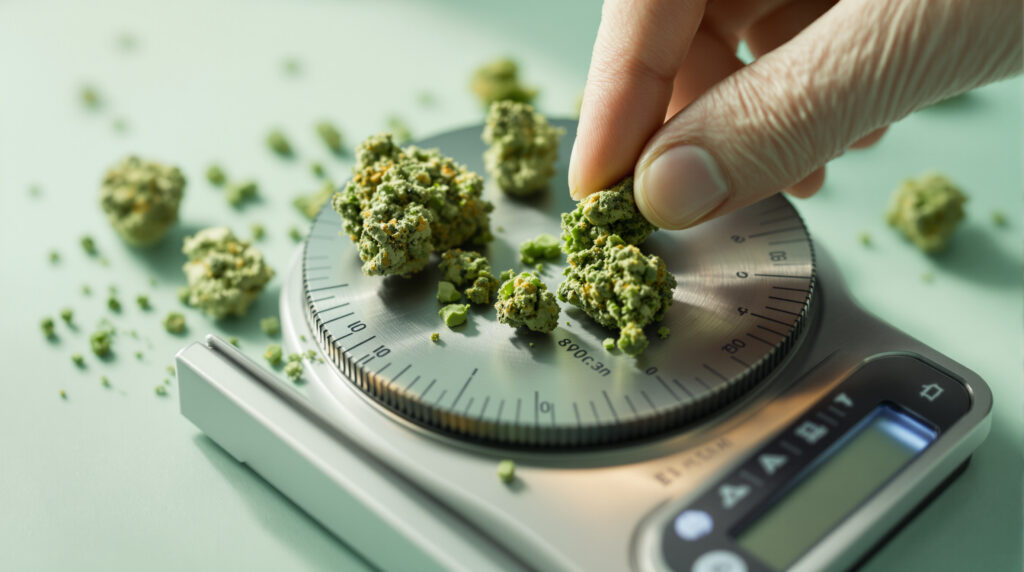
Important after ending the break: resume with a lower dose, typically 30 to 50 percent of your previous standard dose. Sensitivity is restored, and what barely worked before can now be overwhelming. If you’re using the break as a reset, also reflect on consumption habits: frequency, occasions, and social contexts matter. Tolerance rebuilds slowly with moderate frequency over weeks, but rapidly with daily consumption over days.
Frequently Asked Questions
Are 4 weeks really necessary or are 2 weeks enough?
With moderate consumption, 14 days often suffices since most CB1 recovery happens within this timeframe. With chronic daily use, the full 28 days is worthwhile because the recovery curve closes the remaining difference in the final two weeks.
Does CBD help during the break?
CBD doesn’t bind primarily to CB1 receptors and therefore doesn’t interrupt the reset. It can provide support against sleep problems and irritability without technically compromising the break. Purists can skip it, while those seeking easier adjustment can use it temporarily.
How do I prevent tolerance from rebuilding?
Reducing frequency is the most important tool. After the break, if you consume no more than twice weekly instead of daily, tolerance rebuilds much more slowly. Lower doses also help push the plateau further out.
Does exercise help?
Since THC is stored in fatty tissue, intensive exercise measurably mobilizes more THC into the bloodstream, which can even temporarily elevate blood levels. This slightly extends elimination but isn’t an obstacle to reset. Exercise does support sleep and mood during the break.
Hast du schon einmal bewusst eine Cannabis-Pause gemacht?
Scientific sources: Hirvonen J et al. (2012) on CB1 downregulation and recovery · D’Souza DC et al. (2016) on recovery kinetics · Bonn-Miller MO et al. (2014) and Lawn W et al. (2016) on withdrawal symptoms.






Branchen-Update
News, Analysen und Reportagen — mehrmals im Monat direkt in dein Postfach.