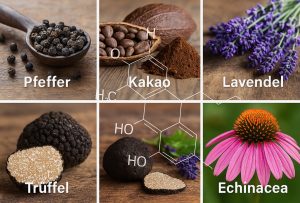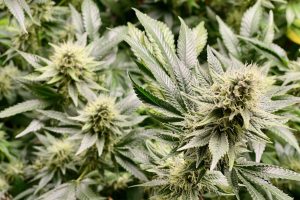

Cannabis contains numerous trace substances beyond well-known compounds like cannabinoids and terpenes. Each strain exhibits a highly individual profile of pharmacologically active compounds that extends far beyond the psychoactivity triggered by THC.
📑 Inhaltsverzeichnis
The combined spectrum of these compounds creates the specific effects profile of each strain. A South African research team has now identified a compound class whose presence in cannabis was previously undocumented and which is extremely rare in nature overall.
Novel Flavoalkaloids Discovered
As part of this study, researchers developed a powerful analytical method for detecting phenolic compounds in plants. The goal was to determine the content of various flavonoids in hemp. Flavonoids belong to the phenol group and are widely distributed throughout the plant kingdom. Detecting phenols is a methodological challenge due to their similar chemical structures combined with highly variable concentrations.


A particular challenge lies in cleanly separating commonly occurring flavonoids from other substances. The research team developed a specially optimized combination of liquid chromatography, mass spectrometry, and UV detection for this purpose. When separating the sample into its components, the team used a combination of two liquid chromatography methods—what scientists call two-dimensional liquid chromatography.
The flavonoid profiles of the examined samples were visualized using contour diagrams. Using this method, the team analyzed three cannabis strains cultivated in South Africa. In total, 79 phenolic compounds were identified. However, one discovery proved particularly remarkable: researchers found 16 phenolic compounds in one of the three strains belonging to a compound class never previously documented in cannabis. This compound class is called flavoalkaloids—essentially a combination of a flavonoid and an alkaloid. Flavonoids are widely distributed in nature.
Alkaloids are also common in the plant kingdom and responsible for the effects of numerous plants. However, a combination of these two compound classes is rare in nature and has never been documented in hemp. Chemically, these secondary plant metabolites consist of a flavonoid carrying a nitrogen-containing residue—typical of alkaloids—in its structural formula. The exact structural formulas of these newly discovered compounds have not yet been fully elucidated. Nevertheless, it can already be stated that this group of flavoalkaloids has not previously been documented in hemp or other plants.
Occurrence Primarily in Leaves
Remarkably, the concentration of flavoalkaloids was highest in the leaves. While most pharmacologically interesting active compounds are concentrated in flowers, this appears to differ for this compound class. The content of other phenolic compounds in the leaves also differed significantly among the three analyzed strains. Through this discovery, leaves could increasingly become a focus of future research.
Discovery Possibly of Medical Significance
Researchers believe this discovery could also have medical relevance. Flavonoids, to which flavoalkaloids are closely related, are of research interest due to their antioxidant, anti-inflammatory, and potentially even cancer-inhibiting properties. Some flavoalkaloids are already part of cancer research.
The newly discovered compound class could harbor medical potential that may play an even greater role in the future. The discovery underscores the need to search for novel and potentially medically relevant phenolic compounds in additional hemp strains.
Sources
Study:
sciencedirect.com






Nutzt du Hanfblätter für Tee oder andere Zwecke?
Branchen-Update
News, Analysen und Reportagen — mehrmals im Monat direkt in dein Postfach.
Folge uns