CBD creams, serums, and balms now fill entire shelves in drugstores and pharmacies. The promises range from clearer skin and fewer wrinkles to relief from chronic skin conditions. However, there is often a large gap between this marketing and reliable scientific evidence. This article clarifies what research actually demonstrates about CBD in skincare and where hope rather than evidence currently prevails.
📑 Inhaltsverzeichnis
- The skin has its own endocannabinoid system
- CBD against acne: What sebaceous gland research shows
- CBD for atopic dermatitis and eczema: Current research status
- Hemp seed oil is not the same as CBD
- What really matters in CBD cosmetics
- CBD as an antioxidant and the anti-aging hype
- Frequently asked questions
- 💬 Fragen? Frag den Hanf-Buddy!
For a comprehensive overview of the entire field, check out our complete guide to hemp cosmetics. Here we focus on the question consumers ask most frequently. Does CBD actually work on the skin, or are you mainly paying for a well-marketed trend molecule?
The skin has its own endocannabinoid system
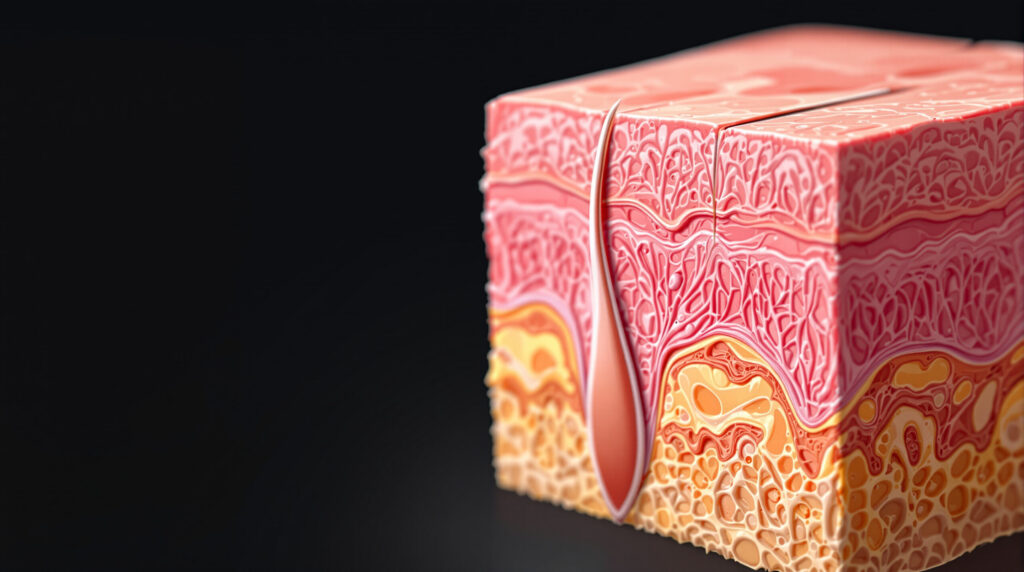
The biological foundation for any effect of CBD on the skin is the cutaneous endocannabinoid system. Our skin is not merely a passive protective layer but an active organ with its own receptors. Keratinocytes, sebaceous gland cells, hair follicles, and immune cells carry CB1, CB2, and TRPV1 receptors. Through this network, the body regulates inflammatory responses, sebum production, and skin barrier renewal.


CBD intervenes in this system without producing psychoactive effects. It binds only weakly to classical cannabinoid receptors and exerts its effects primarily through other signaling pathways, such as TRPV channels and anti-inflammatory mechanisms. Our article on the endocannabinoid system of the skin describes how this control system works in detail. What matters is the distinction: a plausible mechanism of action is not yet proof of clinical effectiveness in humans.
CBD against acne: What sebaceous gland research shows
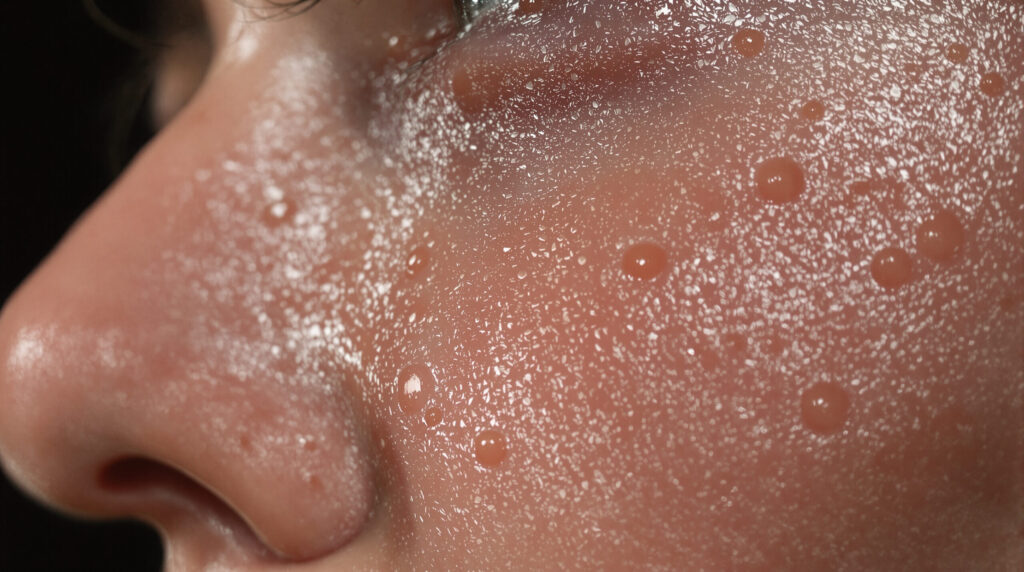
The most thoroughly examined approach concerns acne. A frequently cited laboratory study from 2014 showed that CBD acts on human sebaceous gland cells in three ways. It reduces excessive sebum production, inhibits sebocyte proliferation, and dampens inflammatory messengers such as interleukin-1 and TNF-alpha. Since increased sebum production and inflammation are central drivers of acne, CBD is considered particularly interesting pharmacologically in this context.
However, these results come from cell cultures, not large clinical trials. Randomized, placebo-controlled studies of topical CBD for acne are largely lacking. The laboratory findings are strong evidence, but they do not replace proof of efficacy in patients. Those testing a CBD cream for pimples are therefore operating in an area with good theoretical justification but thin clinical evidence.
CBD for atopic dermatitis and eczema: Current research status
For inflammatory skin conditions like atopic dermatitis and eczema, the data is somewhat more concrete but still limited. An Italian study from 2019 documented improvements in various skin parameters and quality of life for psoriasis, eczema, and scars after several weeks of using a CBD-containing ointment. Recent pilot studies from Hungary in 2024 and 2025 reported that a CBD cream, compared to placebo, could reduce itching and lower transepidermal water loss.
Transepidermal water loss is an objective marker of skin barrier function. When it decreases, the skin retains moisture better. This is precisely a central problem in atopic dermatitis. These findings are encouraging but rely on small participant numbers and short timeframes. Our article on CBD for atopic dermatitis offers deeper analysis of the research. Current study quality is not yet sufficient for guideline-based therapy recommendations.
Hemp seed oil is not the same as CBD
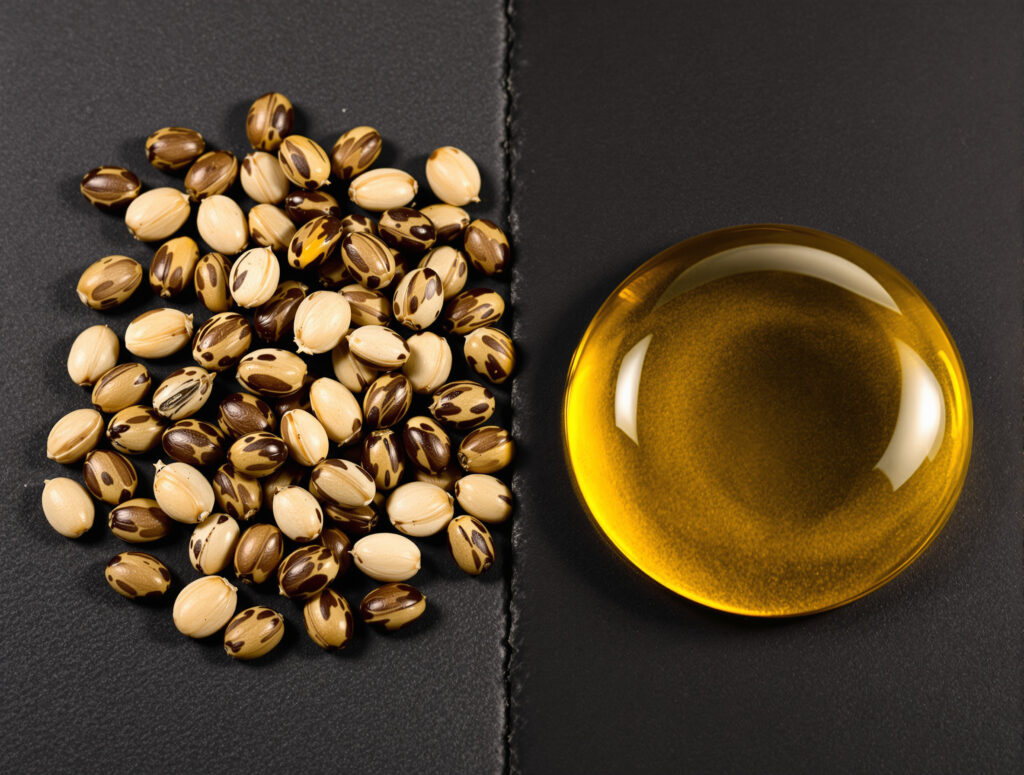
One of the most common confusions concerns the difference between hemp seed oil and CBD. Hemp seed oil is pressed from the seeds of the plant and contains virtually no cannabidiol. Its benefit for the skin is based on a high proportion of essential fatty acids, particularly linoleic acid and gamma-linolenic acid. These fatty acids stabilize the lipid structure of the skin barrier and reduce moisture loss.
A controlled study showed that regular intake of hemp seed oil can noticeably improve skin dryness and itching in atopic dermatitis. CBD, by contrast, works through the endocannabinoid system and anti-inflammatory signaling pathways. Both substances can complement each other in a product, but they are not pharmacologically interchangeable. Our article on hemp seed oil for skincare highlights the benefits of the pure pressed oil. When buying a product, you should therefore pay close attention to the ingredient list.
What really matters in CBD cosmetics
For CBD to work, a relevant amount must actually be present in the product. Many inexpensive products contain only traces of the active ingredient while prominently advertising the term. A look at the declared concentration in milligrams per container is therefore more informative than the label alone. Reputable manufacturers specify the exact CBD content and provide an independent lab analysis certificate.
Full-spectrum extracts contain additional cannabinoids and terpenes besides CBD that could work together in what is called the entourage effect. This effect is also not yet conclusively proven for skin. It also makes sense to do a compatibility test in the inner arm before using a new product over a larger area. Realistic expectations are crucial here. CBD cosmetics can be a nourishing and soothing addition, but they do not replace medically prescribed therapy for pronounced skin conditions.
CBD as an antioxidant and the anti-aging hype
Another industry promise revolves around skin aging. Free radicals from UV radiation, air pollution, and stress damage skin cells and accelerate wrinkle formation. Review articles from 2024 describe CBD as having antioxidant and anti-inflammatory effects. In theory, this molecule could buffer oxidative damage and protect the skin from this stress.
Here too, a sober assessment applies. The antioxidant effect is demonstrated primarily in the laboratory and in cell models. Reliable studies demonstrating a measurable anti-aging effect from a CBD cream in humans are currently lacking. Those using CBD cosmetics for wrinkle prevention should understand it as a nourishing addition. Proven sun protection and consistent skincare remain the most effective measures against premature skin aging.
In daily practice, CBD cosmetics can be easily integrated into an existing routine. A cream or serum is typically applied to cleansed skin before a richer moisturizing step. Since studies usually require several weeks of application, consistency pays off more than a single test. Those with honest expectations will most likely appreciate the gentle, soothing component of such products.
Frequently asked questions
Does CBD cream really help with pimples?
Laboratory studies show that CBD reduces sebum production and dampens inflammation in sebaceous glands. This is a plausible approach to acne. However, large clinical trials in humans are still lacking, which is why definitive proof of efficacy is currently unavailable.
How long does it take for CBD to work on the skin?
Reliable information does not exist because the research is limited. In the available pilot studies, effects on itching and skin barrier usually appeared only after several weeks of regular use. Patience is therefore more important than quick expectations.
Is CBD skincare suitable for sensitive skin?
CBD is considered well-tolerated in topical application, and severe side effects are rarely documented. Reactions can nonetheless occur from other ingredients in the formulation. A compatibility test on the inner arm before first widespread use is therefore advisable.
How do hemp seed oil and CBD differ in cosmetics?
Hemp seed oil contains almost no CBD and works through essential fatty acids that strengthen the skin barrier. CBD is a cannabinoid that acts through the skin’s endocannabinoid system on inflammation and sebum production. Both complement each other but are not the same thing.
Can CBD cream replace medical treatment?
Hast du schon mal CBD-Hautpflege ausprobiert?
No. For pronounced or chronic skin conditions, treatment should be in the hands of a dermatologist. CBD cosmetics can contribute as a supportive measure for skin care and soothing, but they do not replace prescribed therapy. Before combining with medications, a discussion with a doctor is advisable.





Branchen-Update
News, Analysen und Reportagen — mehrmals im Monat direkt in dein Postfach.
Folge uns