„I’m a cannabis patient“ has become a common refrain during traffic stops. A new forensic medicine analysis of 81 expert assessments reveals how little this claim proves on the spot: not a single person could produce a valid medical prescription that was definitely valid at the time of driving.
📑 Inhaltsverzeichnis
What the Forensic Medicine Study Examined
The study by Lea Schlattmann, Uta Küpper, and Benno Hartung was published on September 23, 2026, in the journal Rechtsmedizin (Forensic Medicine) as an open-access contribution. Hartung is no stranger to this debate. A 2016 Düsseldorf study he led made headlines, which we covered at the time under the title Cannabis Users Don’t Drive Less Safely.
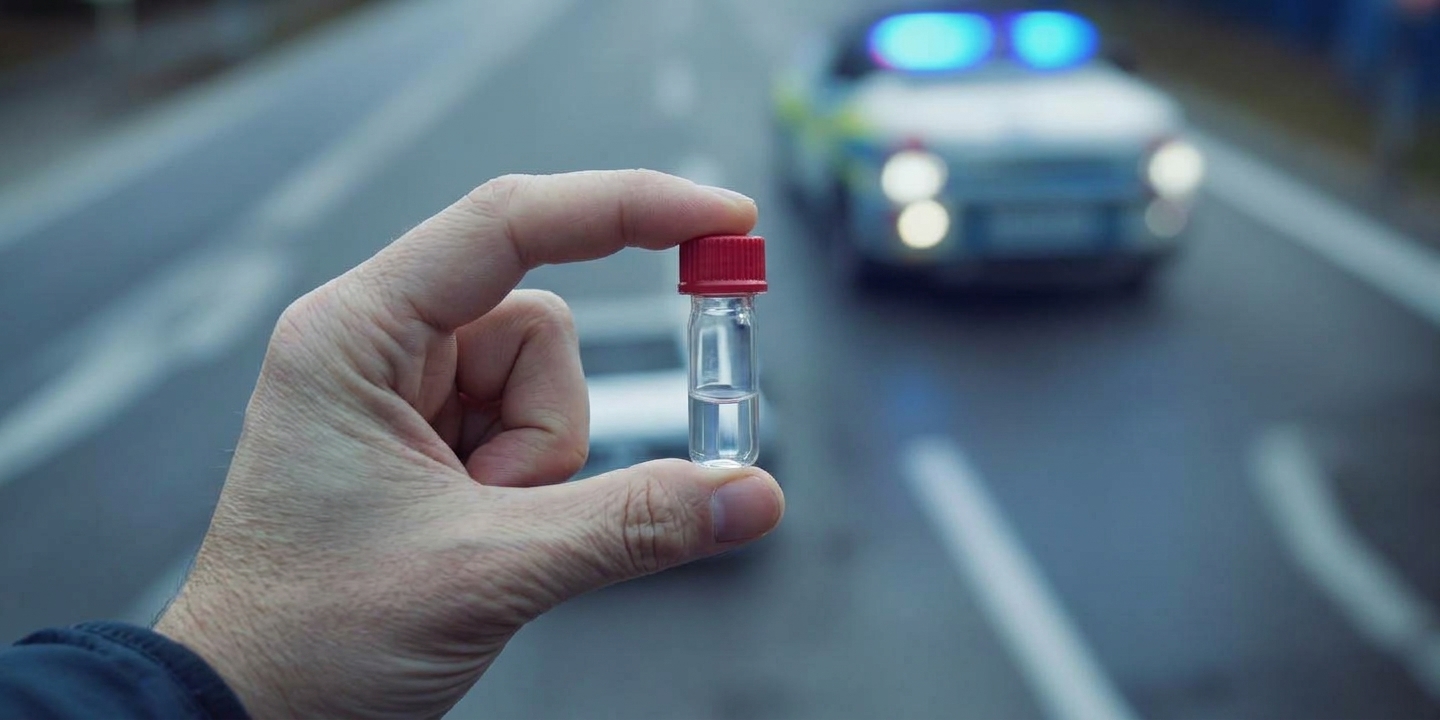
This time, the focus is not on driving experiments but on real cases from traffic. The researchers analyzed all traffic stops between August 2018 and December 2025 where individuals claimed medically prescribed cannabis use and provided a blood sample. They examined the test protocols, concentrations of THC and its metabolites THC-11-OH and THC-COOH, consumption statements, and the credibility of the presented prescription evidence.


The Results: High THC Values, Thin Documentation
The median THC concentration in blood serum was 13.4 ng/ml. In 73 of the 81 cases—roughly nine out of ten—the value exceeded the applicable limit under Section 24a of the Road Traffic Act. Until August 21, 2024, the limit was 1 ng/ml; since August 22, 2024, the limit is 3.5 ng/ml. We’ve summarized the current rules for users in our overview of Cannabis and Road Traffic 2026.
A second finding carries more weight. In twelve cases, there were indications of cannabis-related driving impairment under Section 316 of the Criminal Code. This is no longer a traffic violation but a criminal offense. A valid prescription provides no protection against this.
The largest gap appears in proving the prescription. 44 people presented medical documents; 37 could present nothing at all. After the authors‘ analysis, not a single case demonstrated a prescription definitively valid at the time of driving. Their conclusion is appropriately sobering: merely claiming medical cannabis use allows no conclusions about lawful therapy or traffic law privileges.
Why the Medication Privilege Depends on Proof
The legal situation is clearly defined. Anyone who takes cannabis as a medicine as prescribed for a specific medical condition falls under the medication clause in Section 24a, Paragraph 4 of the Road Traffic Act and may drive even above the limit, as long as no driving impairment is present. The study makes clear where this fails in practice. The clause requires that the prescription can be documented for the specific day.
This aligns with current court rulings. Several appellate courts ruled this year that an online prescription is not a defect, but unclear dosage instructions are. We’ve detailed this in the article Where the Medication Privilege Actually Fails. The forensic medical data provides the empirical counterpart. Courts ask about prescription quality, and it’s precisely this quality that often goes undocumented in routine traffic stops.
Context: What the Numbers Show and Don’t Show
The study makes no statement about cannabis patients overall. It analyzed only cases where police already had probable cause and ordered a blood test. Patients who drive uneventfully don’t appear in this statistics. The „patient“ designation also came from the individuals themselves and wasn’t verified in every case. Some of the 37 people without evidence likely used the patient claim simply as a protective assertion.
For genuine patients, this is the real point. The more unsubstantiated claims appear, the more suspicious police and traffic authorities become toward anyone citing therapy. This is also evident in driver licensing law, as shown in the case before the Berlin Administrative Court. How resistant this area has been for decades can be read in the profile of Theo Pütz, Germany’s driving license expert.
The authors call for binding standards—both for the prescription itself and for proving a valid prescription during traffic enforcement. The demand taps into ongoing debate. The revision of the Medical Cannabis Act, with restrictions on telemedicine and mail delivery, continues to hang in the Health Committee of the German parliament. To date, it includes no rule for how patients should prove their prescription during a traffic stop.
What Patients Can Do Now
From the study and court rulings comes a simple consequence. Anyone driving with medical cannabis should carry a current copy of the prescription with clear dosage information or a medication plan. A medical certificate describing the indication is also helpful. A privately designed patient ID card does not replace these documents. What ultimately matters is your own driving ability: if you feel impaired, don’t drive—with or without a prescription.
Frequently Asked Questions
Are cannabis patients allowed to drive in Germany?
Yes, provided they take their medication as prescribed by their doctor and are not driving impaired. The medication clause in Section 24a, Paragraph 4 of the Road Traffic Act then applies, even if the THC value exceeds 3.5 ng/ml. However, signs of impairment can result in criminal charges under Section 316 of the Criminal Code.
What did the study in the journal Rechtsmedizin find?
Of 81 stopped people who claimed cannabis therapy, 73 exceeded the legal limit. In twelve cases, there were signs of driving impairment. A prescription definitively valid at the time of driving could not be documented in any case.
Is the study representative of all cannabis patients?
No. The analysis covered only cases with blood tests—stops where police had probable cause. It does not capture uneventful patients. The numbers thus describe problem cases in routine traffic enforcement, not the driving behavior of all patients.
What documents should patients carry while driving?
A copy of the current prescription with clear dosage information, a medication plan, and a medical certificate of the indication are advisable. No legally defined patient ID card exists. Patients who notice unclear elements on their prescription should clarify them with their doctor before the next drive.
Does an online prescription protect against a fine?
According to current appellate court rulings, the type of doctor contact is not decisive. What matters is whether the prescription is properly issued and contains clear dosage instructions. A final ruling by the German Federal Court of Justice is still pending.
Note: This article is not legal or medical advice. Whether the medication clause applies in individual cases can only be clarified with legal counsel. The treating physician decides on therapy and dosage.
Sollten Cannabispatienten am Steuer das Rezept mitführen müssen?
Sources: Schlattmann L, Küpper U, Hartung B: Behaupteter Medizinalcannabiskonsum im Straßenverkehr, rechtsmedizinische Analyse von 81 Begutachtungsfällen. Rechtsmedizin, online published September 23, 2026, DOI 10.1007/s00194-026-00865-w (Open Access, CC BY 4.0); Section 24a Road Traffic Act; Section 316 Criminal Code; own reporting.








Branchen-Update
News, Analysen und Reportagen — mehrmals im Monat direkt in dein Postfach.