
Platforms like Alibaba and Facebook advertising have increasingly featured products marketed as „full-spectrum hemp resin“ labeled „CBX,“ typically sold with the promise that they’re completely legal and easy to order throughout the EU. A reader inquiry prompted us to examine this trend, as the slick marketing promises mask considerable ambiguity about what these products actually contain.
📑 Inhaltsverzeichnis
First, the essential fact: „CBX“ is not a clearly defined, standardized active compound. The term is deliberately vague in marketing and fits into the growing gray market of so-called legal-high products, which also includes cannabinoids like HHC and THCP.
What Exactly Is „CBX“?
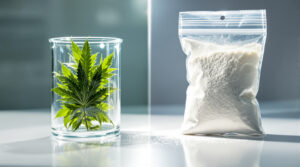
In scientific literature, there is no clearly defined substance called CBX. Sometimes the abbreviation appears as a loose umbrella term for non-intoxicating cannabinoids; sometimes it simply functions as a product label. In the actual marketing of „full-spectrum hemp resin CBX“ on marketplaces, the term primarily works as a brand name deliberately mimicking familiar abbreviations like CBD or CBN.


What’s actually contained in such resins cannot be reliably determined from the outside. This is the first major problem: when you purchase a product whose active compounds aren’t clearly declared, you don’t know what you’re consuming. We provide an overview of genuinely existing new cannabinoids and their differences in our article Differences Between Individual HHC Derivatives.
What „Legal in the EU“ Really Means
The claim that a product is legal across the entire EU is almost always too broad in this sector. There is no unified EU regulation for new and semi-synthetic cannabinoids. Each country decides independently, and the situation changes constantly. Several nations have recently tightened regulations, as we’ve documented in articles including Portugal Bans HHC and our overview Regulation vs. Innovation: How Europe Handles New Cannabinoids.
In Germany, many of these substances fall under the New Psychoactive Substances Act (NpSG), which can encompass entire substance classes even if a specific molecule isn’t explicitly named. We examined the effectiveness of this approach in Can the NpSG Stop Legal Highs? Moreover, when such products are marketed as food items or for consumption, they additionally fall under the Novel Food Regulation. And as soon as a resin contains relevant amounts of THC, consumer cannabis law or narcotics regulations apply regardless.
When importing from non-EU countries like China via marketplaces such as Alibaba, customs becomes an additional factor. A „legal“ badge in an online shop says nothing about whether import and possession are actually permitted in your country of residence. We cannot and will not provide legal advice for individual cases, but this is clear: such advertising promises deserve critical scrutiny.
Health Risks
Beyond legal uncertainty lies the health risk. Products from unregulated sources undergo no reliable quality control. Purity, cannabinoid content, and potential contamination with solvents, heavy metals, or pesticides are not guaranteed with goods from anonymous marketplaces. With semi-synthetic cannabinoids, possible residues from chemical manufacturing are an additional concern, and solid long-term studies on many of these novel compounds are still lacking. Those wanting to play it safe should avoid products without traceable origins and independent laboratory analysis.
What Consumers Should Watch For
- Marketing claims like „100% legal in the EU“ are a warning sign, not a seal of approval.
- Unclear cannabinoid designations like „CBX“ without precise declaration are cause for caution.
- Origin, manufacturer, and independent laboratory analysis should be transparent and verifiable.
- What matters is the legal situation in your country of residence, not disclaimers in the shop.
- When in doubt: don’t buy until composition and legal status are clarified.
We’re tracking this issue and will continue monitoring developments around „CBX“ and comparable hemp resins.
Note: This article is for general information purposes and does not constitute legal or health advice for individual cases.





Hast du schon von CBX oder ähnlichen Legal-High-Cannabinoiden gehört?
Branchen-Update
News, Analysen und Reportagen — mehrmals im Monat direkt in dein Postfach.
Folge uns