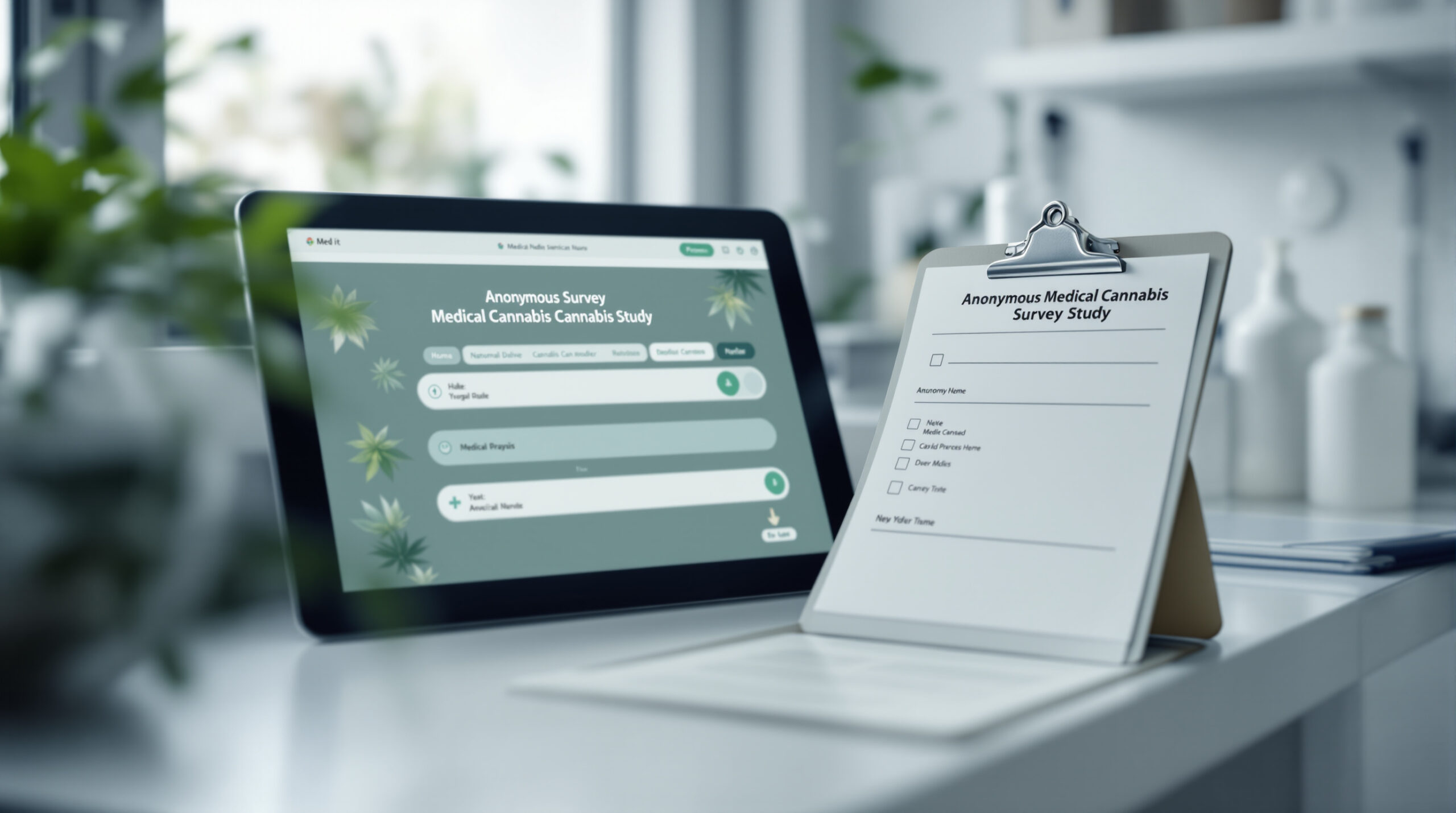
The University of Mainz launched a large-scale online survey for cannabis patients in early May. The Institute for Forensic Medicine aims to close a gap that has remained in previous research on medicinal cannabis: How do patients actually use their therapy, what side effects occur in everyday life, and how do they assess their own driving ability while on medication?
📑 Inhaltsverzeichnis
The survey runs anonymously, takes only a few minutes according to the researchers, and is open to anyone currently prescribed medical cannabis. The project was initiated by PD Dr. Cora Wunder, who heads the Department of Forensic Toxicology in Mainz, together with the scientific team of Marica Hundertmark, André Ihlenfeld, and Assaf Landschaft. Copeia GmbH is involved as an industry partner, providing the technical platform.
Why This Study Matters Now
With the reclassification of cannabis out of the Narcotic Drugs Act in April 2024 and strong growth in patient numbers to approximately 900,000 supplied patients, the supply situation in Germany has fundamentally changed. The previous accompanying survey by the Federal Institute for Drugs and Medical Devices, which documented data from approximately 21,000 therapy courses between 2017 and 2022, provided the most reliable database to date. However, following the end of that survey, there is a lack of systematic overview of what has actually changed in everyday life since liberalization.


This data gap is not merely academic. A draft amendment to the Medicinal Cannabis Act currently sits in the Bundestag, which would ban mail-order sales of cannabis flowers and introduce mandatory in-person doctor contact. Reliable data on how patients actually implement their therapy and which supply channels they use is largely lacking. This is precisely where the Mainz survey comes in.
What the Survey Examines

Four thematic blocks are at the center of the survey. First, the method of administration: vaporization, oral consumption, tinctures, or extracts, as well as any combinations. Second, actual dosing in everyday life—that is, how far patients deviate from their original medical prescription when they self-titrate their symptoms. Third, the spectrum of side effects, both desired and undesired, including the question of whether these effects lead to therapy discontinuation.
The fourth block is typical for a forensic medicine institute and simultaneously politically sensitive: How do patients assess their own driving ability when participating in road traffic while under ongoing cannabis medication, and what strategies do they employ to minimize risks? The question has real consequences, as shown by the recent ruling of the North Rhine-Westphalia Administrative Court on driver license revocation for cannabis patients.
Forensic Toxicology Background

That the study is conducted by the Institute for Forensic Medicine is no accident. Cora Wunder has been researching for years at the intersection of forensic toxicology and medical cannabis application. She has previously published descriptive analyses of individual usage patterns in cannabis medications in Germany. Her focus is on identifying valid markers that can distinguish recreational use from therapeutic application in traffic control situations.
The gap between forensic standard threshold values and the pharmacokinetic reality of chronically treated patients is substantial. THC and its metabolites can be detected in the blood for weeks with regular use without any acute impairment present. Studies from recent years suggest that cannabis patients show hardly any measurable limitations to their driving ability once they are stabilized. The Mainz survey aims to supplement this finding with patient self-reports and feed into the ongoing political debate about threshold values and special legal provisions.
Real-World Data as Complement to Clinical Research

The Mainz survey follows a trend increasingly established in European cannabis research: Real-world evidence from large patient cohorts supplements randomized controlled trials, which face methodological limitations with a plant containing hundreds of active compounds, individual dosing, and subjective symptom assessment. A recently published German healthcare study showed, for example, that medicinal cannabis in 3,500 patients led to significant opioid reduction across numerous indications.
The survey is designed to be completely anonymous. Neither names nor addresses nor other directly identifying data are collected; analysis is conducted exclusively for scientific purposes under GDPR requirements. Patients wishing to participate can access the portal via copeia.de/iacst. The Mainz team has not yet publicly communicated when to expect initial interim results. As experience shows, such surveys are typically analyzed after reaching a meaningful sample size and published in relevant scientific journals.
Frequently Asked Questions
Who can participate in the Mainz cannabis survey?
Anyone in Germany who has been medically prescribed a valid cannabis medication and uses it regularly is eligible to participate. There are no restrictions on specific indications or therapy forms.
Are personal data collected?
No. The survey runs completely anonymously. Neither names, addresses, email addresses, nor other directly identifying information are collected. Data processing follows GDPR requirements exclusively for scientific purposes at the Institute for Forensic Medicine Mainz.
What research questions are central?
Four priorities are key: the method of administration, actual dosing in everyday life, desired and undesired side effects, and self-assessment of driving ability during ongoing therapy. The study aims to provide a realistic picture of the supply situation.
How long does the online survey take?
The Mainz team has not publicly specified the exact processing time. Experience shows that such surveys are designed to be completed in ten to twenty minutes without diminishing willingness to participate.
Who is behind the study?
Study leadership is PD Dr. Cora Wunder, head of the Department of Forensic Toxicology at the Institute for Forensic Medicine at the University of Mainz. The scientific team includes Marica Hundertmark, André Ihlenfeld, and Assaf Landschaft. Copeia GmbH is involved as a technical partner, providing the study portal.
What is the study’s relevance to the planned Medicinal Cannabis Act amendments?
The Bundestag is currently debating amendments to the Medicinal Cannabis Act with mail-order sales prohibition and mandatory practice contact. Reliable data on the actual supply situation and possible consequences of reform is largely lacking. The Mainz survey can help close this gap, even though it is designed independently of the legislative process. Whether consideration in ongoing political deliberation will occur is unlikely given previous practice.
Nimmst du aktuell medizinisches Cannabis auf Rezept?
Source: Press release University of Mainz / Lucys Magazine (05.04.2026), copeia.de/iacst, Institute for Forensic Medicine, Johannes Gutenberg University Mainz.




Branchen-Update
News, Analysen und Reportagen — mehrmals im Monat direkt in dein Postfach.
Folge uns