Since home cultivation of cannabis has become legal in Germany, many hobby gardeners are asking themselves a simple question: How potent is my own harvest actually? A THC test device for home use promises answers at the push of a button, without expensive lab testing and without waiting. But between a 20-euro color test and a portable infrared analyzer costing several thousand euros lies a world of difference. We explain which technologies exist, how accurately they actually measure, and where even good devices reach their limits.
📑 Inhaltsverzeichnis
- Why measure THC content at home at all?
- The three measurement technologies at a glance
- How accurate is a home THC test device really?
- THCA instead of THC: the decarboxylation mistake
- What a THC test device cannot do
- What to look for when buying a THC test device
- Frequently asked questions
- 💬 Fragen? Frag den Hanf-Buddy!
Why measure THC content at home at all?
If you grow your own cannabis, you’re flying blind without a laboratory analysis. The THC values printed on seed packets are laboratory best-case values under ideal conditions and say little about what actually ends up in your own flowers. Light, nutrients, harvest timing, and drying all significantly influence cannabinoid content. A measurement helps you estimate dosage realistically, compare different growing cycles, and determine the optimal harvest time based on data rather than gut feeling.
Especially patients with home cultivation licenses and ambitious home growers want to know whether their flowers contain five, ten, or eighteen percent cannabinoids. How strong the final cannabinoid content turns out depends heavily on the right harvest time. A test device doesn’t replace laboratory analysis, but it provides a reference point that’s otherwise simply missing.


The three measurement technologies at a glance
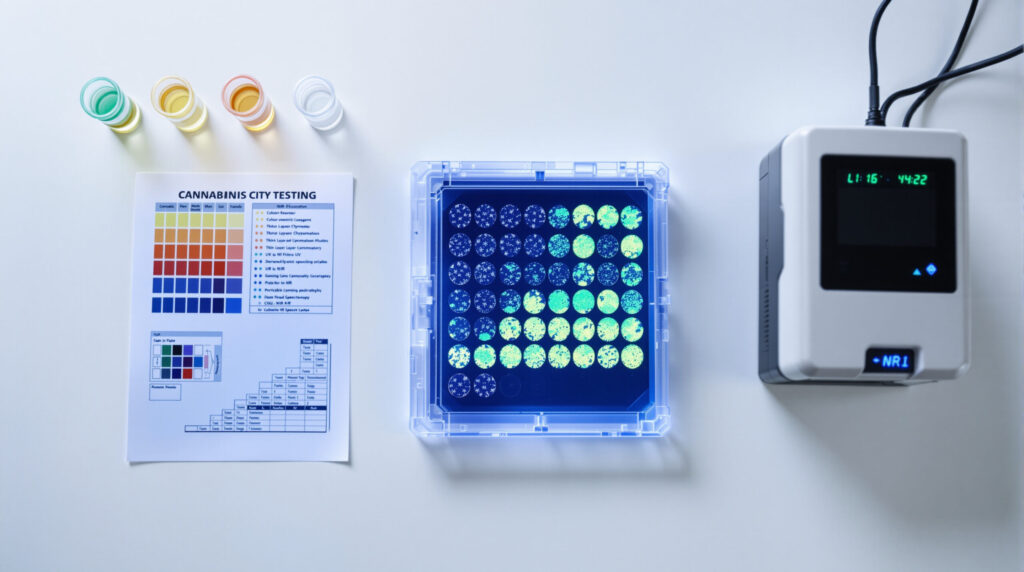
Three fundamentally different approaches have become established for home use. They differ massively in price, effort, and reliability. If you want to buy a THC test device, you should first understand which principle is behind it.
Color tests and reagent kits
The cheapest option is the colorimetric test. You mix a small, weighed amount of flower material with a chemical reagent that changes color depending on THC and CBD content. Well-known kits like Miraculix’s QTest work with around 20 milligrams of sample, a few drops of reagent, and deliver a result after about ten minutes that you read from a color chart. An optional photometer automatically evaluates the reaction and displays a numerical value. Color tests are simple and cheap, but only provide rough estimates and can easily be distorted by accompanying substances in the material.
Thin-layer chromatography
Thin-layer chromatography, or TLC for short, works noticeably more accurately. Here a sample extract travels across a coated plate, which causes the individual cannabinoids to separate spatially and be assessed separately. The procedure is more involved and requires some care, but it distinguishes better between THC, CBD, and their precursors. For ambitious growers who need more than a simple yes-or-no answer, TLC is a sensible middle ground between color tests and electronics.
NIR spectroscopy and portable analyzers
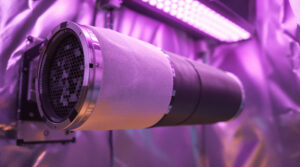
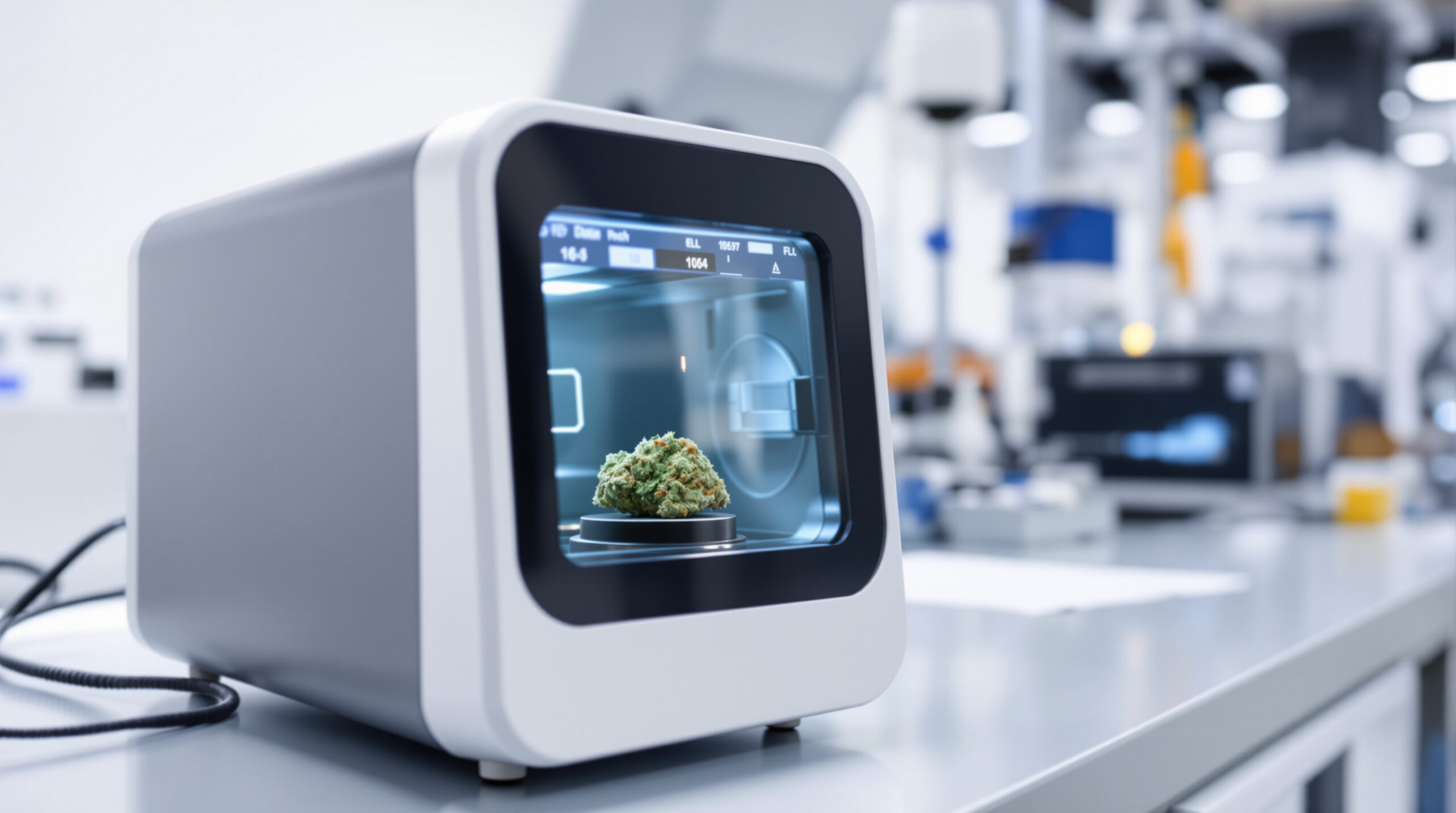
The technically most sophisticated solution is portable devices with near-infrared spectroscopy, or NIR for short. They illuminate the flower with infrared light and calculate cannabinoid concentration from the absorption pattern. The big advantage: the measurement is non-destructive, requires no chemicals, and often takes only about one minute instead of the roughly thirty minutes a laboratory analysis takes. Devices like the Gemmacert target exactly this niche. We’ve already presented such a device in detail; see our report on fast THC and CBD values with Gemmacert. The catch lies in the price and calibration, which we’ll go into more detail on shortly.
How accurate is a home THC test device really?
The honest answer is: more accurate than no measurement, but significantly less accurate than a lab. The most reliable method remains high-performance liquid chromatography, or HPLC for short, or gas chromatography with mass spectrometry. Such analyses cost from about thirty euros per sample and chemically identify cannabinoids exactly. All home methods are measured against these exact laboratory values.
With NIR devices, accuracy depends heavily on the model. Some manufacturers specify a deviation of around two percentage points compared to the lab value, while others cite a tolerance of about ten percent relative to the HPLC result. If the lab shows eight percent THC, the device in the worst case reports something between 7.2 and 8.8 percent. Studies also show that mid-range NIR systems clearly outperform inexpensive models. Color tests rank even lower and are better suited to rough classification than exact numbers.
An often underestimated factor is sample homogeneity. Cannabis is chemically and physically inconsistent; the cannabinoid content fluctuates even within the same plant. Scientific studies show that finely ground and sieved material delivers significantly more reliable predictions than a whole, unground flower. If you only measure once and don’t average, you get a random value instead of a reliable average.
THCA instead of THC: the decarboxylation mistake
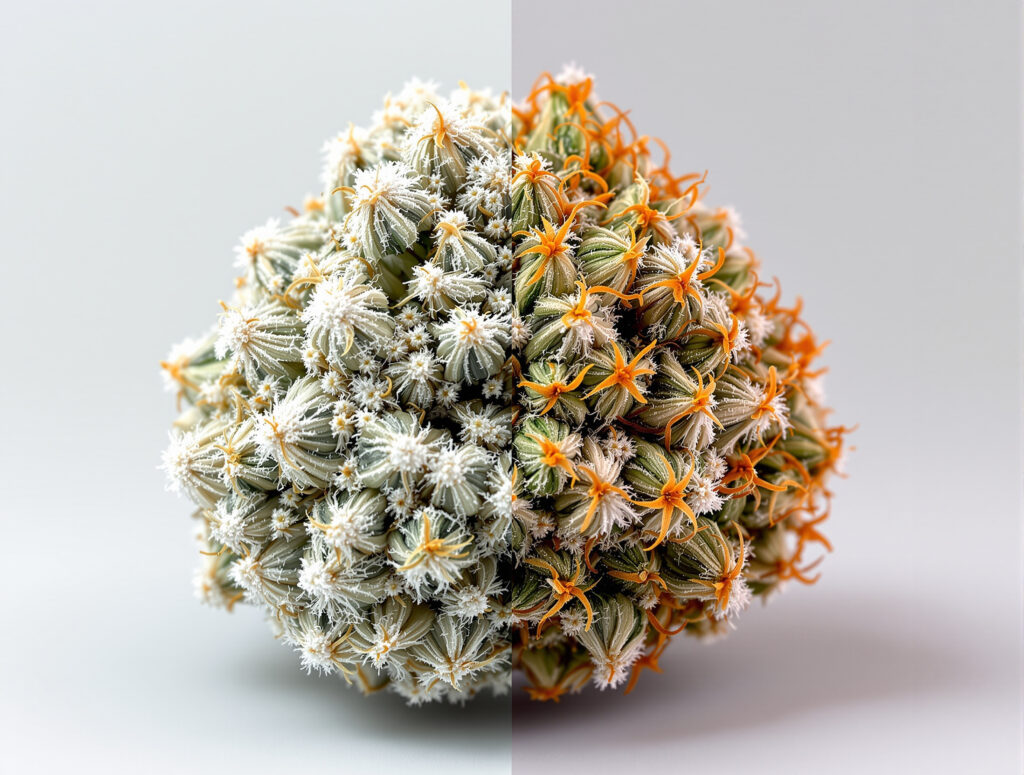
The most important conceptual pitfall has nothing to do with technology but with chemistry. In fresh, dried flowers, the cannabinoid is present almost entirely as THCA, the acidic, not yet psychoactive precursor. Only through heat does this become the actual THC, a process we described in detail under Decarboxylation.
For measurement purposes, this means: A device that only captures active THC massively underestimates the potency potential of the raw flower. What’s meaningful is the so-called total THC value. It accounts for the fact that heating causes some molecular mass to be lost, and is classically calculated as the THCA content multiplied by the factor 0.877, plus any free THC already present. When comparing measurement values from different devices, you absolutely must know whether THC, THCA, or total THC is being reported. Otherwise you’re comparing apples and oranges.
What a THC test device cannot do
As practical as these devices are, you should know their limits. A home device does not replace accredited laboratory analysis and certainly must not be used for legally binding or medical statements. The underlying computational models are trained on specific sample types. A NIR analyzer whose calibration was created for dried flowers will deliver correspondingly unreliable values for hashish, extracts, or very moist material.
Likewise, an inexpensive device cannot reliably detect contaminants like mold, pesticides, or heavy metals. If you need safety for health reasons, there’s no getting around a lab. And finally, no residual moisture content and no uneven sample changes behavior on their own: Results are only as good as the preparation. Realistically speaking, a home THC test device is a valuable tool for self-monitoring and comparing your own harvests, but not a laboratory replacement.
What to look for when buying a THC test device
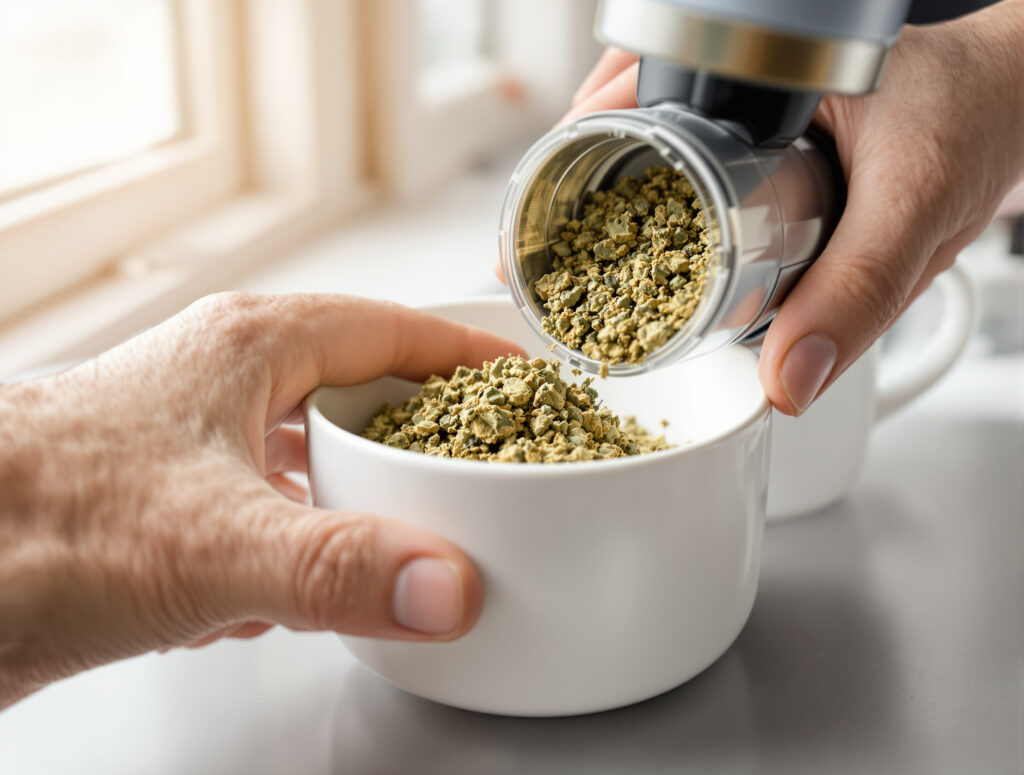
Before making a purchase, an honest needs assessment is worthwhile. If you only occasionally want to know whether a flower falls roughly in the low, medium, or high range, you’re well served by a color test kit for under thirty euros. If, on the other hand, you regularly want to compare different varieties or growing cycles and see reliable numbers, you should consider an NIR device or at least a photometer. What matters less is the advertised maximum value than whether the calibration suits your material.
Three points separate useful devices from disappointing ones. First, calibration: Is the model trained for dried flowers, or also for hashish and extracts? Second, updateability, because cloud-based devices improve their computational models through updates. Third, reproducibility, that is, whether a multiply-measured, ground sample delivers stable values. Reputable providers cite specific deviations compared to HPLC rather than vague advertising promises. If this information is completely missing, skepticism is warranted. And regardless of price, this holds true: the best electronics don’t replace careful sample preparation.
Frequently asked questions
How accurate is a home THC test device?
This depends heavily on the technology. Good NIR devices achieve a deviation of roughly two to ten percent compared to an HPLC laboratory analysis, depending on the model. Color tests, by contrast, only provide rough estimates. For exact, legally secure values, the laboratory remains the only reliable reference.
What does a THC test device cost?
The price range is enormous. Simple color test kits are available for under thirty euros, a photometer costs a few hundred euros. Portable NIR analyzers for flowers, on the other hand, are in the four-figure range and are aimed more at professionals or ambitious frequent users.
Why do the values differ from laboratory analysis?
Cannabis is an inconsistent natural product; cannabinoid content fluctuates within the plant. Home devices work with computational models calibrated to specific sample types. Unground or moist material, single measurements, and incorrect calibration therefore lead to deviations from the exact laboratory value.
Does the device measure THC or THCA?
In the raw flower, the cannabinoid is present almost entirely as THCA, the not yet psychoactive precursor. What’s meaningful is the total THC value, which factors in the later conversion through heat. Before any comparison, check which value each device reports.
Can a THC test device detect mold or pesticides?
Misst du den THC-Gehalt deiner eigenen Ernte?
No. Standard home devices determine cannabinoid concentration, not purity. Contaminants like mold, pesticides, or heavy metals can only be reliably detected in a specialized laboratory. For health-relevant safety, professional analysis is essential.





Branchen-Update
News, Analysen und Reportagen — mehrmals im Monat direkt in dein Postfach.
Folge uns