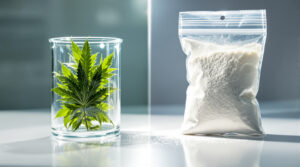

Portugal has officially banned hexahydrocannabinol (HHC). On May 8, 2026, the government published Law No. 19-F/2026, which supplements Portugal’s landmark drug legislation from 1993 and adds the semisynthetic cannabinoid to List II-A of controlled substances. The regulation took effect the following day. With this move, Lisbon joins a wave of European capitals that have removed HHC from circulation over the past two years—including Germany and Austria.
📑 Inhaltsverzeichnis
What the new Portuguese HHC law specifically regulates
Law No. 19-F/2026 amends Decreto-Lei No. 15/93, which has formed the legal framework for narcotics and psychotropic substances in Portugal for over three decades. The amendment includes the complete chemical name of the active substance: 6a,7,8,9,10,10a-hexahydro-6,6,9-trimethyl-3-pentyl-6H-dibenzo[b,d]pyran-1-ol. HHC now sits on equal legal footing with other Table II-A substances. In practice, this means production, import, export, distribution, sale, possession, and consumption are punishable or pursued as administrative violations outside legally authorized contexts.
The Portuguese government justified the move by citing recommendations from the UN Commission on Narcotic Drugs in its 2024 and 2025 sessions. These meetings proposed several new psychotropic substances for international control lists, including HHC. The addition to national law implements the UN decision as binding obligation. With the amendment, Lisbon also republished all annexes of the drug law to make the updated legal framework consolidated and accessible.


Why Lisbon acted now
HHC emerged in recent years as a purportedly legal THC alternative in many EU countries. Retailers exploited regulatory gray zones surrounding novel cannabinoids. The molecule is semisynthetic, present only in trace amounts in the cannabis plant, and manufactured industrially from CBD. It exhibits psychotropic effects similar to those of delta-9-THC but falls below the 0.3% THC threshold that many European hemp regulations use as their benchmark.
In Portugal, HHC-containing products were sold in physical retail stores, vending machines, and online platforms. The product range extended from powder flowers and vape cartridges to gummies, edibles, and oils. Many retailers marketed their products as legal cannabis alternatives, often without laboratory testing and without clear information on composition, dosage, or contaminants. This combination of rapid market expansion and lack of safety, toxicity, and long-term effects data has prompted several EU member states to implement restrictions or bans over the past two years.
With the new law, Portugal follows a broader European trend. In Germany, HHC fell under the New Psychoactive Substances Act in June 2024; Austria banned it in 2023. Belgium, France, and Italy have taken similar steps in recent years. A detailed European overview of novel cannabinoid regulation can be found in our background article on European cannabinoid regulation.
Portuguese authorities warn of whack-a-mole effect
Several Portuguese experts point out that banning a single synthetic cannabinoid does not address the underlying problem. As soon as one substance is prohibited, new, slightly modified chemical variants designed to circumvent legislation flood the market. This whack-a-mole dynamic has generated dozens of new synthetic cannabinoids over recent years—from HHC-O to THCP to H4-CBD. Portugal’s earlier drug model, which decriminalized personal consumption beginning in 2001, remains substantively unchanged. Criminal prosecution continues for manufacturing, trade, and distribution.
Notably, authorities have observed that HHC products remain available in individual retail locations, vending machines, and especially via online shops even after the ban took effect. Enforcement will require time and resources. Alongside this, ASAE, Portugal’s food safety and economic authority, drew attention with Operation Euforia: the agency recently reported seizure of approximately 6,800 items containing cannabis sativa extracts and initiated 19 criminal proceedings. Distinctions between hemp flowers, CBD products, and synthetic cannabinoids regularly blur in practice.
What the ban means for the DACH market
For the German-speaking cannabis industry, Portugal closes a gap in Europe’s patchwork regulatory landscape. As long as individual member states tolerated HHC, cross-border online shipping remained wide open. Consumers in Germany, Austria, and Switzerland could order vape cartridges, gummies, and flowers from Portugal despite domestic laws prohibiting such purchases. The new Portuguese law closes this shipping route. At the same time, statements from Portuguese experts remind us that synthetic alternatives will continue to emerge as long as THC itself remains controlled or prohibited in most European states. The German debate over intoxicating hemp and the CBD boom revolves around precisely this question.
Europe has approximately 24 million cannabis users by current estimates. Countries like Germany are moving toward regulated distribution of natural THC products with the Cannabis Act (CanG) and ongoing reforms to medicinal cannabis legislation. Observers view this as the most effective lever against the market for unregulated semisynthetic substances. Austria’s federal law, which banned HHC in 2023, illustrates the argument: demand partially shifted to other cannabinoids and partly to the black market for classical THC. A comparable dynamic should now be observable in Portugal as well. We examined the Austrian case in detail in our article on HHC prohibition in Austria.
Frequently asked questions
Since when is HHC banned in Portugal?
Law No. 19-F/2026 was published on May 8, 2026. It took effect the day after publication, on May 9, 2026. HHC has been listed on Table II-A of Portugal’s drug list since then.
What penalties apply for HHC possession in Portugal?
HHC falls under the same legal framework as other Table II-A substances. Production, import, export, distribution, sale, possession, and consumption outside authorized contexts can be prosecuted as criminal or administrative violations. The specific sanction depends on quantity and intended use. Personal consumption remains decriminalized under Portugal’s 2001 model; trafficking is subject to criminal prosecution.
What distinguishes HHC from THC?
HHC is a semisynthetic cannabinoid manufactured from CBD. It exhibits psychotropic effects similar to delta-9-THC but typically shows THC values below the 0.3% threshold in laboratory analysis. This was the legal loophole through which HHC products could be sold as legal hemp products in many EU countries for years.
What is the situation in Germany and Austria?
In Germany, HHC has been prohibited under the New Psychoactive Substances Act since June 2024. Austria banned the cannabinoid in 2023. In Switzerland, the situation remains open in several respects, with individual cantons taking different approaches. Portugal now aligns with the three DACH countries with this latest move.
What does this mean for mail-order trade in the DACH region?
Until May 2026, many HHC shippers used Portugal as their base because the country had not yet regulated the substance. With the ban, this shipping route disappears. Orders from Germany, Austria, and Switzerland were already prohibited under national law anyway. Criminal prosecution of suppliers and recipients will now be facilitated.
Sources: CannaReporter, Lei n.º 19-F/2026 (Diário da República, May 8, 2026), Decreto-Lei n.º 15/93, UN Commission on Narcotic Drugs (2024 and 2025 sessions), ASAE.
Related articles
- Greece plans to ban CBD flowers: government advisory board warns of EU conflict
- USA classifies cannabis in Schedule III for first time: what the historic step means for Europe
- Canada reports record sales of hemp products
Sollte HHC in Europa einheitlich reguliert werden?






Branchen-Update
News, Analysen und Reportagen — mehrmals im Monat direkt in dein Postfach.
Folge uns