

Since the Cannabis Consumption Act, adults in Germany are legally permitted to use cannabis. Many employees are therefore wondering whether their employer can still monitor consumption. The answer is clearer than the dispute over legalization might suggest. A legal joint after work protects no one from employment law consequences if performance in the company suffers. At the same time, arbitrary drug tests in the workplace remain prohibited even in 2026. This guide explains what employers are permitted to demand, when a test is permissible, and what rights employees retain.
📑 Inhaltsverzeichnis
- What the Cannabis Act actually changed in the workplace
- Can an employer order a drug test in the workplace?
- The important exception: safety-critical activities
- Data protection and the role of the occupational physician
- If the test is positive: warning, dismissal, and the factor of detectability
- What employees and employers should now consider
- Frequently asked questions
- 💬 Fragen? Frag den Hanf-Buddy!
What the Cannabis Act actually changed in the workplace
Legalization has decriminalized private possession and consumption of cannabis. However, it has left employment law untouched. For the company, the same principle applies as with alcohol. Consumption during leisure time is a private matter as long as it does not impair work capacity. Anyone who appears intoxicated at work violates their employment contract obligations. This was the case before the Cannabis Act and has remained unchanged since.
The decisive point is the separation between possession and work capacity. An employer generally cannot sanction pure consumption during leisure time. However, as soon as the required work performance suffers or a hazard arises, the employer’s management rights come into play. From the duty of care, general protection obligations, and house rules, the employer has a clear right. The employer can prohibit consumption during working hours, breaks, and on the entire company premises. For more on the fundamentals, read our overview on cannabis in employment law.


Can an employer order a drug test in the workplace?
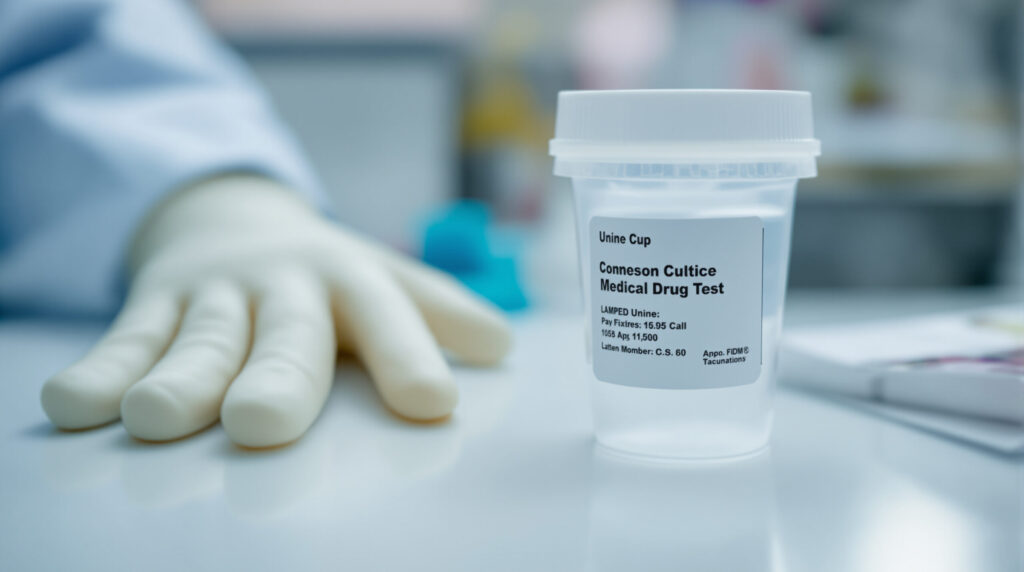
The short answer is: only with consent. A drug test is a significant intrusion into general personality rights and physical integrity. Therefore, an employer cannot force anyone to take a test. Even with reasonable suspicion, participation remains voluntary. Employees have the right to refuse such a test without the refusal alone justifying dismissal.
The logic corresponds to the established handling of alcohol. Likewise, an employer cannot force anyone to breathalyze against their will. However, the employer may certainly respond if work capacity is visibly impaired. Cannabis is treated under the same employment law principles. The law has deliberately not created special rules here. Those who understand this can classify most workplace disputes themselves.
Courts judge random screening very strictly. Routine drug tests without concrete grounds, intended only to preventively detect possible dependencies, are generally impermissible. The situation is different if concrete suspicion exists. If someone appears visibly intoxicated, slurs their speech, or shows clear signs of impairment, the employer may offer a test. However, they cannot force it. They may remove the affected person from dangerous activities and send them home.
Disputed is the question of a contractual clause. Whether employees can effectively commit themselves in the employment contract to regular testing is not legally settled. Many employment lawyers consider blanket testing clauses to be ineffective because they undermine consent. Free consent requires that it occurs without pressure and is revocable at any time. In practice, works agreements create clear and fair rules. How the works council can have a say is described in our article on how the works council participates in cannabis consumption.
The important exception: safety-critical activities

There is a practically significant exception to voluntary participation. In safety-critical areas with high risk of harm, drug screening may be permissible. This refers to activities where intoxication endangers human lives. This includes operating vehicles, operating heavy machinery, or working on construction sites and at heights. Here, the protection interest outweighs the individual’s personality rights.
Such a test is usually possible within the framework of an occupational health examination. The Occupational Health Provision Regulation provides the framework for this. Even then, however, effective consent and a sound legal basis are required, such as a works agreement. The test examines suitability for a dangerous task, not private life. If the result is positive, the employer can remove the affected person from the dangerous activity. Immediate dismissal does not automatically follow.
It is important to distinguish this from road traffic. At work, the issue is concrete safety in the workplace, not fines or driver’s license suspension. Anyone who drives to work should know the separate limit value in traffic. We explain this in detail in the guide to cannabis and road traffic 2026.
Data protection and the role of the occupational physician
Health data are among the particularly sensitive data categories of the General Data Protection Regulation. A drug test result therefore cannot simply end up in the personnel office. Employees must explicitly consent to such data being collected at all. This consent must be free, informed, and specific. A hidden clause in the employment contract generally does not meet these requirements.
The occupational physician plays a central protective role. They are bound by medical confidentiality and cannot share the concrete test result with the employer without being asked. Without express permission from the affected person, the physician only informs the company whether someone is suitable for the respective activity or not. The employer thus learns the result suitable or unsuitable, but not the exact measured values. This filter protects privacy and is one of the most important safeguards in the entire procedure.
If the test is positive: warning, dismissal, and the factor of detectability

A positive test is not an automatic grounds for dismissal. What matters is whether there is a concrete breach of duty or hazard. In the case of a first-time violation, a warning is usually the first step. Only with repeated violations or serious hazards does ordinary or even summary dismissal come into consideration. For safety-critical activities, the threshold for dismissal may be lower.
A technical problem becomes legally significant here. A common urine test does not detect current intoxication but rather the breakdown product THC-COOH. This remains in the body for a long time even after effects have ceased. With occasional consumption, it is often detectable in urine for one to three days. With regular consumption, detection can last several weeks, in rare cases even longer.
This has an important consequence for employees. A positive urine test alone does not prove that someone was intoxicated at work. It only documents past consumption, which could well have occurred purely during leisure time. This is often insufficient for employment law sanctions. We explore the breadth of detection timeframes in our article on THC detectability. Against this background, employers are well-advised not to sanction the mere test result but rather the actual impairment.
There is also the risk of false positive results. Simple rapid tests are prone to error and may react to other substances. Certain CBD products can also in rare cases trigger a test if they contain traces of THC. A positive rapid test result should therefore always be confirmed by a precise laboratory procedure. Employees have a justified interest in such a retest. No one should suffer sanctions based solely on an unconfirmed rapid test.
What employees and employers should now consider
For employees, a simple rule applies. Consumption during leisure time is legal and private, but intoxication at work is taboo. Those working in safety-critical areas should know and factor in the stricter rules. When asked to take a test, there is a right to time for consideration and to consult a trusted person. The works council is an important contact here.
Employers should establish clear and transparent rules, preferably in a works agreement. Blanket and causeless testing quickly enters legally uncertain territory. More sensible is an approach that focuses on concrete work capacity. Legalization itself has not shifted legal obligations in the company. Our overview of cannabis legalization in Germany describes the broader political context.
Frequently asked questions
Can my employer simply demand a drug test?
No, an employer cannot force a drug test. A test generally requires the voluntary consent of the affected person. Even with reasonable suspicion, participation remains voluntary. An exception exists for certain fitness examinations in safety-critical areas, but these also require a valid legal basis.
Can I be fired if I use cannabis during my leisure time?
Pure consumption during leisure time has been a private matter since legalization and does not alone justify dismissal. Dismissal only comes into consideration if consumption impairs work performance or creates a hazard in the workplace. What matters is the concrete effect on work, not private consumption as such.
Does a positive urine test prove I was intoxicated at work?
No, a common urine test detects the breakdown product THC-COOH, not current intoxication. Depending on consumption frequency, this breakdown product remains detectable for days to weeks. A positive result therefore only documents past consumption. It is not proof of acute impairment during working time.
Who learns the result of a drug test in the company?
As a rule, the occupational physician conducts the test and is bound by medical confidentiality. Without the explicit permission of the affected person, the physician informs the employer only whether someone is suitable for the activity. The concrete measured values remain protected. Health data may only be collected with informed consent.
Do stricter rules apply in safety-critical professions?
Wurdest du schon mal am Arbeitsplatz auf Drogen getestet?
Yes, stricter standards apply to activities with high risk of harm. Those who operate vehicles, operate heavy machinery, or work at great heights should expect fitness examinations. Here, the protection of life and health outweighs personality rights. A positive result usually first leads to removal from the dangerous task, not necessarily immediate dismissal.






Branchen-Update
News, Analysen und Reportagen — mehrmals im Monat direkt in dein Postfach.
Folge uns