Cannabis consumption has many forms. And it has been this way for several thousands of years. Time and again, researchers have found evidence in graves and temples that hemp plant material was burned for spiritual purposes and then likely also inhaled. There are now many examples of this in Israel or China as well as other parts of the world. Over time, other methods were also developed for this purpose, which ultimately led to the current state of affairs.
📑 Inhaltsverzeichnis
While cannabis can now be consumed in the most varied forms, such as via the digestive tract thanks to so-called edibles, thanks to vaporizers in vaporized form, and of course also in conical paper rolls, pipes naturally also made the rounds early on. These existed and still exist in the most diverse designs and forms, which ultimately also includes the water pipe, which in jargon is simply called a bong. The word bong is an adaptation of the Thai word „bong“ or „baung“.
It designates a cylindrical wooden tube, a pipe or a container cut from bamboo and also describes the bong used for smoking. But where does the bong come from, and actually why has it developed into an extremely popular means of inhaling cannabis via the respiratory tract? In this article, we want to get to the bottom of the origins and history of the bong and understand why it continues to enjoy such great popularity even today. The history of the bong – and its use for hemp!


What does it look like?
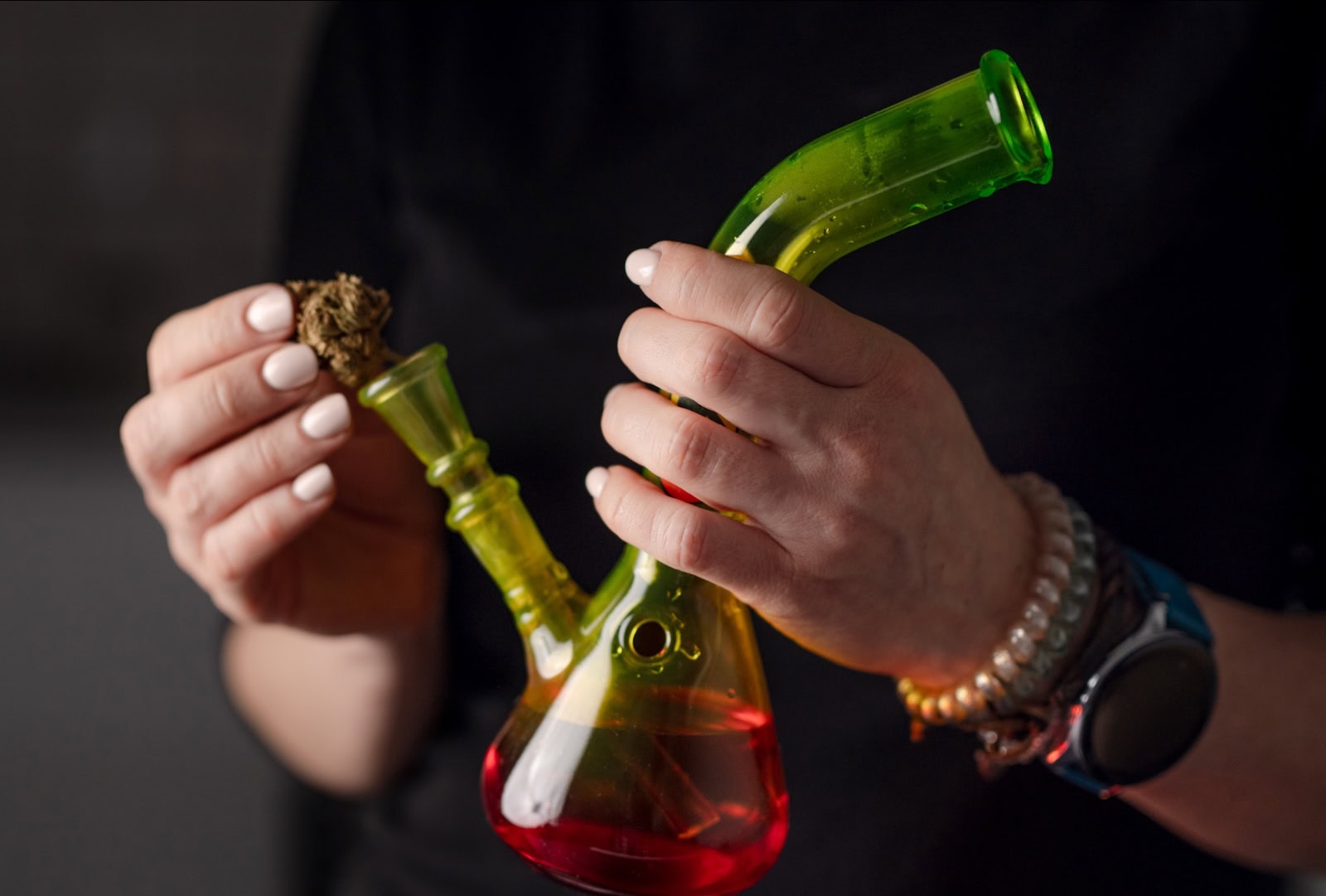
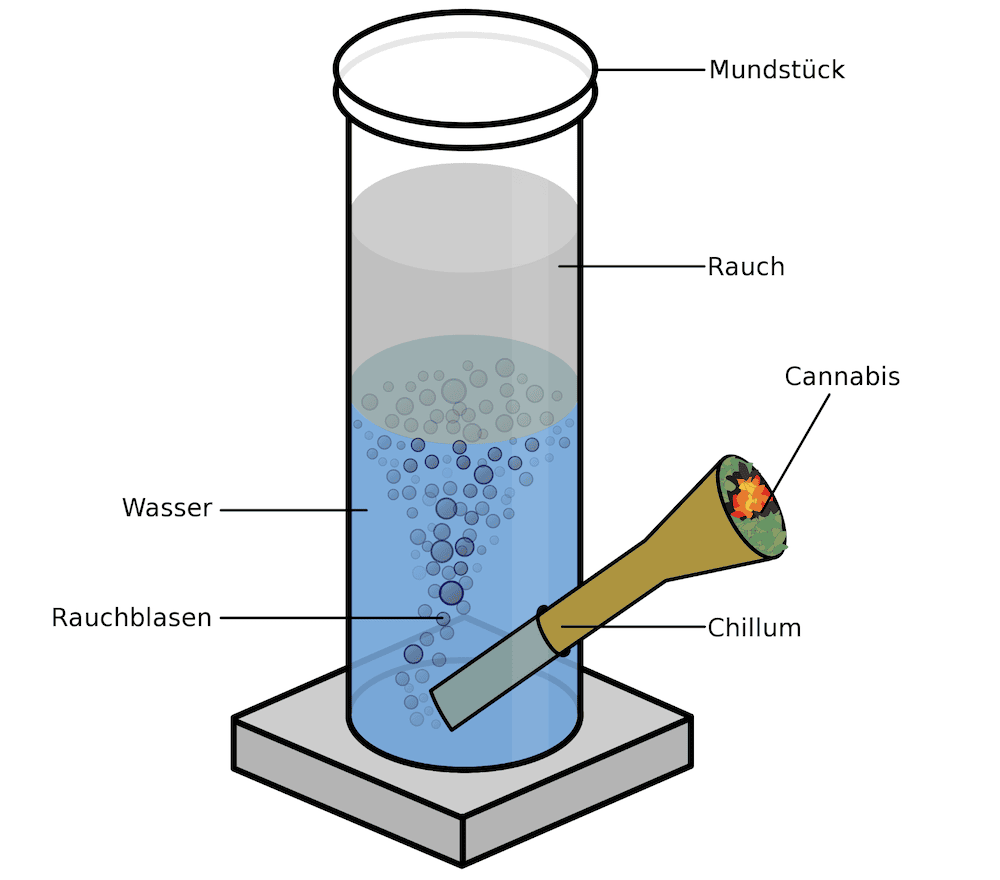
A bong is typically a spherical vessel equipped with two or three openings. One for the mouth, one for a chillum, in which the bowl head is anchored, and possibly also one suitable as a „kicklock“ that makes the resulting smoke easier to reach the mouth opening during inhalation. Within the hollow space of the water pipe, which is often also designed in a straight line, there is water, through which the burning smoking mixture from the bowl head must flow through the chillum before inhalation, and thereby cooled and filtered arrives at the consumer. As mentioned, bongs now exist in all shapes and colors and made from the most varied materials, but this special smoking device must have made its first appearance in a unique design.
Who invented it?
If one searches for the origins of the first water pipes, the available information does not make things one hundred percent clear. Some sources speak of Africa, Asia or India. The Silk Road is in any case said to have been responsible for this particular pipe-building method spreading among the peoples. However, it seems to be established that during excavations of a burial site located in Russia, special gold vessels were found that were already used by Scythian tribal chiefs 2,700 years ago for cannabis and opium consumption.
Much later, during the Ming Dynasty, from the 16th century onwards, the idea of the water pipe is said to have arrived in China from Persia. A little before, during the reign of Emperor Akbar (from 1500), the doctor Hakim Abul Fath is said to have invented the water pipe in India and discovered tobacco in the process. Abul Fath is said to have then suggested passing the smoke from tobacco through a small water vessel before inhalation to make it less harmful. However, there is also the popular theory that bongs actually have their origins in Africa. Archaeologists have discovered clay pipes in Ethiopia dating back to the years 1100 to 1400 after Christ, which suggests that bongs were already used in Africa before they became popular worldwide.
Old pipes for all classes
While it is known that during the Qing Dynasty the Empress Dowager Cixi preferred the water pipe to snuff bottles or other methods of consumption, various herbal goods were also consumed via bongs among the common people. They can be divided into two types. There were handmade bamboo pipes, which were generally used by the rural population, as well as more elegant metal pipes, which were used by Chinese merchants, city dwellers and nobility. And differences are also said to be evident in the latter variants as well.
As a rule, they were made of bronze or brass for the higher classes and in the aristocratic version immediately of silver – often decorated with jewels as well. Three water pipes belonging to Empress Cixi, who controlled the government at that time, are said to have been placed in her grave, one pair of which from her collection is displayed in the Palace Museum in the „Forbidden City“. There were also paraphernalia for bong users at this time. A tobacco tin with a lid was part of the package, as was a pipe stand small enough to be held in one hand. It should also have two large holes for the tobacco container and the water pipe. It is also said to have existed in versions with additional holes that were intended for special utensils for pleasure smoking.
The Modern Bong
In modern times there are countless variants of the bong. Glass blower Bob Snodgrass is referred to as the father of the modern glass bong, who is said to have taught the members of the Grateful Dead band the craft while on tour with the band. His work also made it possible to add various color designs and effects to the glass that did not exist before. This development probably awakened new interest in bongs in the 20th century. Over time – as it had been in the past – bongs made from many materials came onto the market. Clay, stone, ceramic, acrylic, stainless steel or aluminum can all be used to build a bong.
Grown natural materials such as bamboo or coconuts are also suitable for use. However, the glass bong is likely the most popular variant at present, as you can see what is happening inside and it is also easiest to clean with the use of the right products. In addition to the typical criteria of a bong, new inventions have crept into use. For example, you can clamp a pre-cooler between the bowl and pipe via a chillum extension, which cools and cleans the smoke with a little water before it enters the bong. This reduces the scratchy feeling when inhaling and keeps the water pipe itself less dirty.
In addition, evolution has taken place in the chillum itself, which now also comes in variants with a diffuser. This means that at the end of the tube that extends into the water, there are several small openings that distribute the smoke in all directions and smooth it out a bit more. There are also modern smoke bowls with built-in catalyst that ensure that less ash gets through the chillum into the bong during the combustion process. Catalysts also exist in versions that can be inserted between the bowl and chillum.
Why Smoke a Bong?
There can be several reasons why someone reaches for a bong. A joint, for example, takes some time to produce and then several longer minutes to consume. With a bong you only make a cannabis mixture – optionally with tobacco or tobacco substitutes – and fill it into the smoke bowl. You then draw strongly on the mouthpiece while the mixture is ignited with fire, and get a decent amount of the product into your lungs. So-called flood bowls are suitable for one-time consumption, but this brings a direct and strong effect compared to smoking a joint, where the effect sets in slowly and gradually.
Also, drawing on a bong already has a psychological effect, since the smoke doesn’t reach the lungs through the cheeks first, but is inhaled in one long, powerful drag all at once. It takes some practice to smoke a bong, because the strong smoke concentration and the rapidly onset „flash“ can surprise newcomers and make them cough. But be careful, once you get used to it, bong smoking can quickly become a habit. In any case, the existence of the bong shows that people like to engage with the subject itself a bit more beyond the actual enjoyment and want to give the habit a bit more style.
The fact that genuine craftsmanship can come into play in the process continues to fascinate people time and again. However, if you want to acquire a bong for use, you should always pay attention to appropriate quality and care for the piece accordingly so that you can enjoy it for as long as possible. Good drag!
photo credit: By Christopher Thomas – Own work, based on: File: Bong diagram 2.svg (also own work), CC BY-SA 4.0, https://commons.wikimedia.org/w/index.php?curid=80872301
Structure and Function: What Happens in a Bong
At its core, a bong consists of four parts, and each one has exactly one task.
- The head, also called a bowl, holds the material. It usually has a screen inside that prevents plant parts from slipping through.
- The chillum is the tube that runs from the head down into the water. It directs the smoke under the water surface, and that’s exactly where the cooling takes place.
- The chamber is the hollow space above the water. The smoke collects here before it is inhaled. This is the difference from a dry pipe: the drag is bundled rather than continuous.
- The kick hole is located on the side of the lower third. As long as it is covered, negative pressure builds up. When you release it, air flows in and the chamber empties.
Not every bong has a kick hole. In models without one, the head is pulled out of the joint instead, which has the same effect.
What the Water Really Does
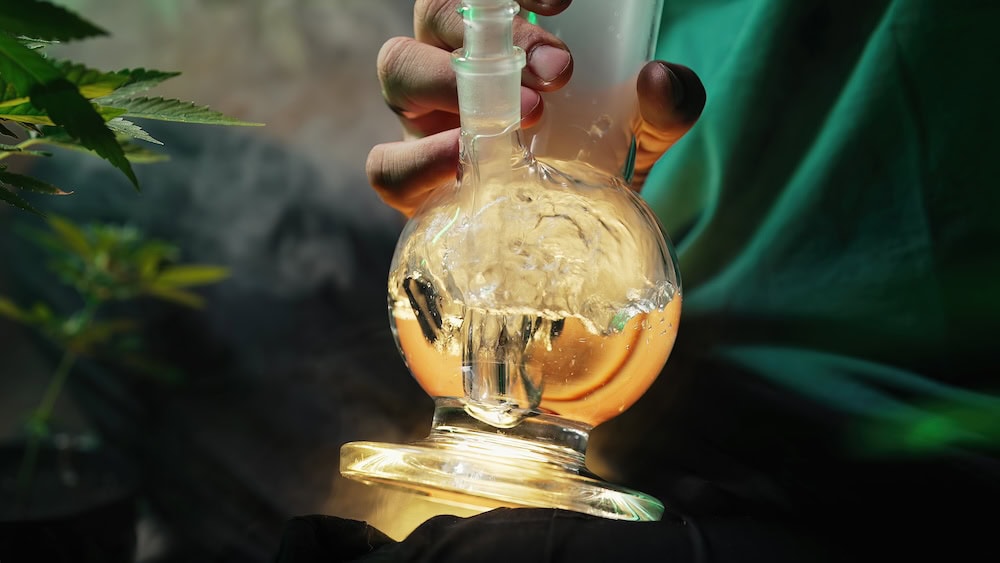
The water serves two functions, and it’s important to distinguish between them. It cools the smoke, measurably so, which is why the drag feels smoother and scratches less. And it retains some of the coarse particles and water-soluble components.
What it does not do: It does not make the smoke harmless. Tar and carbon monoxide are not water-soluble and pass through the water bath largely unchanged. Burning plant material remains the most taxing form of consumption, regardless of how much water the smoke is filtered through. The cooler, softer sensation actually encourages deeper inhalation.
Pre-cooler, Diffuser, Percolator
Three terms that are often mixed up. A pre-cooler is placed between the head and chillum and cools the smoke before it enters the main chamber. A diffuser is a chillum whose lower end has multiple small slits instead of a single opening, which allows the smoke to distribute more finely in the water. A percolator is an additional chamber in the body through which the smoke is passed a second time.
All three improve cooling, and all three make cleaning more complicated. The more chambers and slits there are, the harder they are to access.
Types of Construction at a Glance
Glass
The most common type of construction, and the right one for most people. Glass is flavour-neutral, doesn’t absorb odours and is easiest to clean because you can see what’s happening inside. The price range is large, usable devices are available in the lower double-digit range, and there’s no upper limit. The only real disadvantage is mundane: glass breaks.
Acrylic
Light, inexpensive and significantly more resistant to drops. However, acrylic can never be really clean: the material is softer than standard cleaning agents, gets scratches from scrubbing, and resin settles in these scratches more quickly afterwards. It also absorbs odours. Useful as a travel or backup device, but ultimately unsatisfying as a main device.
Silicone
The most practical and least known variant. Silicone is unbreakable, temperature-resistant, foldable and superior to all other materials when cleaning because you can turn it inside out. Taste-wise it is more neutral than acrylic, but not as neutral as glass.
Ice Bong
Externally resembling a glass bong, with a constriction below the mouthpiece into which ice cubes are filled. The smoke is thereby additionally cooled. This is not a replacement for a precooler, but a different matter; both can be combined.
Bamboo and Natural Materials
Traditional design, rare in this country and mostly in circulation as a souvenir. Bamboo bongs typically have no carb hole. The decisive disadvantage lies in cleaning: the material is neither transparent nor smooth, deposits are not visible and are barely removable.
Holland Bong
A design that looks more like a vase than a cylinder, narrowed in the middle and wider again towards the mouthpiece. Functionally it differs little from a straight glass bong; the shape is primarily a matter of taste.
Building a bong yourself: possible, but rarely worthwhile
Instructions for homemade bongs made from PET bottles, tape and straws have circulated for decades, and they work in principle. There are two things you should know before doing it anyway.
First: Everything near the ember gets hot. With a construction made of plastic and tape, this means that material in the immediate vicinity of the heat source softens or chars, and you inhale its vapors. Anyone building should keep plastic away from the ember and use something heat-resistant for the bowl, ideally metal.
Second: A simple glass bong costs less than a pack of cigarettes per month over a year. DIY construction is an emergency solution, not a money-saving idea.
Frequently Asked Questions about the Bong (FAQ)
How does a bong work?
A bong is a water pipe: the smoke is passed through a water bath that cools it and retains some of the particles before it is inhaled through the mouthpiece. Due to the negative pressure, the smoke initially accumulates in the chamber and then enters the lungs in a bundled form – this makes the drag cooler and smoother than with a dry pipe.
Is smoking from a bong harmful or healthier than a joint?
The water cools the smoke and binds some of the water-soluble substances, yet combustion products such as tar and carbon monoxide remain – so the bong is not smoke-free. Those who want to reduce the burden on their airways will find gentler alternatives in the overview of smoke in comparison as well as with vaporizing with the vaporizer. How widespread different consumption methods are worldwide is shown in our overview of countries with the highest cannabis consumption.
What effect does consumption via bong have?
Due to the large, bundled drag, a comparatively large amount of active ingredient reaches the lungs at once, which is why the effect often sets in faster and more intensively than with smaller drags. The amount absorbed is difficult to dose – those looking for a more controllable option can consider consuming edibles.
Where does the bong come from and since when has it been used?
Water pipes have a centuries-old history and appeared in various cultures of Central Asia and Africa before becoming an integral part of modern cannabis culture. How this consumption culture has developed over time is also shown by the history of Dutch coffeeshop culture.
What accessories do you need for a bong?
Basic equipment includes a head (also called a bowl) for filling, a chillum or downstem that directs the smoke into the water, and ideally a small screen that holds back plant material. Depending on the model, adapters, a precooler or a diffuser can be added. In principle, the bong is not limited to cannabis – a look at smokable herbs in portrait shows which legal alternatives are also suitable for it.
How do you clean a bong properly?
The water should be changed after each use, because a biofilm forms in standing water within a few days. For basic cleaning of a glass bong, isopropyl alcohol with coarse salt is suitable, shaken vigorously and then rinsed thoroughly. Caution with other materials: Salt is harder than acrylic and scratches it permanently, so cleaning should be done dry or with mild dish soap. Similar to cleaning and maintaining a vaporizer: whoever cleans their device regularly extends its lifespan and preserves the flavour.
Wie konsumierst du Cannabis am liebsten?










Branchen-Update
News, Analysen und Reportagen — mehrmals im Monat direkt in dein Postfach.
Folge uns