Two overlooked cannabinoids have been shown to kill lung cancer cells in the laboratory. A research group from the University Medicine Rostock and the University of Rostock tested cannabigerol and cannabichromene on two established cell lines and measured a clearly dose-dependent effect. The study was published in the journal Antioxidants. What makes this work particularly interesting is not merely the fact of cell death, but the pathway through which it occurs. The researchers were able to trace the underlying mechanism in several distinct steps.
📑 Inhaltsverzeichnis
What the Rostock Study Examined Regarding CBG and CBC
The focus was on the A549 and H460 cell lines, two standard models for non-small-cell lung cancer. Both have been used in oncology for decades. They are well-characterized and comparable across laboratories. The study examined cell survival, the triggering of programmed cell death, and mitochondrial function.
Two substances were tested: cannabigerol and cannabichromene—compounds that receive far less public attention than THC and CBD. Neither is intoxicating, and both have only been systematically studied in research for a few years. This is precisely what makes the work compelling. It closes a gap in the investigation of so-called minor cannabinoids.


The Mechanism: Apoptosis via the Mitochondrial Pathway
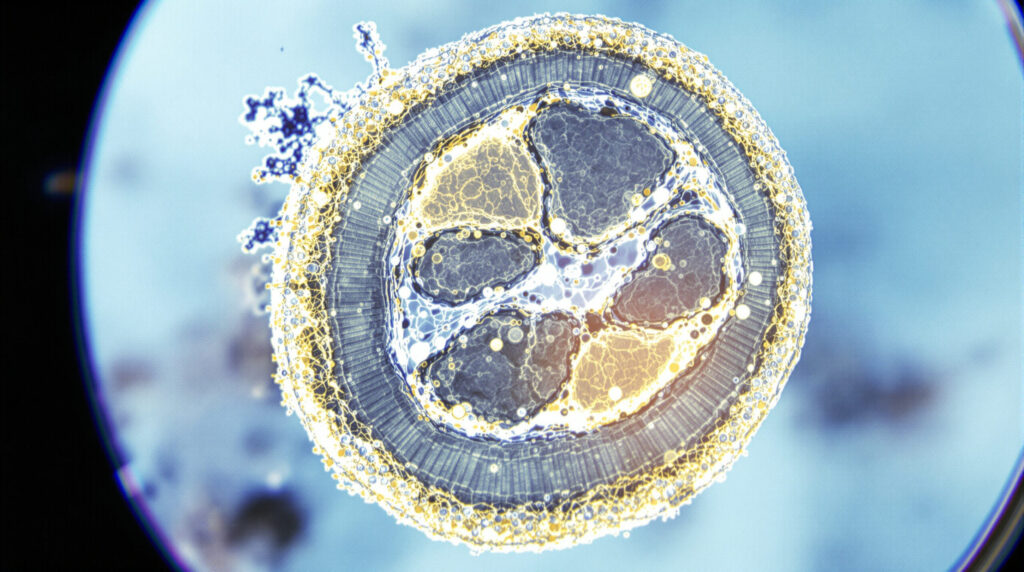
The research group found concentration-dependent triggering of apoptosis and autophagy in both cell lines. Multiple independent markers served as evidence. They detected Annexin-V staining, activation of caspases 8, 9, and 3/7, PARP cleavage, and loss of mitochondrial membrane potential. Additionally, the amount of cytochrome c inside the cells increased.
This combination describes the classical mitochondrial pathway of programmed cell death. Effects on cellular respiration were also observed. The formation of mitochondrial superoxides increased, while the oxygen consumption of mitochondria decreased. With cannabigerol, the researchers additionally observed a reduced amount of the NDUFB8 subunit from Complex I of the respiratory chain. Similar mechanisms of action are known from other studies, such as the research in which a cannabis extract showed lethal effects against melanoma cells.
PPAR-Alpha as a Potential Target

From a pharmacological perspective, the most exciting finding concerns the PPAR-alpha receptor. According to the group’s results, this nuclear receptor mediates the effects of cannabigerol, but not in the same way for cannabichromene. The authors therefore highlight it as a potential therapeutic target. In their conclusion, they state that CBG and CBC trigger apoptosis and cell death in A549 and H460 cells, and that PPAR-alpha mediates the effects of CBG.
An identified receptor is worth more in drug development than a mere effect. It enables targeted follow-up studies, the search for more potent molecules, and assessment of possible interactions. That individual cannabinoids have very different receptor profiles is evident elsewhere too, for instance regarding the differences between the effects of CBD and CBG.
Why Cell Culture Data Is Not Therapy
At this point, realism is called for. This is an in vitro study conducted in cell cultures. Between a petri dish and a human patient with lung cancer lie several developmental stages at which promising substances regularly fail. Cells in culture lack the metabolism of an entire organism, an immune system, and a tumor microenvironment with blood vessels and connective tissue.
There is also the question of concentration. Whether the amounts used in the laboratory can actually be achieved in the body without causing unacceptable side effects can only be clarified through pharmacokinetic research. As long as animal models and clinical trials are lacking, the findings remain limited. What they demonstrate is that a mechanism of action has been plausibly described. A treatment is not yet in sight. How the evidence base appears across different cancer types is shown in the overview of the meta-analysis on cannabis therapy potential in cancer.
Context: Germany as a Hub for Cannabinoid Research

The source of this work is noteworthy. It comes from the Institute for Pharmacology and Toxicology at the University Medicine Rostock, supported by the institution’s Electron Microscopy Center. Cannabinoid research at this level takes place at several sites in Germany. In public debate, however, it rarely receives attention. That discussion is dominated by legalization, prescribing practices, and reimbursement.
For patients, the study changes nothing immediately. Anyone with a cancer diagnosis should discuss any self-experiments with CBG or CBC products with their treatment team and absolutely should not replace ongoing therapy. The value of this work lies in basic research. It provides a concrete starting point for the next phase, and that is precisely how it should be read. How this differs from the reality of care is illustrated in our report on how an NHS Trust allowed patients to use their prescribed cannabis medicine in the hospital. That common assumptions about cannabis often don’t hold up is also shown by research demonstrating that motivation is not affected by cannabis.
Frequently Asked Questions
What are CBG and CBC?
Cannabigerol and cannabichromene are two non-intoxicating cannabinoids found in the hemp plant. CBG is considered a precursor from which other cannabinoids are formed through plant metabolism. Both are present in typical varieties only in small amounts and have been systematically studied for only a few years.
Do CBG and CBC Cure Lung Cancer?
No. The study was conducted exclusively on cell cultures in the laboratory. There are neither animal studies nor clinical trials in humans that would prove efficacy. No therapy recommendation can be derived from this result.
Which Cell Lines Were Used?
A549 and H460 were tested—two established cell lines for non-small-cell lung cancer. They are considered standard models because they are well-characterized and make results comparable across laboratories.
What Does PPAR-Alpha Mean in This Context?
PPAR-alpha is a nuclear receptor that controls, among other things, fat metabolism. According to the Rostock data, it mediates the effect of cannabigerol on cancer cells. This identifies a concrete molecular target where further drug development can focus.
Should Cancer Patients Now Take CBG Products?
Self-experimentation is not recommended. Over-the-counter products cannot be compared to laboratory conditions in terms of dosing and purity, and interactions with cancer therapies are possible. Any use should be discussed with the treatment team.
Kanntest du CBG und CBC vor diesem Artikel?
Sources: Antioxidants (University Medicine Rostock and University of Rostock, June 2026), CannaReporter.






Branchen-Update
News, Analysen und Reportagen — mehrmals im Monat direkt in dein Postfach.
Folge uns