Whoever buys cannabis seeds will inevitably stumble across cryptic abbreviations. F1, F2, BX, IBL, or S1 appear on many packages without anyone explaining what they mean. These abbreviations are not marketing jargon. They precisely describe which breeding generation a strain is in and how reliably its traits are inherited. Those who understand cannabis genetics know before the first seed germinates whether plants will grow uniformly or vary considerably. This guide decodes the most important terms and shows what they mean for your own cultivation.
📑 Inhaltsverzeichnis
- Genotype, Phenotype, and Chemotype: The Foundation of Cannabis Genetics
- From Landrace to Inbred Line (IBL): Stable Base Genetics
- F1, F2, and F3: What Filial Generations Really Mean
- Backcross (BX) and Self-Pollination (S1): Two Paths to Stability
- Polyhybrids and the Heterosis Effect: Why True F1 Seeds Boom
- What Cannabis Genetics Means for Your Home Cultivation
- Regular, Feminized, and Automatic Seeds in a Genetics Context
- Frequently Asked Questions
- 💬 Fragen? Frag den Hanf-Buddy!
Genotype, Phenotype, and Chemotype: The Foundation of Cannabis Genetics
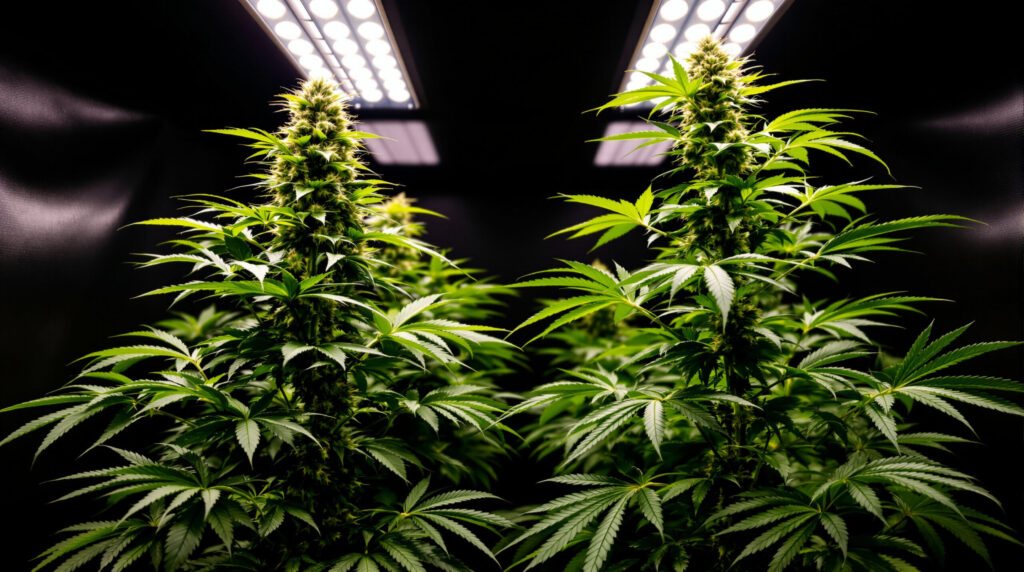
Before breeding abbreviations make sense, it’s worth looking at three basic concepts. The genotype is the complete genetic code of a plant. It establishes the potential—which traits are possible at all. The phenotype is what becomes visible in the end. It emerges from the interplay of genetics and environment, such as light, temperature, and nutrients.
Two seeds with identical genotypes can therefore look different if they grow in different rooms. The chemotype, in turn, describes the chemical profile—the ratio of cannabinoids and terpenes. Only these three levels together explain why the same strain can produce either a compact or a stretchy plant. You can find more background information in our article Understanding Cannabis Genetics.


This difference is more than theory. One and the same seed can develop a dense, resinous flower under strong light. Under insufficient light, the same genetics remains thin and airy. The genotype merely sets the framework. How much of this potential the plant realizes depends on the environment. This is precisely why the designation on the seed packet alone says nothing about the later result in the grow room.
From Landrace to Inbred Line (IBL): Stable Base Genetics
Every breeding story begins with the landrace. These are populations adapted to a region over centuries, such as those from Afghanistan, Thailand, or Colombia. Landraces are genetically diverse but lack uniformity. Two seeds from the same landrace can produce very different plants.
Breeders want to harness this diversity. To do so, they repeatedly cross the most similar plants over many generations. After about five to six generations, the desired traits are largely fixed. The result is called an inbred line, abbreviated IBL for Inbred Line. An IBL passes on its characteristics very reliably, which is why it serves as clean base genetics for modern crosses. How landraces and bred strains differ in their cannabinoid profiles is explored in the article Breeding vs. Landrace.
F1, F2, and F3: What Filial Generations Really Mean
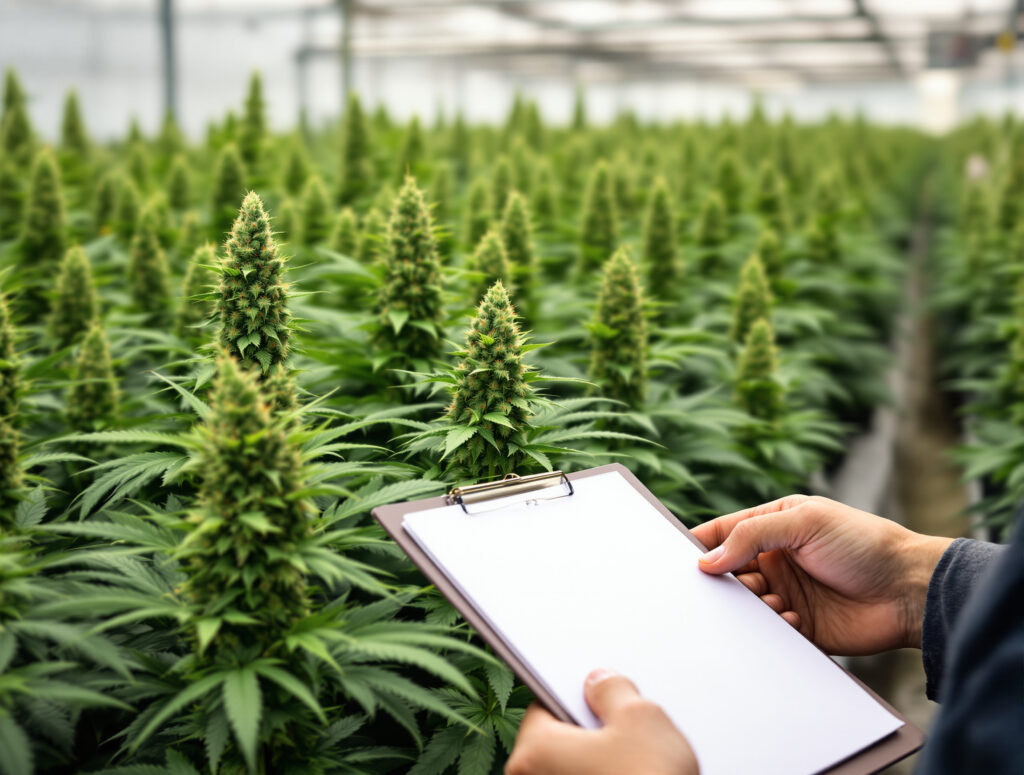
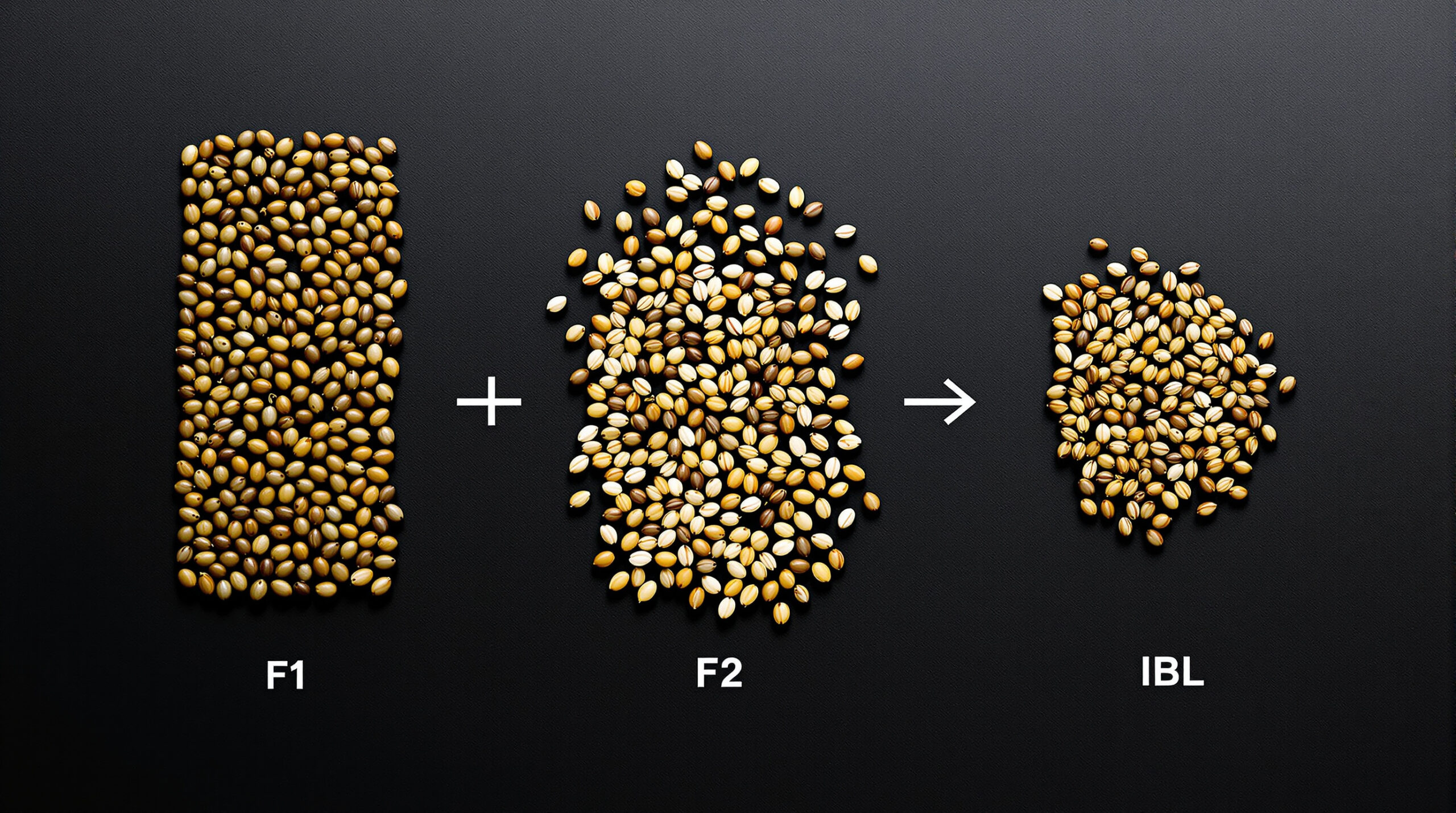
The F stands for filial generation, meaning the offspring generation of a cross. When two different inbred lines are crossed, the first offspring generation is created: the F1. This is where the appeal lies. True F1 hybrids are exceptionally uniform because both parent lines are stable. Each plant grows almost like a clone of the next, with the same height, flowering time, and very similar cannabinoid values.
It becomes interesting at the next level. When two F1 plants are crossed, the F2 is produced. Now the genetic material of the grandparents shuffles anew, and the offspring vary greatly. This so-called segregation is exactly what Gregor Mendel described. In the F2, traits suddenly reappear that were hidden in the F1.
The reason lies in the inheritance of dominant and recessive alleles. In the F1, the dominant trait from both parents masks the recessive one. Only in the F2 can two recessive alleles come together and become visible. This is why one F2 package often produces three or more clearly different types. Breeders exploit this exact diversity to select the most interesting plants from an F2 for further work. The F3 and further generations result from continued crossing and are mostly used for gradual stabilization. Our article F1 Hybrids in Hemp Plants explains the fundamentals.
Backcross (BX) and Self-Pollination (S1): Two Paths to Stability
Sometimes a breeder wants to lock in a single trait, such as the aroma of a special mother plant. Then they use backcrossing, abbreviated BX. Here, an offspring is crossed again with one of its parents. This increases the proportion of desired parent genetics. A first backcross is called BX1, a second BX2. This way, coveted cutting varieties can be recreated as seed.
Self-pollination takes a different approach. Here, a female plant pollinates itself. To achieve this, it is treated with colloidal silver or silver thiosulfate so it produces male flowers. The resulting pollen pollinates the same plant. The result is S1 seeds that produce almost exclusively female offspring and resemble the mother plant closely. S1 is thus a common route to feminized seeds but differs from a classical cross of two plants.
Polyhybrids and the Heterosis Effect: Why True F1 Seeds Boom
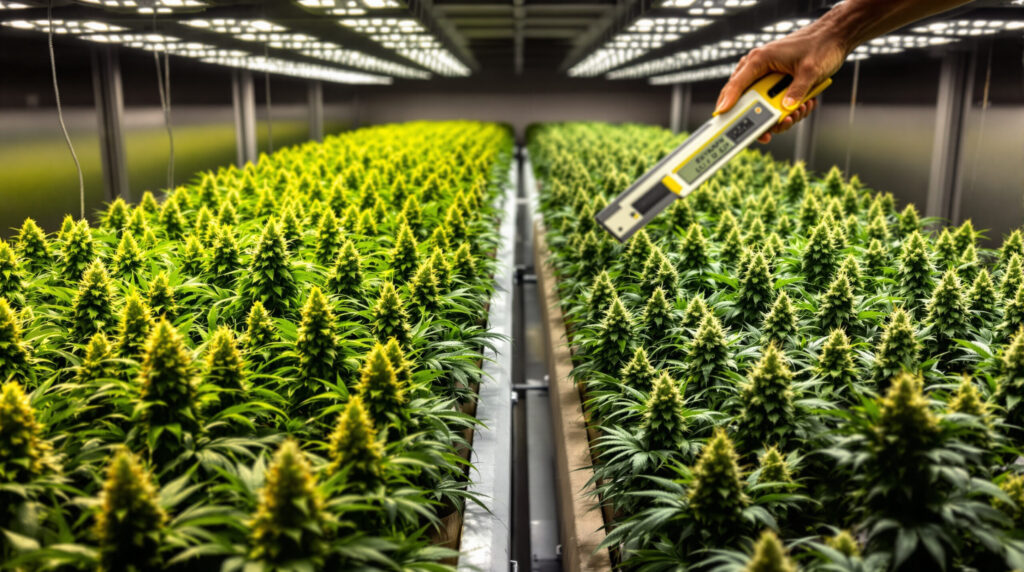
Most strains on the market are strictly speaking polyhybrids. They are created when two different hybrids are crossed instead of working with stable inbred lines. The result is genetically mixed, and offspring often vary considerably. This is precisely why many growers search for the best phenotype when buying such seeds—a practice called pheno-hunting.
True F1 hybrids solve this problem. Because both parents are homozygous, the offspring benefit from the heterosis effect, also called hybrid vigor. Plants grow more vigorously, are more stress-resistant, and deliver measurably higher yields. Since Royal Queen Seeds made true F1 hybrids available for home cultivation in 2023, this category has been considered a minor revolution. Producers report around 15 to 25 percent higher yields compared to classical strains. How far modern genetics can push yields is also shown in our report on triploid cannabis genetics.
What Cannabis Genetics Means for Your Home Cultivation
For practical purposes, theory can be reduced to one simple question. Do you want reliability or diversity? Those seeking predictable, uniform cultivation are well served by true F1 hybrids or stable feminized strains. All plants mature similarly, which significantly eases care and harvest.
Those who want to experiment and find their own favorite plant deliberately choose F2 seeds or regular lines. Here, the search for the perfect phenotype is worthwhile, even if the outcome is less predictable. In both cases, it’s important to use a reputable seed source, because only documented genetics delivers what the label promises. Our guide Identifying a Good Seed Bank summarizes what to look for.
Regular, Feminized, and Automatic Seeds in a Genetics Context
Besides breeding abbreviations, you’ll encounter three seed types in stores that relate to a different level. Regular seeds produce female and male plants in natural ratio. They are the foundation of any serious breeding work, since only they produce male pollen donors. For pure flower production, they are less practical since male plants must be culled early.
Feminized seeds, which include S1 lines, produce almost exclusively female plants. Automatic strains, or autoflowers, flower regardless of light cycle and usually carry genetics from Cannabis ruderalis. This classification says nothing about the generation. A feminized strain can be a true F1 just as well as a regular one. Our comprehensive strain guide shows which current strains are particularly in demand in 2026.
Frequently Asked Questions
What is the difference between F1 and F2 in cannabis?
An F1 is the first offspring generation from crossing two stable parent lines. It is very uniform. An F2 is created by crossing two F1 plants. In the F2, genetic material segregates again, which is why plants vary much more.
What does BX mean on cannabis seeds?
BX stands for backcross. An offspring is crossed again with one parent to strengthen a specific trait. A first backcross carries the abbreviation BX1, a second BX2. This allows breeders to deliberately reinforce characteristics of a mother plant.
Are S1 seeds feminized seeds?
Yes. S1 seeds result from self-pollination of a single female plant. Since no male genetics are introduced, the offspring are almost completely female. They resemble the mother closely and are thus considered feminized seeds.
What is the heterosis effect?
The heterosis effect, also called hybrid vigor, describes increased vitality in crosses from two homozygous lines. Plants grow more vigorously, tolerate stress better, and often produce higher yields. In true F1 hybrids, this effect is most pronounced.
Which genetics are suitable for beginners?
Achtest du beim Samenkauf auf die Zuchtgeneration?
For getting started, stable feminized strains or true F1 hybrids are ideal. They grow uniformly and mature at similar times. This makes watering, care, and harvest more plannable. Regular seeds and F2 lines are better suited to experienced growers deliberately searching for a specific phenotype.






Branchen-Update
News, Analysen und Reportagen — mehrmals im Monat direkt in dein Postfach.
Folge uns