Sponsored. This article was produced in paid partnership with Assertivitech s.r.o.
📑 Inhaltsverzeichnis
A pocket-sized rolling tool without moving parts: a flexible mat, an aluminum rod with a longitudinal slot—that’s all the Blunt Roller 1881 needs. We examined the concept and demonstrate how it works in two videos.
Hand rollers know the frustrations: paper shifts, filling distributes unevenly, and the filter ends up crooked. Rolling machines solve this with two rollers and a belt, but they’re bulky, break down, and always produce the same cylindrical shape. The Blunt Roller 1881 from Czech manufacturer Assertivitech takes a different approach.


The Design: Two Parts, No Moving Pieces
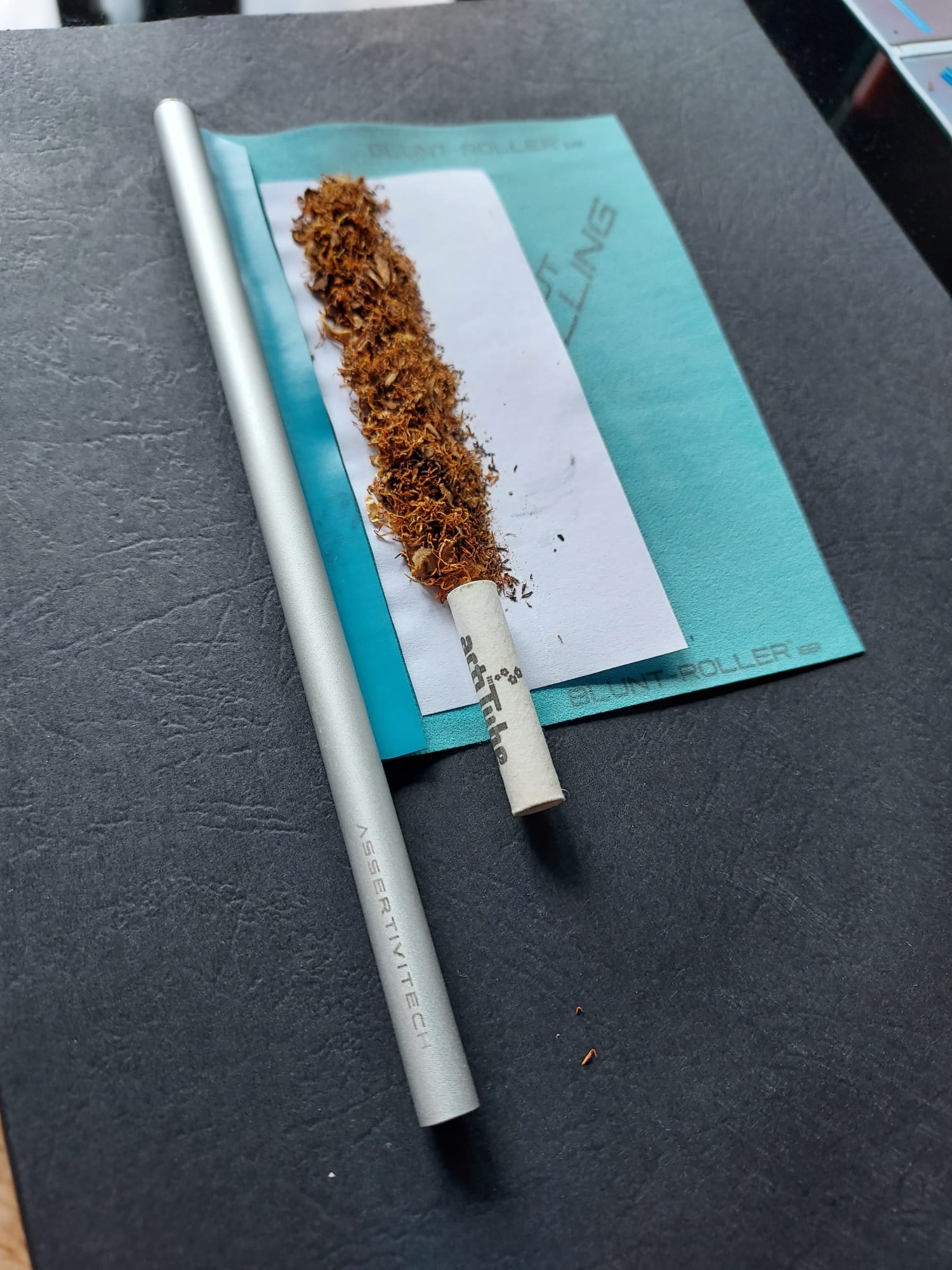
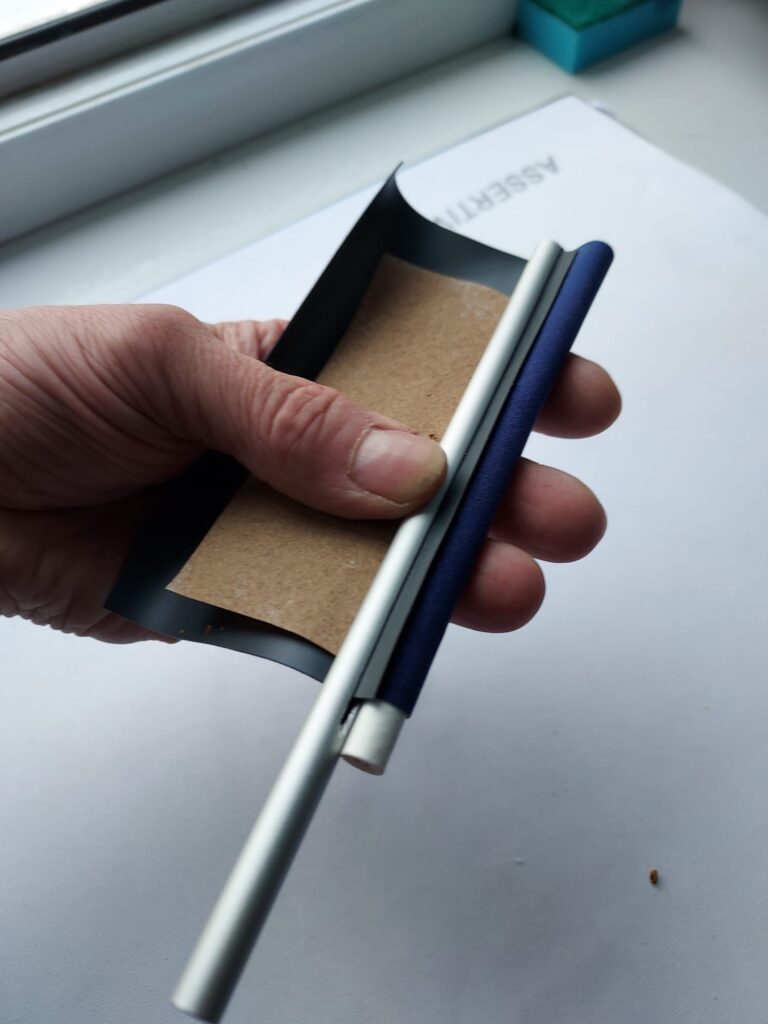
The tool consists of two components. First is a flexible, smooth mat that lies flat in your hand or pocket when at rest. It replaces the rolling surface that a belt provides on traditional machines.
Second is an aluminum rod with a longitudinal slot. The paper’s edge is clamped into this slot. The rod serves three functions simultaneously: it holds the paper, it defines the rolling axis, and its diameter determines the diameter of the final product.
There are no moving parts. Nothing can catch, nothing wears out, and there’s no belt to tear. That’s the core design philosophy.
Basic Function in Video
The process is shown in the first demonstration: lay paper on the mat, feed the edge into the rod’s slot, add filling, roll up, and seal the adhesive strip.
What stands out is how little finesse the process requires. Because the rod fixes the paper and the mat guides the filling, the typical slip-up moment in hand rolling is eliminated.
The Conical Variant
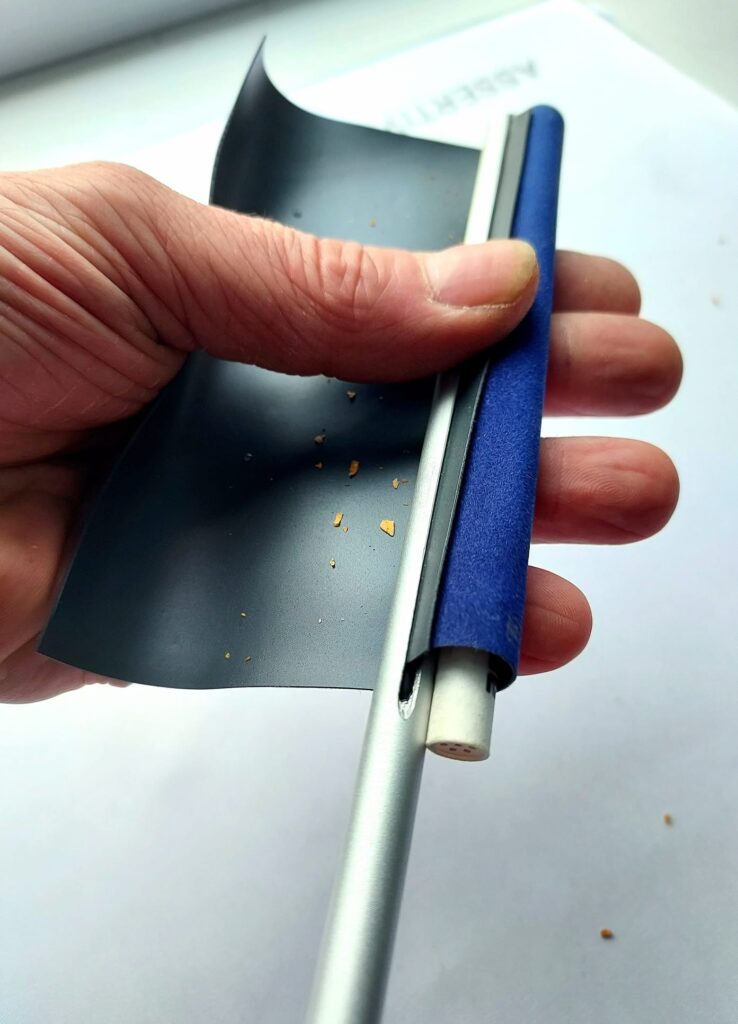
More interesting is the second function, because it achieves something conventional rolling machines cannot: a conical shape. With machines featuring two parallel rollers, the diameter is fixed across the entire length, producing an invariably uniform cylinder. Conical shapes otherwise only come from hand rolling or prefabricated cones.
Based on what the demonstration shows, the cone is created through rod guidance rather than an additional component. This suggests the same tool can produce both cylindrical and conical results depending on how it’s guided.
What We Noticed
Three details from the material warrant mention.
- The filter is already in place. The product photos show a finished piece with an inserted filter featuring multiple perforations. For those interested in how such filters work, our article on activated carbon filters in joints covers what tobacco research reveals about harm reduction claims.
- The format is flat. When folded, the tool is roughly the size of a card case. This sets it apart from rolling machines that must be transported as bulky three-dimensional objects.
- Filling must be prepared. Like any rolling method, uniformity of material determines the outcome. Our guide to cannabis grinders covers what to watch for.
What the Material Cannot Answer
Honesty is essential here. The footage shows the manufacturer using the tool, and it’s convincing. What it cannot show is how the tool performs in other hands.
Key questions remain unanswered: How steep is the learning curve for inexperienced users? How does it handle different paper sizes and thicknesses? How easily does the mat clean? How does the clamping slot hold up over extended use? Reliable answers would require a separate hands-on test with a sample unit.
What can be said now: the approach of eliminating mechanics and determining shape through guidance rather than mechanical design is unconventional and solves a problem where conventional rolling machines fail—the conical form.
The tool is manufactured by Assertivitech s.r.o. in the Czech Republic. Product details, care instructions, and additional images are available on the manufacturer’s website. The Blunt Roller 1881 is listed there as a numbered limited edition.
Note: This article reflects information current as of September 10, 2026, and is neither legal nor medical advice. It contains no health or efficacy claims. The footage shown comes from the manufacturer; we have not conducted our own hands-on test, and such claims are marked as open questions. A rolling tool is an accessory and makes no statement about the legality of its contents. Cannabis legality varies by jurisdiction and use case.
Sources: Product photos and four function videos from manufacturer Assertivitech s.r.o. (provided September 2026); independent analysis of visual materials; original reporting.
Sponsored. This article was produced in paid partnership with Assertivitech s.r.o.
A pocket-sized rolling tool without moving parts: a flexible mat, an aluminum rod with a longitudinal slot—that’s all the Blunt Roller 1881 needs. We examined the concept and demonstrate how it works in two videos.
Hand rollers know the frustrations: paper shifts, filling distributes unevenly, and the filter ends up crooked. Rolling machines solve this with two rollers and a belt, but they’re bulky, break down, and always produce the same cylindrical shape. The Blunt Roller 1881 from Czech manufacturer Assertivitech takes a different approach.
The Design: Two Parts, No Moving Pieces
The tool consists of two components. First is a flexible, smooth mat that lies flat in your hand or pocket when at rest. It replaces the rolling surface that a belt provides on traditional machines.
Second is an aluminum rod with a longitudinal slot. The paper’s edge is clamped into this slot. The rod serves three functions simultaneously: it holds the paper, it defines the rolling axis, and its diameter determines the diameter of the final product.
There are no moving parts. Nothing can catch, nothing wears out, and there’s no belt to tear. That’s the core design philosophy.
Basic Function in Video
The process is shown in the first demonstration: lay paper on the mat, feed the edge into the rod’s slot, add filling, roll up, and seal the adhesive strip.
What stands out is how little finesse the process requires. Because the rod fixes the paper and the mat guides the filling, the typical slip-up moment in hand rolling is eliminated.
The Conical Variant
More interesting is the second function, because it achieves something conventional rolling machines cannot: a conical shape. With machines featuring two parallel rollers, the diameter is fixed across the entire length, producing an invariably uniform cylinder. Conical shapes otherwise only come from hand rolling or prefabricated cones.
Based on what the demonstration shows, the cone is created through rod guidance rather than an additional component. This suggests the same tool can produce both cylindrical and conical results depending on how it’s guided.
What We Noticed
Three details from the material warrant mention.
- The filter is already in place. The product photos show a finished piece with an inserted filter featuring multiple perforations. For those interested in how such filters work, our article on activated carbon filters in joints covers what tobacco research reveals about harm reduction claims.
- The format is flat. When folded, the tool is roughly the size of a card case. This sets it apart from rolling machines that must be transported as bulky three-dimensional objects.
- Filling must be prepared. Like any rolling method, uniformity of material determines the outcome. Our guide to cannabis grinders covers what to watch for.
What the Material Cannot Answer
Honesty is essential here. The footage shows the manufacturer using the tool, and it’s convincing. What it cannot show is how the tool performs in other hands.
Key questions remain unanswered: How steep is the learning curve for inexperienced users? How does it handle different paper sizes and thicknesses? How easily does the mat clean? How does the clamping slot hold up over extended use? Reliable answers would require a separate hands-on test with a sample unit.
What can be said now: the approach of eliminating mechanics and determining shape through guidance rather than mechanical design is unconventional and solves a problem where conventional rolling machines fail—the conical form.
The tool is manufactured by Assertivitech s.r.o. in the Czech Republic. Product details, care instructions, and additional images are available on the manufacturer’s website. The Blunt Roller 1881 is listed there as a numbered limited edition.
Note: This article reflects information current as of September 10, 2026, and is neither legal nor medical advice. It contains no health or efficacy claims. The footage shown comes from the manufacturer; we have not conducted our own hands-on test, and such claims are marked as open questions. A rolling tool is an accessory and makes no statement about the legality of its contents. Cannabis legality varies by jurisdiction and use case.
Sources: Product photos and four function videos from manufacturer Assertivitech s.r.o. (provided September 2026); independent analysis of visual materials; original reporting.








Branchen-Update
News, Analysen und Reportagen — mehrmals im Monat direkt in dein Postfach.
Folge uns