What Activated Charcoal Filters in Joints Actually Remove

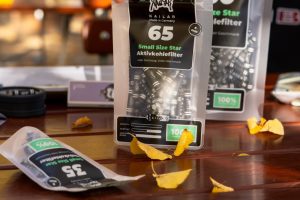
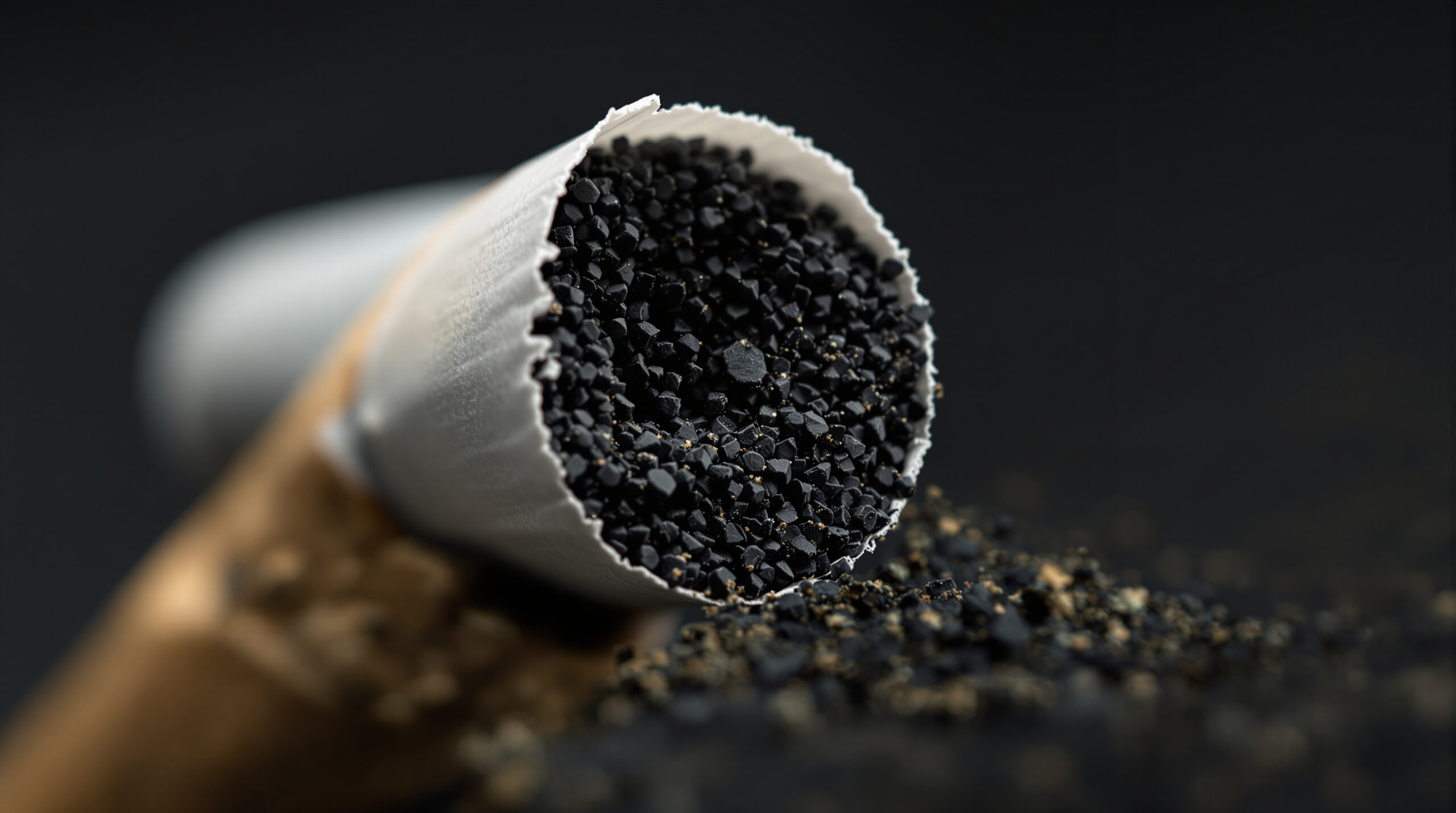
A 2018 analysis by Hoffmann and colleagues in the journal Chemical Research in Toxicology measured the effect. Activated charcoal binds 70 to 88 percent of free radicals from cannabis smoke. This sounds impressive but says little about the actual amount of harmful substances that reach the lungs. Activated charcoal removes volatile terpenes alongside reactive species, dampening the aroma and effects profile that users experience during consumption.
📑 Inhaltsverzeichnis
The quantitative reduction of condensable tar is considerably more modest across several older aerosol measurement studies from tobacco research. Values around 7 percent appear in data compiled by the US National Cancer Institute in its 2001 Monograph 13. An earlier review published by this magazine in 2017 as a test of common activated charcoal filters reached comparable findings.
The Compensation Paradox from Tobacco History

British behavioral researcher Michael Russell described in the 1970s what tobacco research later termed compensation smoking. Tobacco users who switched to filtered or supposedly milder cigarettes inhaled deeper, more frequently, and longer. Individual harmful substance exposure often ended up near or above pre-switch levels. The National Cancer Institute systematically compiled this data in Monograph 13 in 2001; the US Surgeon General included it in his 2004 tobacco report.


A 2017 analysis by the US CDC, published in Regulatory Toxicology and Pharmacology, confirmed the pattern. The tobacco industry had marketed filters for decades as a health promise, yet epidemiological data on lung-related diseases showed no measurable improvement. This historical context has now resurfaced in current cannabis filter discussions.
Three Mechanisms That Undermine the Filter Promise
First, terpene loss weakens the subjectively perceived high. Consumers compensate by taking deeper and longer drags. According to calculations documented in the cited tobacco reviews, this mechanism can in unfavorable cases lead to tar exposure up to 86 percent higher per session, despite the filter binding some contaminants per individual draw.
Second, activated charcoal does not work selectively. What softens taste also softens the potency peak. Third, increased compensation also means higher cannabis consumption per session. For members of cultivation associations whose monthly distribution amounts are legally capped, this is a direct economic factor. More on how filter design has evolved in the German market was detailed by Christian Schäfer earlier this year using the example of the combination of activated charcoal and tip feel.
What the Research Evidence Means for German Consumers and CSCs
In Germany, Austria, and Switzerland, activated charcoal filters are standard stock in head and grow shops. They are also offered without barriers in German cultivation associations. The debate around harm reduction is not an abstract academic topic here. In April, the German Federal Criminal Police Office documented that the German cannabis black market remains robust despite partial legalization. Quality and education standards are entirely absent there.
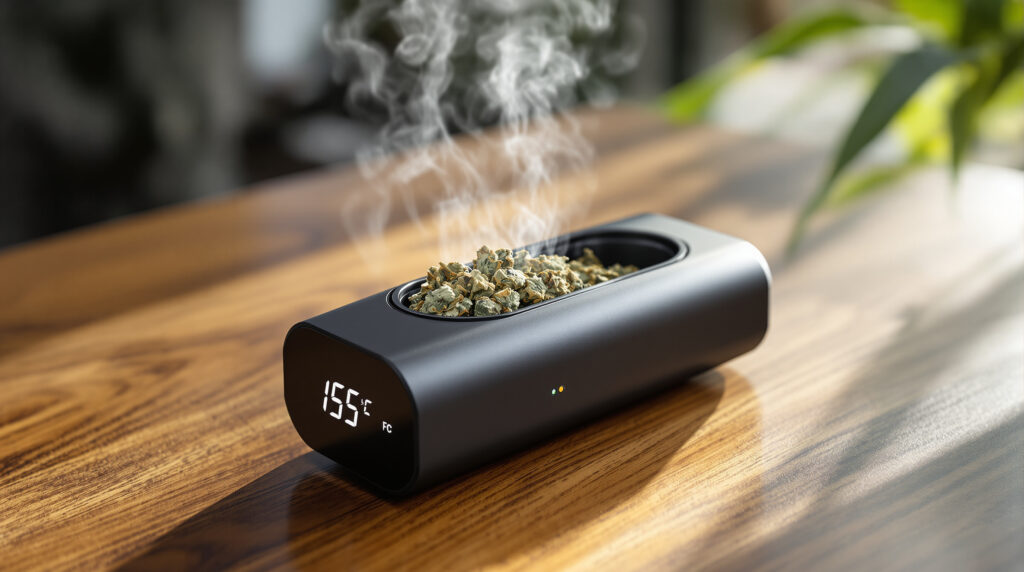
Swiss pilot projects have shown that regulated distribution models not only reduce consumption but also enable honest education. More conscious use of filter products, more vaporizing as the lowest-harm inhalation method, smaller sessions, or a slower pace are options that remain underaddressed in German CSC practice. A March 2026 study also clarified that cannabis smoke is less harmful than tobacco smoke across several toxicological measures. This contextualizes the discussion but does not replace serious risk communication.
Frequently Asked Questions
Are Activated Charcoal Filters in Joints Pointless?
No. They do measurably reduce free radicals and can subjectively smooth the taste. However, the evidence suggests that tar and condensable substance reduction often falls short of marketing promises. This is especially true if the user compensates for weaker effects by inhaling deeper and longer.
Does This Mean I Should Smoke Without a Filter?
Not necessarily. Those who choose inhalation have various options. Vaporizing bypasses most combustion byproducts entirely and is considered the lowest-harm inhalation method from a medical perspective. Edibles and tinctures avoid the lungs altogether. Those who prefer joints can avoid the compensation trap by consciously choosing filters and not reflexively increasing the pace, depth, and frequency of drags.
Do These Studies Really Come from Tobacco Research?
The central datasets originate from tobacco research from the 1970s through early 2000s. The National Cancer Institute extensively compiled data on filtered cigarettes in its 2001 Monograph 13; the Surgeon General included them in his 2004 report. The physical mechanisms of combustion, contaminant adsorption, and inhalation compensation operate similarly in structural terms for both cannabis and tobacco. These findings are therefore transferable to joints but not one-to-one calibrated.
Are Vaporizers Really Healthier?
Vaporizing heats the material to a temperature below the pyrolysis threshold, so no combustion occurs and no tar-containing combustion byproducts form. Studies show lower levels of carbon monoxide, polycyclic aromatic hydrocarbons, and aldehydes compared to smoked joints. Vaporizing is therefore the first recommendation in most medical guidelines when inhalation cannot be avoided.
Where Can I Find Education Instead of Marketing?
Verwendest du Aktivkohlefilter, wenn du einen Joint rauchst?
Those seeking systematic information about consumption methods will find independent materials at German, Austrian, and Swiss addiction counseling centers. Cultivation associations are also obligated under the Cannabis Consumption Act to provide education. Scientific primary sources are freely accessible via the PubMed database. Sources: High Times „Are Joint Filters Making You Inhale 86% More Tar?“ (24.05.2026); Hoffmann et al., Chemical Research in Toxicology (2018); National Cancer Institute Monograph 13 (2001); Surgeon General’s Report on the Health Consequences of Smoking (2004).





Branchen-Update
News, Analysen und Reportagen — mehrmals im Monat direkt in dein Postfach.
Folge uns