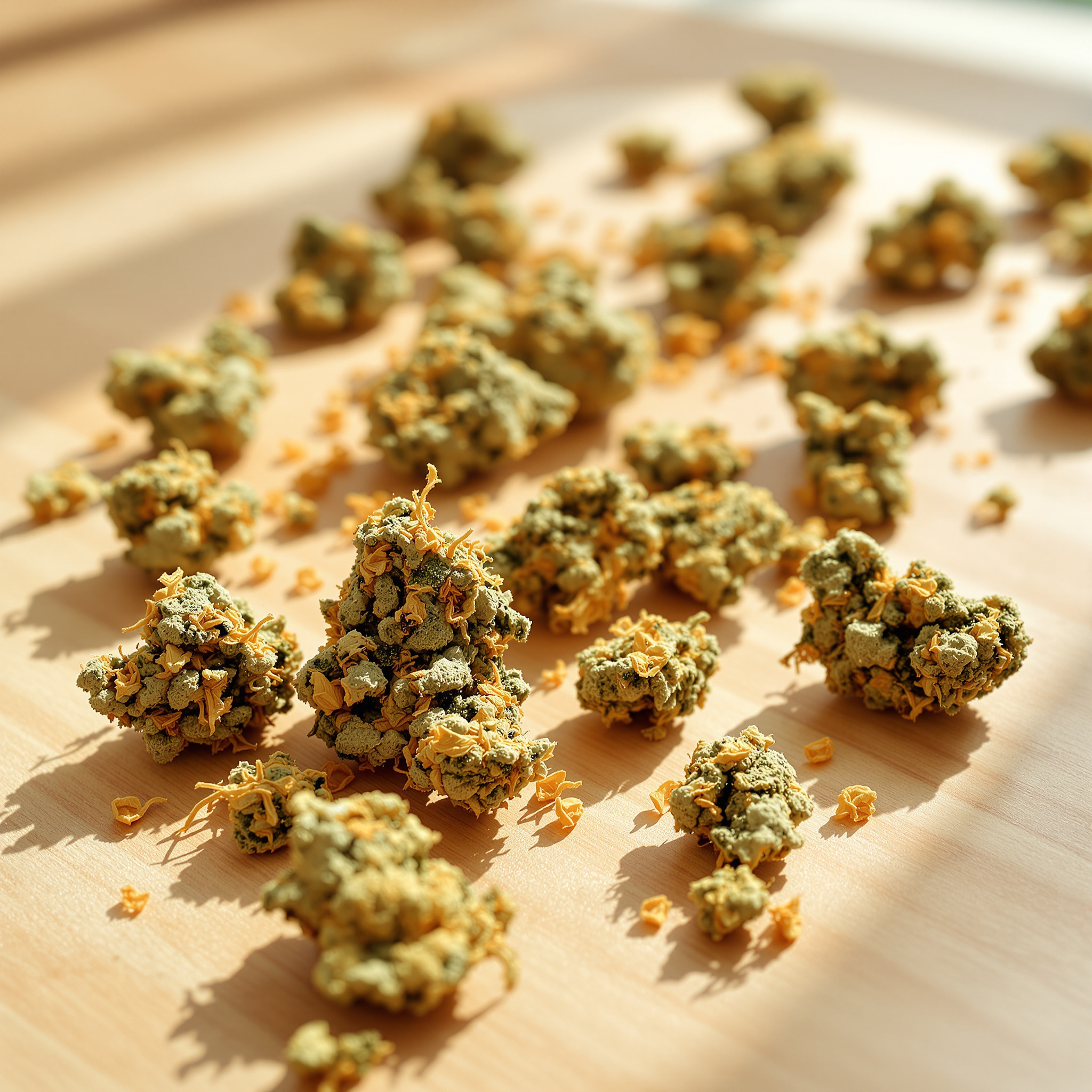
A grinder doesn’t clog because it’s old, but because resin is sticky. The short answer to the question of how to get it clean: take it apart, knock out the loose residue, and then, depending on the material, either soak it in isopropyl alcohol or clean it dry. Metal tolerates alcohol; wood and plastic don’t. That’s essentially all there is to it, and that’s exactly why it’s worth knowing the details, because most broken grinders aren’t worn out, but were cleaned the wrong way.
📑 Inhaltsverzeichnis
- The short version by material
- Step by step: cleaning a metal grinder thoroughly
- Without liquid: the freezer method
- Vinegar and salt: why we advise against it
- Ultrasonic cleaner: when it’s worth it
- How often is necessary
- What you need
- The five most common mistakes
- Frequently asked questions
- More about the grinder
- 💬 Fragen? Frag den Hanf-Buddy!
The short version by material
| Material | Suitable | Keep away from |
|---|---|---|
| Aluminum, anodized | Isopropyl alcohol, freezer, brush | Vinegar, salt, dishwasher |
| Stainless steel, titanium | Isopropyl alcohol, ultrasonic, brush | Dishwasher |
| Plastic | warm water with dish soap, freezer | Alcohol, acetone, hot water |
| Wood | dry, brush, toothpick | any liquid |
| Ceramic | warm water, alcohol | Impacts, dropping |
Step by step: cleaning a metal grinder thoroughly
This is the standard case, because most grinders are made of anodized aluminum. Allow 30 to 45 minutes, most of which is waiting time.
1. Take it apart
Take the grinder completely apart. With a four-piece model, that means the lid, grinding chamber, collection chamber with screen, and kief chamber. Lay the parts out next to each other in the order in which you removed them. That sounds excessive, but it saves time when reassembling, because the screen and sealing ring often only fit in one direction.


2. Scrape off the resin before you wash it away
The resin on the lid and teeth isn’t dirt, but active material. Scrape it off with a toothpick or a small tool and save it before you reach for the alcohol. Whatever ends up in the alcohol bath is lost, unless you let the solvent evaporate.
3. Knock out loose residue
Tap each part with the palm of your hand against a clean, hard surface. A soft brush, such as an old toothbrush, gets the rest out from between the teeth.
4. Alcohol bath
Place the metal parts in isopropyl alcohol of at least 90 percent. Lower concentrations contain too much water and dissolve resin less effectively. 20 to 30 minutes is usually enough, or longer if the resin buildup is heavy. Afterwards, work over the parts with a brush, rinse thoroughly with warm water, and let them dry completely.
Drying is the step most people skip. Residual moisture in the kief chamber turns the screen into a caked layer the next time you grind, one that you can hardly get off again. Leave the parts out in the open for at least an hour, ideally overnight.
5. Screen and kief chamber
The screen is the most delicate component. It consists of a thin mesh that deforms permanently even under moderate pressure. Clean it only with a soft brush in the direction of the mesh, or with compressed air from the back. No toothpicks, no pointed objects, and under no circumstances scrub over it.
6. Reassemble
Only reassemble once everything is truly dry. With models that have a magnetic closure, it’s worth taking a quick look at the magnets: are they still firmly seated, and is the gap free of residue? A magnet that comes loose will end up between the teeth the next time you grind.
Without liquid: the freezer method
For wood and plastic, this is the best method, and for metal a good interim solution. Take the grinder apart, put the parts in the freezer for 30 minutes, and then knock them out. Cold makes resin brittle instead of sticky; it flakes off instead of smearing. No chemicals are involved, and the resin that comes off remains usable.
The downside: the method removes things that are stuck on, not dried-on layers. For a grinder that hasn’t been cleaned in a year, it’s a first step and not a solution.
Vinegar and salt: why we advise against it
The mixture of vinegar and coarse salt circulates as a household remedy, and it does indeed dissolve deposits. For the material most grinders are made of, it is nevertheless the wrong choice.
Vinegar is an acid, and salt acts as an abrasive. Anodized aluminum has a thin protective layer that is vulnerable to exactly this: acid attacks it, and salt grains grind it away mechanically. Underneath lies bare aluminum, which oxidizes faster, becomes duller and lets resin cling more strongly in the future. After cleaning, the grinder is clean, but permanently worse off.
With stainless steel the risk is lower; with coated surfaces and with aluminum it is real. Isopropyl alcohol costs little, works better and does not attack the surface. We see no reason to reach for acid.
Ultrasonic cleaner: when it’s worth it
An ultrasonic bath loosens resin from gaps between the teeth that no brush can reach, and it is safe for metal parts. It makes sense if you already own one or look after several devices. For a single grinder, buying one is overkill, because an alcohol bath achieves the same thing, only more slowly.
Two caveats: parts with glued-in magnets don’t belong in it, because the adhesive can come loose, and you are better off not putting the screen in with the rest but cleaning it separately.
How often is necessary
That depends less on the material than on how much you grind.
- After every grind: tap it out briefly and wipe off the kief. That takes ten seconds and prevents half of all clogging.
- Daily use: a thorough cleaning once a week.
- Occasional use: once a month is enough.
- Screen and kief chamber: every few weeks, depending on how much collects.
Plastic and wood need slightly shorter intervals, because the surfaces are rougher and resin adheres better. A more reliable signal than any calendar is the resistance when turning: if it catches, it’s time.
What you need
- Isopropyl alcohol of 90 percent or higher. From the pharmacy or the hardware store, it costs a few euros.
- A soft brush. An old toothbrush is perfectly sufficient.
- Toothpicks. For scraping off resin, not for the screen.
- Compressed air, if available. Handy for the screen, not essential.
- Disposable gloves, if sticky fingers bother you.
Special grinder cleaners exist, and they work. But they don’t solve the problem any better than isopropyl alcohol, just at a higher price. We advise against non-stick sprays unless a food-safe approval is expressly stated, because everything you spray into the grinding chamber ends up in your material afterwards.
The five most common mistakes
- Dishwasher. Heat, lye and salt attack anodized surfaces and warp plastic. No grinder belongs in there.
- Alcohol on plastic or wood. Plastic turns cloudy and brittle, wood swells and cracks.
- Reassembled while damp. See above. This permanently gums up the screen.
- Scrubbing the screen. Once deformed, the mesh can’t be saved, and for many models there is no replacement.
- Throwing the resin away. What sticks to the lid is the most concentrated thing that was in the device.
Frequently asked questions
Can I use high-proof drinking alcohol instead of isopropyl alcohol?
In principle yes, in practice no. Even high-proof spirits are well below 90 percent, contain sugar and flavorings, and leave a sticky film. Isopropyl alcohol evaporates without leaving a residue.
My grinder barely turns anymore. Is it done for?
Usually not. Stiffness almost always comes from resin between the teeth and on the sliding surface, not from wear. An alcohol bath usually dissolves it. If it still catches afterwards, check whether a tooth is bent or a magnet has come loose.
How do I get the smell of alcohol out again?
With time. Isopropyl alcohol evaporates completely, and the smell disappears as it air-dries. If something is still noticeable after a day, the grinder wasn’t dry, just drained.
Can I replace the screen?
For branded devices often yes, for cheap models almost never. This is one of the points where the price difference makes itself felt, long after the purchase is forgotten.
Does frequent cleaning damage the grinder?
Wie reinigst du deinen Grinder normalerweise?
Dry tapping out doesn’t. When it comes to the alcohol bath, the rule is: as often as necessary, as rarely as possible. Someone who bathes their grinder weekly without needing to will wear down the surface sooner than someone who cleans it as needed.
More about the grinder
- Overview: What you need to know about cannabis grinders
- Grinder materials compared
- Using a grinder correctly








Branchen-Update
News, Analysen und Reportagen — mehrmals im Monat direkt in dein Postfach.
Folge uns