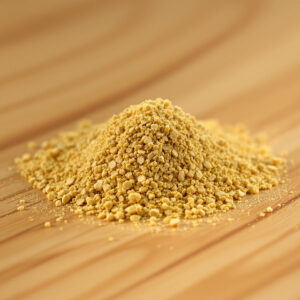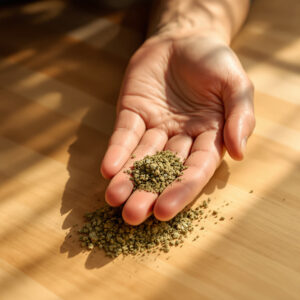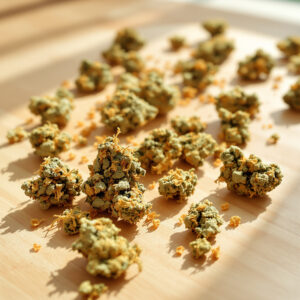
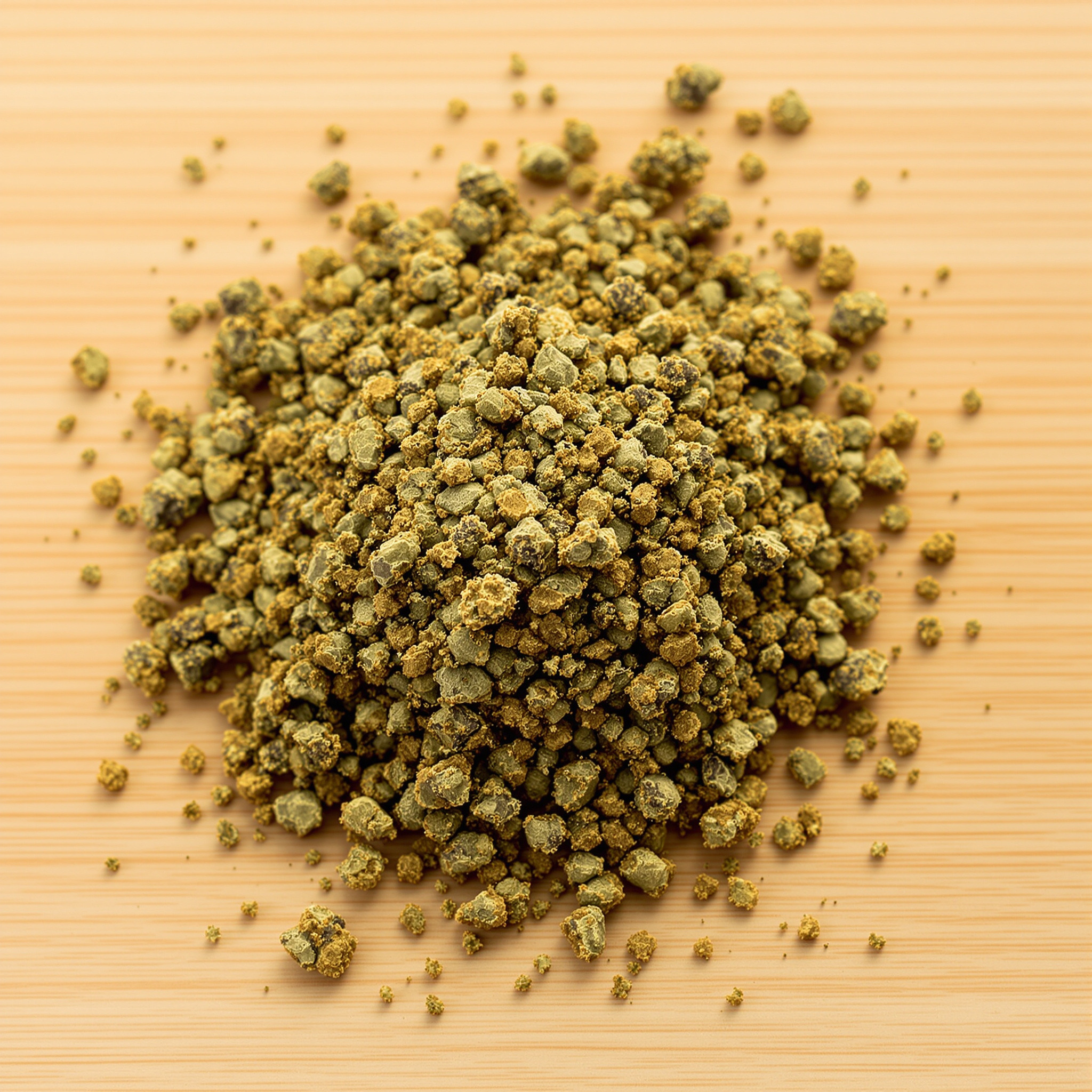
Using a grinder seems straightforward: load the flower, put the lid on, turn. And it works—as long as you don’t care what comes out. If your results are sometimes too fine and powdery, sometimes too coarse, if the grinder is hard to turn, or if barely any kief makes it to the collection chamber, it almost always comes down to four things: too much material, too much pressure, grinding too long, or including stems. Here’s how to do it right and which consistency works best for each consumption method.
📑 Inhaltsverzeichnis
Step by Step
1. Prepare the Flower
Break up larger buds by hand before loading them into the grinder, and remove thick stems. Both for the same reason: hard, woody parts wear down the teeth more than anything else, and they contain little of value anyway. A stem caught between two teeth can bend the tooth out of alignment.
2. Don’t Overfill
Fill the grinding chamber no more than two-thirds full. An overfilled grinder doesn’t grind finer—it grinds unevenly because the material can’t distribute properly. It piles up on top, gets compressed, and blocks the teeth. Two small runs are faster than one large run where you have to apply force.


3. Turn Evenly, Without Pressure
Rotate the grinder steadily and without squeezing it together. A well-made grinder needs almost no pressure; the teeth do the work. Applying pressure dulls the teeth and produces uneven results.
Five to ten full rotations are the typical range. Then open it up and check the consistency instead of continuing to grind.
4. Shake Once
A quick shake with the lid closed redistributes the material over the teeth and helps kief fall through the screen on multi-chamber grinders. This is the step most often skipped when people wonder why their kief chamber stays empty.
5. Check Instead of Regrind
Open the grinder and look at the consistency before turning it again. Grinding something too fine can’t be undone.
Which Consistency for What
| Consistency | Best For | Why |
|---|---|---|
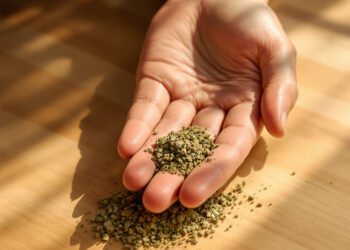
| Fine | Vaporizer, Joint | Large surface area, even vaporization/burn, smoother draw |
| Medium | Pipe, Bong | Burns evenly, remains breathable |
| Coarse | Blends, Flavor focus | Burns slower, less surface area exposed |
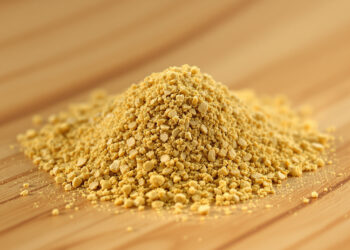
Too fine is a real problem, not just a matter of taste. Powder-fine material compacts and blocks airflow. In a joint it won’t draw, it falls through the screen in a pipe, and it can clog the screens in a vaporizer. Grinding for too long creates exactly this problem.
What Tooth Shape Does
Tooth shape determines whether material is cut or torn, and thus how uniform the result becomes.
- Diamond-shaped is the most common type and why most grinders work similarly well. The diamond cuts and distributes simultaneously, yielding a uniformly fine result.
- Shark teeth are longer and sharper. They grab the material more than cut it, delivering a coarser, less uniform result. That’s not necessarily a drawback for pipe and bong use.
- Pyramid-shaped is found mainly in simple plastic grinders. This shape is less effective and wears faster, especially with resinous material.
- Spiral-shaped is rare and usually found on more expensive grinders. The material is continuously guided through the arrangement, producing a very uniform grind.
Practically speaking: if your results are consistently too coarse, it’s more likely a function of tooth shape than your technique. Conversely, a coarse grinder won’t produce fine results just from grinding longer—you’ll only get dust mixed with chunks.
Six Common Mistakes
- Overfilling. Results in uneven grinding and a hard-to-turn grinder. Two runs are better than one.
- Grinding stems. They stress the teeth most and contribute nothing of value.
- Turning with pressure. Dulls the teeth. A grinder that only turns with force usually isn’t broken—it’s gummed up with resin.
- Grinding too long. Fine becomes powdery, and you can’t undo that.
- Never shaking. Kief stays on top instead of falling into the collection chamber.
- Using the grinder as storage. Material sitting in the grinding chamber for days dries out and gums up the grinder further. Grind and remove.
Frequently Asked Questions
How many rotations are right?
Five to ten as a starting point, then check. This depends heavily on the flower: sticky, freshly dried material needs more rotations than dry material, and with dry material you can cross into powdery territory faster than you’d like.
My grinder is hard to turn. Is it broken?
Almost never. A stiff grinder usually has resin buildup on the sliding surfaces and between the teeth. Cleaning it solves the problem. If it still binds afterward, check whether a tooth is bent or a stem is stuck.
Why isn’t kief collecting in mine?
Three common reasons: it’s not being shaken, the screen is clogged, or the material is too moist. Kief only falls through if the trichomes are dry enough to break off.
Can I grind cannabis without a grinder?
Yes, with your fingers or scissors. The result is coarser and less uniform, and the resin stays on your fingers instead of in the grinder. It works in a pinch, but as a permanent solution it wastes material.
Should I dry or warm up the flower before grinding?
No. Material that’s too dry crumbles into powder, warmed material becomes sticky and gums up the grinder faster. Flower at room temperature with normal residual moisture grinds best.
More on Grinders








Wie oft schaust du während des Mahlens nach der Konsistenz?
Branchen-Update
News, Analysen und Reportagen — mehrmals im Monat direkt in dein Postfach.
Folge uns