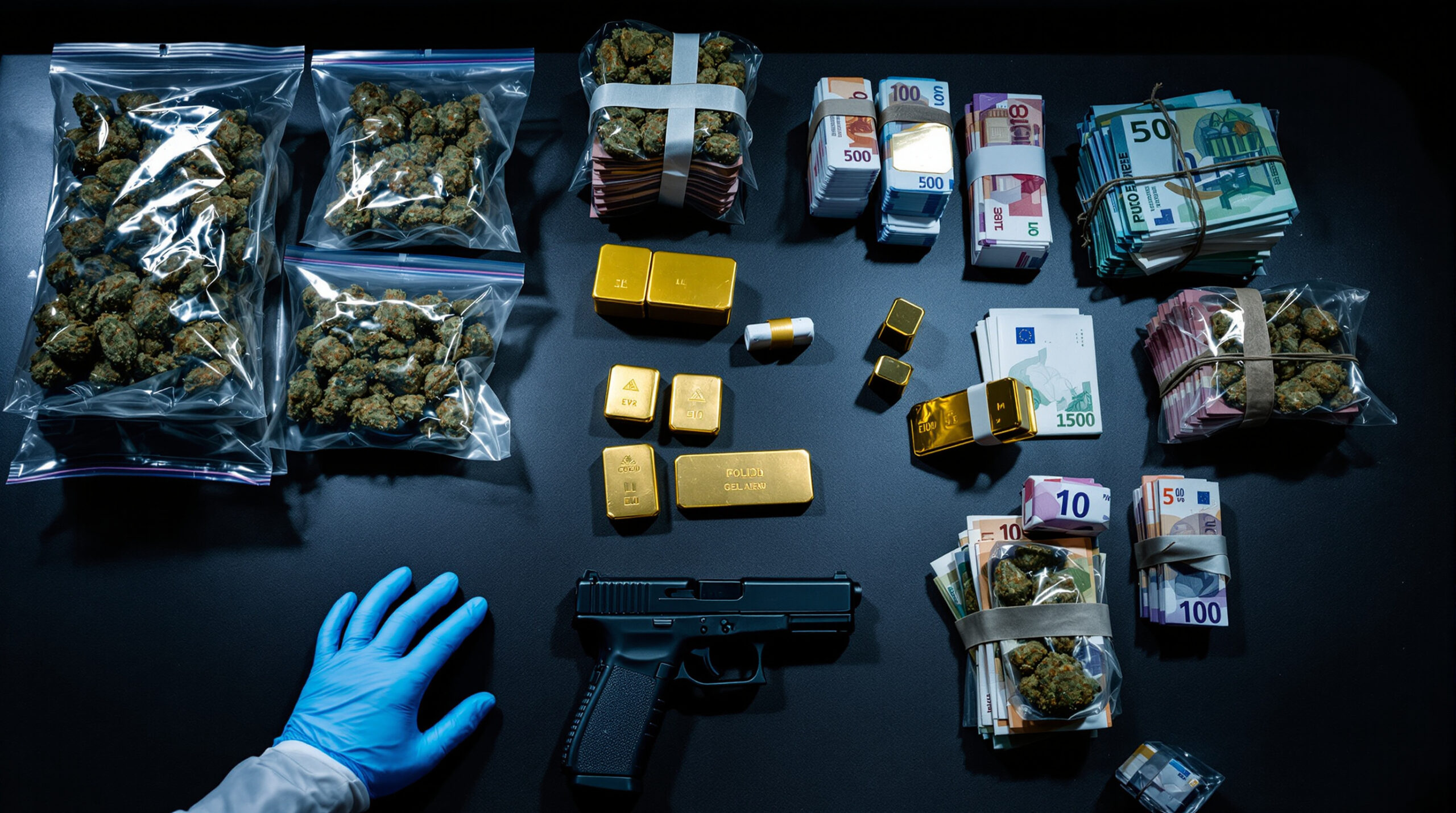
These are images that lend themselves to a success story: 9,720 cannabis plants, neatly arranged in rows, plus gold bars, a Rolex, 1.4 million euros in cash, and a pistol. On June 11, 2026, Vienna police presented the largest cannabis seizure in Austrian history. Around one ton of marijuana, secured in a hall in Vienna-Liesing disguised as a CBD operation. The headlines spoke of a „record blow against the drug mafia.“ But the seizure proves above all one thing: how much money, crime, and loss of control the ban produces every single day.
📑 Inhaltsverzeichnis
- What was found in the disguised hall
- A record that doesn’t refute prohibition but explains it
- What the state loses: up to half a billion per year
- Youth protection doesn’t happen in the back alley
- The black market is a child of prohibition
- Austria’s reality: penalties for grams, billion-dollar market for gangs
- No automatic solution: a look at Germany
- Frequently asked questions
- 💬 Fragen? Frag den Hanf-Buddy!
Because each of these plants, each gold bar, and each weapon is a direct product of prohibition. In a regulated market, the same hall would not be a crime scene, but a tax-paying, controlled operation with age verification at the checkout and laboratory analysis on the label. That is precisely the point the success story overlooks.
What was found in the disguised hall
The raid itself took place some time ago. Already on September 9, 2025, special forces, including the WEGA unit, stormed a 3,200 square-meter hall in Vienna-Liesing. On the surface, the operation posed as legal CBD production; inside, according to police, a highly professional cannabis plantation was running. The investigation, named Operation „Psycho“ after the nickname of a suspect, had begun in late 2024, with intensive surveillance starting in January 2025.


According to the Vienna State Criminal Police Office (Central-East branch), approximately 1,044 kilograms of cannabis with a THC content of 15 to 20 percent were seized: 9,720 live plants, approximately 300 kilograms of already harvested material, and around 500 kilograms of ready-to-sell product. Police valued it at 4.5 million euros on the street. It is the largest quantity of cannabis ever confiscated in Austria. „The plantation was set up in a highly professional manner,“ said lead investigator Martin Roudny.
Thirteen people were arrested, nine of them directly at the scene. Three Austrian men aged 42, 46, and 55 are considered the heads of the organization, who according to the indictment organized production, storage, staff recruitment, distribution, and sales. The alleged managing director, the 42-year-old, was not present during the raid, fled to Croatia, and was extradited to Austria in February. The remaining detainees were workers from Serbia and Bosnia employed as „gardeners“ who were illegally in the country. In addition to the drugs, investigators found 1.4 million euros in cash, gold bars and coins, a Rolex, forged documents, and a Glock pistol.
A record that doesn’t refute prohibition but explains it
The list of seized items reads like an indictment against prohibition itself. Mountains of cash, gold as a store of value, forged papers, smuggled workers with no rights, a firearm to secure the operation: all of this is not a side effect of cannabis, but of the ban. Where a product is in demand but illegal, it is not the market with receipts and tax numbers that takes over, but organized crime with weapons and black money.
Demand does not disappear with a raid. One ton of cannabis taken off the market today simply means a new hall will be set up elsewhere. The ban does not determine whether cannabis is produced and consumed, but only who profits from it: a criminal apparatus or a controlled, taxed economic sector.
What the state loses: up to half a billion per year
The economic dimension can be quantified. The Momentum Institut concluded in an analysis from May 2026 that legalization would bring the Austrian state approximately 500 million euros annually. The calculation comprises around 210 million euros in taxes on legal sales (152 million cannabis tax plus 58 million sales tax), approximately 93 million euros in income, corporate, and social contributions, as well as about 192 million euros in savings for police, judiciary, and correctional services. The basis is an assumed annual demand of 35 tons and a sales price of 10 euros per gram.
The study is methodologically based on the frequently cited study by economists Justus Haucap and Leon Knoke from the Düsseldorf DICE Institute. For Germany, the two arrived in 2021 at a total potential of more than 4.7 billion euros per year, including 1.8 billion euros alone in cannabis tax, over one billion euros in law enforcement savings, and 313 million euros in the judiciary, plus approximately 27,000 new legal jobs. That such figures are not fantasy is shown by a look across the Atlantic: In Canada, cannabis tax revenues now exceed those from beer and wine.
Instead, in Austria, 4.5 million euros in street value from a single hall flows entirely into the hands of a criminal organization. Not a single cent of it goes to education, prevention, or the health system.
Youth protection doesn’t happen in the back alley
The strongest argument of prohibition supporters is the protection of young people. Yet this protection does not exist on the black market. A dealer does not ask for ID; a back-alley producer neither checks THC content nor mold, pesticides, or adulterants. The seized product in Liesing with 15 to 20 percent THC entered the market without any age verification or quality inspection.
A regulated market reverses this logic: sales only to adults, controlled potency levels, declared ingredients, traceability. Experience from Germany, where the Consumption Cannabis Act has been in effect since April 2024, also refutes the fear of increased youth consumption: youth consumption was already declining before and has remained so. Anyone who takes youth protection seriously must regulate the market instead of leaving it to criminals.
The black market is a child of prohibition
Smuggled workers without documents, a weapon, gold bars as anonymous stores of value: the hall in Liesing was a nexus of organized crime. Such structures fund themselves across their business sectors, from human trafficking to money laundering. Cannabis is often the highest-margin and lowest-risk product, precisely because the ban keeps prices high.
Legalization deprives these networks of their business foundation by redirecting demand into legal channels. This is not a theoretical argument: Swiss pilot programs like the one in Lausanne show measurable losses for the black market as soon as a legal source of supply exists. That cross-border trade is a professional, mafia-style business was demonstrated by Hanf Magazin most recently in the case of Californian cannabis in furniture shipments.
Austria’s reality: penalties for grams, billion-dollar market for gangs
While organized crime produces on a ton scale, the individual consumer in Austria remains subject to punishment. Under Section 27 of the Narcotic Substances Act, possession of even the smallest amounts is prohibited and punishable by up to one year imprisonment. While diversion—a procedure without conviction and criminal record—usually applies to small amounts for personal use, the apparatus of reporting, investigation, and justice still runs, along with the corresponding costs.
Politically, Austria has seen little movement for years. The Constitutional Court has rejected a petition for legalization, and real reform is still not on the government’s agenda. The result is a situation in which the state pursues consumers but leaves the gangs the most lucrative part of the value chain.
No automatic solution: a look at Germany
To be honest: legalization is not a switch that turns off the black market overnight. Germany shows the pitfalls. Because the Consumption Cannabis Act does not provide for commercial retail, but only home cultivation and cultivation associations, many consumers still lack a convenient legal source of supply. Accordingly, the black market remains relevant, and the debate over whether the reform is a success or a wrong turn is in full swing.
But the right lesson from this is not to maintain the ban, but to do better than the German compromise: with a regulated retail trade that actually takes customers away from the black market, with clear tax rates, and with consistent youth and consumer protection. Austria has the chance to learn from its neighbors‘ mistakes instead of using them as an excuse for inaction.
The hall in Vienna-Liesing thus becomes a symbol. The same 9,720 plants could pay taxes, secure jobs, and deliver tested products in a regulated market. Instead, they produced piles of cash, gold bars, and a weapon. The record seizure is not proof that the ban works. It is proof that it does precisely the opposite.
Note: The seizure figures are based on the statement from the Vienna State Police Directorate dated June 11, 2026, as well as consistent reports from ORF, APA, and Heute. The economic estimates come from the Momentum Institut (May 2026) and from the study by Haucap and Knoke (DICE, 2021). This article contextualizes the news and reflects the editorial position.
Frequently asked questions
What was seized in the cannabis record seizure in Vienna-Liesing?
On June 11, 2026, Vienna police seized 9,720 cannabis plants and approximately one ton of marijuana in a disguised hall. Added to this were gold bars, a Rolex, 1.4 million euros in cash, and a pistol – Austria’s largest cannabis seizure to date.
Why is the record seizure considered an argument against the cannabis ban?
Such quantities only arise because a banned market enables high profits and keeps trade firmly in the hands of organized gangs. That consumption does not explode after legalization is documented by the Trier study on stable cannabis consumption. The ban does not dry up the market; it merely shifts it to the black market.
How much tax revenue does Austria lose through the black market?
Estimates by the Momentum Institut put the lost tax and contribution potential of a regulated cannabis market at up to half a billion euros per year. This money currently flows entirely into the illegal market instead of public coffers.
How do other countries deal with the cannabis black market?
Sollte Cannabis in Österreich legal reguliert und besteuert werden?
Several countries opt for regulation instead of repression. The Netherlands, for example, maintains its coffeeshop model, as shown by the decision that the Amsterdam coffeeshop ban for tourists is off the table. Austria, by contrast, continues to punish personal consumption while leaving the billion-dollar market to gangs.






Branchen-Update
News, Analysen und Reportagen — mehrmals im Monat direkt in dein Postfach.
Folge uns