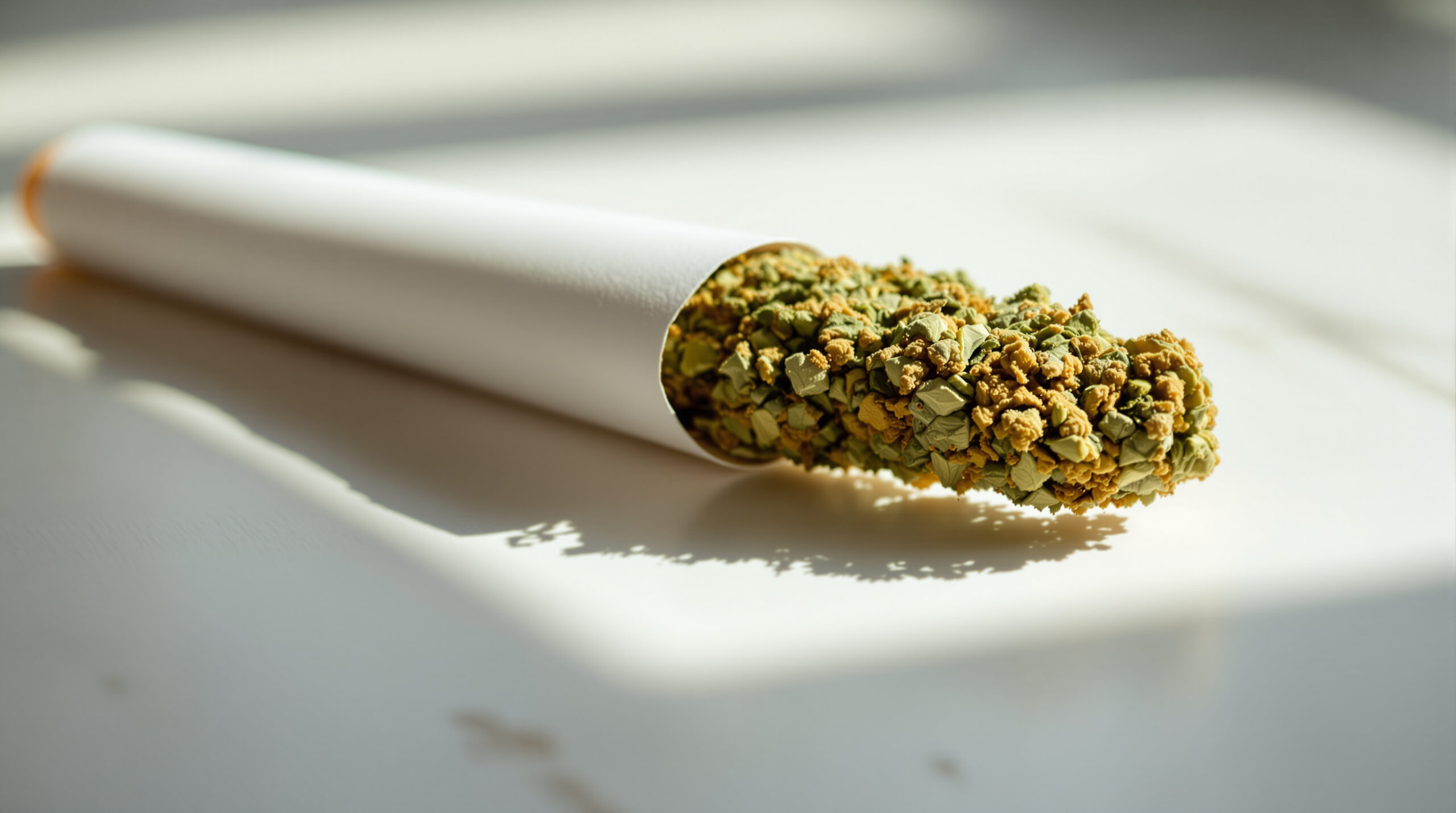
Anyone in Europe who rolls a joint almost automatically mixes tobacco into it. Most people give it about as little thought as they do rolling papers or filters. Yet it is precisely this habit that determines what you end up dependent on. This article explains why mixing is the norm here, what research says about dual use, and what happens when you leave the tobacco out.
📑 Inhaltsverzeichnis
Why people mix in Europe and not in North America
The joint with tobacco is not a natural form of consumption, but a regional peculiarity. In Germany, Austria and Switzerland, the mixture of cannabis and tobacco is the standard form, whereas in the United States and Canada it is the exception. There, people mostly smoke it pure, in blunts, pipes or vaporizers.
The reasons are practical and have grown historically. Cannabis was scarce and expensive in Europe for a long time, imported hashish could hardly be smoked without an admixture, and the cigarette was ubiquitous anyway. Necessity became habit, and habit became culture. Anyone who starts today usually adopts the mixture unquestioningly from those who show them how.


This distinction is more than a footnote, because it explains why a considerable part of what is perceived in Europe as cannabis dependence may in truth be a nicotine dependence. Anyone who has never smoked it pure cannot tell the two apart at all.
What research says about dual use
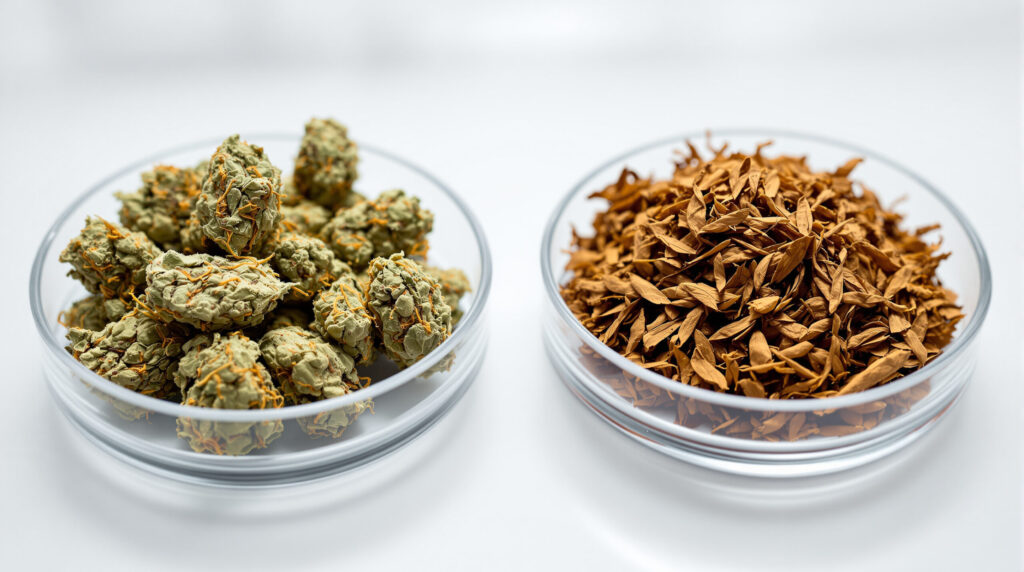
That tobacco in a joint is the greater health problem has long been undisputed in research. We covered this in our smoke check comparing tobacco and cannabis, and we have also put the question of whether smoking weed is healthier than smoking cigarettes into sober perspective.
For the combination of both substances, concrete figures are now available. A study by Vanderbilt University published in Nature Mental Health in May 2026 quantified the association for the first time in clinically identified high-risk individuals: in this group, the risk of later developing a psychotic disorder was almost three times as high as with abstinence from both substances. The details can be found in our article on the Vanderbilt study on mixed use.
The context matters here: the figure applies to a high-risk group, not to the general population, and a statistical association is not yet proof of cause and effect. But it shows that the combination is a factor in its own right and not simply the sum of two individual risks. Older studies on the risks of mixed use point in the same direction.
What actually happens when you leave it out
Anyone who cuts out tobacco usually experiences two things at the same time that are hard to tell apart. One is physical nicotine withdrawal with restlessness, irritability and difficulty concentrating, which typically peaks after a few days and then subsides. The other is the loss of a ritual.
Christoph Lentz has described what this confusion feels like from the inside. Under this name, the doctorate-holding cell biologist published the book „Ich rauche ja nur Cannabis: Die Wahrheit über Tabak im Joint“ („I only smoke cannabis: The truth about tobacco in the joint“) about his own exit from mixed use. He is not an addiction specialist, and that is precisely what makes his perspective interesting: he knew the neurobiological mechanisms professionally and still overlooked for years what his own craving was aimed at.
This ritual is the underestimated part. Rolling, lighting up, the break on the balcony, reaching for the lighter in certain situations: such routines have been practised over years and are tied to triggers, to the end of the working day, to meals, to stress, to the company of certain people. When the tobacco is dropped, these triggers remain and look for a new target. Many people then interpret the craving as a craving for cannabis, even though it is the conditioning that is making itself felt.
Christoph Lentz describes exactly this mix-up. For him, it only became visible when he supplied the nicotine via a patch and thereby separated it from the joint.
„The joint with tobacco suddenly became surprisingly unattractive to me. I still felt like having cannabis, but the need to smoke a joint with tobacco was suddenly almost gone. Looking back, this made it clear to me that I had mistaken a large part of the urge for the next joint for a craving for cannabis, even though a great deal of nicotine and the habit associated with it was in there.“
Christoph Lentz
What mattered for him was that this allowed him to separate two things that had previously appeared as a single craving:
„For the first time, I could distinguish between the physical craving for nicotine and the later, learned impulse to smoke in a particular situation. Until then, I had always perceived both as a single craving for cannabis.“
Christoph Lentz
Before the changeover, by his own description, he had consumed every 45 to 60 minutes and had considered that to be his cannabis requirement. He had not expected one side effect of the separation:
„My inner stress level has dropped significantly. Before, my head was constantly occupied with the next dose: when will I smoke the next joint, how long is it still to go? Today I consume significantly less overall and am still, or perhaps precisely because of that, much more relaxed.“
Christoph Lentz
The second common effect concerns the amount consumed, and here experiences diverge. One path: those who smoke pure consume less, because the automatic reach is gone, which in mixed consumption is carried along by the nicotine. Part of the consumption was never a need for cannabis, but a need for nicotine.
„The substitution trap definitely happened to me as well. But I wouldn’t say that it necessarily has to become more cannabis again. What can creep back in much more quickly is the frequency of consumption. You get used to consuming in certain situations or at certain times of day again relatively quickly, even though you don’t really need the effect at all.“
Christoph Lentz
The other path is the most common trap when switching, and it is rarely named: cannabis consumption rises. If the ritual remains but the nicotine is missing, some people fill the gap with more cannabis. Quitting tobacco then turns into entering a higher level of consumption, and this is barely noticeable at first, because the actual goal seems to have been achieved. Anyone planning the separation should therefore consciously keep an eye on their own amount in the first weeks.
How strong this effect can be is shown by Lentz’ own progress. It is expressly his personal experience and not a figure to be expected:
„Over the last few years, my cannabis consumption averaged about 3 grams per day. About four months after I stopped smoking and substituted the nicotine with the patch, I was suddenly at maybe 0.3 grams a day, and no longer smoked, but in the vaporizer. There are now even days when I vape only about 0.1 grams or consume no cannabis at all. That used to be unthinkable.“
Christoph Lentz
What helped him was less a programme than a single question that he asked himself before consuming. It can be applied to any habit and costs nothing:
„Do I really want the effect of cannabis right now? That sounds banal, but it changed a surprising amount for me. Quite often I noticed that the effect actually wouldn’t have fit what I was about to do. Sometimes it was simply the impulse to consume right now, because I was just used to it.“
Christoph Lentz
The question also works in retrospect, that is, after consuming. Anyone who asks it of themselves for a while gets to know their own patterns, and without having to forbid themselves anything. That is the difference between observing and quitting.
Lentz explains why this pattern persists so stubbornly with an image that needs no technical vocabulary:
„I like to think of it as a path leading through a meadow. If someone walks across it once, you hardly see anything. But if someone walks the same path every day, the trail becomes more and more visible. The more often it’s used, the wider and more worn it gets. If cannabis and nicotine are consumed together for years, the connection between the two gets stronger and stronger.“
Christoph Lentz
This path includes not only the two substances but also the situations: after a meal, during a work break, in the evening on the couch, with friends. At some point the situation alone is enough.
„At some point a certain situation or mood is enough, and the brain already knows the way. It practically says: This is the way, now a joint would be good. You don’t even have to think about it consciously. It’s not a conscious decision, but a very well-practised routine.“
Christoph Lentz
But this is precisely why it also follows that something can be changed, and without a feat of strength. The nicotine patch broke the connection, says Lentz, because the nicotine suddenly came from a different source and no longer via the familiar route. The old path didn’t disappear immediately; he simply used it less and less often.
„You don’t have to destroy the old path by force. You just have to start no longer using it and instead take new paths.“
Christoph Lentz
The self-test: a week without tobacco, not without cannabis
Anyone who wants to know what they are actually hooked on doesn’t have to quit to find out. Lentz suggests an experiment that answers the question by itself, and at an unfamiliar point:
„Just leave out the tobacco for a week. Not necessarily cannabis right away, just the tobacco. And then observe yourself. What happens in your head? How often do you suddenly think about smoking a joint? Does it get really urgent? Do you start looking for reasons why you absolutely need tobacco now? Or is it surprisingly easy to do without the tobacco?“
Christoph Lentz
In his own case the result was clear. When the cannabis was missing, he became restless. When the tobacco was missing, it became urgent, even to the point of late-night drives just to get a resupply. This is not a scientific test, as he himself stresses, and everyone reacts differently. Its advantage lies elsewhere:
„Precisely because you don’t ask yourself: Am I addicted? But simply observe what actually happens. And if someone notices: Strange, I could leave out cannabis right now, but with tobacco I get really restless, then it’s worth taking a closer look.“
Christoph Lentz
The ways out of the mix
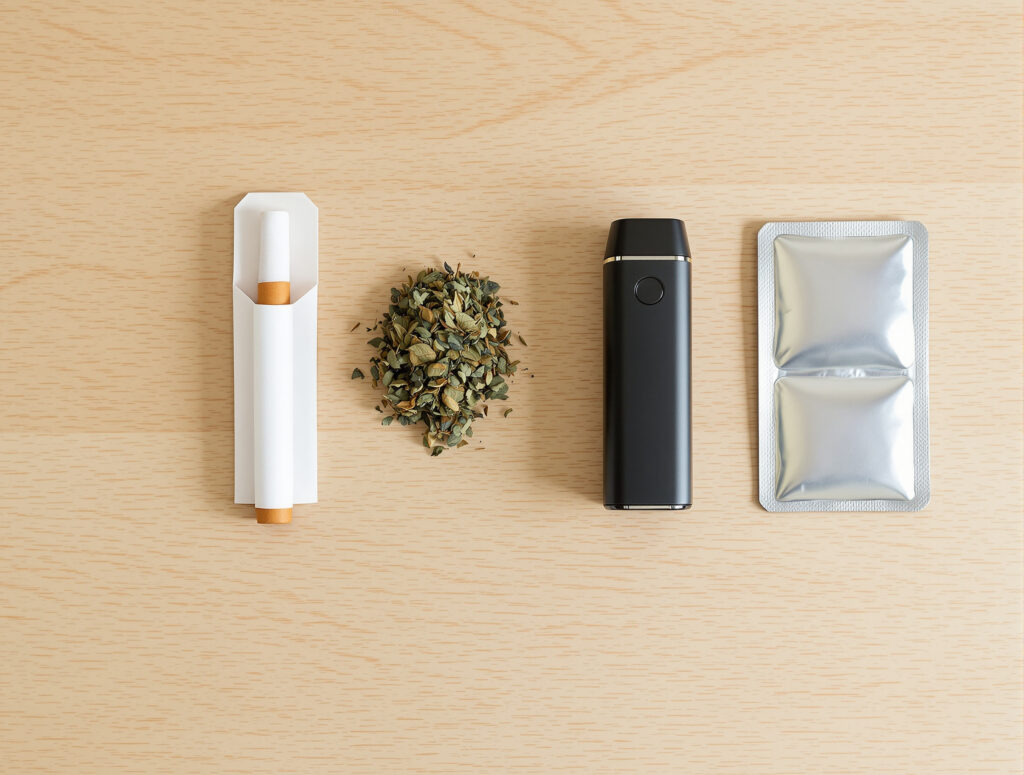
There is not one right way, but several, which differ in effort and consequences.
- Smoking it pure. The most obvious option, but one that takes some getting used to: pure cannabis burns differently, the joint draws differently, and dosing is harder at first. Anyone who uses hashish will hardly manage without mixing it with something and needs an alternative.
- Herbal blend instead of tobacco. Damiana, mullein or raspberry leaves replace the volume without delivering nicotine. Important: combustion is still combustion. The smoke is not healthy, merely nicotine-free.
- Vaporizer. The most consistent solution, because it ends combustion and nicotine at the same time. Many people find the switch difficult because the effect and the ritual feel noticeably different. If you are toying with the idea, you will find field reports on individual devices on our site.
- Eating and drinking (oral intake). If you want to give up smoke entirely, you can also take cannabis orally – for example as an oil or in baked goods. The effect sets in later and lasts longer, but combustion is eliminated completely. Especially at the beginning, the rule is: dose low and wait.
- Nicotine replacement. Patches or chewing gum temporarily decouple the two substances: the nicotine keeps coming, but no longer from the joint. This can help you recognise in the first place which part of the craving comes from where. It is not intended as a permanent solution.
- The filter fallacy. Activated charcoal filters are often sold as a healthier option. What tobacco research says about this is covered in our article on activated charcoal filters in joints. In short: they are no substitute for giving up tobacco.
Before getting to his approach, here is his most important caveat: „The biggest mistake was actually the idea that you first have to have the perfect plan. There is no perfect. Just get started. You can always adjust the path along the way.“ Lentz describes from his own experience what such a switch can look like in practice. First he roughly estimated how much nicotine he took in daily through tobacco and set his patch dose accordingly. He kept this dose constant for six weeks before he even began to reduce it. Only after that did he work his way down in steps of about a week, cutting the patches into smaller pieces. What he would do differently today is remarkable:
„When you keep working your way down from a patch dose of over 20 milligrams, at some point you no longer take the last one to three milligrams quite so seriously. For me, that was a fallacy. The very last milligram in particular was really intense once again. It felt almost as if my addiction memory was letting out one last big outcry.“
Christoph Lentz
His advice is correspondingly unspectacular, and that is exactly what makes it useful: „It’s not a race. Better slow and sustainable than too fast, especially with the last milligrams.“
Christoph Lentz holds a doctorate in cell biology and has published, under this name, the book „Ich rauche ja nur Cannabis: Die Wahrheit über Tabak im Joint“ („I only smoke cannabis: The truth about tobacco in joints“) about his exit from mixed use. He is not a medical doctor; his accounts are personal experience and not a treatment recommendation. Anyone who wants to use nicotine replacement products should sensibly discuss the approach with a doctor or at a pharmacy.
What this is not about
Separating cannabis and nicotine is not a call for abstinence and not a moral programme. It is a decision about the form of consumption. The often-invoked comparison with alcohol – spirits or wine – only half fits: unlike with alcohol, with cannabis you can not only leave out the added substance but also avoid combustion altogether. Anyone who reaches for a vaporizer or switches to oral intake chooses a noticeably less harmful form. Anyone who wants to keep consuming can therefore do so – just with the knowledge of which part of the habit belongs to which substance, and that the form of consumption itself makes a big difference.
For many, this is the real realisation: it was not the cannabis that made them roll every evening for years, but the tobacco in it.
Wie rauchst du Cannabis am häufigsten?
Note: This article is for information purposes only and does not constitute a health claim or a statement about effects. It is not a substitute for medical advice or advice from an addiction specialist. Anyone who suspects a dependence on nicotine or cannabis can find help from the Bundeszentrale für gesundheitliche Aufklärung (Federal Centre for Health Education) and the Rauchfrei-Telefon (smoke-free helpline). Smoking damages your health, regardless of what is being smoked.




Branchen-Update
News, Analysen und Reportagen — mehrmals im Monat direkt in dein Postfach.
Folge uns