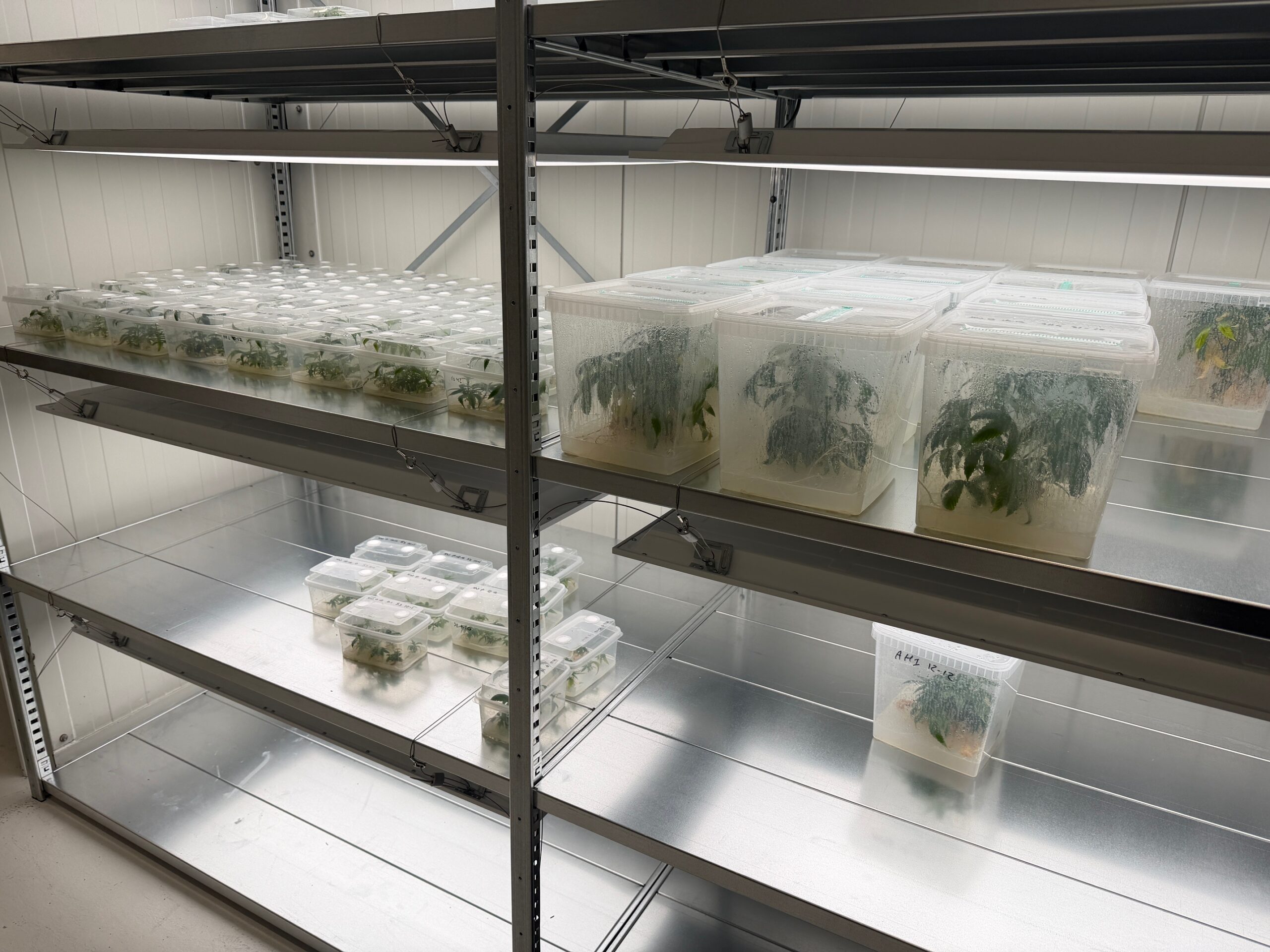
While most of the now 413 German cultivation associations equip themselves with classical mother plant maintenance and cuttings in soil or coco substrate, the Cannabis Social Club Aachen e. V. takes a biotechnological step further: In a custom-built in-vitro laboratory in the Roetgen industrial area, the association propagates its cannabis seedlings sterile in test tubes, according to its own statement as the first cultivation association in Germany. Club spokesperson Thomas Baumeister describes the process matter-of-factly: „The process is lengthy, but it pays off at harvest.“
📑 Inhaltsverzeichnis
- In-vitro culture: What the method concretely means
- Why the effort should pay off
- 450 square meters, five tents, an industrial setup
- Ordering via the Cannanas app
- From self-cultivation model to medical perspective
- Thomas Baumeister on lab setup, strain archives, and what he would advise newcomers
- Frequently asked questions
- 💬 Fragen? Frag den Hanf-Buddy!
In-vitro culture: What the method concretely means
In-vitro culture, also called tissue propagation, has been established in medical cannabis production for years. Among cultivation associations, however, it remains an exception according to Baumeister: „We are the only association I know of that uses this cultivation method.“ The process begins classically, with a carefully selected mother plant. At CSC Aachen, this is currently including the variety Quantum Ganga, a ten-year-old breeding line.
Three to five centimeters of a fresh shoot are sufficient to start a new seedling on its way. These shoots are sterilized in the laboratory, freed from fungi and bacteria, and placed in a nutrient medium made of sugar, vitamins and minerals. In the first four weeks, the shoot ideally develops its first roots. Subsequently, the seedling is repeatedly divided and transferred to fresh nutrient solution until a market-ready cutting emerges. „On average it takes three months to get a good seedling,“ says Baumeister.


The advantage of the method: seedlings grow under sterile conditions, are disease-free and genetically highly stable. The disadvantage: they are extremely sensitive. „Even an unclean tweezers or a cough with an open seedling container can infect the plants,“ explains the club spokesperson. „You throw away hundreds of plants again and again.“ Currently around 100 cannabis seedlings are in the Aachen laboratory; in two weeks the first ones are expected to leave their containers and transition to the growth phase.
Why the effort should pay off
From a professional standpoint, several factors speak in favor of the additional costs of in-vitro propagation: standardized and reproducible plant quality, reduced pathogen-related losses, long-term protection of valuable genetics, more efficient scaling, and higher phytosanitary control. For a cultivation association with a supply mandate, these are noticeable levers, especially compared to classical cutting propagation, where a single mold outbreak can jeopardize an entire batch.
Economically, the association plans to sell the seedlings to other cultivation associations or hobby growers in a few years, at a unit price of around seven euros. „We want to recoup the additional laboratory costs through seedling sales,“ says Baumeister. The end product itself, the flowers for its own members, should not become more expensive as a result than at comparably operating clubs.
450 square meters, five tents, an industrial setup
The actual flowering phase does not take place in the laboratory but in a 450 square meter hall in the Roetgen industrial area. Five room-high black tent cubes stand side by side there, along with ventilation systems that draw excess moisture from the tents. Lighting is provided by Dimlux LED systems, whose spectral control enables targeted crop steering. OptiClimate systems maintain constant temperature and humidity. After harvest, the cannabis dries for twelve days in climate-controlled rooms; curing and fermenting are handled by freeze dryers and Cannatrol systems, among others.
Since October 2025, the association has been selling cannabis to its members, initially from conventional plants grown in coco substrate. Ten to twenty varieties have been harvested so far. With around 16 to 17 grams per member per month, consumption is just under the legal 25-gram daily limit, summed up monthly. With currently 150 members, the harvest easily covers supply, and the association has capacity in the hall for around 500 members according to Baumeister. This is also the legal maximum per cultivation association.
Ordering via the Cannanas app
CSC Aachen has largely digitized operational hurdles in daily operations with an app solution: members use the Cannanas app to preload their account with credit and place orders in advance. During pickup at the club room at Rotter Bruch 26 in Aachen, the order is then simply handed over, with ID checks and age verification happening in parallel. „Whoever loads their account in advance helps us and themselves,“ it says on the association’s website. The Cannanas app, a management tool for Cannabis Social Clubs developed in Germany, thus covers the complete workflow from membership application through fee management to distribution.
From self-cultivation model to medical perspective
Baumeister states his long-term goal openly: „The dream would be to someday grow cannabis for medical use.“ The in-vitro technique would be an ideal prerequisite for this. The strict GMP requirements for medical cannabis demand precisely the standardization, pathogen-freedom, and traceability that the process provides by nature. Currently, however, such a license is not provided for cultivation associations; the leap into the medical market is regulatory future talk.
Until then, the Aachen association’s primary goal is to build a professional supply structure. According to Baumeister, membership growth was slow at first but has picked up. „There are still people who call us and ask whether membership is legal. Legalization was only the first step.“ His sobering assessment of the market situation: „Suppose 20,000 people in Aachen smoke cannabis, and each social club is allowed a maximum of 500 members, then we still have a long way to go to complete supply coverage.“
Question 1, Inspiration
How did you come up with the idea to integrate in-vitro culture into a CSC? Was there a specific model from the medical field, a university, or from abroad?
Thomas: No. I simply wanted to make our club stand out from the others. Through long and good contacts, I had the right Dutch contact with the necessary experience on hand. Then it was like one plus one equals two—a logical conclusion.
Question 2, Investment
What investment amount was in the picture for the laboratory setup? What were the largest cost blocks?
Thomas: All told, with climate control and building the rooms from sandwich panels, we invested around 40,000 euros. The flow hood was relatively expensive, and in total, the LED panels added up significantly.
Question 3, Success Rate
How many plants are you currently losing to contamination? Is there a success rate you’re calculating with?
Thomas: The success rate is well over 90 percent once everything is properly dialed in and set up. In the beginning we had the typical teething troubles, and we’re also learning the method ourselves for the first time. That cost us several hundred, possibly even around 1,000 plants.
„
The success rate is well over 90 percent once everything is properly dialed in.
Thomas Baumeister, Club Spokesperson CSC Aachen
Question 4, Strain Archive
Which strains besides Quantum Ganga do you currently maintain in in-vitro culture? Are you deliberately planning to preserve older or rare genetics?
Thomas: We currently have three different Amnesias, Sour Neville, Permanent Marker, Apple Zoap, Flosidos, Ozzie Bastard, Mac1, and Mike Tyson in preservation. We would also store and preserve genetics for other associations.
Question 5, Seedling Sales
You’re planning to sell seedlings for around seven euros to other associations and hobby growers. How do you structure that legally?
Thomas: Propagation material is not subject to quantity limitations to my knowledge. Our main focus is clearly on the associations.
Question 6, Medical Cultivation
Your dream is to grow cannabis for medical use. What are the biggest hurdles between your current association status and a possible medical license?
Thomas: I haven’t thought much about it concretely while dreaming. If we can make a name for ourselves in the next year or two, that would satisfy me for now.
Question 7, Cannanas App in Daily Operations
How has the Cannanas app specifically eased the on-site process for you?
Thomas: We started directly with Cannanas and therefore have no comparison to a setup without an app. Without this solution, I imagine an extremely high amount of paperwork.
„
We can easily provide up to 50 grams per member per month.
Thomas Baumeister, on individual maximum quantities
Question 8, Consumption Control
16 to 17 grams average consumption per member per month. How do you manage that? Is there an individual monthly maximum?
Thomas: We can easily provide up to 50 grams per member per month. Should we quickly reach 500 members, there is still room for expansion at our cultivation location.
Question 9, 500-Member Limit
The 500-member ceiling per cultivation association: sensible safeguard or political brake against genuine supply?
Thomas: I think the limit is fine. It ensures the model truly stays social and doesn’t put companies with the largest investment capital at the front.
Question 10, Tips for Other CSCs
If another CSC were thinking about building an in-vitro lab today: what tips would you give them?
Thomas: If there’s no one in the background with real knowledge and especially experience in the field, you should better leave it alone. Or at least test it small scale first. If it were that simple, probably many more clubs or even companies would already be doing it. While we’re at it: I’m currently also founding a company that works with this topic.
The answers were slightly edited for better readability as complete sentences, without changing the substantive core.
Frequently asked questions
What is in-vitro culture for cannabis?
In-vitro culture (Latin for „in glass“) is a biotechnological propagation method in which plant parts are cultured in a sterile container with nutrient medium. A few centimeter-long shoot from the mother plant is sterilized and placed in a nutrient solution where it develops roots and new shoots. Advantage: pathogen-free, genetically identical and particularly vital seedlings. Disadvantage: high effort, long lead time, and susceptibility to contamination.
Why don’t most cultivation associations do this?
Setting up a sterile laboratory requires specialized equipment, skilled personnel, and several months of startup phases. Classical cutting propagation is significantly cheaper and sufficient for most associations to ensure supply. With its laboratory, CSC Aachen is simultaneously preparing for larger scaling and potentially medical cultivation.
What does membership cost at CSC Aachen?
The membership fee is 120 euros per year (10 euros per month), payable in advance. In addition, there is a contribution per gram of cannabis between four and eight euros. Members consume on average 16 to 17 grams per month. Ordering is done via the Cannanas app.
How many cultivation associations are there in Germany?
According to research by the Editorial Network Germany, there are currently 413 approved cultivation associations nationwide (as of April 2026). Each individual one is allowed a maximum of 500 members.
Which strains does CSC Aachen grow in the laboratory?
Including the strain Quantum Ganga, a ten-year-old breeding line. The mother plant provides the genetic material. From this, identical clones are produced in the laboratory. Which additional strains the association maintains or propagates has not been publicly communicated to date.
Sources: Cannabis Social Club Aachen e. V. (cannabis-social-club-aachen.de), CSC Aachen press release from 05.09.2026 on the establishment of the in-vitro laboratory, Aachen newspaper „Das Gras aus dem Glas: Aachener Cannabis-Club mit Hightech-Labor in Roetgen“ (as of 05.09.2026), Cannanas (cannanas.de). As of 05.11.2026.
Related articles
Wie vermehrst du deine Cannabis-Pflanzen aktuell?






Branchen-Update
News, Analysen und Reportagen — mehrmals im Monat direkt in dein Postfach.
Folge uns